THE SHORT ANSWER
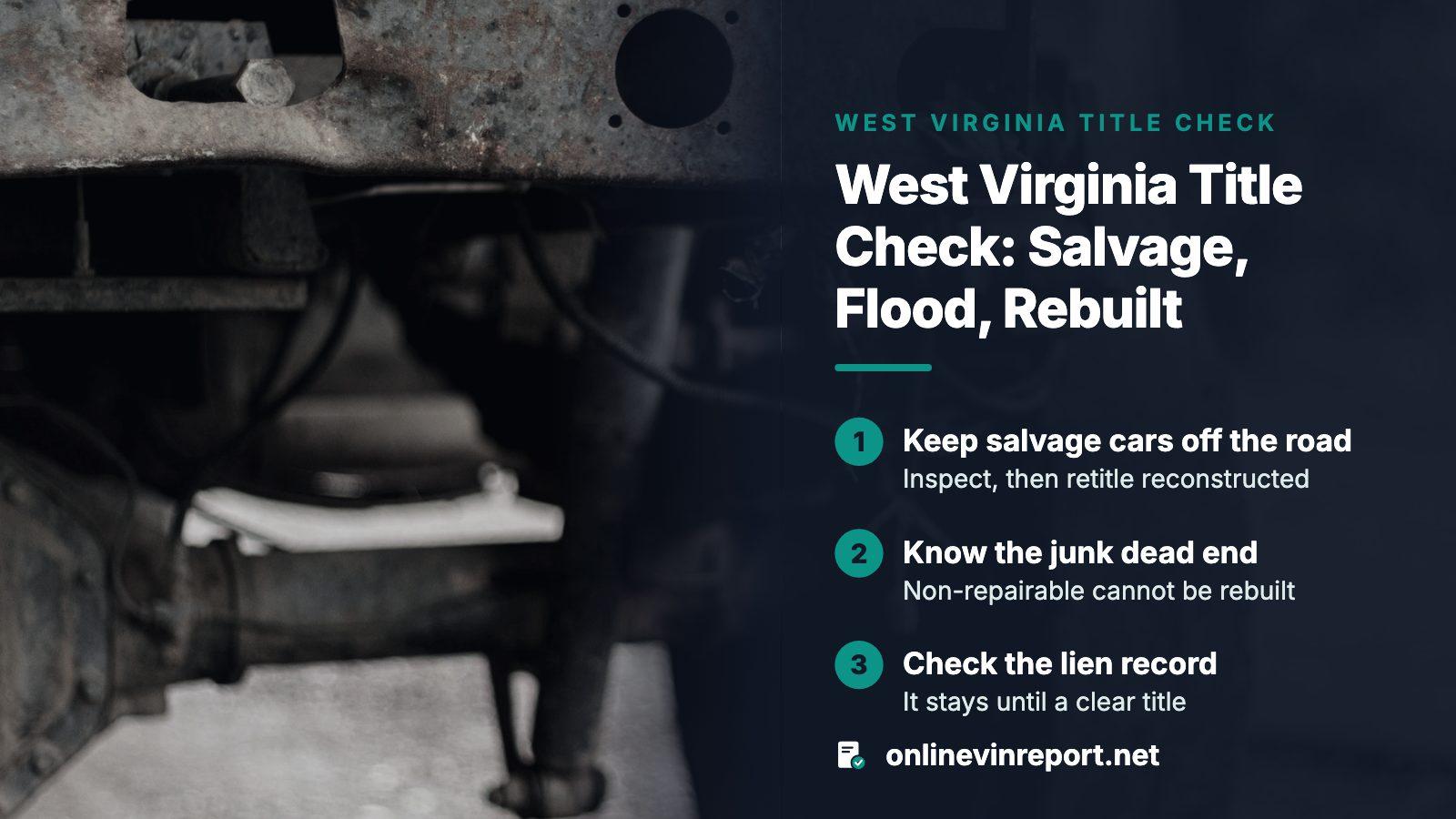
Copy the VIN, run it through an online title search and read the brand lines first. Salvage, flood, rebuilt and junk each change what the car is worth and what West Virginia lets its owner do. Then compare the result with the paper title: the seller's name, the VIN, the mileage and the lien release. If the car was rebuilt, ask for the DMV inspection paperwork.
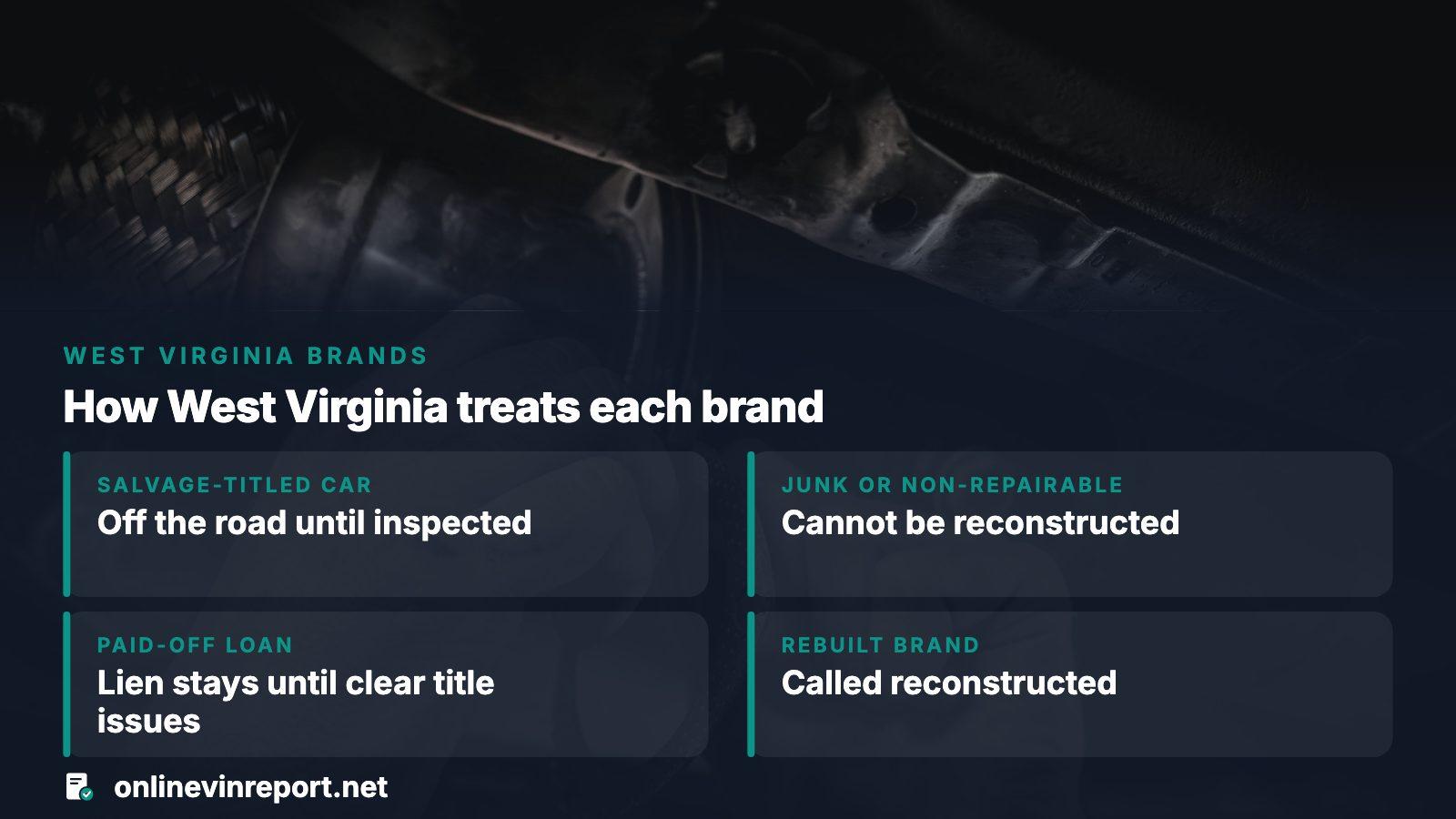
- Salvage-titled car
- Stays off the road until inspected and retitled reconstructed
- Junk or non-repairable
- Cannot be reconstructed at all
- Paid-off loan
- Lien stays on the DMV record until a clear title is processed
- Preview
- Free; the report is one payment
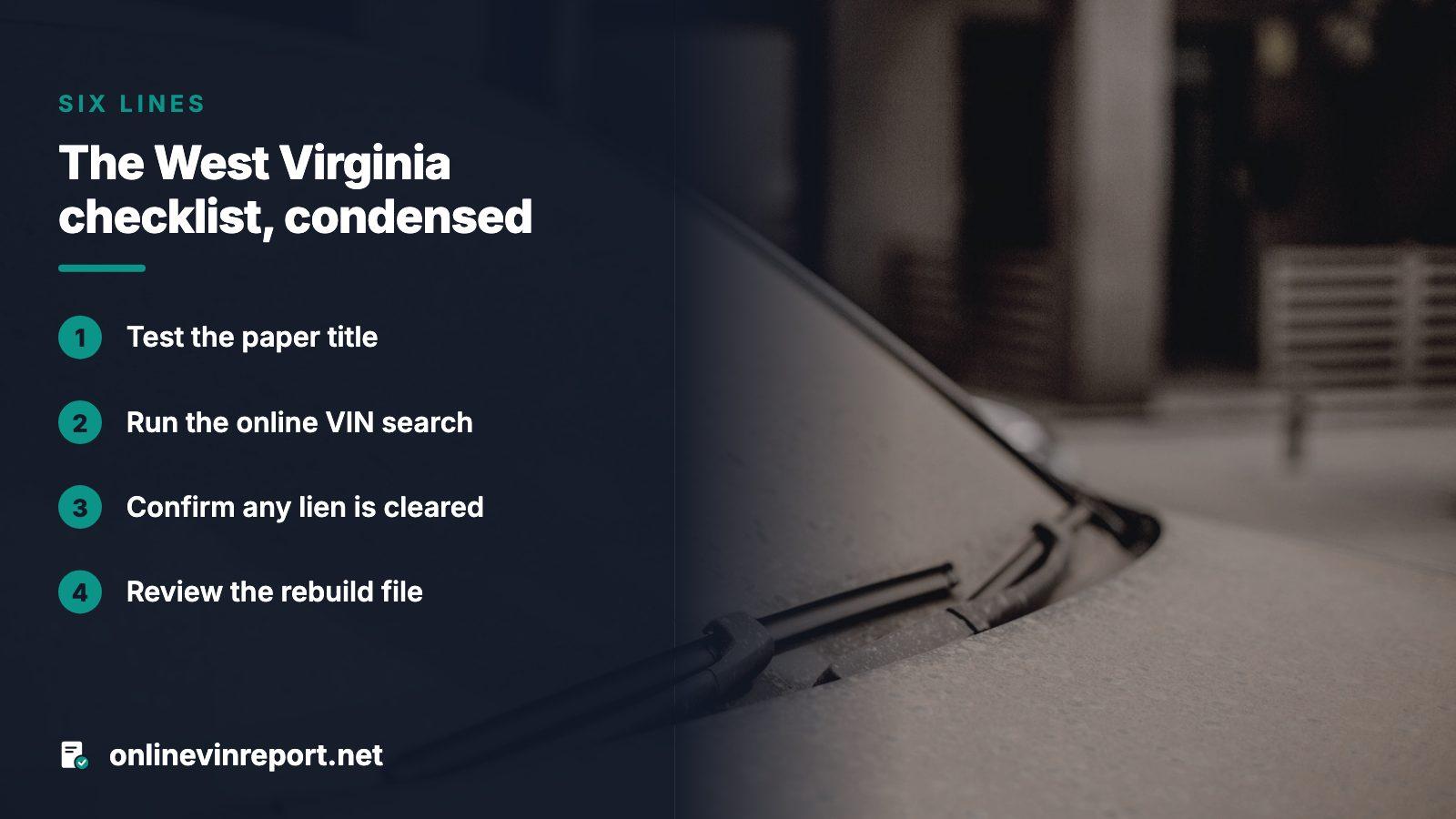
The West Virginia title check as a six-line checklist
Work down the list in order and stop at the first line that fails. Each row names what to look at and what should make you pause.
| Line | Look at | Pause if |
|---|---|---|
| 1. VIN | The number on the car, on the title and on the bill of sale | Any character differs between the three |
| 2. Seller | The owner named on the West Virginia title | The person selling is not that owner, or one of two owners joined by AND is missing |
| 3. Brands | An online VIN search: salvage, flood, rebuilt, junk and total-loss entries | A brand appears that the paper never mentions |
| 4. Lien | A lender's name on the title and any payoff papers | The seller offers a letter but no clear title |
| 5. Mileage | The dash reading against the title and the search | The dash shows less than either record |
| 6. Rebuild file | Photos, receipts and DMV forms for a reconstructed car | The owner cannot produce them |
Line 3 first: what an online VIN search covers
The paper can only say what its owner chose to show. The VIN search can contradict it, so run it before you set out for a viewing. Its records come from title agencies, insurance carriers, recyclers and junk or salvage yards, and a good result lists each brand with its date, the latest mileage readings and any insurer decision that the car was a total loss.
Two limits apply. Some states report in real time while others send updates daily or over several days, so last week's sale may not show yet. And an empty result only means no participating source reported anything; repair history is outside these records altogether.
The DMV's online services page lists no title or lien lookup. It does list a Request for Vehicle Information, but gives no description of what comes back, so ask the DMV before leaning on it.
Reading each brand the West Virginia way
The state's salvage application has separate boxes for non-repairable, flood damage, fire damage and plain salvage. These are different kinds of entry, not synonyms.
| Entry | What it means here | Your move |
|---|---|---|
| Salvage | The car needed a salvage certificate. No registration until it passes the state's rebuild exam and gets a reconstructed title. | Treat it as a project. Do not pay road-car money. |
| Reconstructed | A salvage car that was repaired, examined by a DMV inspector, passed the state safety inspection and was retitled. | Sellable, though once a write-off. Price it that way and ask for the file. |
| Non-repairable or junk | The application describes non-repairable as over 75 percent damaged and not meant to be rebuilt. Such a car cannot be reconstructed. | Parts only. Walk away from a road-car price. |
| Flood | Water damage has its own box on the salvage application. | Have a mechanic check under the carpets and in the electrics. |
Line 6: what a reconstructed car's paperwork should hold
The DMV tells owners to keep their rebuild records for at least three years, so a seller should be able to hand over copies.
- Photos taken before repairs began, from the front, the rear and both sides.
- Receipts for parts, equipment, materials and labor. If a major piece came off another car, such as an engine, transmission, fenders or two or more doors, that car's VIN is on record.
- Proof the airbags are intact or were replaced to the maker's specifications.
- The DMV examination form signed by its inspector, plus the certificate from the state safety inspection, whose decal lasts 12 months.
What the file proves
It shows the owner's records and the finished car satisfied the state's examiners. It says nothing about how the structure was straightened. Put your own mechanic under the car before you pay.
The DMV's brochure lists $22.50 to process a salvage certificate and a $35.00 inspection fee for the reconstructed title, plus other applicable fees. Check current amounts with the DMV.
Lines 1, 2 and 5: test the paper title
The DMV's own buyer warnings double as a checklist, and each item takes a minute.
- The seller is the owner printed on the title. A middleman who never retitled the car is a warning.
- The VIN on the title matches the car.
- With owners joined by AND, both signatures appear. With OR or AND/OR, one is enough.
- The dash mileage is not lower than the title's reading, and the seller marked the odometer status as actual, not actual or exceeding mechanical limits.
A box marked not actual proves nothing by itself. Still, put it to the seller and compare it with the odometer readings in the VIN report.
Line 4: why a payoff letter is not enough
When a loan ends, the lender mails the owner the title with a validated release, and the owner is expected to apply for a clear title straight away. The state's record does not change when the lender signs off. Until a clear title is processed, the lender still appears as a lienholder.
Ask for this in writing
The processed clear title, or a copy of it, instead of only the lender's release. If the owner lost the title while a lien was on file, the original lender must release it before a duplicate can be issued.
Cars that arrived from another state
States define brands differently, so a car treated as salvage elsewhere may carry no such label on a newer title, and a total-loss decision can stick to a car later recovered in good shape. The online search is where those entries surface.
Rules for bringing a car in point the same way. An out-of-state salvage car must first be exchanged for a West Virginia salvage certificate on form DMV-SV-1. New residents have 30 days to title and register, and a financed car also needs written word from its lender that the lender is the one holding the title. If a seller says the car just moved here, ask which of those steps happened.
Preview first, then the report
Begin with the preview, which is free and shows whether the VIN carries title brands, salvage entries or auction photos. Once a car looks worth pursuing, buy its report as a single payment. Bundles of 3, 5 or 10 suit a shopper weighing several cars, and no subscription sits behind any of it. Amounts are on the pricing page.
Read the brand entries first, each with its date and state, then the photos, mileage readings and any lien or impound entry. Take every brand and mismatch to the seller in writing. The DMV's Salvage Unit takes questions on salvage paperwork at (304) 926-3971.
Where this information comes from
- West Virginia DMV: Titles — Source for the buyer warnings, joint-owner signatures, odometer status, lien payoff and duplicate-title rules.
- West Virginia DMV: How to Title a Reconstructed Vehicle — Source for the salvage-to-reconstructed steps, records, fees and driving limits.
- West Virginia DMV: Salvage Certificate Application DMV-SV-1 — Source for the separate non-repairable, flood, fire and salvage boxes.
- West Virginia DMV: Self Service online services — Shows which vehicle services the DMV offers online and that no title lookup is listed.
- West Virginia DMV: New Residents — Source for the 30-day titling window and the lienholder letter.
- NMVTIS: Consumer information — Source for the data feeds, what a title record shows and the differences between states' brands.
- NMVTIS: Frequently asked questions — Source for what an empty result can mean, reporting delays and the missing repair history.
Sources and photos: Facts checked against the sources above in November 2026. Photos by Zoshua Colah, JavyGo and Martin Fennema on Unsplash; diagrams by OnlineVINReport.
Keep reading
- Flood car VIN check: find a flood brand before you buyWhy water damage needs its own check when the paper looks clean.
- Rebuilt title inspection: what the state checks and what a VIN title check addsWhat a state exam of a rebuilt car does and does not prove.
- Check title and lien by VIN: brands first, then who holds a claimA closer look at liens and who really holds the title.
- Title washing: how a brand vanishes and what a VIN title check can showHow a brand can drop away when a car crosses a state line.
Frequently asked questions
How do I do a West Virginia title check?
Copy the VIN, search it online and read the brand entries first. Compare the result with the paper title: the owner's name, the VIN, the mileage and any lien. If the car was rebuilt, ask for the DMV inspection records, then pay a mechanic to look at it before you hand over money.
Is there a car title search for West Virginia on the DMV site?
The DMV's online services page lists no title or lien lookup, only a request form for vehicle information with no description. Its titles page points buyers to the national title database for history. Ask the DMV what the request form returns before relying on it, and use a VIN search for brands.
Can I register a salvage-titled car in West Virginia?
Not as it stands. A salvage-titled car must be inspected and retitled as reconstructed first. Its owner may drive it to the inspection only with a one-trip permit from the State Police, and a car branded junk or non-repairable cannot be reconstructed at all.
What is a reconstructed title in West Virginia?
It is the title a salvage car receives after repairs, a DMV examination and the state safety inspection. It shows the car cleared the paperwork steps, including before photos, parts receipts and the airbag requirement. It still marks a former write-off, so price it accordingly.
Does paying off a loan clear the lien in West Virginia?
Not by itself. The lender sends the owner the title with a release, but the DMV record stays unchanged until a clear title is processed. When buying, ask for that clear title instead of settling for a release letter, and have the seller confirm in writing that the payoff is complete.
Now check the car itself
The guide explains what to look for. The report shows what this VIN has on record.