THE SHORT ANSWER
Title washing means a damage brand such as salvage or flood is absent from a car's current title even though a state once recorded it. Some cases are fraud. Many are two states applying different rules. A VIN title check lists brands filed by any state, so it can contradict a clean paper title, but it cannot show a brand that no state ever applied.
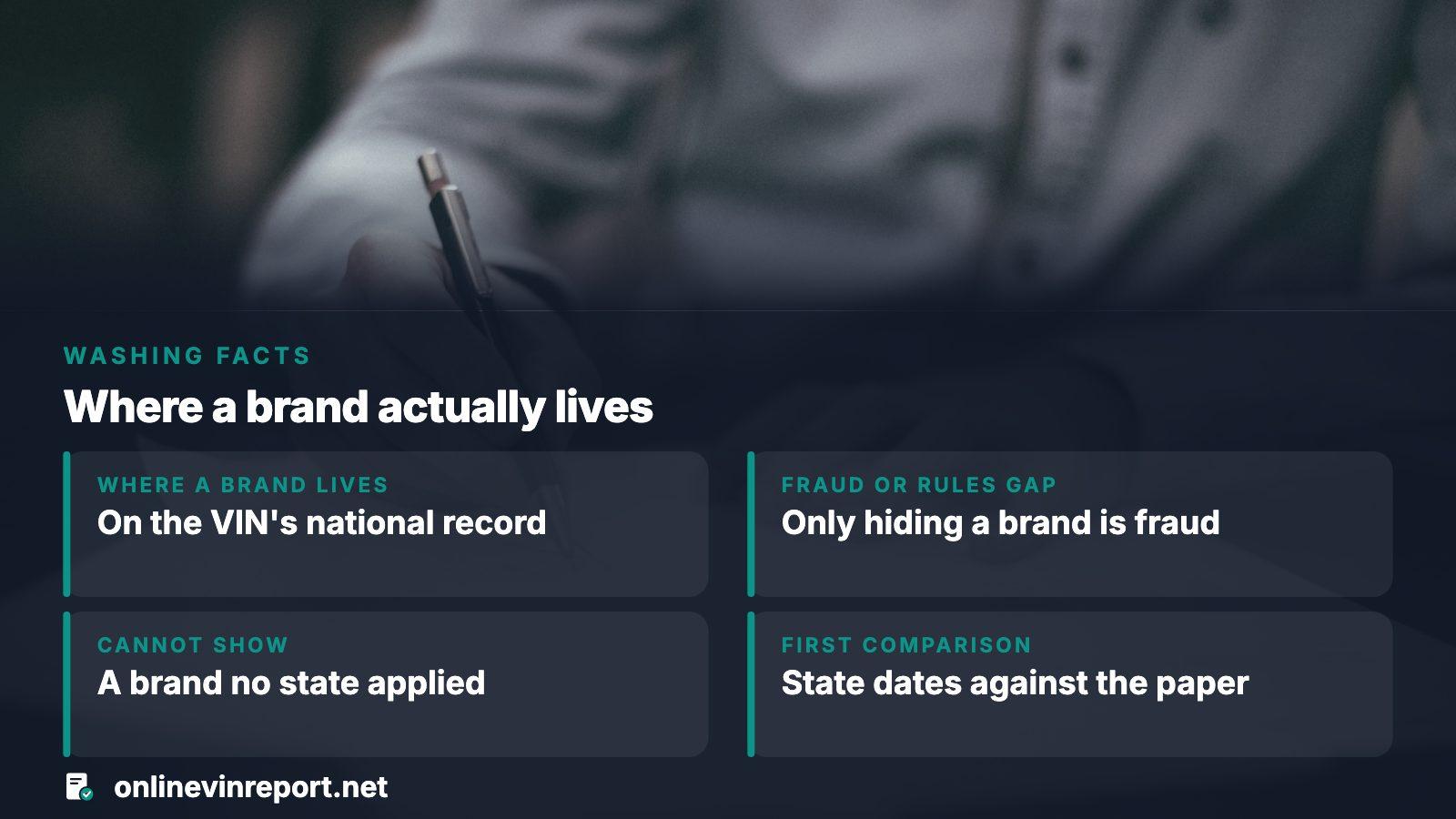
- Where a brand lives
- On the VIN's national record, not only on paper
- Fraud or rules gap
- Both happen; only hiding a brand on purpose is fraud
- What a check cannot show
- A brand that no state ever applied
- Best first comparison
- States and dates on the record against the paper
The paper can be clean while the record is not
A title is a document a state prints from its own file, and a brand is a note in that file saying the car was written off, flooded or ruled junk. Title washing happens when the car is retitled somewhere else and the note stays behind, leaving clean paper on a car with a recorded past.
The national title database was built to close that gap. Once a state brands a vehicle, the brand stays on the VIN's record in that system. The system's consumer page says a brand can be washed away when another state issues a new title without asking the state that applied it. An online title check reads that record by VIN, so it tests the car rather than the seller's document.
Three routes to a clean title, and which ones a VIN check can see
Not every clean title on a damaged car was washed on purpose. Sort the cases by one question: did any state ever record a brand?
| Why the paper is clean | Brand ever recorded? | Visible to a VIN check? |
|---|---|---|
| Retitled in a state that never looked up the car's history | Yes, by the first state | Usually; the brand outlives the paper |
| New state has no matching category, so the wording was dropped | Yes, in the first state's words | Yes; brands from any state are kept |
| First state's own rules never counted the damage | No | No; nothing was recorded |
Only the first row is fraud by definition. The other two are lawful, which is why a spotless title says less than buyers assume.
One wreck, two rulebooks: where Wisconsin and Texas draw the line
Two agencies show how one wreck can earn two titles. Wisconsin's branding form calls a car under seven years old salvage when repair cost, using the larger of estimate and actual bill, passes 70 percent of its market value. Texas sets its own line at repairs beyond the car's value before the loss, for every model year.
| Point of difference | Wisconsin | Texas |
|---|---|---|
| Salvage line | Repairs over 70 percent of value | Repairs above full pre-damage value |
| Age condition | Under seven years for salvage and hail; none stated for flood | None since September 2003 |
| Hail | Its own brand, under seven years old | A paid hail claim is excluded |
| Middle band | Insurance Claim Paid brand for losses of 30 to 70 percent, under seven years old | Repairs below full value fall short of salvage |
A young car wrecked in Wisconsin may earn a salvage brand that the same wreck would not earn in Texas. At repairs of 75 percent of the car's worth, one state brands it and the other leaves the title alone.
Some states carry brands across the border, with exceptions
Do not picture every state as a laundromat. A damaged car that crosses into Texas with another state's salvage title, or a similar ownership document marked accident damage, flood damage or rebuildable, is a salvage vehicle under the Texas manual.
One exception sits in the same definition: an out-of-state car with a rebuilt, prior salvage or salvaged notation is not counted as salvage there. What happens to a brand depends on its exact wording and on the state reading it, and a VIN record lists what each state filed.
Cars that were never branded have nothing to wash
The third row of the table is the costly one, because no record exists to find. Age limits are the usual cause. Wisconsin attaches salvage only to cars under seven years old, so an eight-year-old wreck past the threshold keeps a clean title there, and that is not washing.
Federal reporting has gaps too. The insurer rule spans a five-model-year window, and the cause of a loss, such as flood or collision, is encouraged but optional. A total loss can sit on file with no cause attached.
- Past its state's age limit, a clean title is weak evidence.
- A total-loss entry with no cause still calls for questions about water, fire and impact.
- An empty record means nothing was reported, not that nothing happened.
Reading the dates on a state-by-state title record
A washed title has a recognizable shape: a brand recorded at one moment, a new title issued at another, and a state line between them. The record dates each titling state, so no detective work is needed. Compare these items:
- Titling states in order, and how long the car stayed in each
- Newest title date against any total-loss or salvage entry
- Odometer reading dates against the mileage on the paper
- The seller's story of where the car lived against the states listed
From an NHTSA owner complaint
One owner bought a used 2014 Honda Odyssey at an auto auction. Two history reports pulled afterward, the owner says, showed heavy earlier damage and an odometer discrepancy, yet the title read clean with an actual-mileage statement. The owner noticed the new title had been issued only a day before the auction sold the car, suspects washing and reports no resolution from the auction.
The takeaway is timing. A clean title dated a day before a sale is a detail a VIN record can confirm or contradict before you bid. Treat it as one person's story, not a ruling.
What an online title check shows, and where it stops
A VIN title check pulls what states, insurers and salvage yards filed against the 17 characters: current state of title, the last issue date, brands from any state, odometer readings, and total-loss and salvage entries. Repair and maintenance history is not part of the federal record.
Run it before you visit the car. A free preview signals whether any records turn up for the VIN. The report is bought once, not rented by the month, and packs exist for people comparing candidates; details sit on the pricing page. Salvage and auction entries can include photos, evidence that does not rely on any title.
A search cannot invent a brand. If no state applied one and no insurer or yard filed a loss, nothing comes back, and on an older car that silence is a cue to inspect harder.
When the clean paper meets a damaged car
From an NHTSA owner complaint
Another buyer financed a 2021 Dodge Challenger through the seller and says it was sold as a clean-title car. The owner calls it a washed title with undisclosed structural damage, adds that independent shops saw signs of an old impact and poor repairs, and reports three differential failures in under six months.
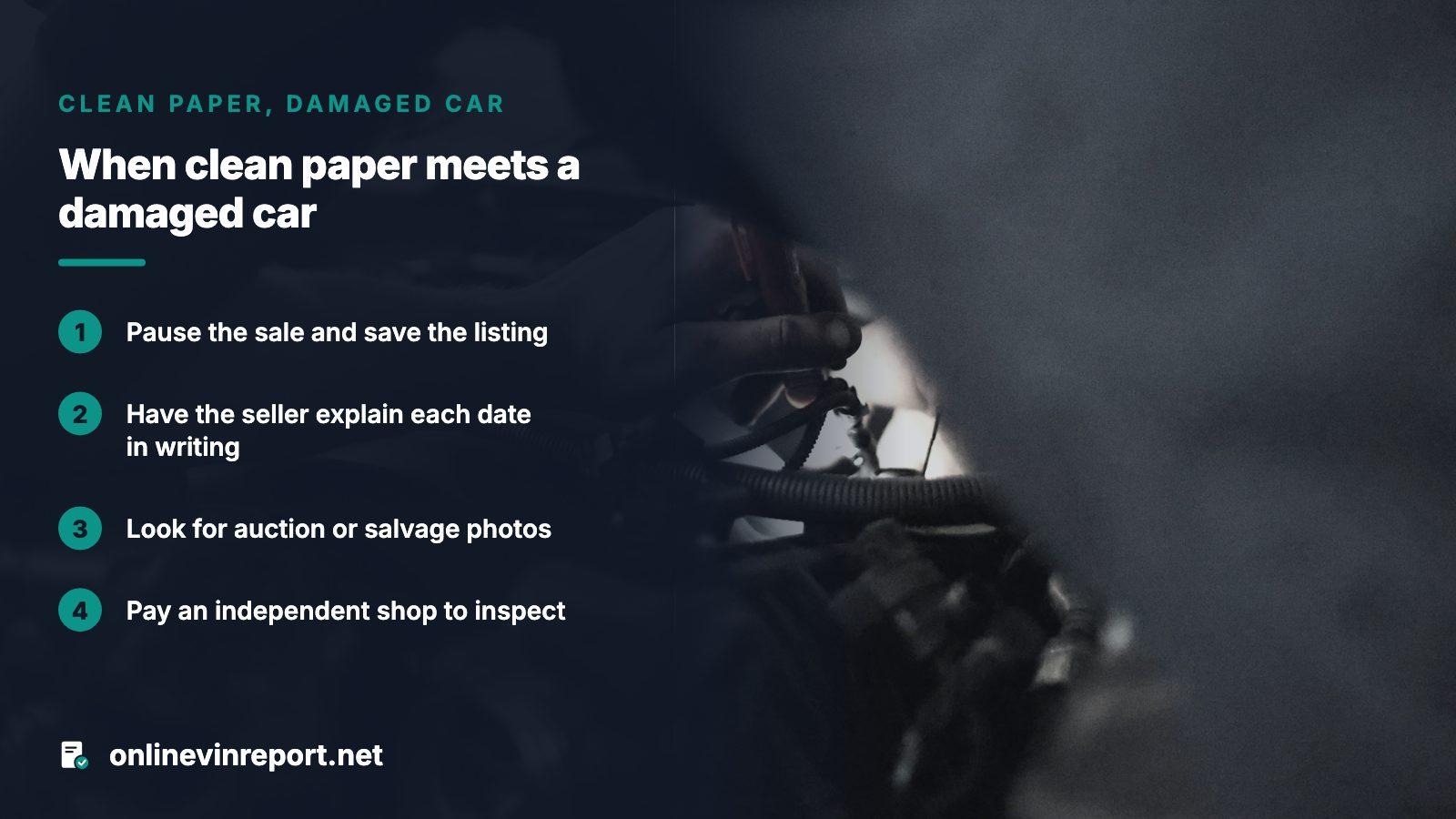
This is the owner's account, unconfirmed here, but it shows what late discovery costs: repairs on a financed car and a dispute with the seller. A title lookup before signing is the cheapest step in the sequence, though it will not catch everything. When paper and record disagree, work through these steps.
- Pause the sale and save the listing, messages and title photos.
- Ask the seller to explain each state and date on the record, in writing.
- Look for auction or salvage photos tied to the VIN.
- Pay an independent shop to inspect the structure and the paint for repair signs.
- Walk away if the explanation does not hold together.
Where this information comes from
- NMVTIS: consumer information — Says brands stay on the national record, that states set different branding thresholds and how brand washing can happen.
- NMVTIS: understanding a vehicle history report — Lists what the federal title record covers and what it leaves out.
- 28 CFR 25.55: insurance carrier reporting — Source for the five-model-year window and the optional reason for a loss.
- Wisconsin DOT: branding notification form MV2849 — The state's own wording for its salvage, hail, flood and Insurance Claim Paid brands.
- TxDMV: Salvage/Nonrepairable Motor Vehicle Manual — Texas salvage definition, its exclusions and how out-of-state documents are treated.
- NHTSA owner complaint 11675470 — owner experience, paraphrased
- NHTSA owner complaint 11666655 — owner experience, paraphrased
Sources and photos: Facts checked against the sources above in November 2026. Photos by Clarence Tioh, Mustafa Sheikhmouss and Scott Graham on Unsplash; diagrams by OnlineVINReport.
Keep reading
- What is a branded title? How to read salvage, flood and rebuilt brands by VINWhat each brand means, and which labels are state wording rather than federal terms.
- Total loss threshold by state and what it means for a VIN title checkWhy one wreck can be salvage in one state and ordinary damage in another.
- Salvage title VIN check: run it online before you payHow to run the VIN and read what comes back.
- Salvage auction history check: see if a car was sold as a wreckWhere pre-repair photos come from and how to read them.
Frequently asked questions
What is title washing?
A damage brand such as salvage or flood, recorded by one state, is missing from a title a later state issues. Fraud explains some cases; in others the second state's rules would not have branded the car. The brand may still sit on the VIN's national record.
Is title washing illegal?
Retitling a branded car to hide the brand, or selling it as unbranded, is fraud. A clean title issued under a state's own rules, with nothing concealed, is not. Procedures differ by state, so report a suspected deliberate wash to the titling agency where the sale happened.
Will a VIN check show a washed title?
Often. It lists brands applied by any state, so a brand dropped from the paper can still appear. It cannot show a brand no state applied, and it covers only what states, insurers and yards reported. Add photos and an inspection to any result.
How can I tell if a title was washed?
Compare the states and dates on the VIN's record with the paper and the seller's story. A new clean title soon after a loss or auction sale in another state is the pattern to question. Ask for earlier title documents, then inspect the car.
Can a clean title hide a past crash?
Yes. Clean means no brand was attached under the issuing state's rules. Damage under that state's threshold, outside its age limit or of a kind it does not brand leaves the title clean on a repaired car. Damage records, photos and a mechanic fill that gap.
Now check the car itself
The guide explains what to look for. The report shows what this VIN has on record.