THE SHORT ANSWER
Type the 17-character VIN and read the brand entries first. Salvage, flood, rebuilt and junk each point to a past write-off or serious repair. Then read the lien entries, and if one appears, get a lender payoff letter before any money moves. National records have gaps, so even a clean screen deserves a call to the state title office or the lender, plus an inspection.
- Brands read
- Salvage, flood, rebuilt, junk
- Lien entries
- Shown where a record exists
- Preview
- Free
- Full report
- One payment, no subscription
A title check and a lien check answer two different questions
A brand records what happened to the car itself. A lien records who is still owed money against it, which says more about the seller than the vehicle. Different sources feed each, so a search can be strong on one and quiet on the other.
| Question | Where the answer is kept | How far to trust a search |
|---|---|---|
| Was the car ever written off? | Title brands, insurer total-loss calls and yard transfers | Reported nationally, but coverage is partial |
| Does a lender hold a claim? | The state's own title record | Varies by state and by data provider |
| Is the seller's paper the current title? | The state title office and the lender | Only they can settle it |
The four brands a VIN title search looks for
A brand is a label a state attaches to a title after a serious event. The federal title system keeps every brand it is told about, so a car that crosses a state line brings its label along.
- Salvage: the car was judged too costly to repair and written off.
- Junk: the car was dismantled or passed to a yard or recycler.
- Flood: water damage was the cause, though only some states have a flood brand.
- Rebuilt: formerly salvage, now repaired and cleared for registration.
Because each state sets its own standards, a loss can go unbranded. A total-loss or yard entry sitting beside a clean title points to a brand that never landed.
Why lien data is thinner, and where it lives
The federal consumer title report lists brands, odometer readings, insurer total-loss calls and yard transfers, yet it leaves liens out. Under the federal rule covering what each state sends every 24 hours there are five named items, and the lienholder is not one of them.
- New York's DMV status page asks for a VIN, model year and make. It answers with when the title was printed, how many liens exist, and who each lienholder is and where, while leaving owner details out.
- In Texas a lender can record an electronic lien; the state holds the record and prints a paper title only once the release arrives.
So a report's lien and impound entries reflect whatever was filed and shared. Treat that as a screen, then confirm with the state or the lender.
Running the check in five moves
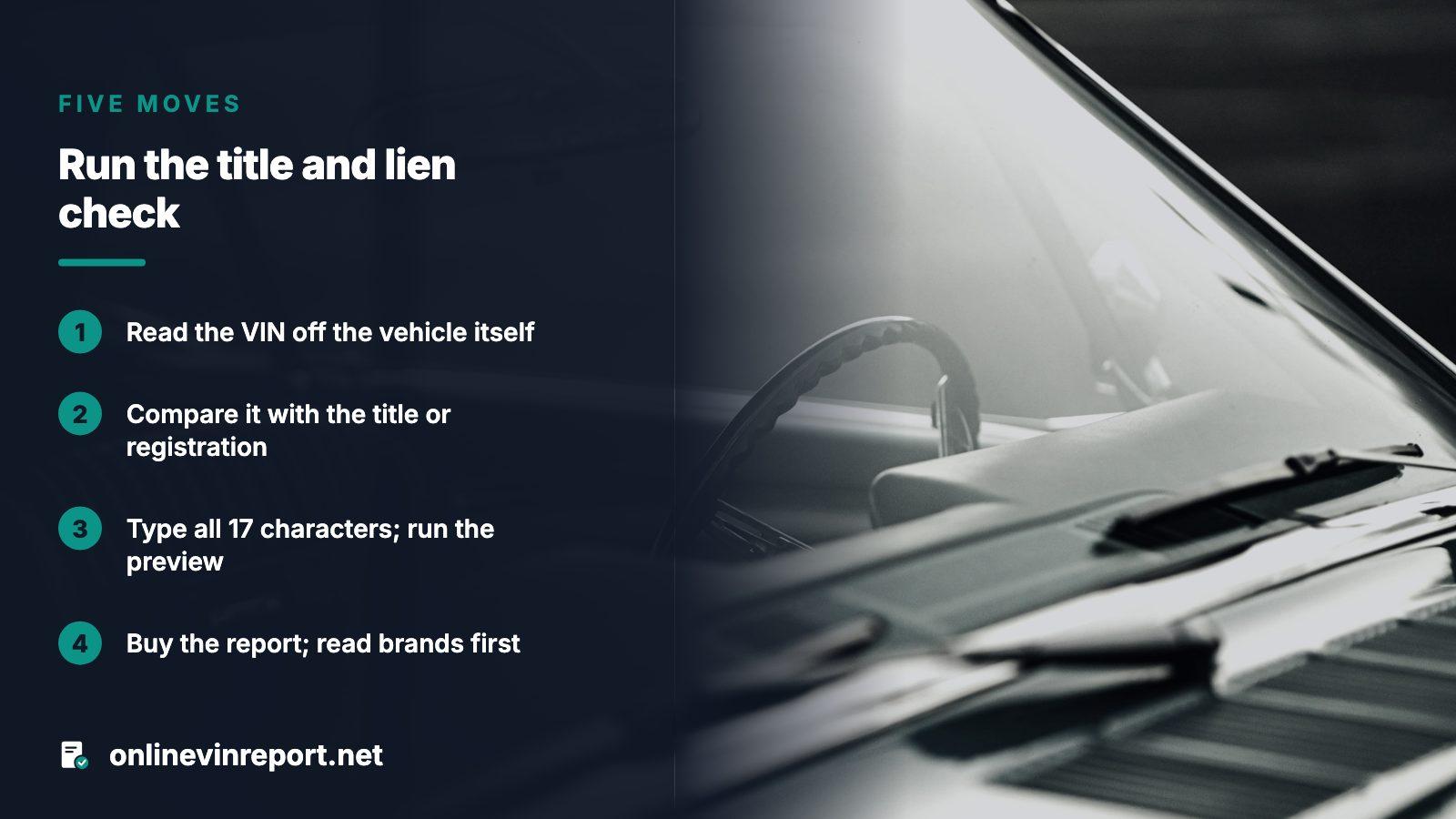
- Read the VIN off the vehicle itself. Check the dash plate at the foot of the windshield and the door-pillar sticker; both should show the same 17 characters.
- Compare them with the number on the title or registration the seller hands over. Any difference means stop and ask why.
- Type all 17 characters into the search form above. A single wrong one pulls up a different car.
- Run the preview first; it settles whether this car justifies a full report.
- For shortlisted cars, buy the report and read brands first, then lien and impound entries, then salvage and auction records. Log each state and date, and put follow-up questions to the seller in writing.
Reading the result: what each outcome should do to your offer
| On screen | Likely story | Your move |
|---|---|---|
| A brand with state and date | A state or insurer logged the loss | Line the date up with owner and mileage entries, then reprice or pass |
| Total-loss or yard entry, clean title | The brand may never have been applied | Price it as a branded car |
| A lien entry | Money may still be owed on the car | Request a payoff letter, then confirm with the state or the lender |
| Brand elsewhere, clean title here | The record follows the VIN; the paper may not | Ask why the title moved |
| Nothing recorded | Nothing was filed, or the data has gaps | Good sign, not proof: inspect |
From an NHTSA owner complaint
A 2013 Chevrolet Equinox owner wrote that the transfer case failed noisily on the road. Looking into repairs, the owner learned from GM that the vehicle was branded, something the selling dealership never raised and later said it had not known.
A dealer's ignorance protects nobody. A search before signing finds the label nobody mentioned.
When the history report and the state disagree
Records sometimes clash, and the two directions are different problems. A loss missing from a clean-looking title is hidden damage. A brand the state does not list can penalize an honest owner.
From an NHTSA owner complaint
A 2019 Honda Civic owner said Honda, through its dealer, would not replace a compressor covered by an air-conditioning recall because a history report showed a branded title. The Maryland motor vehicle agency, the owner reported, called the title clean, and the owner offered that proof. Even so, the owner says neither dealer nor automaker would touch the car.
Carry the state's own answer. The federal report itself directs readers to the state record, so obtain written confirmation before buying, or before disputing what the car is.
If a lien shows up on the car you want
A lien alone need not end the deal; plenty of cars are sold while still being paid off. The danger is paying the seller while the lender goes unpaid. A sale works only when the lender lifts its claim and a clean title follows.
- Get the lender's name and a written, dated payoff figure.
- Route the payoff to the lender, not via the seller.
- Wait for the release. Texas gives lienholders 10 days after payment; other states differ, so ask your DMV.
- A paper title arrives with a release letter. With an electronic lien, lender and state exchange the release and the state issues the paper title.
From an NHTSA owner complaint
Buyers of a 2012 Ford Fiesta at an auto auction said the car sputtered and lost power just after they drove away. Roughly a week on, they were told lien paperwork had been filed weeks before the sale. Calls to the auction office went unreturned, and they asked for a refund.
A lien discovered after payment is far harder to fix than one found beforehand. Run the VIN before bidding.
What it costs
A first look through the preview is free. After that, each VIN's report is charged separately, and larger packs exist when you are checking a shortlist of cars. Nothing renews on its own, and the pricing page has the amounts.
One report puts brand history, lien and impound entries, odometer readings and auction photos side by side. Preview every candidate and keep the report for cars you would really buy.
Before money changes hands
A VIN report records history, not how the car runs. Have an independent mechanic look it over whatever the search shows, and keep any promise from the seller in writing.
- Match the VIN across the car, the title and the report.
- Settle any lien with the lender, on paper.
- Get the inspection done before you commit.
- Pay only when the title can pass to you.
Where this information comes from
- NMVTIS: Information for consumers — what the national title report holds, its gaps, and how brands persist
- 28 CFR 25.54: What states report to NMVTIS — the five required data items and where the lienholder falls outside them
- New York DMV: Check a title or lien status — what a state status page asks for and shows about liens
- TxDMV: Add or remove a lien — release deadline, paper and electronic lien handling
- NHTSA owner complaint 11508601 — owner experience, paraphrased
- NHTSA owner complaint 11666642 — owner experience, paraphrased
- NHTSA owner complaint 11406629 — owner experience, paraphrased
Sources and photos: Facts checked against the sources above in November 2026. Photos by Sasun Bughdaryan, Dylan Michaud and Masjid MABA on Unsplash; diagrams by OnlineVINReport.
Keep reading
- Salvage title VIN check: run it online before you payRun the brand half of this check step by step.
- Title washing: how a brand vanishes and what a VIN title check can showSee how a brand can vanish when a car changes states.
- Car title check online: salvage, flood, rebuilt and junk by VINRead the wider guide to what a car title can and cannot prove.
- PricingSee the report options before you decide.
Frequently asked questions
Can I look up a lien through my state instead?
Some states publish an online status page for their own titles. New York's asks for a VIN, model year and make, then reports how many liens exist and who holds each. Each page covers a single state, so brands recorded elsewhere will not appear.
If a title is clean, can a lien still exist?
No, because a lien is its own entry on the state record. Where electronic liens are used, the paper title is printed only after the lender releases, so a seller holding no paper title may still be paying off a loan. Request the lender's identity and a written payoff.
How soon must a lender release a lien once the loan is paid?
That varies by state. Texas allows the lienholder 10 days from receiving payment, after which the owner needs a release letter or the electronic release. Ask the lender how long it takes, and check your own state's rule with its DMV.
Why would a lien not show up in a search?
Lienholder details are not among the items states are required to report nationally, so what a search finds depends on the state and the data provider. A lien kept only on a state record can be absent. When it matters, ask the state or the lender.
Which should I check first, the brand or the lien?
Brands, because a brand changes the car's value, can end the deal alone and stays on the record for good. A lien is different: money clears it, provided the lender is paid and lets go. Once the brand history is acceptable, turn to the lien.
Now check the car itself
The guide explains what to look for. The report shows what this VIN has on record.