THE SHORT ANSWER
A rebuilt title inspection confirms identity and where major parts came from, so it works as a theft screen rather than a review of the repair. Texas issues the title from a statement form, and Wisconsin sends the car to State Patrol by appointment. A VIN title check cannot show what an inspector saw, but it shows the brand sequence and any salvage auction photos, which tell you whether to pay a shop to look further.
- What the state verifies
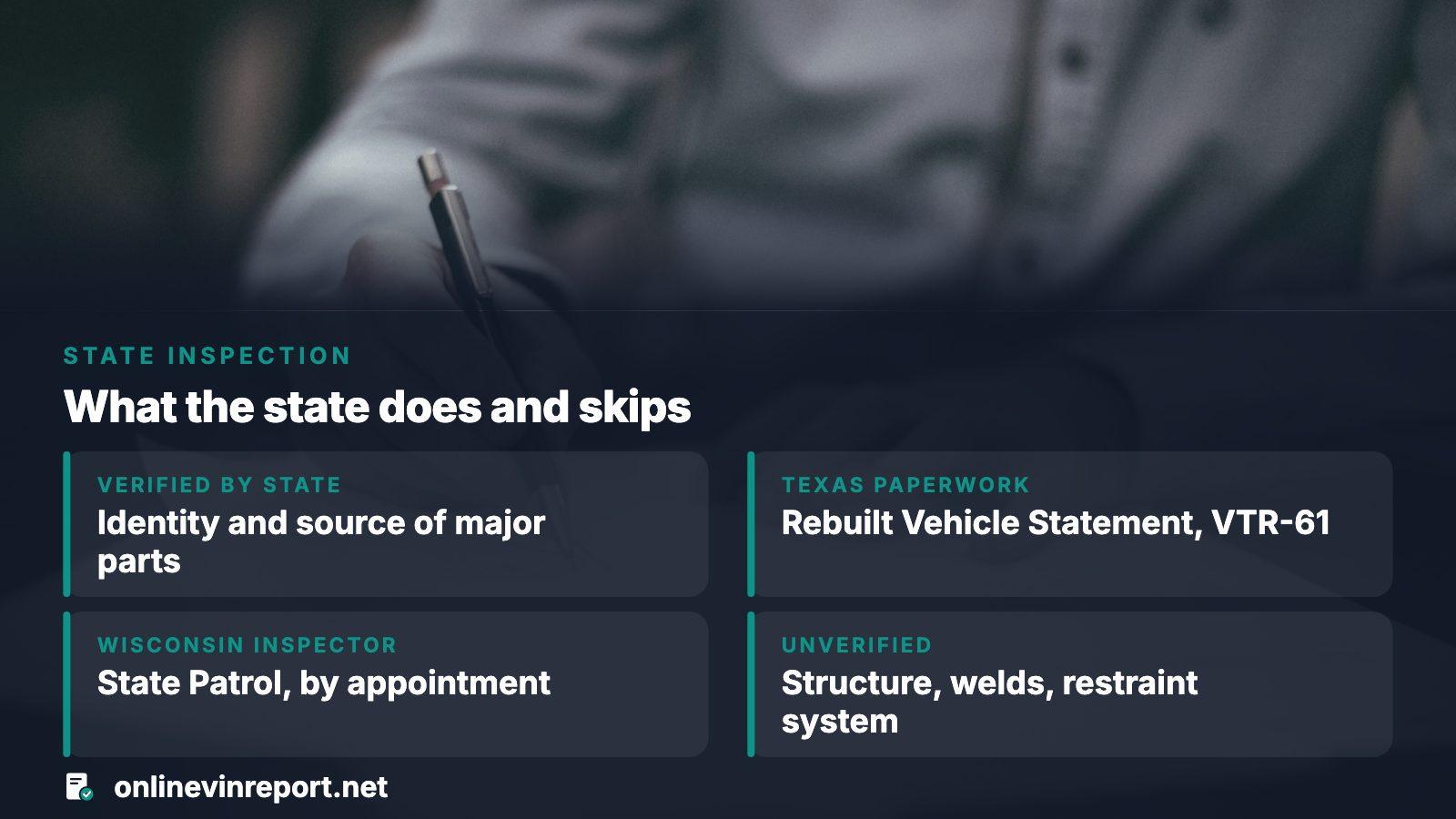
- Identity and the source of major parts
- Texas paperwork
- Rebuilt Vehicle Statement, Form VTR-61
- Wisconsin inspector
- State Patrol, by appointment only
- What stays unverified
- Structure, welds and restraint system
Where the inspection sits in a rebuilt car's paper trail
A rebuilt brand is the last link in a chain. First comes the wreck, flood or fire. Then an insurer or owner writes the car off and the title takes a salvage brand. After repairs, the owner returns to the state, and a rebuilt title replaces the salvage one. The inspection, or the paperwork standing in for it, is the gate between those last two steps.
That order is why an online title check earns its place. The state step happens once, in one office, and leaves little for a buyer to read later. The brands on either side of it sit in the title record, which follows the VIN from state to state.
What the state process asks about, and what it leaves alone
Read the forms and the pattern is plain. States want proof that the car matches the VIN on its title and that each major replacement part has a lawful source. That is anti-theft work, aimed at a familiar fraud: a wrecked car with clean paperwork becomes the shell for passing off a stolen one.
| Question | Does the state process answer it? | Where the answer lives |
|---|---|---|
| Does the car match the VIN on its title? | Yes | Inspection or VIN certification |
| Where did a replacement body, frame or engine come from? | Yes | Disclosure of the source vehicle |
| Was the structure returned to factory dimensions? | No | An independent body shop |
| Was the airbag system replaced or only reset? | No | A technician with a scan tool |
A buyer worries most about the bottom two rows, and a rebuilt brand cannot fill those in.
Two states, two very different procedures
Texas issues a rebuilt salvage title from a Rebuilt Vehicle Statement, Form VTR-61. The applicant describes the vehicle, explains the repairs and identifies the donor for any replacement body, frame or engine. The applicant also certifies who did the work and that every part was lawfully obtained. The form sets no repair standard and asks no qualified person to approve the structure.
In Wisconsin, a repaired salvage vehicle must be physically inspected, but only authorized inspectors may do it and only by scheduled appointment. The agencies on the state's list are State Patrol posts and similar law enforcement offices, arranged by county. That suits a question about identity and parts, not one about weld quality.
When the file says repairs unknown
Texas lets a person who bought an already repaired car write "Repairs unknown" in the work section and skip page 2 of the form. The rule is fair to an innocent buyer, who should not be stuck without a title because the last owner threw away the receipts.
The cost lands on whoever buys the car next. A rebuilt title can rest on a file that records, in effect, that nobody knew what was done. Missing parts records fare worse: an applicant who cannot name the source of a replaced basic component faces a tax assessor-collector hearing or a bonded title.
No repair paperwork from the seller?
Treat the title as silent on the work. It shows the state accepted a filing, not that the repair was competent. Price the car as if the damage were unknown until a shop says otherwise.
What an online title check shows on a rebuilt car
OnlineVINReport starts from the 17-character VIN and works outward from the title record. On a rebuilt car, the report covers the half of the story the inspection never touched. A full report can include:
- Title brands on record, including a salvage, junk or flood brand that came before the rebuilt one
- Accident and damage entries on file for the VIN
- Salvage and auction history with photos, which can show the car before repair
- Odometer readings over the car's life, to compare against the dashboard
- Theft, insurance, lien and impound records
- Open recalls, which stay open on a repaired car
The preview is free and shows whether title and auction records exist, so you can judge if a full report is worth buying. After that it is a single purchase, never a subscription, and the pricing page lists single reports and packs of 3, 5 and 10.
Reading the brand sequence: four patterns to sort
Sort what the record shows into one of these patterns. None is a verdict. Each one points to a question for the seller or the shop.
| Pattern on the record | What it suggests | Next step |
|---|---|---|
| Salvage brand, then rebuilt brand | The ordinary path through the state | Find the auction photos, then book an inspection |
| Rebuilt brand with no salvage or auction entry | A thin damage history or an incomplete record | Ask for repair paperwork and treat the damage as unknown |
| Auction photos of wreck damage, but a clean title today | A brand may have dropped off along the way | Compare states on the title record and read about title washing |
| Flood brand, then rebuilt brand | Water reaches wiring and interiors, which are hard to repair out | Ask the shop to check electrical systems and corrosion |
The inspection you arrange yourself, aimed by the photos
The state has settled who the car is and left the repair open. That open question is the one worth paying to settle.
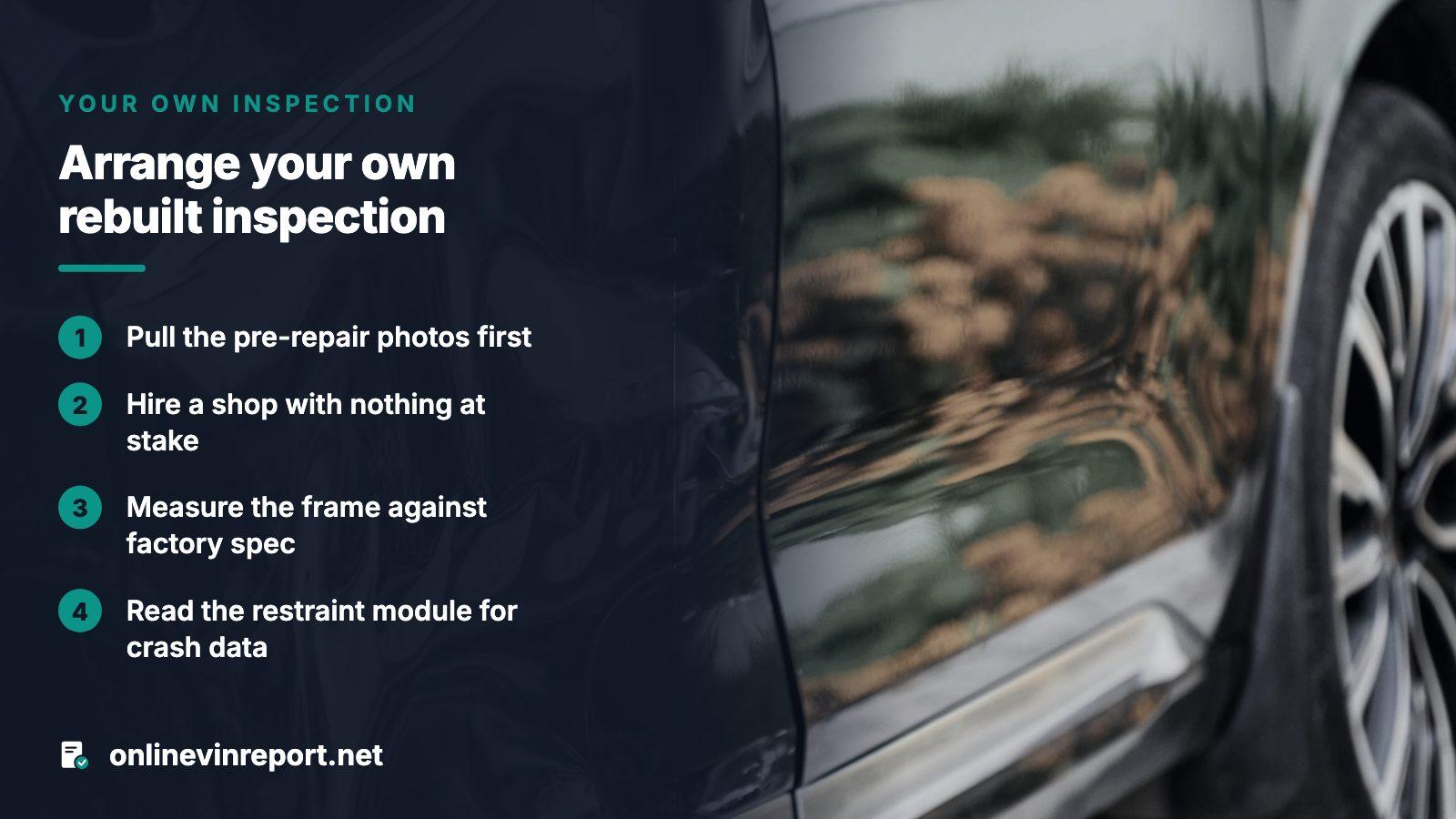
- Pull the pre-repair photos first. The auction record by VIN shows where the car was hit, so the shop knows where to spend its hours.
- Hire a shop with nothing at stake. One that did not do the repair and earns nothing from the sale has no reason to soften its findings.
- Request a measurement of the frame or unibody against factory specification. A walkaround cannot catch what a gauge does.
- Have the restraint module read for stored crash data and faults, because a warning lamp that goes dark proves little.
- Ask for the findings on paper, dated. That gives you bargaining power on price and a record if the car is resold.
If you are the one who rebuilt it
Keep every receipt, and note the serial numbers of major components as each one goes in: body, frame and engine, plus the donor vehicle for each. The paperwork is built around that disclosure, and it is where applications stall. Texas also makes a licensed salvage dealer or independent dealer who rebuilds a wreck put the title in the dealership's name before resale. Check your own state's form first, since one state may want a statement and another an appointment.
Free screens first, then the full title record
Start with checks other organizations publish at no charge. NHTSA's recall lookup returns open recalls by VIN, and the NICB offers VINCheck, a screen for thefts and insurer write-offs reported by member companies.
Then pull the record that carries the brand and the state-to-state sequence. Federal NMVTIS data reaches buyers through approved providers, which the NMVTIS site lists. A vehicle history report also adds factory specs, so you can confirm the car in the driveway matches the record.
Where this information comes from
- TxDMV: Salvage and Nonrepairable Motor Vehicle Manual — Covers Form VTR-61, the repairs unknown entry, part and donor VIN disclosure, and how out-of-state VIN certification works.
- Wisconsin DOT: Salvage Vehicle Inspecting Agency List — Shows who may inspect a repaired salvage vehicle in Wisconsin and that inspections run by appointment.
- NMVTIS: vehicle history record information — The federal title system behind brand records, with the list of approved data providers.
- NHTSA: recalls lookup — Open safety recalls by VIN, which apply however the car is titled.
Sources and photos: Facts checked against the sources above in November 2026. Photos by Martin Fennema, Maxim Tolchinskiy and Scott Graham on Unsplash; diagrams by OnlineVINReport.
Keep reading
- What is a rebuilt title? What it means and what a VIN title check showsWhat the brand itself means once a salvage car has been repaired and retitled.
- Salvage title VIN check: run it online before you payRun the lookup that surfaces the salvage brand ahead of the rebuilt one.
- Title washing: how a brand vanishes and what a VIN title check can showHow a brand can vanish between states, and how to catch it.
- PricingReport options and pack sizes, paid once with no subscription.
Frequently asked questions
Does passing a rebuilt title inspection mean the car is safe?
Not by itself. The process confirms the car's identity and that major parts were lawfully obtained. Whether the structure and restraint system were repaired well is a separate matter, and an independent shop that measures and scans the car is the way to learn it.
Can I run a rebuilt title inspection online?
No. The inspection or filing happens with the state, in person or on paper. Online, you can read the title record by VIN, which shows the brands and history on file. That covers what happened before and after the state step, though not what the state saw.
Will a VIN check show whether the car passed its inspection?
It shows the rebuilt brand and the brands around it, which means a state issued that title. It does not reproduce the application, the inspector's notes or the repair file. If those matter, ask the seller for the paperwork.
Can a rebuilt title exist with no record of the repairs?
In Texas, yes. A buyer of an already repaired car can enter repairs unknown on the form and skip the second page. The title then carries the rebuilt brand with little behind it, so ask for receipts or photos.
Do I need my own inspection if the car already has a rebuilt title?
Yes, and arguably more than on a clean-title car. The brand marks a past loss and does not describe the fix. A shop that did not do the work, guided by the pre-repair photos, is best placed to judge it.
Now check the car itself
The guide explains what to look for. The report shows what this VIN has on record.