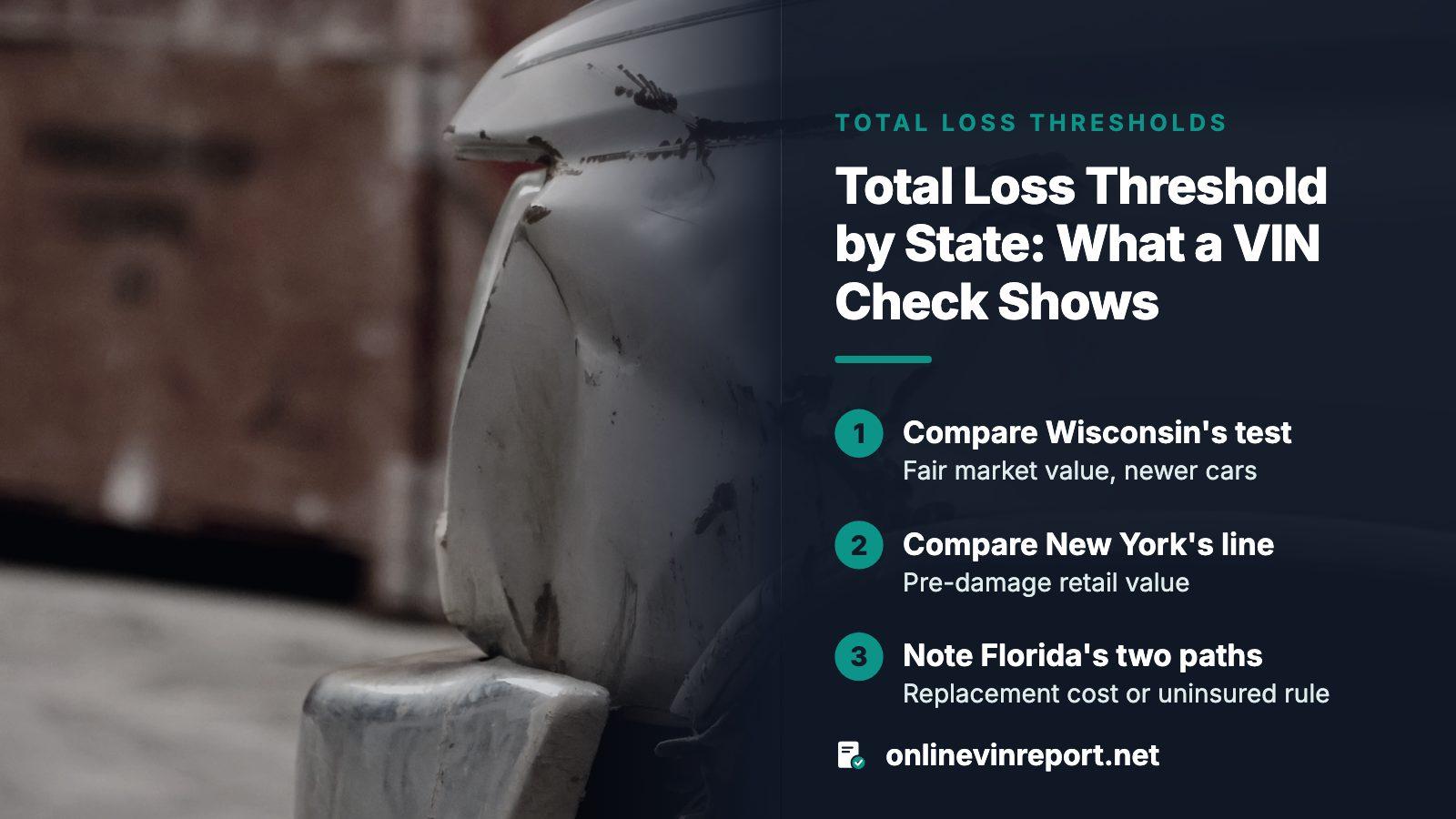
THE SHORT ANSWER
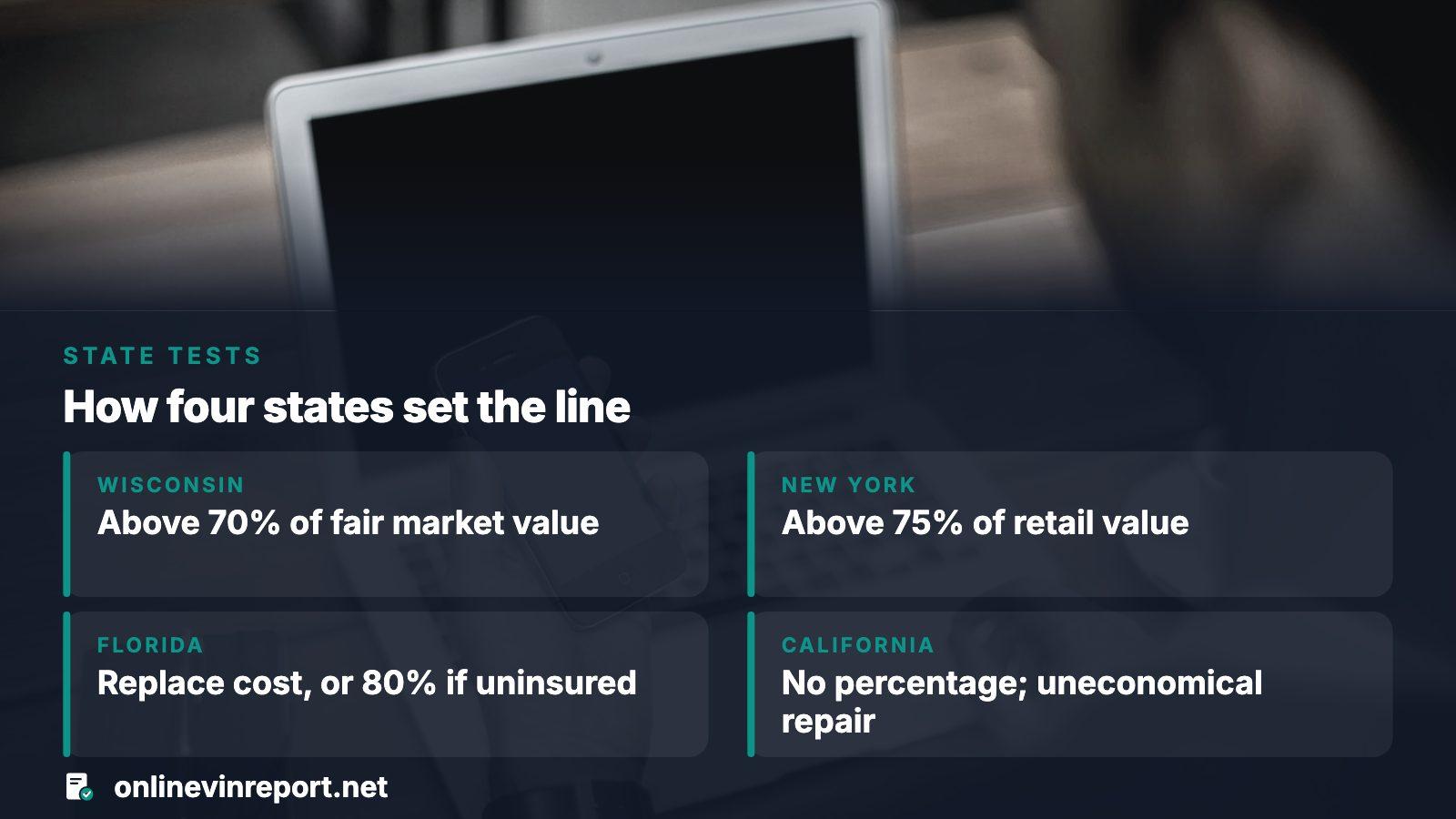
States do not share one threshold. Wisconsin brands salvage above 70 percent of fair market value on cars under 7 years old, and New York above 75 percent of pre-damage retail value. Texas branding starts once repairs would cost more than the car's value at the moment before it was hit, on any model year. Florida keys on an insurer's replacement payment, or 80 percent for uninsured cars, and California uses no percentage. Check the VIN instead of trusting a table.
- Wisconsin
- Above 70% of fair market value, under 7 years old
- New York
- Above 75% of pre-damage retail value
- Florida
- Insurer pays to replace, or 80% when uninsured
- California
- No percentage, a judgment of uneconomical repair
Percentage, comparison, judgment: the rules do not match
A table with a percentage beside every state looks tidy and is partly wrong, because states do not all use a percentage. Some print a number in a statute or on a state form. Some only compare the repair bill with what the car was worth. Some ask whether the paying party thought repair made sense, and one ties the label to an insurer's payout.
That matters when you read a title check online: the brand on screen is one state's rule applied to one car on one date, and the same word can sit on very different amounts of damage.
Five states, five different tests
Each row comes from the state's own form, statute, manual or DMV page.
| State | How the line is drawn | Detail worth knowing |
|---|---|---|
| Wisconsin | 70 percent of fair market value, measured on the larger of the estimate and the final repair bill | Salvage and hail brands apply only below 7 years of age; the form puts no age limit on flood |
| New York | Repair costs above 75 percent of pre-damage retail value | A salvage title earned in another state also pulls a car into the New York salvage process |
| Florida | An insurer pays to replace the car, or an uninsured repair reaches 80 percent of replacement cost | A repair agreed with the insurer at a cost above 100 percent of replacement still earns a Total Loss Vehicle brand |
| Texas | Repair bill larger than the car's pre-damage actual value, whatever the model year | Repainting, hail and sales tax are excluded when repair cost is counted |
| California | No percentage: the owner, lender or insurer judges repair uneconomical | A total loss payment counts even when the car is repaired afterward |
What the national title database uses instead
The national title database, NMVTIS, borrows no state's percentage. Its rule calls a car salvage when what the wreck would fetch at salvage, added to the bill for making it roadworthy and legal, tops its market value from just before the damage. A car a state or an insurer declares a total loss falls in the same class whether or not the insurer takes ownership.
The federal total loss formula is wider than most state tests: repair cost plus projected supplements, lost resale value and rental reimbursement, set against pre-accident value less the salvage proceeds. Junk is a separate class, meaning a car unfit for any public road and worth only parts or scrap.
What insurers must file
Carriers file monthly inventories of cars from the current model year plus the four before it. They must give the VIN, dates and where the car came from. Saying why it was taken is optional but encouraged.
Two quantities: what counts as repair and what counts as value
Two states can share a percentage and still brand different cars, because the repair figure and the value figure are defined differently. Wisconsin counts whichever is larger, the estimate or the final bill, so a high estimate keeps counting after a cheaper repair. Texas drops repainting, hail, gradual damage and sales tax before it compares anything.
- Wisconsin measures against fair market value.
- New York measures against pre-damage retail value.
- Florida measures against the cost of replacing the car with one of like kind and quality.
- Texas measures against actual cash value, drawn from industry price guides or an insurer's uniform method.
Reading a brand that came from another state
Brands travel with the VIN, but the rule that produced one stays with the issuing state. A damaged car that enters Texas carrying an out-of-state document marked accident damage or flood damage becomes a Texas salvage case; one marked rebuilt or prior salvage does not. New York holds title and registration renewal when it finds a salvage past nobody declared.
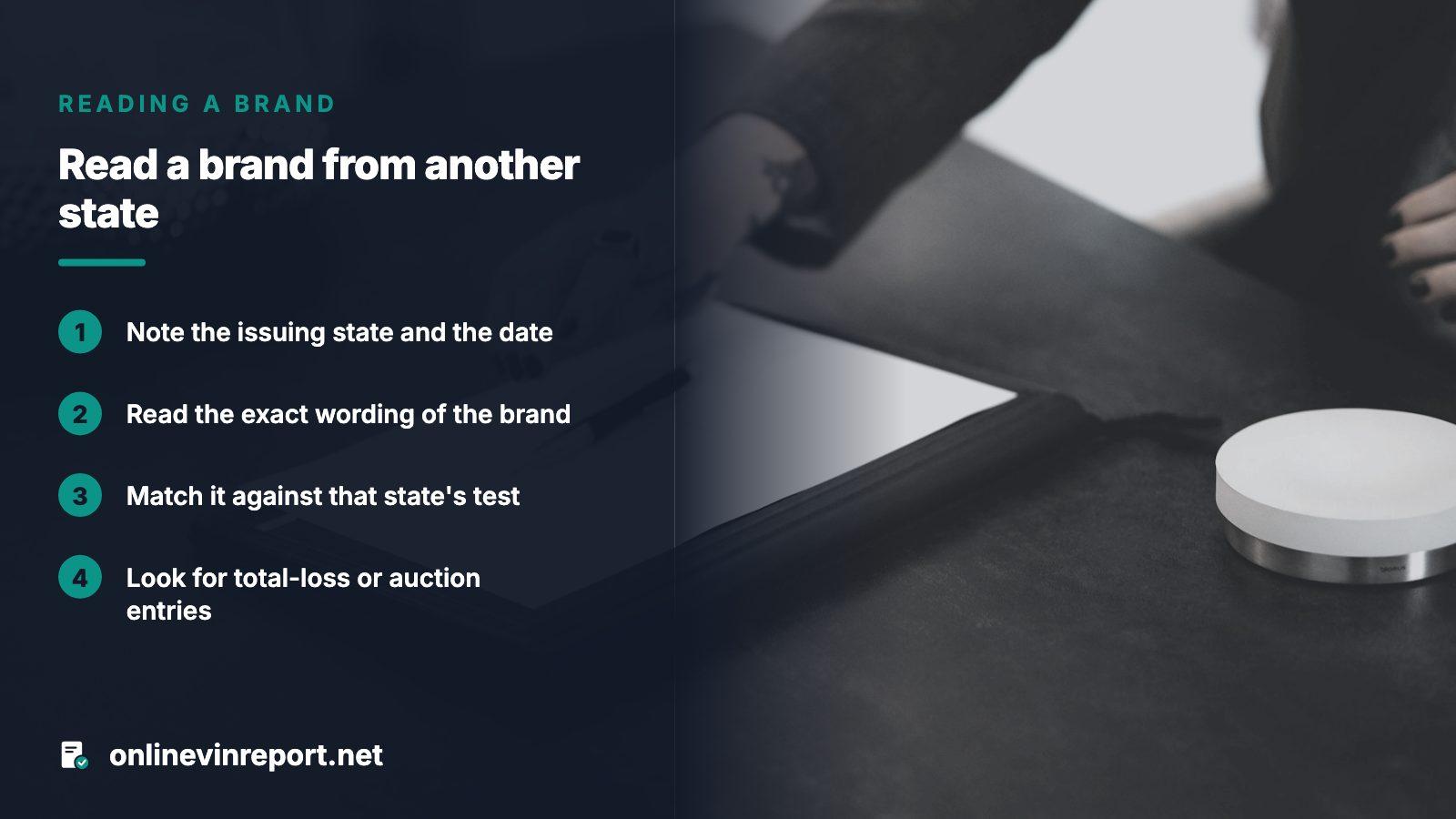
Wording differs too. California's own brand is Salvaged, and other states write damaged, dismantled, totaled, scrap vehicle or water damage. When an online report shows a brand, work through it in this order:
- Note the issuing state and the date, since that state's test applied.
- Read the exact wording of the brand.
- Match it against that state's test in the table above.
- Look for a total loss or salvage-auction entry and its photos.
- Compare odometer readings on either side of that date.
When a clean title does not mean a clean car
A car damaged below the line can carry a clean title. Wisconsin is the exception worth knowing: when an insurer takes a car under 7 years old after paying a claim that put the damage at 30 through 70 percent of market value, the title gets an Insurance Claim Paid brand. A state without such a brand leaves that middle band off the title.
- Texas leaves paid hail claims and paint-only damage out of salvage.
- Wisconsin's salvage and hail brands skip cars at 7 years and older.
- Florida does not treat a car repaired by agreement as a total loss, and a brand follows only when the insurer's repair cost passes 100 percent of replacement.
The federal feed has a gap of its own, since the insurer filing rule reaches only the current and four earlier model years. A clean title says the line was not crossed, not that the car was never hurt, so run the VIN before leaning on it.
If you own a car that was just written off
The threshold is where owners usually start arguing, but the two figures behind it give more room. Ask which value standard your state names and what the insurer counted as repair. In Texas, repainting and sales tax are left out of the repair figure, so an estimate that counted them overstates the number the salvage test uses.
Keeping the car does not avoid the brand. Wisconsin's form has a notification-only route for owners who keep the vehicle, after which the state issues a branded title in the owner's name, and Texas has an owner-retained category for the same case. The brand then travels with the VIN, so a later buyer's online title check can show it.
Where a VIN check fits in
No table can say what happened to one particular car. OnlineVINReport opens with a free preview of the VIN. Buying the full report comes after that, and the pricing page lists the pack sizes. It covers title brands, the total loss or salvage-auction record with photos where one exists, and odometer readings.
Use the number as a decoder
Take the brand and the issuing state from the report, then read that state's test. The report shows a line was crossed. Auction photos and an independent inspection show how far.
Where this information comes from
- 28 CFR part 25, subpart B: NMVTIS — federal salvage, junk and total loss definitions and the insurer reporting window
- TxDMV: Salvage and Nonrepairable Motor Vehicle Manual — Texas salvage test, repair cost exclusions, out-of-state documents and owner-retained cars
- Wisconsin DOT: Form MV2849, branding notification — 70 percent test, age limits and the Insurance Claim Paid brand
- Florida Statutes section 319.30 — total loss by insurer payment or 80 percent, and the Total Loss Vehicle brand
- New York DMV: Salvage vehicles — 75 percent test and the other routes into salvage
- California Vehicle Code section 544 — total loss salvage vehicle defined without a percentage
- California DMV: Branded titles — how brand wording varies between states
Sources and photos: Facts checked against the sources above in November 2026. Photos by Everett Pachmann, Annika Wischnewsky and Alejandro Escamilla on Unsplash; diagrams by OnlineVINReport.
Keep reading
- Salvage title VIN check: run it online before you payRun the salvage check step by step before you pay.
- How a car gets a salvage title, and what a VIN check showsFollow a car from the damage to the brand on its title.
- Clean title vs salvage title: how to tell them apart with a VIN checkSee how the two title types differ for a buyer.
- Salvage check with pictures: see the damage before you buyLook at the auction photos behind a total loss entry.
Frequently asked questions
What total loss threshold does my state use?
It depends on how your state writes the rule. Wisconsin sets 70 percent of fair market value, New York 75 percent of pre-damage retail value, and Florida 80 percent for an uninsured car. Texas weighs the repair bill against the car's pre-damage value, and California states no percentage. For another state, read its DMV or statute wording.
Why do online total loss tables disagree?
The rules differ in kind, so one column can only approximate them. California names no percentage and Texas compares repair cost with value, so any figure printed for those states is an interpretation. The state's own wording is the dependable reading.
Does a total loss always mean a salvage title?
No, because payout and brand follow separate rules. In Texas a paid hail claim does not create a salvage vehicle. In California a total loss payment counts even if the car is repaired later. In Florida a car repaired by agreement is not a total loss, yet it gets a Total Loss Vehicle brand if the insurer's cost passes 100 percent of replacement.
Will a brand from another state show up on a VIN check?
Brands are meant to follow the VIN between states, and the federal title system collects reports from insurers and salvage yards to support that. The insurer filing rule reaches only the current and four earlier model years, so an older car may lack an insurer entry. A report shows what was filed, not everything that happened.
Can I find the threshold from the VIN alone?
The VIN does not carry it. A report shows the brand, the issuing state and the dates, and you then read that state's test yourself. Start with the free preview, and buy the full report when you need the brand and total loss details before making an offer.
Now check the car itself
The guide explains what to look for. The report shows what this VIN has on record.