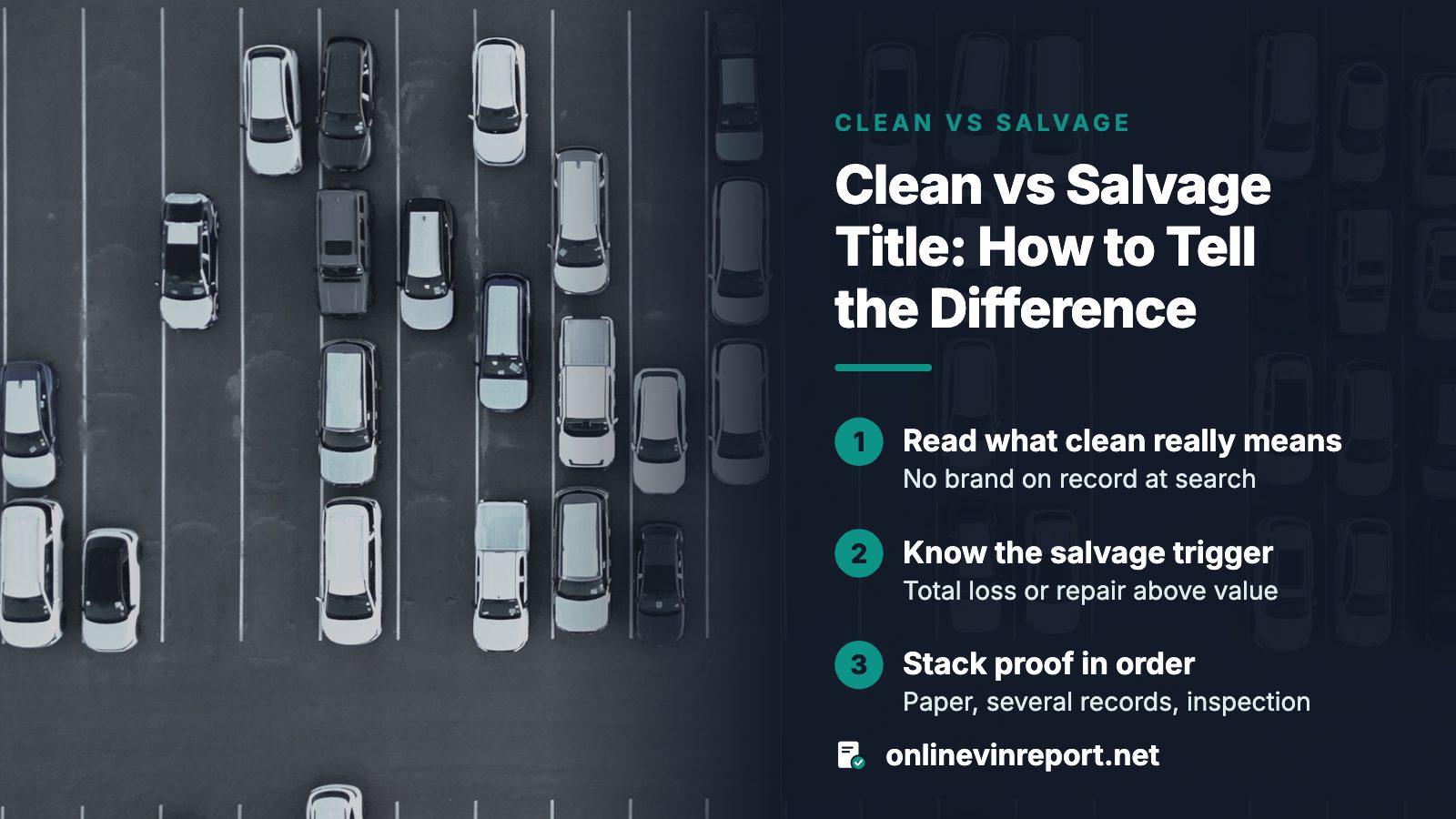
THE SHORT ANSWER
Read the title for a brand such as salvage, rebuilt, junk or water damage; a title with none is called clean. Then run the VIN through an online title check, since a brand recorded in another state may not appear on the paper you are holding. A clear result is a snapshot, not a guarantee, so finish with a mechanic's inspection before you pay.
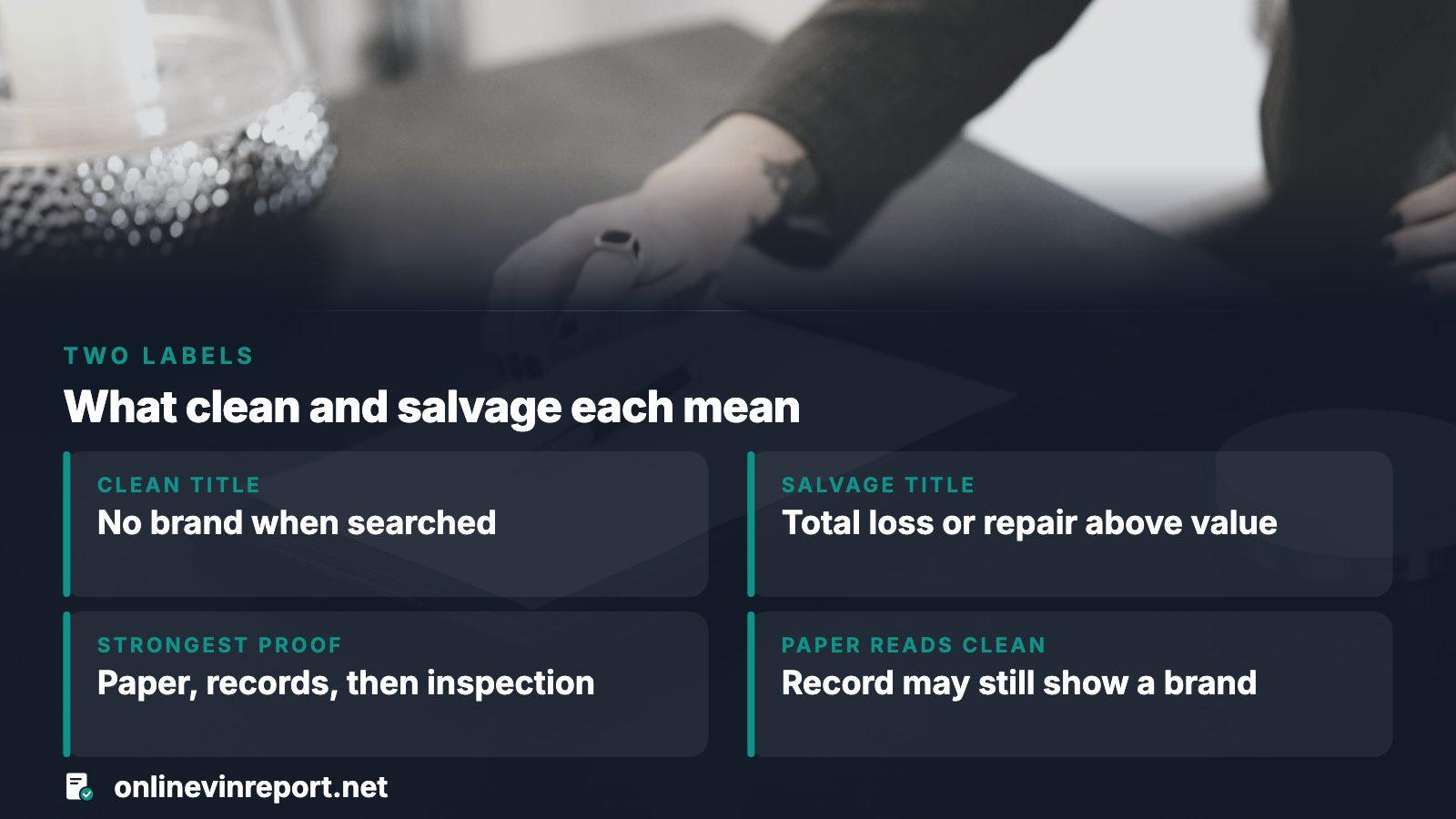
- Clean title
- No brand on record when the search was run
- Salvage title
- A brand for a total loss or a repair bill above the car's value
- Best proof
- Paper title, VIN records from several sources, then an inspection
What clean and salvage each record
Clean is shop talk for a title with no brand on it, not a legal grade. Texas's title-check page uses the phrase in a buying tip and lists Clear as a brand entry. In practice, no brand was on record when the search ran.
Salvage is a defined brand. Texas describes it as a car whose repair bill, parts and labor, passes a share of retail value set by each jurisdiction, and says insurers usually make the call. A total loss declared by an insurer also lands in the salvage history that NMVTIS reports show.
| Label | What the record says | On the road? |
|---|---|---|
| No brand | Nothing branded in the records searched | Yes, condition still unknown |
| Salvage | Written off after damage, theft or a total-loss ruling | Not until rebuilt and inspected |
| Rebuilt | Former salvage car that passed the state's checks | Yes, and the brand history follows it |
| Junk | Good only for parts or scrap | Never titled or registered |
Reading the paper title in your hands
Start with the document, not the ad. California prints brands in a red box headed VEHICLE HISTORY, top right on its title, and its DMV tells buyers to read that box, the last-sale mileage and the listed owner. Other states use other words: damaged, dismantled, junk, rebuilt, totaled and water damage all appear as brands, so read whatever is printed instead of hunting only for salvage.
The salvage family is wider than wrecks. Texas also files fire damage, owner retention and theft under salvage, so ask the seller what the brand was for.
When the paper reads clean and the record does not
A title shows what its own state recorded. NMVTIS, the federal title-history database fed by participating states, insurers and salvage yards, lists any brand a car has been given plus its current and earlier state of title, so a car branded in one state can carry a clean document after it moves to another. Title washing, covered in its own guide here, is the extreme case.
From an NHTSA owner complaint
A 2013 Nissan Altima owner told NHTSA the car came to them in 2018 holding a title that read clean. When a transmission recall letter arrived, the owner says, Nissan would not do the work, pointing to a VIN history of salvage in two other states and asking for clear titles from both. The owner reports being told by those states that a second title cannot be issued while the first is held.
The lesson: the document and the VIN's history can disagree, and this owner says the maker sided with the history.
Running the VIN through an online title check
Read the VIN off the vehicle and match it to the number on the title and in the ad before searching; a mismatch is an answer on its own. Then check more than one record.
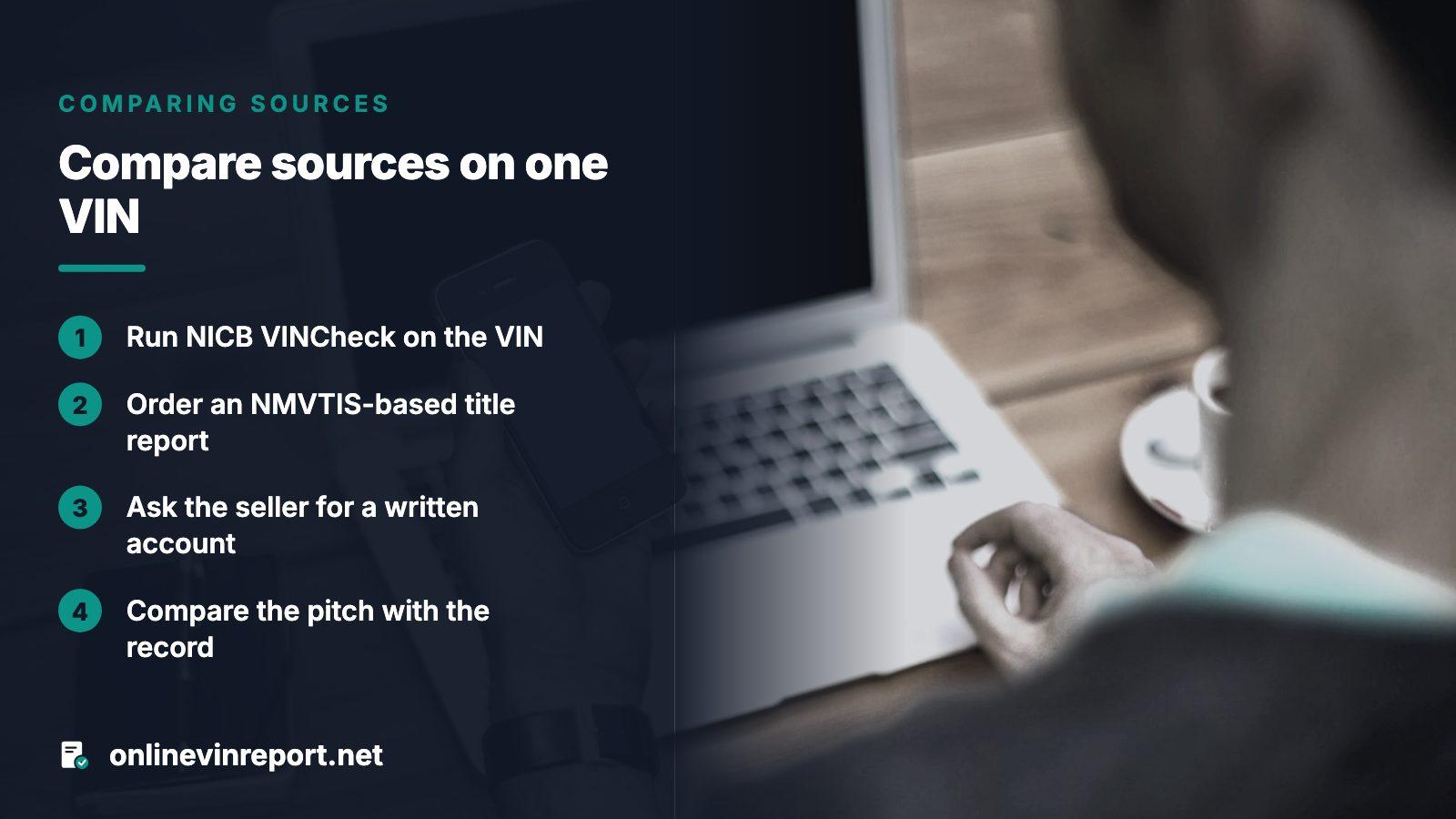
- NICB VINCheck, which the FTC calls free. It surfaces cars an insurer reported as flooded, stolen and never found, or salvage, but covers only cars that carried insurance at the time of the loss.
- An NMVTIS-based title report. It lists current and prior states of title, each brand with the date applied, the latest odometer data, theft history, and total-loss or salvage history.
- The seller's account. Ask for a written explanation of any brand the records show, with repair paperwork.
- A side-by-side comparison. Any gap between the sales pitch and the records is reason to pause.
OnlineVINReport adds a free preview before any purchase, then a one-time report with no subscription. For this question, its title-brand findings and salvage records, with auction photos where they exist, are the sections to read first.
What a clear result does and does not prove
A clear result says only that no brand had reached the file on the day of the search, which is why TxDMV ties its Clear entry to the moment of purchase. When a report returns no brand, odometer or title data at all, NMVTIS says the likely cause is that the states involved have not reported it.
| Result | What it suggests | What it cannot show |
|---|---|---|
| Clear title record | No brand or salvage entry has reached the national file | Repairs, since NMVTIS keeps no repair history |
| Clear on VINCheck | No insurer flood, theft or salvage declaration on file | Anything that happened while the car was uninsured |
| Salvage or total-loss entry | Severe earlier damage recorded by an insurer, yard or state | How well the repair was done |
Age and timing matter. Insurers must report salvage and total losses for the current model year plus the four before it, while salvage yards report inventories of any model year, so an older car's write-off is less certain to be on file. States feed NMVTIS on different schedules, so a very recent brand may lag.
Evidence on the car that can overrule the paperwork
A record is only as good as what was reported to it, so inspect the car with the history in mind. These tells come from California's DMV and the FTC:
- Heavy repairs to the inner fenders, or mold and rust under the trunk carpet
- Safety labels that should be on the car and are missing
- Mud or sand under the seats or dash, rust around the doors, mismatched or stained carpet, a smell of mold or strong cleaner
The FTC and TxDMV both point buyers to an independent mechanic before any money moves, a deposit included. A history report tells you what was recorded; the mechanic tells you what is on the car today.
If the check turns up a brand
California requires sellers, dealers included, to disclose a salvage title and history, and a licensed dealer there must pull an NMVTIS report and post a notice on any car with a junk or salvage past. Its DMV admits enforcement is hard, especially for cars from other states.
From an NHTSA owner complaint
A 2011 Honda Odyssey owner wrote that the dealership's paperwork called the title clean. Trying to insure the van, the owner says, the insurer judged it unsafe because of significant past damage and said it needed a rebuilt title. The owner adds that the dealer never mentioned 3 accidents, and that an agreed buyback was then refused.
The lesson: a brand can come to light at the moment of insuring the car, when backing out is hardest. TxDMV's advice on salvage cars is to weigh insurability and resale value before buying, and a car still branded salvage must be rebuilt and inspected before it can run on the road.
Where a full report fits
The free preview comes first. If the checks above point to a brand or a write-off, a full OnlineVINReport report is the next step: you pay once, whether for one report or a pack sized to a shortlist, and nothing renews. Open the title brands, the salvage and auction history with photos, and the damage records first, because they show what the document alone cannot. Prices are on the pricing page.
Pair it with the inspection, and let the report settle what the paperwork and the seller leave open.
Where this information comes from
- NMVTIS: Frequently asked questions — what reports hold, who reports, and how timing varies
- Texas DMV: Title check, look before you buy — the Clear entry and the salvage, rebuilt and junk definitions
- Texas DMV: Salvage brands — who decides salvage, which brands count, and buyer advice
- California DMV: Branded titles — where brands print, disclosure duties and inspection tips
- FTC: How to steer clear of a flood-damaged car — what NICB VINCheck covers and the signs of water damage
- NHTSA owner complaint 11342126 — owner experience, paraphrased
- NHTSA owner complaint 11308808 — owner experience, paraphrased
Sources and photos: Facts checked against the sources above in November 2026. Photos by Iain, Alejandro Escamilla and Annika Wischnewsky on Unsplash; diagrams by OnlineVINReport.
Keep reading
- Salvage title VIN check: run it online before you payRun the salvage check on a VIN and read what comes back.
- Title washing: how a brand vanishes and what a VIN title check can showHow a brand can vanish from the paper while the record keeps it.
- What is a rebuilt title? What it means and what a VIN title check showsThe brand that sits between salvage and an ordinary title.
- Why a salvage title is bad, and how a VIN check shows it firstWhat a salvage history does to price, insurance and repairs.
Frequently asked questions
If the title is clean, can the car still have been in a crash?
Yes. A brand attaches when a state or insurer records a specific event, such as a total-loss decision. Damage short of that can sit under a clear title, and NMVTIS holds no repair history to show it. Accident records and an inspection fill the gap.
Is a rebuilt title a clean title?
No, rebuilt is a brand of its own. The usual path runs from salvage to repair to a state inspection to a title reissued as rebuilt (revived salvage in California). NMVTIS reports list any brand a car has been given, so a seller calling such a car clean needs a VIN check.
Is NICB VINCheck enough to tell clean from salvage?
It is a good free first stop, but the FTC notes it covers only vehicles insured at the time of the damage. A write-off during a lapse in cover may not appear. Pair it with an NMVTIS-based title report that holds brands recorded by states.
Can I check a title status with only the VIN?
Yes. NICB and NMVTIS-based reports both search by VIN, so you can run the check from the listing before meeting the seller. In a private sale you still need the real title; TxDMV advises never leaving without it.
Is it illegal to sell a salvage car as clean?
Rules differ by state. California requires sellers, dealers included, to disclose a salvage title and history, though its DMV calls enforcement difficult for out-of-state cars. If a description conflicts with the record, keep the VIN report and ask your state's DMV what applies.
Now check the car itself
The guide explains what to look for. The report shows what this VIN has on record.