THE SHORT ANSWER
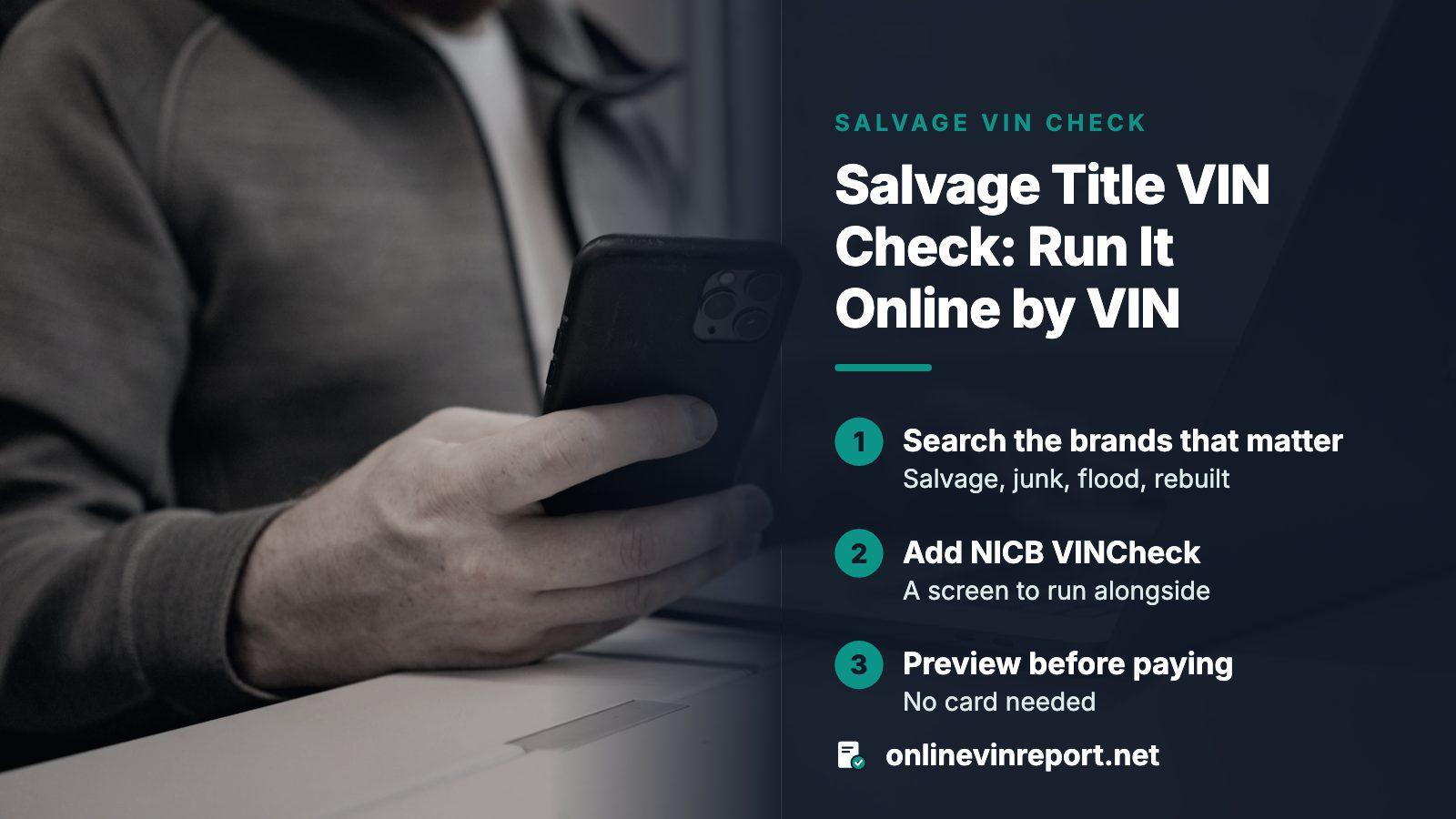
Enter the VIN and read the title brand section for salvage, junk, flood or rebuilt. Then look for a total-loss or salvage-yard entry with no brand next to it, because that gap is how a washed title shows up. A brand means someone already wrote the car off. A clean result is only encouraging, since repairs paid out of pocket leave no record. Pair it with NICB's VINCheck and an inspection.
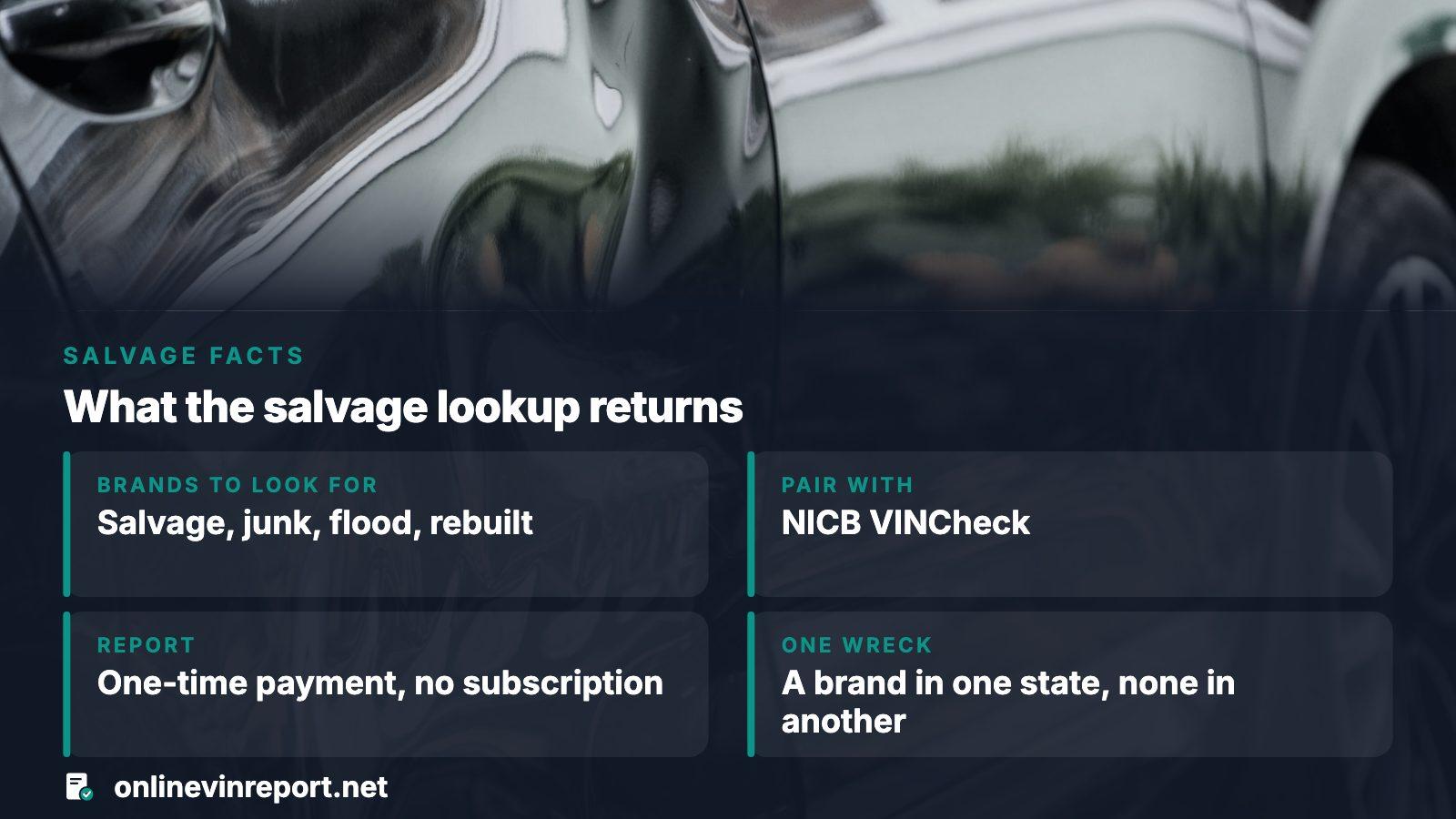
- Brands to look for
- Salvage, junk, flood, rebuilt
- Free screen to pair with it
- NICB VINCheck
- Preview
- Free, no card needed
- Full report
- One-time payment, no subscription
What an online salvage title VIN lookup returns
Run online, the lookup compares one VIN with state title brands, insurer total-loss reports and salvage-yard filings. A hit returns the brand, the issuing state and a date, plus auction photos and damage notes if the car was sold as a wreck. Four brands matter most.
| Brand | What it records | Your move |
|---|---|---|
| Salvage | An insurer wrote the car off as a total loss, and it is off the road until repaired | Price it as a wreck, or pass |
| Junk | The car is beyond road use and valued for spare parts or scrap metal | Not a car to drive |
| Rebuilt | A former salvage car was repaired, then passed a state inspection and returned to registration | Buy only with repair papers and a real discount |
| Flood | The state noted water damage as the cause of the loss | Check wiring and carpet padding, or pass |
Run the salvage title VIN lookup in five steps
Run it from your phone while the car is still just a listing.
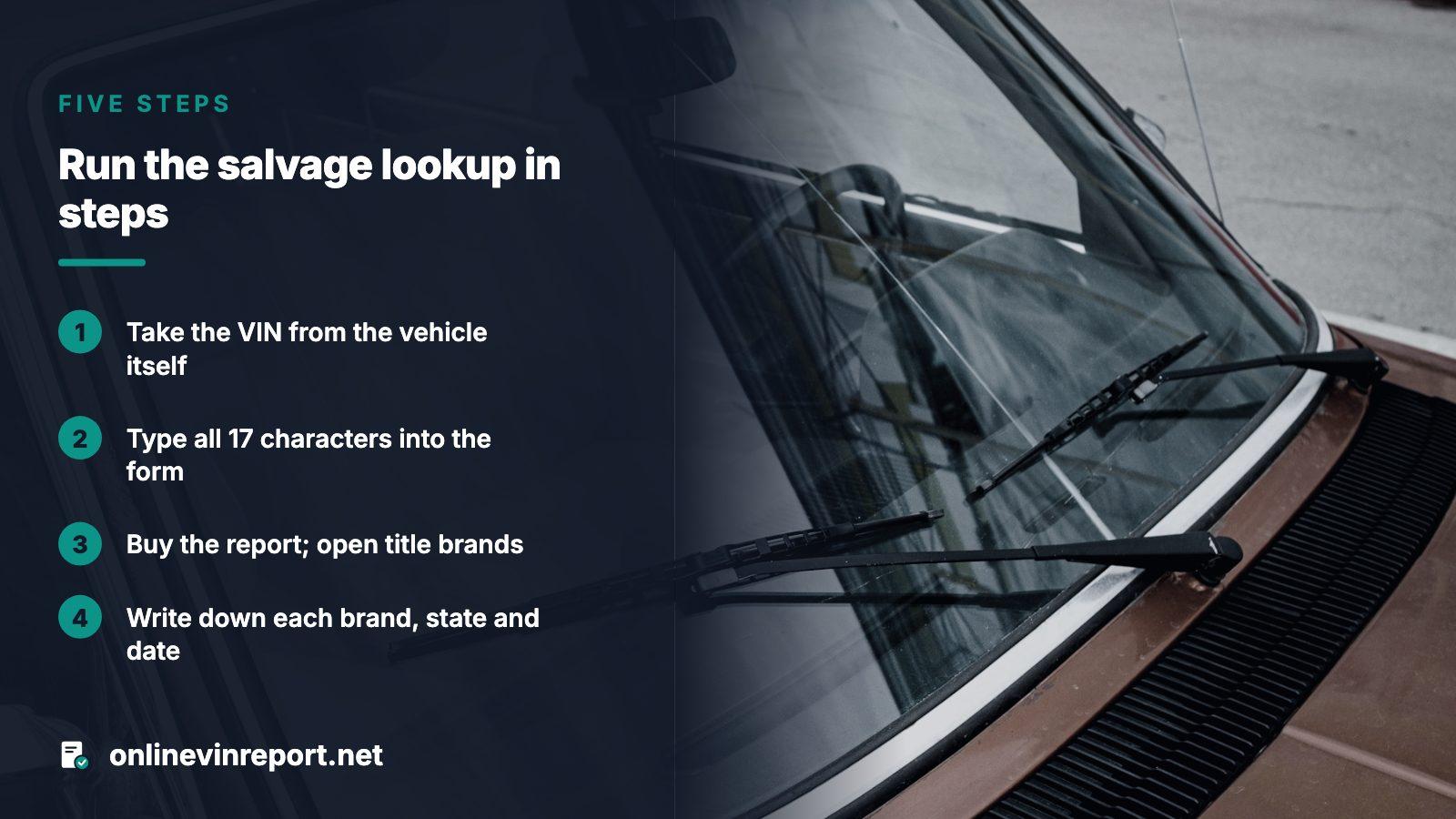
- Take the VIN from the vehicle, not the advertisement. One copy sits on a plate visible through the windshield at the dashboard's driver end, another on the label set into the driver-side door frame. The two numbers and the title must match.
- Type all 17 characters into the form on this page. A single typo pulls up someone else's car, or an error.
- Take the free preview first. It needs no card.
- If the car is a real contender, buy the report and open the title brand section before anything else.
- Write down every brand, state and date, and put them to the seller.
Reading the result: five patterns
A search for salvage title history tends to end in one of these shapes.
- A dated brand. The loss is on record, so line the date up against the odometer readings and the seller's story of who owned the car at the time.
- A total-loss or auction entry with no brand. This is how a washed title looks. Treat the car as branded, then negotiate or leave.
- A brand from another state, a clean title in this one. The brand travels with the VIN. Ask why the title moved.
- A salvage-yard entry showing the car crushed or exported. If the ad says it runs, the conversation is over.
- Nothing found. Good news, with the limits explained further down. Go and inspect the car.
Why the same wreck can carry a brand in one state and stay clean in another
Brand rules are state law. Several states set the line at 75% of pre-damage value, others at 80%, and California skips percentages and asks whether repair would be uneconomical. The federal definition is wider than any of them. It counts insurer write-offs made under policy terms too, so a car that missed a state formula can still turn up in the national record.
Some states add limits before the test even starts. South Carolina skips the salvage brand when a vehicle's value falls below a stated figure. New Jersey reserves one branch for vehicles eight or fewer model years old. Michigan attaches its 75% and 91% tiers to late-model vehicles alone.
Weigh a clean title by age and value
On a recent car that was worth real money, a clean title says a lot, because the state's test almost certainly applied. On an older, cheaper car it may only mean the test never looked at it.
Why a buyer is allowed to run this check
Federal rules name the prospective purchaser among the people the national title system must answer, for the one vehicle being bought. You are not asking a favor. Access runs through providers the Justice Department approves, and they charge, so the right is real and the delivery is commercial.
The title and brand records in an OnlineVINReport report come from NMVTIS data supplied by an approved provider, with other sources alongside. The system answers whether a vehicle is or has been junk or salvage, so a salvage past stays visible even after the car was repaired and retitled.
Red flags that end the negotiation
One is a reason to slow down. Two together are a reason to leave.
- The seller dodges a request for a photo of the VIN plate.
- The windshield plate and the jamb label show different numbers.
- A paper title reads clean while the record shows a brand from elsewhere.
- The record lists a write-off or salvage sale and the title carries no brand.
- A yard filing says crushed, disposed of or bound for export.
- The price sits far under market and the seller wants cash fast.
What no online lookup can see
Picture an owner who dropped collision coverage and wrecks the car. A private repair involves no insurer, no total-loss declaration and so no record anywhere, and the car sails through every check. A missing yard filing proves little either, because a yard may report through its state instead of filing separately.
- Doors, hood or trunk sitting unevenly in their openings
- Paint that changes depth or texture from one panel to the next in raking light
- Paint dust on door seals, under-hood wiring or inside the filler flap
- Welds that look unlike the factory pattern, or an airbag light that acts strangely at startup
Free checks to run beside it, and what the report costs
NICB's VINCheck is a free screen for stolen and written-off cars, built from insurers that choose to take part, and it caps daily searches. NHTSA runs a free recall search by VIN, and open recalls survive a rebuild. Florida's motor vehicle agency publishes a free title status check, while many states publish nothing. A plain VIN decode only reads how the car was built, so it never shows a brand.
Running a VIN through the preview is free, and no payment card is requested. You pay once per report with no subscription, and multi-report packs come in 3, 5 or 10. Prices are on the pricing page.
If the lookup returns a salvage or rebuilt brand
A brand means reprice, not automatic goodbye. Four things decide it: which parts were damaged, who repaired them, whether the paperwork survives and whether an insurer will actually write a policy on it. Ask for repair invoices and the inspection record, and get a coverage quote on the VIN before paying a deposit.
Records can grow after the fact, because a yard may file an update once a car's fate is settled. If the purchase drags on for weeks, pull the record again before you sign.
Where this information comes from
- eCFR: 28 CFR Part 25, subpart B (NMVTIS) — Federal definitions of salvage and junk automobiles, who may ask the title system about a vehicle, and what a salvage yard must record.
- NMVTIS: consumer information and approved providers — The federal title system behind brand records, and the public list of providers allowed to sell its data.
- NICB: VINCheck — A free screen for stolen and written-off cars reported by insurers that take part.
- NHTSA: recalls lookup — Open safety recalls by VIN, which stay open on a repaired or rebuilt car.
- FLHSMV: Motor Vehicle Information Check — An example of a state tool that returns title status and brand flags for a VIN.
Sources and photos: Facts checked against the sources above in November 2026. Photos by Anastasiia Nelen, Max Tokarev and Maxim Tolchinskiy on Unsplash; diagrams by OnlineVINReport.
Keep reading
- What is a branded title? How to read salvage, flood and rebuilt brands by VINEvery brand type explained, and how each one changes what a car is worth.
- Title washing: how a brand vanishes and what a VIN title check can showHow a brand gets lost between states, and how to catch it.
- Total loss threshold by state and what it means for a VIN title checkWhy the same damage totals a car in one state and not in another.
- PricingReport options, pack sizes and the one-time payment, with no subscription.
Frequently asked questions
How do I check a VIN for a salvage title?
Read the 17-character VIN off the dashboard plate and the door label, enter it for the free preview, and open the full report if the car is still in play. Check the title brand section, then any salvage or auction entries. Run NICB's VINCheck as well, and compare everything with the paper title the seller hands you.
Is there a free salvage title check?
Partly. NICB's VINCheck costs nothing and flags stolen and written-off cars from insurers that take part, and a few states, Florida among them, run free title status tools. The preview here is also free, but the full history is a one-time payment. A VIN decode alone shows build details, never brands.
Does every salvage title show up on a VIN check?
No. A wreck fixed quietly without an insurance claim leaves nothing to find, and a state's branding test may never have applied to a car that old or that cheap. A brand that was issued does follow the VIN into other states, which is the reason to run the lookup.
Why does the result say salvage without saying why?
Total-loss and salvage-yard filings record the VIN, dates and parties, not the cause of damage. A flood write-off and a collision write-off read alike. Read the auction photos and damage notes where they exist, then inspect the car for water lines, fresh paint and replaced airbag modules.
What separates a salvage title from a rebuilt title?
A salvage title marks a total-loss car that is off the road as it stands. A rebuilt title means it was repaired and passed a state inspection, so registration is allowed again. Every rebuilt car was salvage first, and that earlier brand matters more to value than the current label.
Now check the car itself
The guide explains what to look for. The report shows what this VIN has on record.