THE SHORT ANSWER
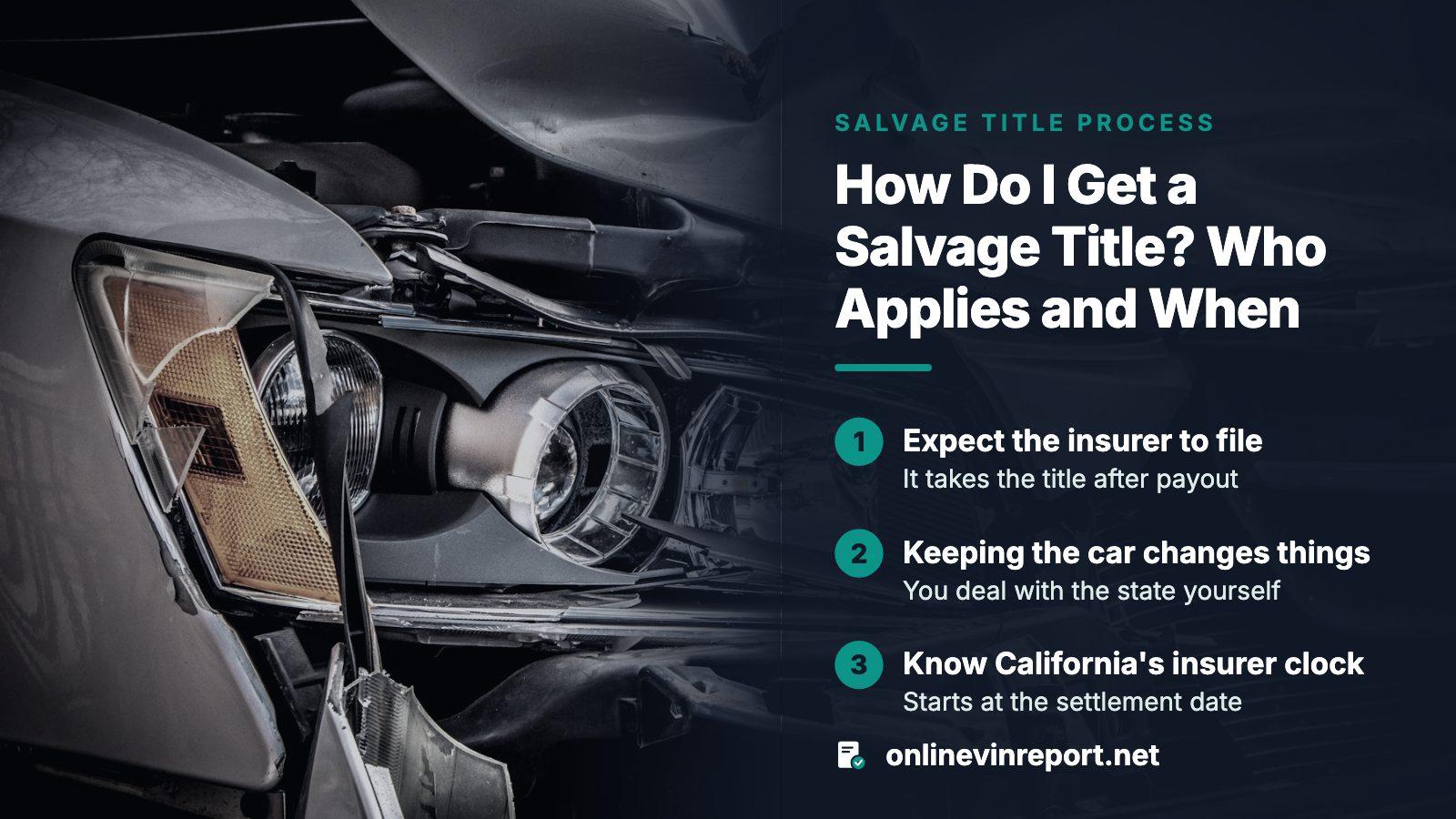
A car gets a salvage title when repair cost plus wreck value exceeds what it was worth before the damage, or when an insurer or state declares it a total loss. After a claim, the insurer normally takes the title and applies. With no claim, or if you keep the car, the owner applies. Deadlines and forms vary by state.
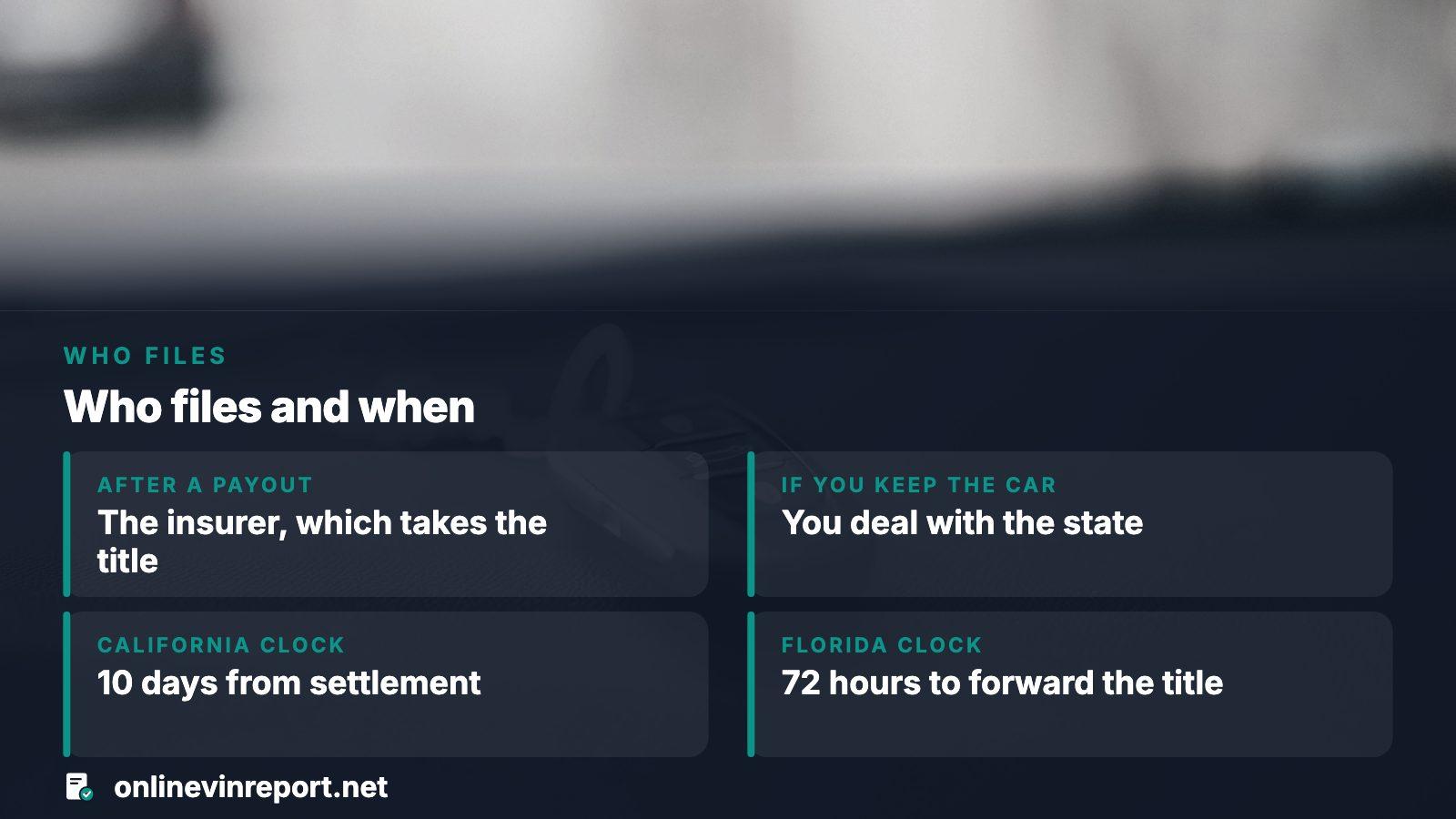
- Who files after a payout
- Usually the insurer, which takes the title
- If you keep the car
- You deal with the state agency yourself
- California insurer clock
- 10 days from the settlement date
- Florida title clock
- 72 hours to forward the title
The brand follows a write-off, not an application
Federal rules treat salvage as arithmetic. Take what the damaged car would bring as a wreck, add what it would cost to put it back into legal road use, and compare the sum with its market value just before the event. A higher sum means salvage. Any car an insurer or a state calls a total loss counts too, even when the insurer never takes ownership.
So the answer to how a car gets a salvage title is awkward: usually nobody chooses it. An adjuster, an insurer or a state decides repair costs too much next to the car's worth, and the paperwork follows.
The usual route: the insurer pays and the title moves
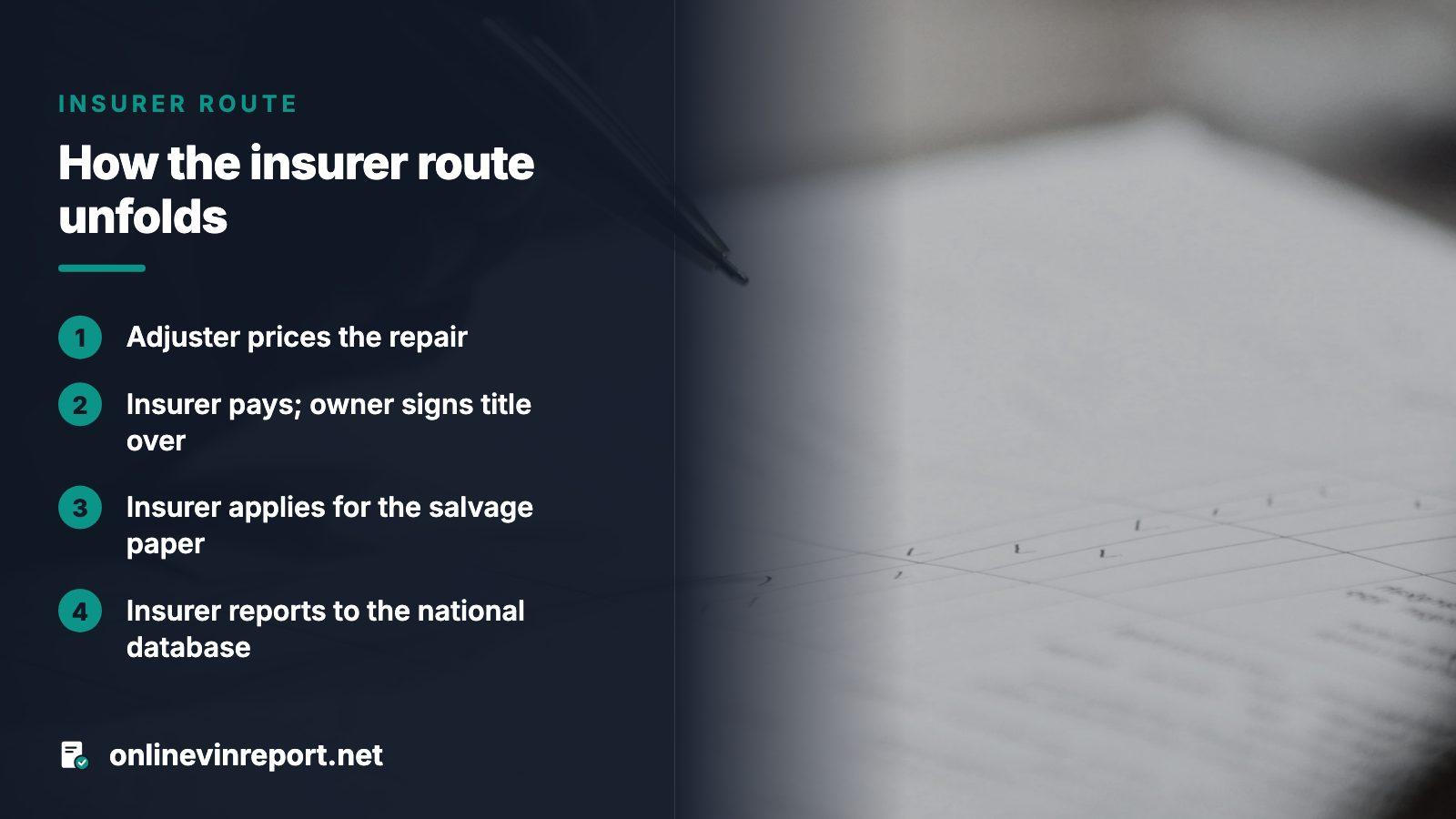
The common sequence begins with an insurance claim.
- A crash, fire, flood or hail storm damages the car.
- An adjuster prices the repair. If the bill is too high beside the car's value, the insurer declares a total loss.
- The insurer pays and the owner signs the title over.
- The insurer applies to the state for a salvage certificate or title. California allows 10 days from the settlement date; Florida expects the title forwarded within 72 hours of receipt.
- The insurer reports the car to the national title database, which later VIN checks draw on.
From an NHTSA owner complaint
A 2010 Honda Civic owner wrote that the airbag deployed unexpectedly in a construction zone, perhaps as the car crossed a metal plate. Because replacing the airbag system would cost so much, the owner says, the insurer wrote the car off and took it for salvage, though nothing else was wrong. The owner adds that the insurer relied on a virtual inspection.
Take from it that a write-off can hinge on one repair bill, not a wreck. That is why a salvage brand says little about how the car looks or runs.
When the filing lands on the owner
With no claim, or when you keep a car after a payout, the owner deals with the state. California says the owner must obtain the certificate when no settlement exists, on form REG 488C with proof of ownership. In Florida the title goes to the state with a repair-cost estimate, and the car cannot be sold off or scrapped until a certificate is issued, to the owner if the owner kept the car.
| State | Who acts | Clock stated | How the state frames it |
|---|---|---|---|
| California | Insurer after a settlement; owner if none | 10 days for the insurer | An insurance settlement starts the insurer's clock |
| Florida | Owner, or the insurer that paid | 72 hours to forward the title | Insurer replacement payout, or 80 percent or more of replacement cost if uninsured |
| Texas | Insurers usually decide | Not stated; ask TxDMV | Repair cost above pre-damage value |
Other states set their own forms, clocks and fees. Ask the agency where the car will be titled before committing to repairs or a sale.
Salvage, certificate of destruction or junk: the car decides
- Salvage: repairable in principle. Texas keeps it off public roads until it has been rebuilt and inspected.
- Destruction or nonrepairable: the state decides the car should not be rebuilt. Florida applies this to a car whose model year is 7 years old or newer and valued at $7,500 or more, when the repair estimate is 90 percent or more of retail value, and to older or cheaper cars worth only parts or scrap.
- Junk: federal wording requires both that the car cannot operate on public roads and that it has no value beyond parts or scrap, a narrower test than salvage.
A Florida certificate of destruction replaces the title for the car's remaining life, and it can change hands only twice before dismantling is required.
Hail, fire, theft and abandonment lead to the same brand
Collisions are one cause among several. Federal wording lists fire, flood and trespass beside collision and accident, and Texas counts fire damage, owner-retained total losses, a stolen car on which an insurer paid, and abandoned cars towed at police request among its salvage brands.
Theft needs one caution. The national title system's consumer page notes that a stolen car that turns up undamaged can still carry a total-loss label, so the entry alone does not prove a destroyed car. Read the date and the repair evidence before walking away from a deal.
Why the title in the seller's hand can still look clean
Each state decides what to brand, and the sources feeding the national record follow no single standard, so it has holes. Its consumer page says not every vehicle or state is covered, and a lookup may find nothing on a car that does have a salvage past.
Age adds a wrinkle. The federal reporting duty for insurers is written around the current model year plus four earlier ones, so an older write-off may rest on state title agencies and salvage yards.
From an NHTSA owner complaint
A buyer of a used 2014 Toyota RAV4 says the title looked standard. About a year later the maker first called the car eligible for a bulletin repair, then reversed itself, calling the car ineligible as a total-loss vehicle. The owner then learned of hail damage and an insurance total-loss claim, and reports that the title never got a salvage brand. A complaint to a Texas insurance regulator, the owner adds, brought no help.
One owner's account does not settle what the insurer did. It does show the buyer's position: full price paid, a clean-looking title, history learned from someone else's lookup. A title check before payment reads the VIN against brand records instead of the seller's paperwork.
After the brand: rebuild, inspect, retitle
Texas will not let a salvage vehicle onto public roads until it has been rebuilt and has passed inspection; meanwhile it can only be given a salvage or nonrepairable title, or be cleared for disposal. Florida's choice between a rebuildable car and one headed for dismantling rests on the repair-cost estimate filed with the application.
After a rebuild passes, the car is retitled with a new brand, not a clean record. The national record keeps brand history, so a later VIN check can still surface the earlier salvage entry.
If the car in front of you might carry the brand
- Take the VIN from the listing and confirm it against the car in person.
- Run a title check before negotiating. A salvage, flood, rebuilt or junk entry changes what the car is worth to you.
- If a brand appears, ask for pre-repair photos and itemized invoices. A salvage auction record may supply the photos.
- Compare the state's own title record, since the national record has gaps.
- Pay an independent mechanic to examine the structure, and get an insurer to confirm coverage on that VIN.
OnlineVINReport reads those brands by VIN, and its full report adds salvage and auction history with photos where a car went through one, plus odometer readings and insurance records. A free preview comes first; the full report is a single purchase, with the options on the pricing page.
Where this information comes from
- 28 CFR Part 25, subpart B: NMVTIS rule — federal wording for salvage, junk and total loss, and the insurer reporting duty
- California DMV: Total loss, salvage and non-repairable vehicles — who applies, the insurer's 10-day clock, the owner's duty and the form
- Florida Statutes 319.30: total loss and salvage — the 72-hour title rule, owner-kept cars and certificate of destruction limits
- Texas DMV: Salvage brands — what Texas treats as salvage and the rebuild-before-driving rule
- NMVTIS: Information for consumers — what the national record shows and where it has gaps
- NHTSA owner complaint 11481606 — owner experience, paraphrased
- NHTSA owner complaint 11374185 — owner experience, paraphrased
Sources and photos: Facts checked against the sources above in November 2026. Photos by Clark Van Der Beken, Masjid MABA and Bence Balla-Schottner on Unsplash; diagrams by OnlineVINReport.
Keep reading
- Total loss threshold by state and what it means for a VIN title checkSee how states decide when repair cost makes a car a write-off.
- Salvage certificate: what it means and what a VIN check showsLearn how a salvage certificate differs from a salvage title.
- Salvage title VIN check: run it online before you payRun the title brand check before you pay for a car.
- What is a rebuilt title? What it means and what a VIN title check showsSee what changes once a salvage car passes inspection.
Frequently asked questions
Can I apply for a salvage title myself?
Yes, when no insurer is handling it, such as when there was no claim or you kept the car after a payout. California says the owner must obtain the certificate if there is no settlement. Ask your state agency for the current form and fee.
How long do I have to apply?
It depends on the state and the applicant. California gives an insurer 10 days from the settlement date. Florida expects the title forwarded within 72 hours, by the owner or by the insurer after receiving it. Texas's brands page gives no deadline, so ask the agency.
Does every totaled car end up with a salvage title?
No. A car can be handled as salvage in one place and never receive the brand in another, and some states do not report. A certificate of destruction or junk status may apply instead. A VIN check shows what is on file.
What changes once the car is repaired?
The car must pass inspection, and in Texas the title then reads rebuilt. That is a new label, not a clean record, because the national record keeps brand history. Treat a repaired car as salvage first and fixed second, and price it that way.
Is a salvage title proof of a crash?
Not necessarily. Federal wording also names fire, flood and trespass, and Texas treats fire damage, owner-retained total losses, paid theft claims and abandoned cars as salvage. Insurers are encouraged, not required, to report why they took a car, so the cause may be missing. Ask for photos and invoices.
Now check the car itself
The guide explains what to look for. The report shows what this VIN has on record.