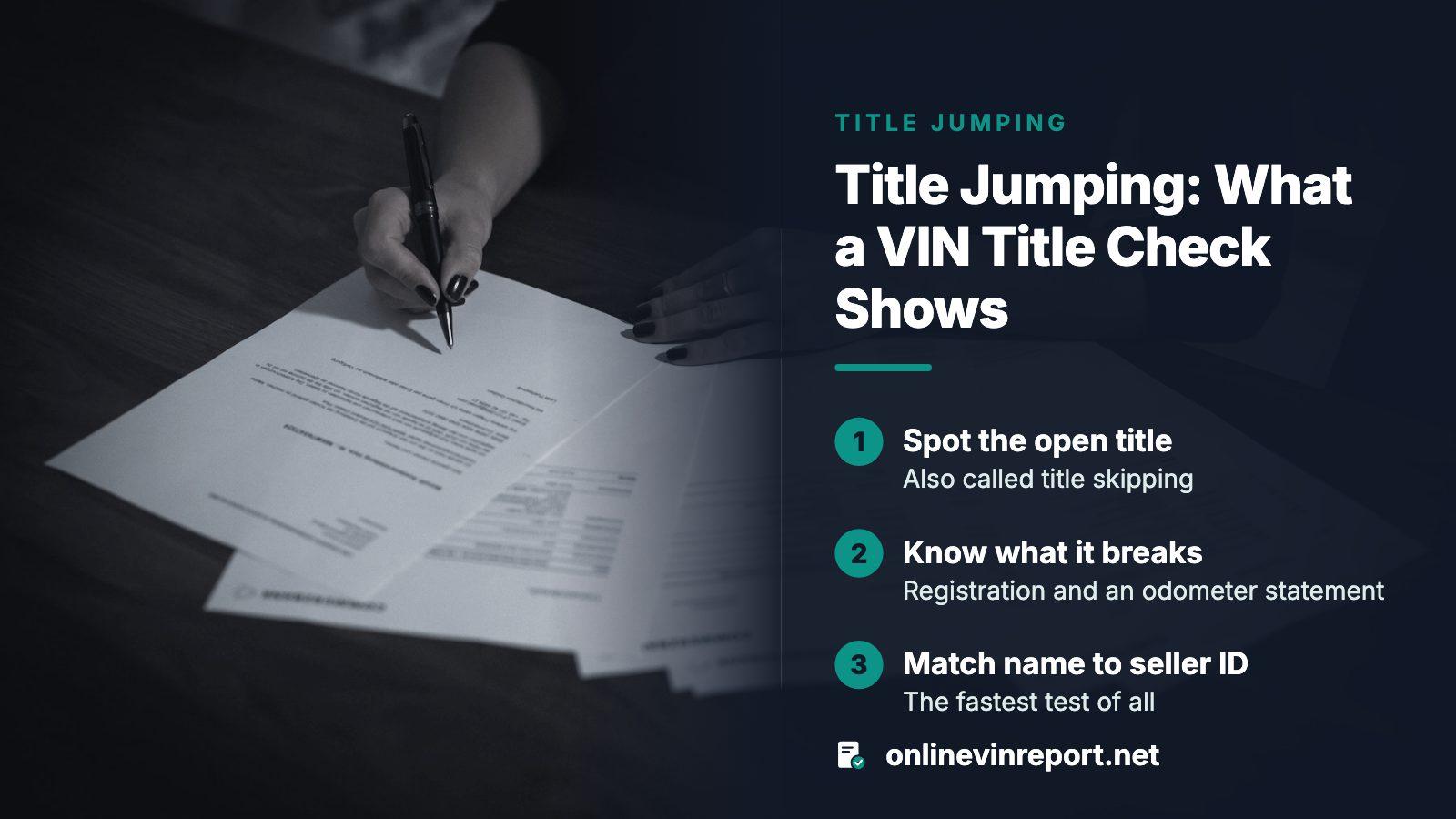
THE SHORT ANSWER
Title jumping means a seller resold a car on a title signed by an earlier owner, without ever registering the car in their own name. Your state office will not record a sale from someone who is not the owner of record. A VIN title check lists the last title date, issuing state, brands and odometer dates, and any of them can contradict the seller's account. The name on the title against the seller's photo ID settles it.
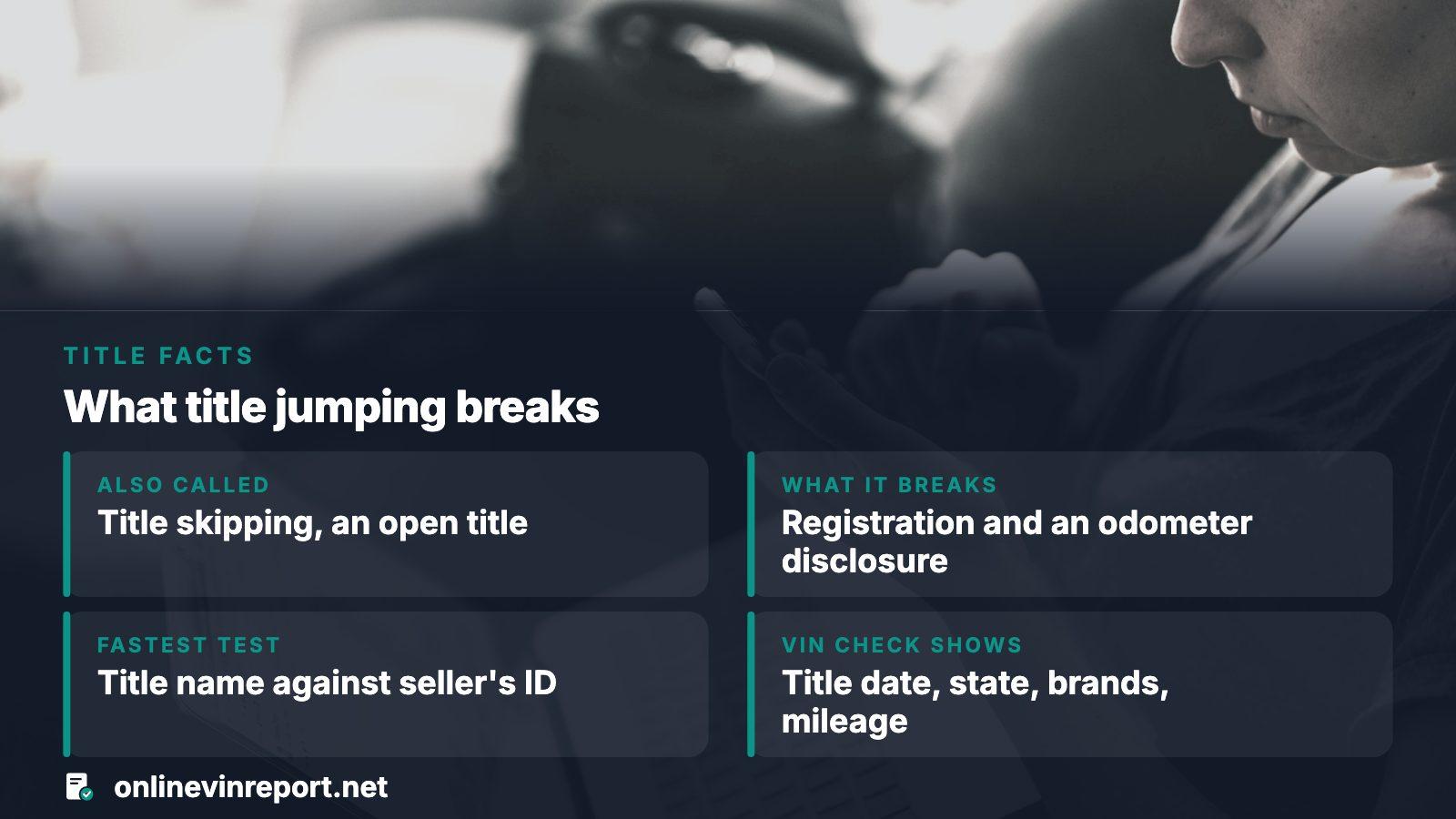
- Also called
- Title skipping; the paper is an open title
- What it breaks
- Your registration, and one odometer disclosure
- Fastest test
- Name on the title against the seller's ID
- VIN check can show
- Title date and state, brands, odometer dates
A title history is a chain of filings, and jumping removes a link
Picture a title history as a list of dated entries, one added each time a new owner files and pays. Title jumping is a buyer who never files. They pick up a title the last owner signed, hold the car for a few weeks, then hand the same paper to you.
The only name on that document belongs to someone long out of the picture, and the person you dealt with appears nowhere on it. Nothing looks forged, which is why the defect hides so well. The document is called an open title, and the habit is sometimes described as title skipping.
Why you can own the car and still be refused plates
At the counter you are asking the state to log a handover from the person named on the title to you. The person who sold you the car is a different individual, and the named owner never agreed to any sale. A clerk has no discretion to bridge that, because liens, brands and theft reports all hang off the ownership history.
So you end up with keys, a receipt and no plates. Insuring the car and selling it later hit the same wall. A private sale can hand you the vehicle, but only the state can hand you the title.
The timeline test: set the seller's story beside the record
An online search reads what states and their data partners filed against the VIN, not the paper in the seller's hand. That makes it a cross-check on whatever you were told. The rows below are examples of claims worth lining up.
| The seller says | The record shows | How to read it |
|---|---|---|
| I've owned it since spring | A last title date from a couple of years back | Their purchase was probably never filed, so ask whose name is on the paper |
| I'm the third owner | Two recorded owners | A sale happened somewhere that no office logged |
| The mileage is original | Odometer readings that stop, then resume far later | A transfer without a statement can leave exactly this gap |
| It has a clean history | A salvage or flood brand from an earlier owner | The brand follows the VIN, whoever is holding the paper |
The comparison takes a minute and needs only the 17 characters of the VIN.
What no title search can see
The flipper never filed anything, so no database holds a trace of them. A missing filing looks identical to a person who was never involved. A search can raise suspicion, and it cannot prove a jump.
The federal rule behind the national title information system, 28 CFR 25.53, expects it to let a user judge whether a document claiming to be a title is valid and what its status is. The operator must also share information with a prospective buyer who asks. Use it for that job: confirm what the state shows, then compare it with the person in front of you.
Silence is not a clean bill
A skipped transfer leaves no entry to read. If the dates fit the seller's story but the name on the paper is still not theirs, believe the paper.
The mileage record loses a page as well
Under 49 CFR Part 580, the odometer statement is owed by whoever hands over ownership, whether through a sale or a gift. Pledging the car as loan security does not count. The statement sits on a form with a printed warning about fines or imprisonment for leaving it blank or giving a false figure, and each transfer needs its own.
Skip the transfer and the statement goes with it. The run of readings that exposes rollback now has a hole exactly where the car changed hands, and the hole stays for the car's lifetime, costing the next buyer as much as it costs you. A mismatched name beside a mileage figure too low for the car's age deserves a second look.
Three reasons a seller skips the state
Two motives explain most cases, and a third explains the innocent ones. They call for different reactions.
- Avoiding the bill: the car is a quick resale, and registering it first means fees and forms for a car they plan to keep only a few weeks. Sellers often offer this as if it were a defense.
- Dodging a count: the FTC's used car rule treats anyone who has sold five or more used vehicles over the past twelve months as a dealer, whatever the seller calls themselves. Titles in their own name would document that volume.
- Honest muddle: estates, gifts between relatives and inherited cars generate messy paperwork, so not every mismatch is a scheme. The cure is identical, and it must happen before you pay.
Six tests to finish before any money moves
- Name test: the owner line on the title and the seller's photo ID must name one person.
- Signature test: an assignment already signed by a stranger, with the buyer's section blank, is the open-title pattern.
- VIN test: read the plate at the dashboard corner, then find the same 17 characters on the title. Any difference ends the conversation.
- Alteration test: on a paper title, look for erasures and misspelled words. Florida's department lists both as fraud indicators.
- History test: ask for something dated from the seller's supposed ownership, such as an insurance card or a repair invoice, and compare it with the record's last title date.
- Friend test: a seller acting for someone else should bring that person's signature. If the friend exists, collecting it is easy.
If you already hold an open title
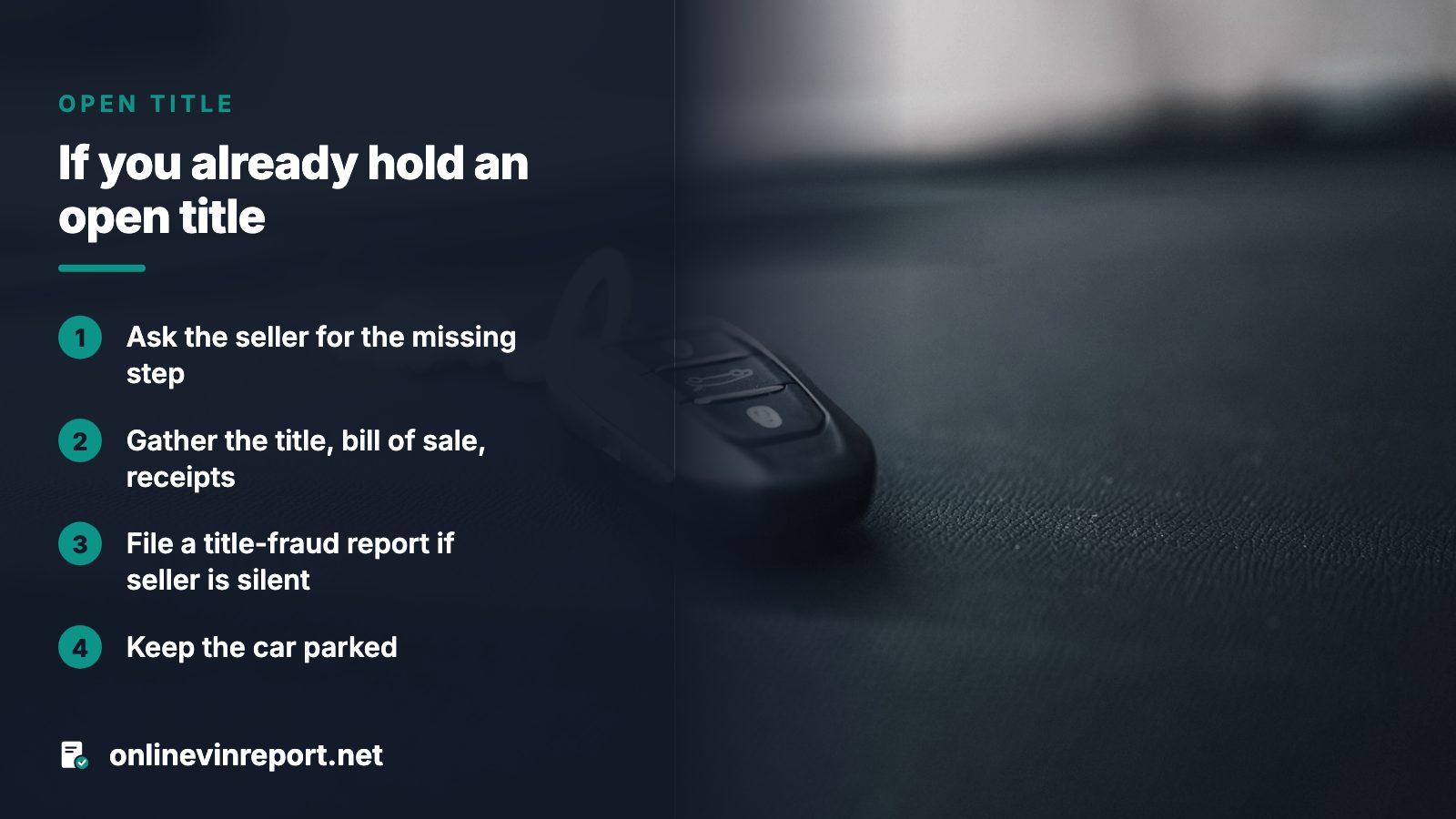
- Call the seller today and ask for the missing step: the middle owner registers the car properly, then transfers it to you. That route closes once calls stop being answered.
- Gather the paper trail: the title, any bill of sale, a receipt for what you paid, the original advertisement and the text threads. Take it to your own titling office and ask which remedy your state uses. Some issue a bonded title, some go through a court and some run an administrative review.
- If the seller has gone silent, file a title-fraud report. Florida, for one, publishes a reporting form and names a fraud unit to receive it, and a report creates a dated record.
- Keep the car parked. Driving it unregistered adds a second problem, and an insurance dispute is better settled before an accident than after one.
Where the VIN search fits in the buying order
Run the VIN while the car is still only a listing, then read the paper in person. The preview is free and shows whether the search holds anything on that vehicle. For a car you are serious about, the report is a single transaction with no subscription, and multi-report packs exist for shoppers weighing several cars. The pricing page lists the options.
Where this information comes from
- FLHSMV: Title Fraud — A state agency's advice to match the seller's ID to the title name, compare VINs, watch for erasures and report suspected fraud.
- 49 CFR Part 580: odometer disclosure requirements — Defines the transferor and the statement owed at each transfer of ownership.
- 16 CFR Part 455: FTC Used Motor Vehicle Trade Regulation Rule — The dealer definition that explains why a high-volume seller avoids putting titles in their own name.
- 28 CFR Part 25: NMVTIS operator responsibilities — Says the system should let a user judge a title document's validity and status, and share information with prospective purchasers.
- NMVTIS: consumer information and approved providers — The Justice Department page on the federal title record and the providers approved to sell reports from it.
Sources and photos: Facts checked against the sources above in November 2026. Photos by Dimitri Karastelev, Bence Balla-Schottner and Michal Biernat on Unsplash; diagrams by OnlineVINReport.
Keep reading
- Car title check online: salvage, flood, rebuilt and junk by VINHow to run a full title search by VIN and read the brand section.
- Registering a car without a title: what the VIN check shows firstWhat registering looks like when the paperwork is missing or incomplete.
- Title washing: how a brand vanishes and what a VIN title check can showThe other title trick: a brand that vanishes when a car moves between states.
- Bill of sale for a car: the deal it proves and the history it can'tThe paper that records who sold what to whom, and why to keep it.
Frequently asked questions
Is title jumping illegal?
Titling rules are set state by state, so the offense and its penalty depend on where the sale happens. What never varies is the buyer's outcome: a document the local office cannot process. Florida's agency has a title-fraud category covering altered titles and titles obtained by false means, with its own reporting route.
Will a VIN check reveal a jumped title?
Not directly, because a skipped filing leaves nothing to read. A check can show the last title date, state, brands and odometer dates, and those may disagree with how long the seller claims to have owned the car. Treat a mismatch as a reason to ask questions, then settle it with the title and the seller's ID.
What if the seller says they are selling for a friend?
Then the friend should sign the title over to you directly, and waiting for that costs you nothing. If the friend cannot be reached, the seller cannot deliver what you are paying for. A vague answer or a refusal is the answer, so step back before any payment.
I am the seller. How do I avoid creating an open title?
Fill in the buyer's name and details rather than leaving the line empty, complete the odometer statement, and file whatever release-of-liability notice your state offers. If the buyer never registers, the car may remain linked to you in the state's record, and tolls, tickets and liabilities can follow.
Does a clean brand history mean the sale is safe?
No. Brands and paperwork are separate questions. A car with no salvage, flood, rebuilt or junk brand can still arrive on an open title, and a branded car can come with spotless paperwork. Check the record by VIN for brands and dates, and the paper for names and signatures.
Now check the car itself
The guide explains what to look for. The report shows what this VIN has on record.