THE SHORT ANSWER
A bill of sale documents a private car sale, but the signed title is what hands over ownership. Federal odometer rules also put the mileage statement on the title, so the mileage line on your receipt is only a back-up record. Whether your state demands a bill of sale turns on which state will issue the title. Run the VIN before signing, because a title brand never appears on the receipt.
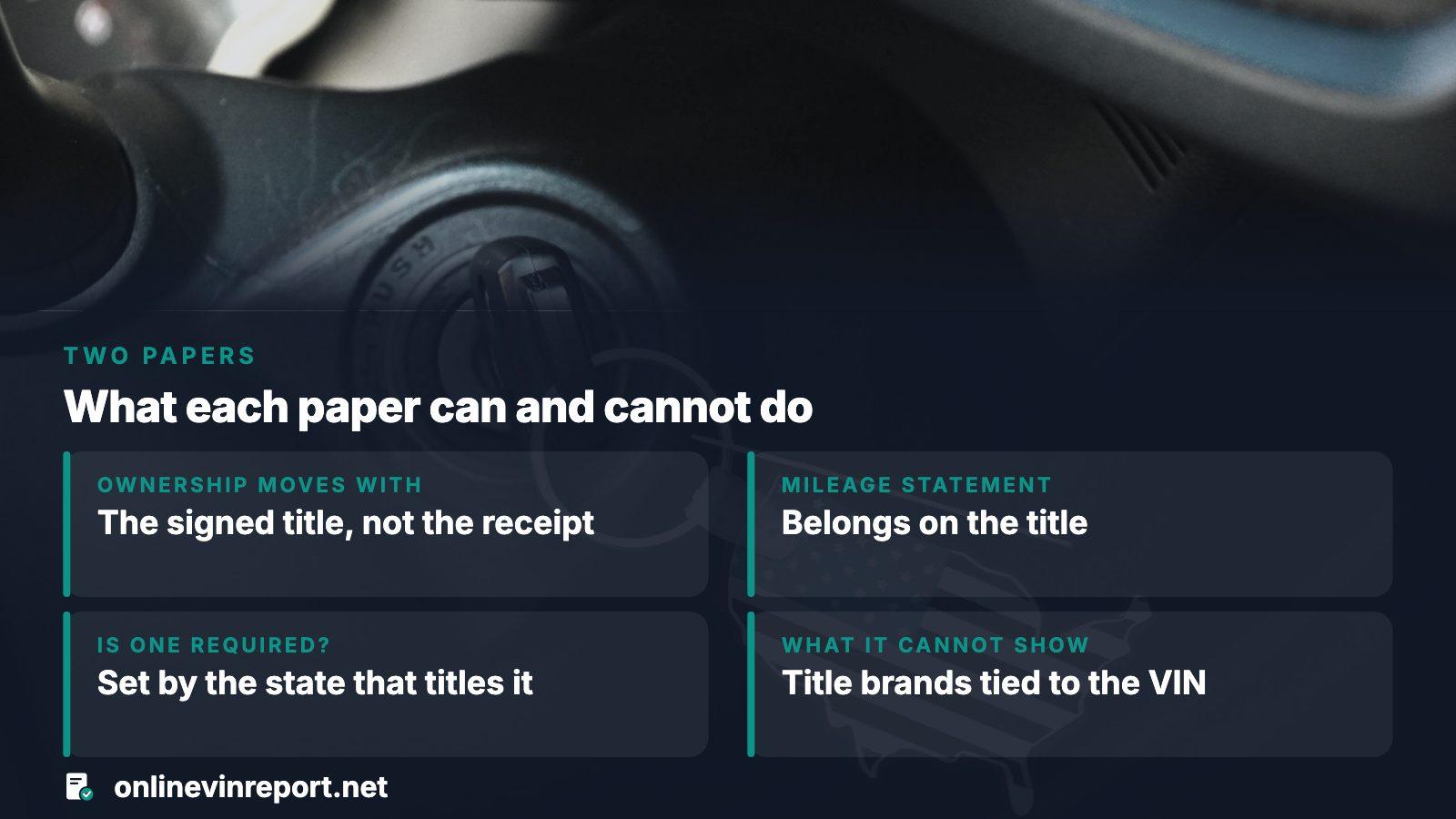
- What moves ownership
- The signed title, not the receipt
- Mileage statement
- Belongs on the title under 49 CFR Part 580
- Is one required?
- Set by the state that will title the car
- What it cannot show
- Title brands, which sit against the VIN
Two papers that do different jobs
At a private sale the two papers travel together, and mixing them up is where buyers get hurt. The title is how the state tracks ownership. The bill of sale is the paper trail the two of you create for a single transaction.
Lose the title and the receipt will not get you registered. Lose the receipt and you still own the car, but proving the price or the promises gets hard. Photograph both before you part ways, and file them together.
Which paper answers which question
Three records matter in a private sale, and each one leaves a blind spot.
| Record | It can answer | It leaves open |
|---|---|---|
| Bill of sale | Who the parties are, which car, what date, what price | Whether the seller really owned the car, loan-free |
| Title, paper or electronic | Who the state lists as owner, plus any brand it added | Anything recorded in other states, by insurers or at salvage yards |
| VIN title check | Brands, salvage entries and auction history recorded against the VIN | How well a repair was done, which needs an inspection |
Only the last one is a search. Because it reads records tied to the VIN rather than to one state's paper, it can contradict a title that looks spotless, and the mismatch is your first question for the seller.
The federal mileage statement belongs on the title
Many buyers believe the odometer line on a template satisfies federal law. Under 49 CFR Part 580 it does not. The titled owner discloses the mileage on the title itself, signs it and prints a name, and the rule specifically rules out a reassignment form for that job. Search the whole regulation and the phrase bill of sale never turns up.
The statement carries five items: the reading without tenths of a mile, the date, a printed name and current address for each side, and the car's identity as VIN plus make, model, year and body type. The seller also vouches that the reading is accurate as far as they know, or flags a problem with it. The buyer countersigns. Copy the mileage onto your receipt too, as an extra record.
Some transfers need no statement at all under section 580.17:
- Anything rated above 16,000 pounds gross vehicle weight
- Trailers and other towed equipment with no engine of their own
- Older cars, judged by the years elapsed since January 1 of their model year: ten for the older group of model years, twenty for the newer group
An older car whose title has no mileage box is following the rule, yet nothing federal vouches for its odometer. State paperwork still applies.
What to put on the page
Keep the content tight and checkable.
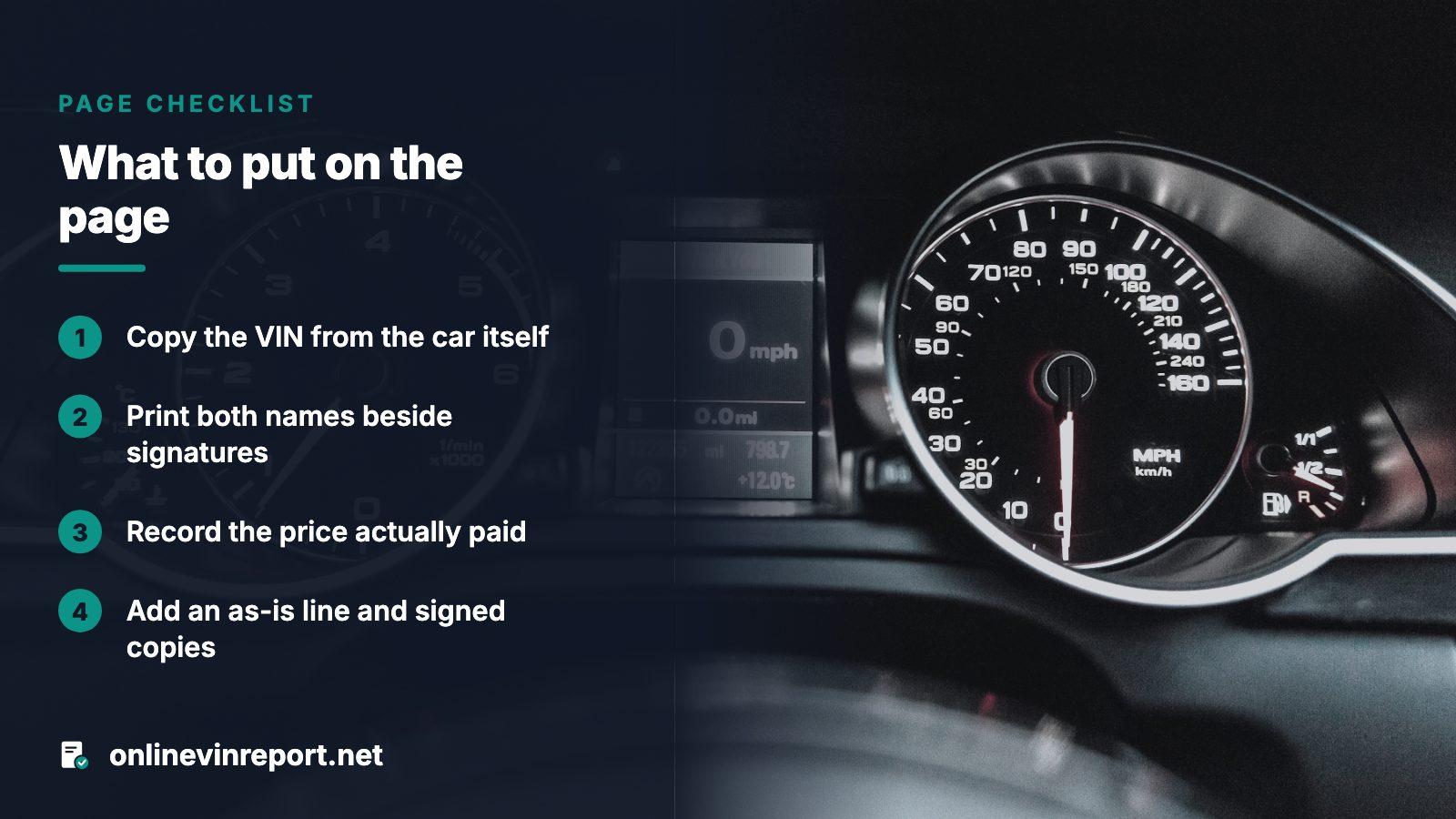
- Take the VIN from the car instead of the advert. Read the number from the dashboard corner by looking down through the windshield, then match it to the sticker inside the driver's door and to the title.
- Names and addresses of both people, printed beside the signatures.
- The sale date and the price actually paid. Understating the price to pay less tax is fraud, and it shrinks what you could claim if the car is not as described.
- The odometer reading, marked as a second record.
- An as-is line, if no warranty was offered.
- The place you signed, if it was away from the seller's home.
- A signed copy for each of you.
Turn the seller's promises into dated statements
An as-is line records that you took the car in the condition you saw and that nobody guaranteed its future. It cannot rescue a false statement. A wrong mileage, or a branded title called clean, was a claim of fact, and a clause about condition does not erase it.
So record the claims, worded as the seller's own. Try "Seller states the title has never carried a salvage, flood, rebuilt or junk brand" or "Seller states no loan is owed on this car." Each line fixes who said what, and when. Your own wording, such as "clean title," asserts what you cannot know first hand.
Then check the claim against the record. A VIN title check does that, and a brand the seller denied turns a spoken answer into evidence before you pay.
Electronic titles and the loan question
Several states hold titles electronically, and Part 580 lets the mileage statement sit inside the electronic record. There may be no paper at the handover: the state's system completes the transfer, sometimes only after a lender releases its interest. Your receipt may then be the sole paper recording when it happened, how much changed hands and who signed, which raises its value without making it enough.
Ask who holds the title
A bill of sale cannot give you clear ownership while a lender has a claim. Ask whether a loan exists, who holds the title and how it will be released. Then see whether the VIN record shows a lien that matches the answer.
Your state decides whether one is required
Only the state that will issue the title sets the rule that applies, and it may not be where you shook hands. Practice falls into a few groups:
- A bill of sale is a condition of processing the transfer.
- It is requested only when the title offers no place to record the price.
- A notary must witness it, though most states do not ask.
- The agency publishes its own form and expects you to use it.
- Nothing is required, though the receipt remains your only proof of price and date.
Use the agency's form when one exists: it holds the fields its clerks check, plus any notary block. That is why this page carries no template.
When a seller balks at signing
A seller who will not sign a plain bill of sale is telling you something. Watch for these:
- No printed name or address, so you cannot tell who is selling.
- A name different from the one on the title, which means a middleman, not the owner.
- A suggestion to leave the price blank or enter a lower figure.
- A VIN missing from the paper or different from the one on the car.
- A receipt offered without a signed title.
A different name and no signed title is the classic curbstoning pattern, an unlicensed dealer staying out of the title chain. Walk away, or run the VIN first and see what the title record says.
After you sign: two clocks and a VIN check
The date on the paper starts two deadlines. A temporary tag covers driving until plates arrive, with a window set by state law, and the title must move into your name inside a separate state window. Satisfying one does not satisfy the other, so start the title transfer immediately.
A VIN title check belongs before you sign, and still helps afterward if you skipped it. OnlineVINReport begins with a no-cost preview of the number. Paying for the complete report is a single event rather than a recurring plan, and prices sit on the pricing page. Add NHTSA's recall lookup, which costs nothing, and NICB VINCheck for theft and salvage records that insurers report.
Where this information comes from
- eCFR: 49 CFR Part 580, odometer disclosure — The federal rule behind the mileage statement: where it goes, what it must contain and which vehicles are exempt.
- NHTSA: recalls lookup — A no-cost search by VIN for open safety recalls, which a manufacturer repairs without charge.
- NHTSA: vPIC VIN decoder — Federal build data for a VIN, useful for holding the title's make, model and year against the car.
- NICB: VINCheck — A lookup of theft and salvage records reported by participating insurers.
Sources and photos: Facts checked against the sources above in November 2026. Photos by Dimitri Karastelev, Ambitious Studio* | Rick Barrett and Jake Kling on Unsplash; diagrams by OnlineVINReport.
Keep reading
- Title jumping: what an online VIN title check can and cannot showWhat a receipt with no signed title behind it leaves you holding.
- What is a branded title? How to read salvage, flood and rebuilt brands by VINWhat salvage, flood, rebuilt and junk brands mean and how a VIN shows them.
- Car title check online: salvage, flood, rebuilt and junk by VINRun the title search that no seller's paperwork can stand in for.
- Temporary tag rules and the title check to run before it expiresHow long you can drive on the sale date before plates arrive.
Frequently asked questions
Does a bill of sale make me the owner of a car?
No. Ownership moves when the seller signs the title over and the state records the new owner. A bill of sale is evidence of the deal. Registration offices want the title, and some states want the receipt too, so hold both.
Does writing the mileage on a bill of sale meet federal odometer rules?
No. Part 580 puts the mileage disclosure on the title, signed by the seller, and never mentions a bill of sale. Write the mileage on your receipt as an extra record, but make sure the seller also completes the title statement.
Do I have to have a bill of sale to buy from a private seller?
Your state decides, meaning the one that will title the car. Some require it for a transfer, some only when the title has nowhere to put the price, and some leave it optional. Ask that state's motor vehicle agency.
When does a bill of sale need a notary?
Only where the state says so, and most states do not ask for it. Where a notary applies, the requirement is usually built into the state's own form, one more reason to use that form.
Will a bill of sale tell me if a car has a salvage title?
No. It only repeats what the seller wrote or said. To see title brands, put the VIN through a title check and hold the result up against the title you have in hand. The preview is free, so you can look before deciding on a full report.
Now check the car itself
The guide explains what to look for. The report shows what this VIN has on record.