THE SHORT ANSWER
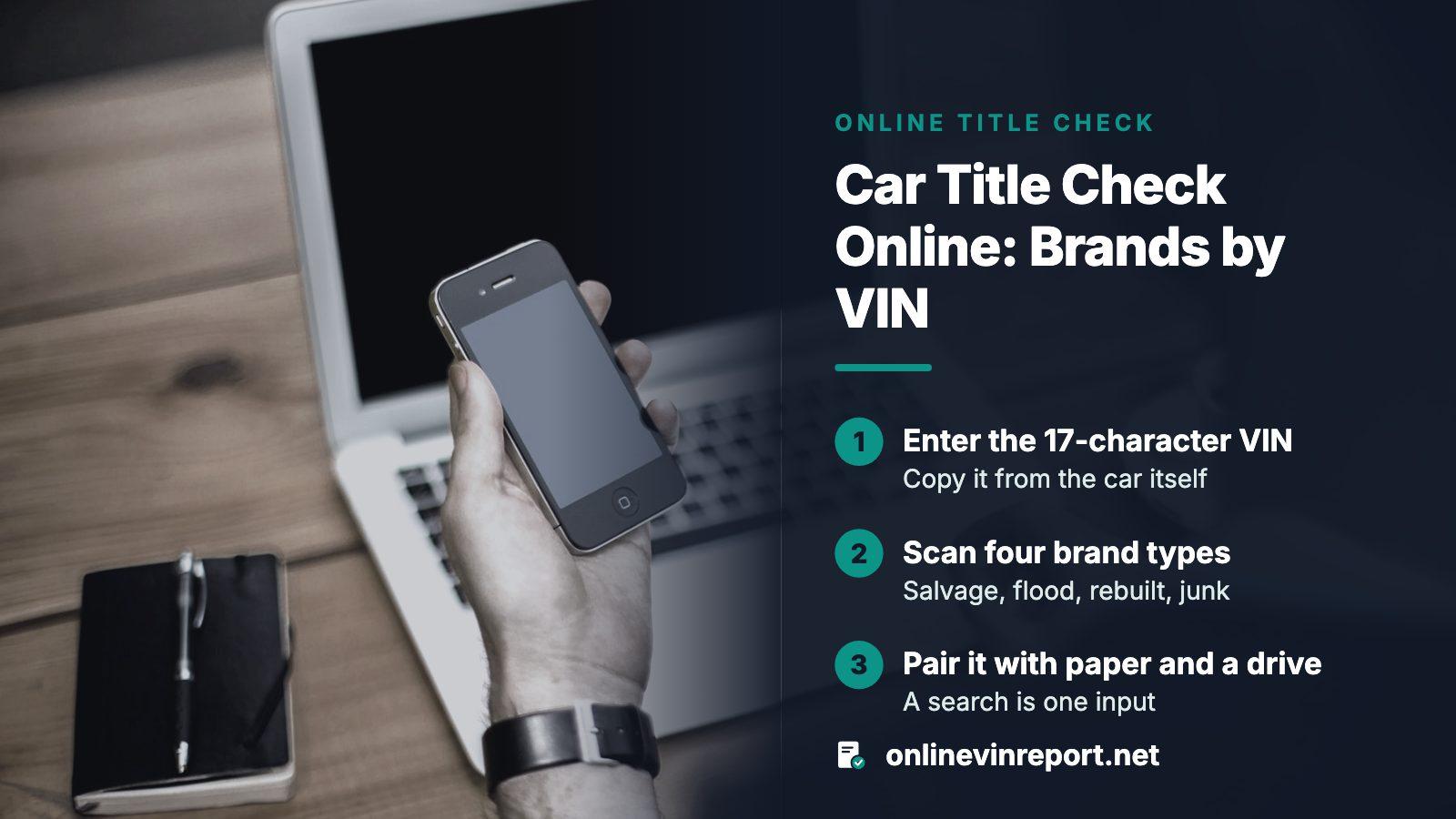
Enter the 17-character VIN and read the title brand section first. A salvage, flood, rebuilt or junk brand means someone already wrote the car off. A total-loss or auction entry beside a clean title means a brand was lost along the way. The paper title and a state status page only show what one state recorded, so the VIN search covers the rest. A clean result still calls for an inspection.
- Brands searched
- Salvage, flood, rebuilt, junk
- What you need
- The 17-character VIN
- Preview
- Free
- Full report
- One payment, no subscription
A title check is three questions, and only one needs a search
The phrase means different things to different buyers. Some want to know if the paper in the seller's hand is real, some want what the state has on file, and most want everything ever recorded against the car. In the US each state titles its own cars, so each question needs its own tool, and a title check website that reads the VIN answers the last one.
| Question | Where the answer lives | What it takes |
|---|---|---|
| Is the document real, and is it this car's? | The paper, plus a decode of its printed VIN | A few minutes in daylight |
| What does the state hold today? | A state title status page, if one exists | Free in some states, absent in others |
| What was recorded in any state, by insurers or at salvage yards? | An online title search by VIN | A free preview, then one report |
The brands a car title search is built to find
A brand is a note a state adds to a title record after something serious happened to the car. The search reads those notes by VIN and puts the state and date beside each. The federal title record, NMVTIS, takes in reports from motor vehicle agencies, insurers and salvage yards, and the Justice Department lists the approved providers that sell access.
- Salvage: the damage was treated as a total loss, and the car stayed off the road until repaired.
- Junk: the car is valued for parts or scrap and is not meant to drive again.
- Rebuilt: a former salvage car was repaired, passed a state inspection and returned to registration.
- Flood: water damage is the recorded cause of the loss.
Wording varies, and two states can describe one event differently, so read the event behind the label.
Running the check online in five steps
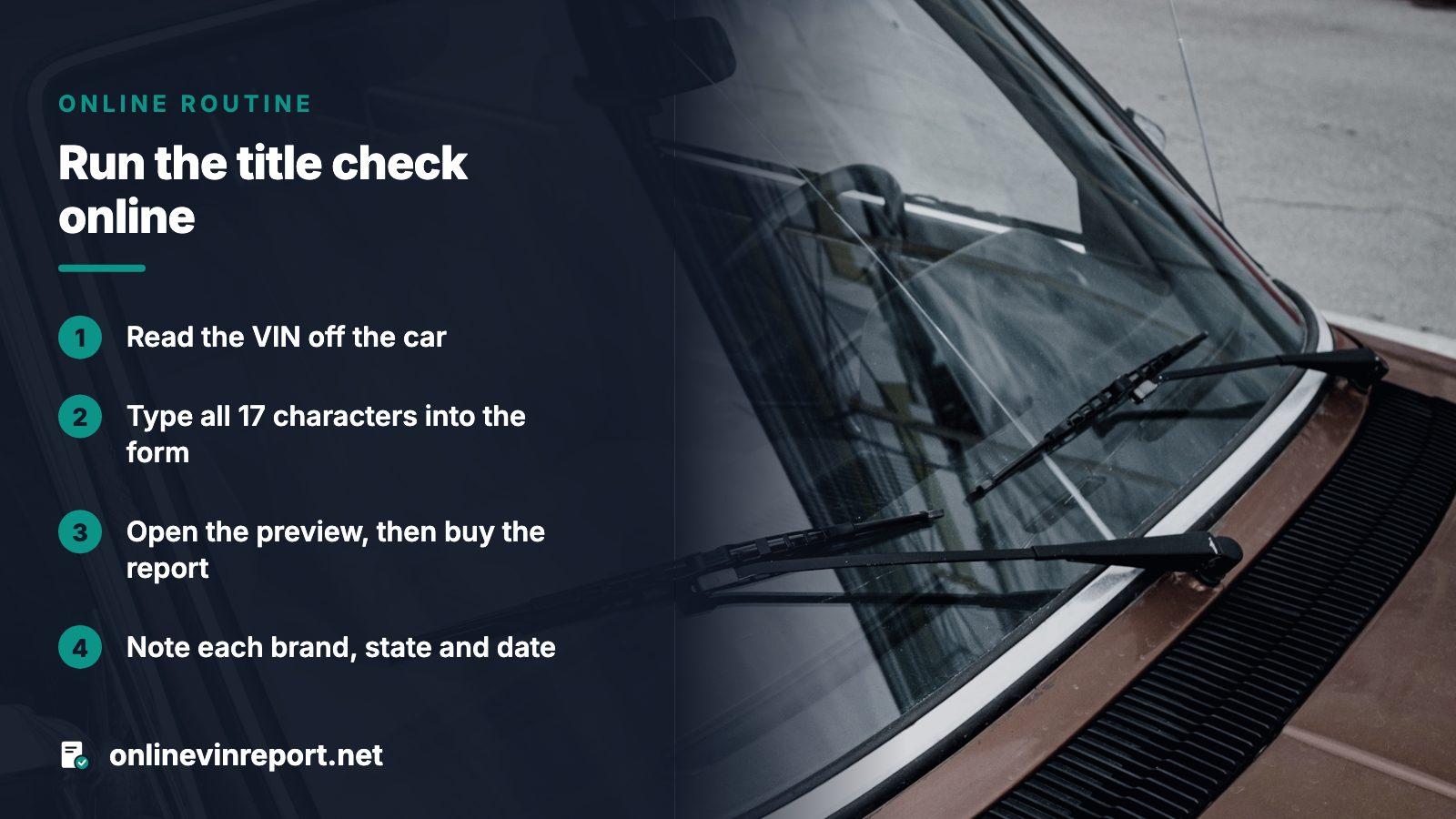
- Read the VIN off the car: through the windshield at the driver's side of the dashboard, and on the label in the door frame. Both should match the number printed on the title. Ignore the number in the advertisement.
- Type all 17 characters into the form on this page. A single wrong character brings up another car or an error.
- Open the preview before spending anything.
- Once the car makes your shortlist, buy the report. Read the title brand section first, then the salvage and auction entries.
- Copy down each brand, state and date, and put them to the seller in writing.
Reading what comes back
Results fall into a few shapes. The second row is the one buyers miss.
| What you see | What it means | Your next move |
|---|---|---|
| A brand with a state and date | The loss is documented | Match the date to the owners and odometer readings, then reprice or pass |
| A total-loss or auction entry beside a clean title | A brand was dropped between states, or never applied | Treat the car as branded and negotiate on that basis |
| A brand from another state, a clean title in the seller's state | The record follows the VIN even when the paper does not | Ask why the title moved |
| A lien or impound entry | Someone besides the seller may hold a claim | Get a payoff letter before money moves |
| Nothing on record | No state, insurer or yard filed anything | Encouraging, so inspect the car |
What the paper title still tells you that no search can
A search describes the car's record, not the document in front of you. Federal rules in 49 CFR Part 580 require a physical title to come from a secure process that makes copying hard and lets changes be seen by a person looking. The rule also puts make, model, year, body type and VIN on the title, and a VIN decode returns four of those five.
- Tilt the paper against a light. A hologram shifts with the angle.
- Hold it to a window. Security paper has a watermark or a thread inside the fiber.
- Check the laminate over the mileage, names and VIN. It should lie flat and unbroken.
A photo is not the title
A scan or phone picture of a paper title is only an image of one, and security features do not survive a camera. Read the VIN from it and search that, then inspect the real document before you pay.
If the seller cannot put the title in your hand
A missing title is not always a bad sign. Federal rules accept four situations in which a seller may use a power of attorney to sign the odometer statement.
- A lender is holding the paper title.
- The paper title was lost.
- The electronic title sits under a lender's control.
- The state's electronic system cannot produce it.
The seller should name the one that applies and prove it, ideally with a payoff letter. A lien follows the car to the next owner, not the seller. A lost title should be replaced by the state before the sale. A seller who never held the title personally is a separate problem, usually called title jumping, and it stops registration.
Why a clean result is encouraging, not final
A title carries the brand its state applied on the day it was issued. It misses a crash repaired without a claim, a flood in a state whose brand rules the car did not meet, and a loss an insurer settled without calling the car a total. It also cannot show a brand that another state recorded and this one never carried over, which is how title washing works.
A search reports filings, not events
If damage never led to a claim, a state filing or a salvage sale, there is no record to find.
Add NICB's VINCheck, a free screen of theft and total-loss data from participating insurers, and NHTSA's recall lookup, also free. Then pay a mechanic to look at the car.
What the report adds to the preview
The preview is free, which lets you test a VIN before deciding. One payment buys a report, with no subscription involved, and packs of 3, 5 and 10 exist for comparing several cars. The pricing page has the options. A report contains:
- Title brands with state and date, plus accident and damage entries
- Odometer history and insurance records
- Salvage and auction sales, with photos
- Liens, impounds and theft
- Open recalls, owner count, use type, market value and factory specs
If a brand shows up: reprice, verify or walk
A brand changes the price and the paperwork, and it does not always end the deal. Before a deposit, read your insurer the VIN and ask whether it will cover the car and on what terms.
- Salvage or rebuilt: ask for repair invoices, photos from before the repair and the state inspection record, then pay for an independent structural inspection.
- Flood: leave. Corrosion keeps working in wiring and modules, and no discount covers a fault that has not appeared yet.
- Junk: not a car to buy as transport.
- Odometer warning: a seller can certify the reading as actual, as past the odometer's mechanical limit, or as not the actual mileage. The last two are warnings, so price from service records instead of the dash.
Where this information comes from
- eCFR: 49 CFR Part 580, odometer disclosure and title security — The federal rule behind secure title printing, electronic title records and the power of attorney conditions.
- eCFR: 49 CFR 580.5, disclosure of odometer information — Lists the vehicle identity fields on a title and the three odometer certifications a seller can make.
- NMVTIS: National Motor Vehicle Title Information System — The Justice Department page listing the approved providers that sell reports using federal title data.
- NHTSA: vPIC VIN decoder — The federal decoder that returns make, model, year and body type from the VIN printed on a title.
- NICB: VINCheck — A screen of insurer-reported theft and total-loss records to run beside a title search.
Sources and photos: Facts checked against the sources above in November 2026. Photos by Alejandro Escamilla, Max Tokarev and Carrie Allen www.carrieallen.com on Unsplash; diagrams by OnlineVINReport.
Keep reading
- Salvage title VIN check: run it online before you payThe narrower search when your worry is a write-off, with a look at how states differ.
- What is a branded title? How to read salvage, flood and rebuilt brands by VINWhat each brand means and how it changes value, insurance and lending.
- Title washing: how a brand vanishes and what a VIN title check can showHow a brand disappears between states and how to catch the gap.
- PricingReport options, pack sizes and the one-time payment.
Frequently asked questions
How do I do a car title check online?
Take the VIN from the dashboard corner or the door frame, type all 17 characters into the search form and open the preview. When the car makes your shortlist, buy the report and read the brand section first. Then compare each brand, state and date with the seller's story.
Is there a free car title check?
The preview here is free, and so are NICB's VINCheck, NHTSA's recall lookup and the status pages some states publish. Each shows only part of the picture. The full report, with brands, salvage and auction entries and liens, is one paid purchase.
Will a title check reveal a flooded or wrecked car?
It shows the ones that left a record: a brand, a total-loss declaration, an insurance entry or a salvage auction sale. A privately repaired crash, or water damage that never reached an insurer, leaves nothing to find. A clean result means inspect next.
Is a photo of the title enough?
No. Under the federal definition a scanned paper title is still just an image of a physical document, and watermarks, holograms and laminate do not come through a camera. Read the VIN from the photo, then examine the original in person before any money changes hands.
What if a lender still holds the title?
That is one of four situations federal rules accept, and it can be checked. Ask for a payoff letter naming the lender and the amount. The lien must be cleared before the title is released and it follows the car, so never pay without that letter.
Now check the car itself
The guide explains what to look for. The report shows what this VIN has on record.