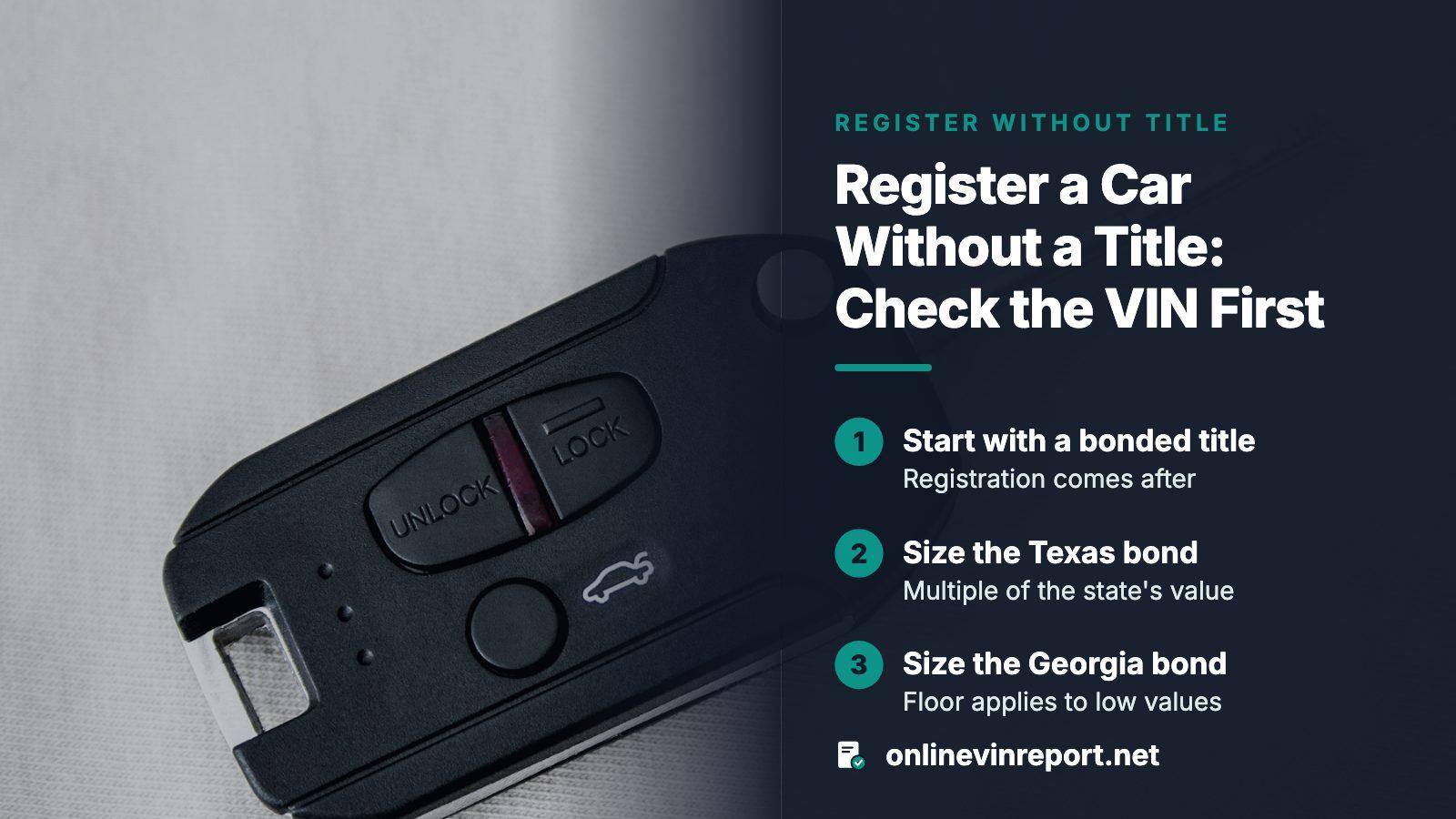
THE SHORT ANSWER
Not directly. Registration follows the title, so a car with no usable paper must be titled first. Most states allow that through a bonded title, backed by a surety bond. The state looks up the VIN first, and a stolen record, a recent lien, or a junk or nonrepairable record can end the application. A salvage or flood brand carries onto the new title.
- Usual fix
- A bonded title, then registration
- Texas bond size
- 1.5 times the value the state sets
- Georgia bond size
- 2 times average retail, never under $5,000
- Brands on the record
- They carry onto the new title
Registration is the last step, not the first
Registration is permission to drive a car on public roads. A state gives it to the person its records list as owner, and the title is where that entry lives. Take the title out and there is nothing to attach a plate to. In Texas, one county application at the very end covers title and registration together, and the steps before it prove the car can be titled at all. Your VIN record is part of that proof.
Four kinds of missing paper, and only one needs a bond
Work out which of these you are in before pricing a bond, because three have cheaper exits. If the car is already yours on paper, one call to the titling agency costs nothing.
| What happened | Where it leads |
|---|---|
| You are the owner on record and the paper is lost | A replacement certificate from the issuing state, with no bond |
| The seller is the owner on record and never mailed it | A dispute with the seller, settled before any state filing |
| The title names a stranger, and the seller appears nowhere on it | Title jumping, a gap in the ownership chain that a bond cannot close |
| No title exists that anyone can produce | A bonded title, or your state's equivalent procedure |
What a bonded title is and who it protects
A bonded title is the regular certificate the state always prints, with one addition: a surety bond filed alongside it. You buy the bond, an insurer stands behind it, and the state is its beneficiary. If an earlier owner, an heir or a lender turns up and wins a claim to the car, that person collects from the bond, not from the state.
The bond amount is the cover, not your cost. You pay a premium, a slice of that amount set by your credit, and a very small bond can carry a minimum premium that inflates the slice. Ask the state for its determination first, then shop for the bond.
Texas and Georgia: one instrument, different rules
Neighboring states use the same legal tool and share almost none of the details, so read your own state's page.
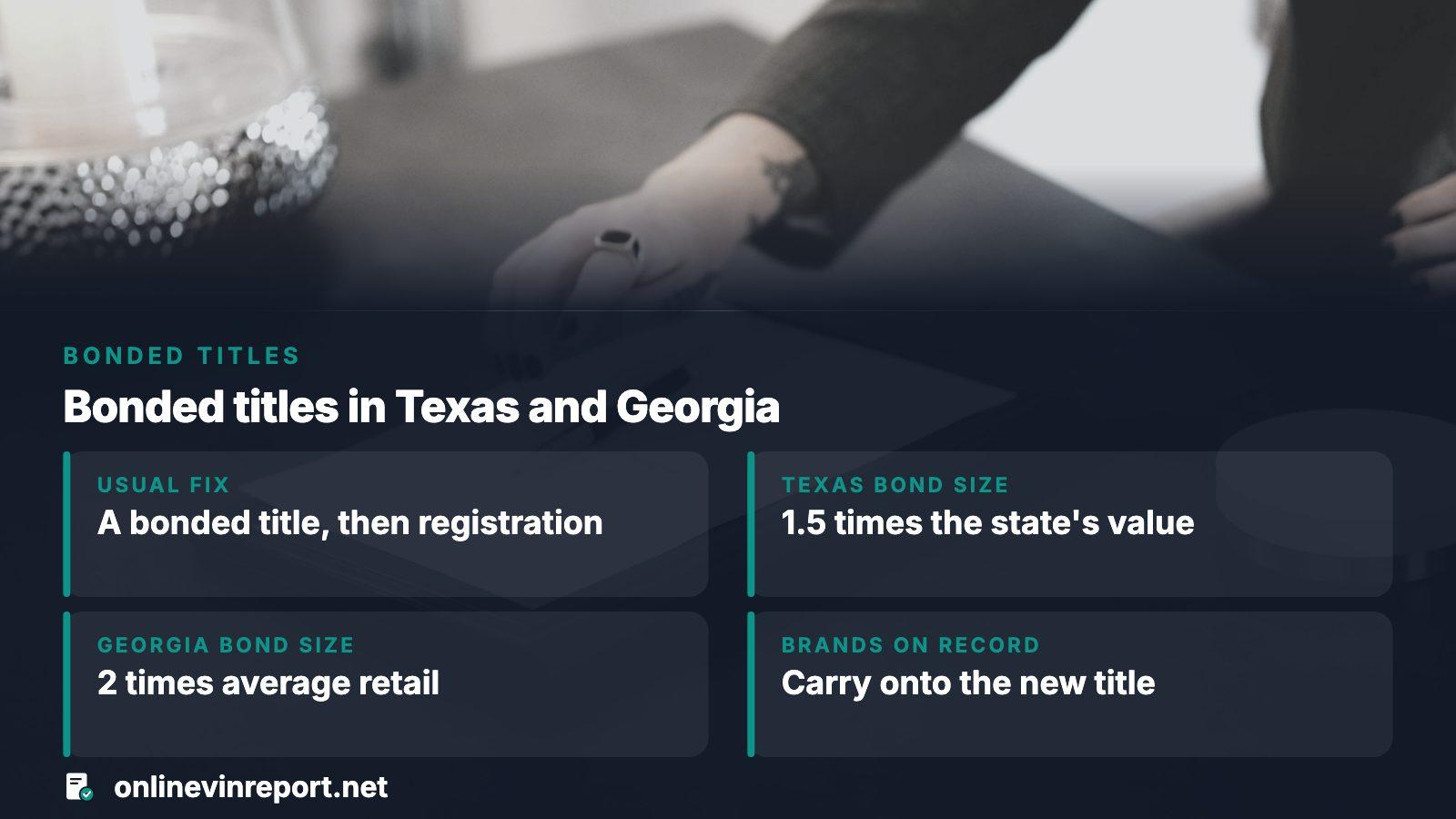
| Point | Texas | Georgia |
|---|---|---|
| Who can apply | Texas residents, or military personnel stationed there | Legal residents of Georgia |
| Bond size | 1.5 times the value the department sets | 2 times average retail value, never under $5,000 |
| First stop | A regional service center, $15 fee, then the county tax office | A county tag office, with an $18 title fee |
| Deadlines | One year to buy the bond after the notice, then 30 days to file | Six months from the bond's issue date |
| Vehicle limits | Complete car, not junked or nonrepairable | Nothing from model year 1985 or earlier, no abandoned vehicles |
What the state looks up on your VIN before it issues a title
Texas shows its hand on page two of the bonded title application, in a box for department use. A representative records a search of the state's own systems and whether a Texas record exists. If none does, the box adds a stolen-vehicle search and an insurance claims search. Next comes the national title system, then checkboxes for the brands it returns: salvage, flood, junk, replica, reconstructed, rebuilt salvage, a manufacturer buyback or mileage marked not actual.
Federal rules push every state toward the same lookup. Before titling a car someone says was bought in another state, the state must send the VIN through the national system, which returns the title's validity and status, any junk or salvage history, and whether the odometer data fits.
Georgia hands that lookup to you. The application must include a national title report, or an equivalent source the department authorizes, plus a certified history from the issuing state when the record shows an out-of-state title.
A salvage or flood brand rides onto the new title
A bond fills a gap in your proof of ownership, not in the car's history. States send each title's brands to the national system every 24 hours, so a brand recorded years ago is what a new bonded title inherits.
Federal rules draw the lines. A junk automobile can no longer run on public roads and is worth nothing but its parts or scrap. A salvage automobile is one where the repair bill plus salvage value would top the car's market value from the moment before the event, and an insurer's total loss ruling qualifies as well.
Junk and nonrepairable cars are dead ends
Texas lists junked and nonrepairable vehicles as ineligible for a bonded title, and its application asks outright whether the car is nonrepairable or salvage. A repaired salvage car can be titled there, but Form VTR-61, the rebuilt vehicle statement, joins the file. A branded car means a longer file, and the brand stays visible to the next buyer.
Other records that stop a bonded title
Brands are one blocker among several. The two states put these others in writing.
- A lender's interest recorded in the past 10 years. Texas wants a signed original release or a no-interest letter from the lender, and otherwise points owners toward a court order.
- A lien found in the title history. Georgia requires Form T-4, a satisfaction notice or lienholder affidavit, whenever the history shows a security interest.
- A theft flag or an unverified number. A car never titled in Texas must pass a VIN inspection by law enforcement, and the applicant certifies the VIN was checked on the car itself.
- An incomplete car. Texas needs a body, frame and motor, though the car does not have to run.
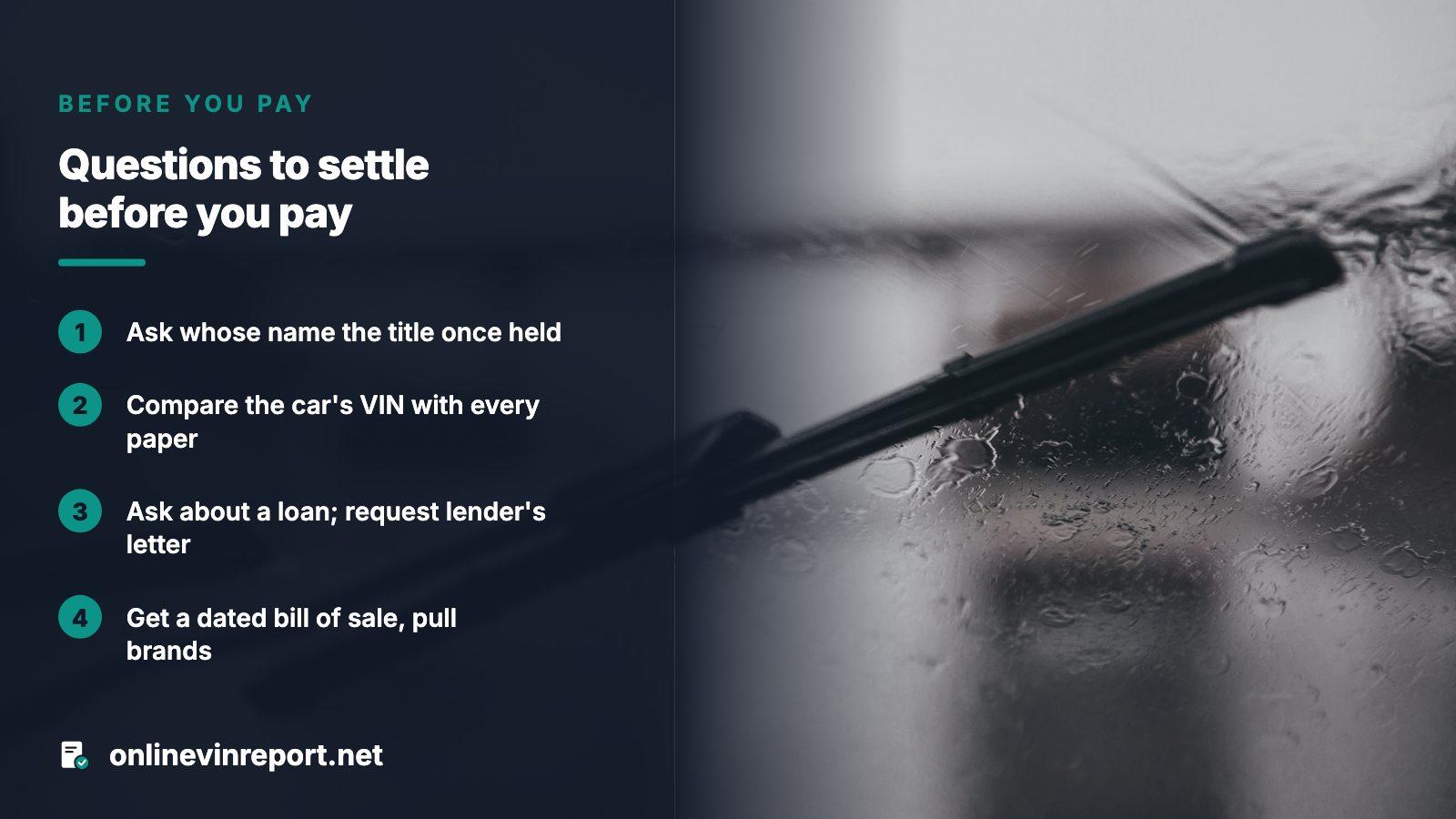
Questions to settle with the seller before you pay
Most bonded title trouble is visible before the sale, if someone asks in the right order.
- Ask whether the title was ever in the seller's name, and whose name it sat in before.
- Read the VIN off the car itself and compare it with every document you are handed.
- Ask whether a loan was ever taken on the car, and request the lender's written release if so.
- Get a dated bill of sale and keep proof of payment, since Texas accepts either as ownership evidence.
- Pull the VIN's title brands and settle on a price only after reading them.
Run the title check while you can still walk away
The record the clerk reads is open to you at the start. An online VIN title check returns the brands recorded against the number, each with a state and date, alongside salvage and auction entries with photos, any lien, theft flags and odometer readings. Hold those entries against the seller's story. A brand nobody mentioned is your answer.
Start with the preview on OnlineVINReport, which costs nothing. You pay once for the full report, and the pricing page lists the options.
No lookup replaces a mechanic. The Justice Department's page on the national report names five items: the state holding the title and the date it last changed, any brands, the newest odometer figure, total loss records and salvage records. Repair history is not in it, and the page urges an independent inspection too. The FTC adds that the National Insurance Crime Bureau's free lookup only catches cars that were insured when damaged.
Where this information comes from
- TxDMV: Bought a vehicle without a title — Texas eligibility, the bond multiple, the filing windows and the VIN inspection rule.
- TxDMV: Form VTR-130-SOF, Bonded Title Application — The application questions and the department-use box of VIN lookups and brand checkboxes.
- Georgia Department of Revenue: Bonded vehicle title — Georgia's eligibility limits, bond rules, required national title report and filing window.
- eCFR: 28 CFR 25.54, responsibilities of the states — Daily brand reporting and the verification check before a title issues on an out-of-state purchase.
- eCFR: 28 CFR 25.52, definitions — The federal meanings of junk automobile, salvage automobile and total loss.
- US Department of Justice: Understanding an NMVTIS vehicle history report — The five items the national report covers and the advice to add an inspection.
- FTC: How to steer clear of a flood-damaged car — What the insurer-backed flood and salvage lookup does and does not catch.
Sources and photos: Facts checked against the sources above in November 2026. Photos by Shadow Photography, Thibault Valjevac and Annika Wischnewsky on Unsplash; diagrams by OnlineVINReport.
Keep reading
- Duplicate title: what it means and how to check the car by VINWhen the title exists in your name and only needs replacing.
- Title jumping: what an online VIN title check can and cannot showThe broken ownership chain that a bond cannot repair.
- What is a branded title? How to read salvage, flood and rebuilt brands by VINWhat each brand on the record means for the car.
- Car title check online: salvage, flood, rebuilt and junk by VINRunning the brand search by VIN before you buy.
Frequently asked questions
Can you register a car when there is no title at all?
Not on its own. A state registers a car it has already titled, so the real task is getting a title in your name. If the seller has no paper, ask your state titling agency about a bonded title or its equivalent before buying any bond.
Will the state check my VIN before it issues a bonded title?
Yes. Texas lists searches of its own records, a stolen-vehicle search and the national title system on its application, and federal rules require a national verification before a state titles a car bought elsewhere.
Will a bonded title wipe out a salvage or flood brand?
No. The bond answers claims about ownership. A brand such as salvage or flood is reported by the state and shows on the resulting title, and Texas adds a form for repaired salvage cars.
Can a junk or nonrepairable car get a bonded title?
Not in Texas, where the state page lists both as ineligible. Check your own state's rule before paying a seller anything. Federal rules define a junk automobile as one that can no longer run on public roads and has value only as scrap or parts.
Is a VIN check enough when the seller has no title?
No. The record shows what the state would find, but it cannot prove the seller owns the car. It does not replace a bill of sale, a lender's release or a mechanic's inspection, and the national report omits repair history.
Now check the car itself
The guide explains what to look for. The report shows what this VIN has on record.