THE SHORT ANSWER
A temporary tag is a short-term driving permit for a recently bought vehicle. No federal rule defines it: states set the length and who qualifies, and some bar salvage or nonrepairable vehicles from certain permits. The tag's end date is separate from the deadline to put the title in your name. Reading the title brands and odometer data by VIN during the tag period gives you time to act on what you find.
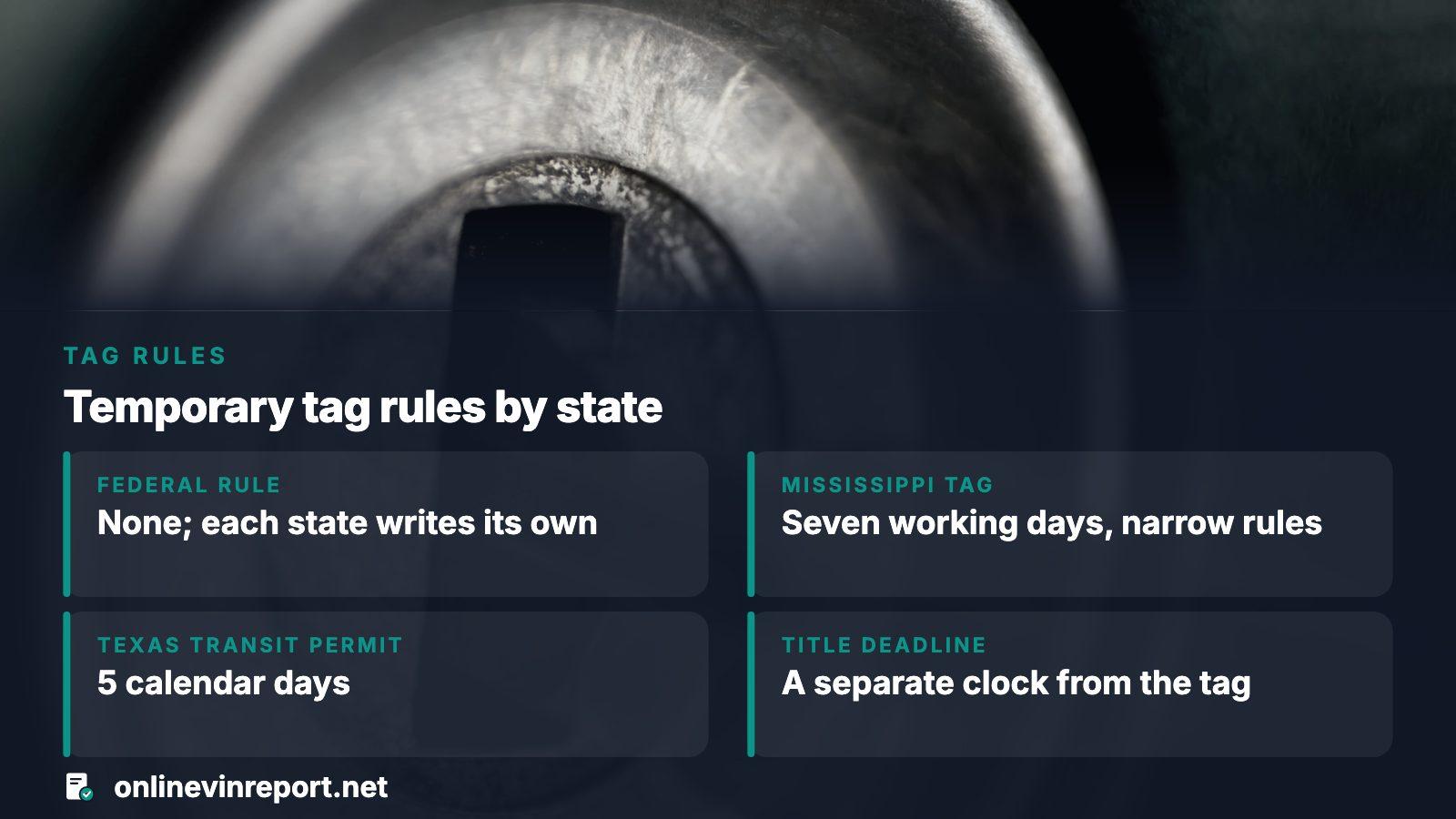
- Federal rule
- None; each state writes its own
- Mississippi tag
- Seven working days, narrow eligibility
- Texas transit permit
- 5 calendar days, not for salvage titles
- Title deadline
- A separate clock from the tag
A tag permits driving; the title records what the car is
The tag is a stopgap permit that keeps a freshly bought car legal on the road. The title is the ownership record, and it is where a state notes whether the car was ever a total loss, flooded, rebuilt or junked.
Nothing on a paper tag reveals a salvage brand, and no federal text defines the tag: a search of the Code of Federal Regulations finds no hits for temporary tag or temporary license plate, and none for temporary registration within Title 49. The governing rule is whatever the registering state wrote.
Two clocks start the moment you pay
The date on the tag is one deadline. A second one, usually longer, sets how long you have to file the title in your name before late penalties start. A valid tag does nothing for the second.
| Clock | What it limits | What a miss costs |
|---|---|---|
| Tag window | Time the car may be driven before plates are fitted | Driving unregistered, which can be cited |
| Title filing deadline | Time allowed to get the title into your name | Late fees; in some states, tax penalties too |
Starting the title work only when the tag nears its end is the common slip, and a surprise in the title record then leaves little time.
Mississippi's seven working days apply to a narrow set of sales
Mississippi's rule shows how many conditions hide behind one number. The tag lasts seven full working days, excluding the purchase date, with no extension. It covers sales by a dealer or an auction to nonresidents, and to residents who may drive out of state before they have a Mississippi plate. Dealers may not drive their own inventory on one, and the tags are bought ten at a time. Quote the number without those conditions and it becomes a grace period the state never gave anybody.
Texas: five permits, and several turn away branded cars
Texas splits the idea into separate products, summarized below from the state motor vehicle department's own page.
| Permit | Length and limits | Where a brand matters |
|---|---|---|
| Vehicle Transit Permit | 5 calendar days from printing, no fee, one trip | Salvage and nonrepairable vehicles excluded |
| One-Trip Plate | 15 calendar days; one trip with an endpoint inside Texas | Junk, salvage and nonrepairable vehicles excluded |
| 30-Day Plate | 30 calendar days, may be bought up to 60 days early, needs Form VTR-66 | Salvage and nonrepairable titles excluded |
| 72-Hour and 144-Hour | Commercial permits for laden trucks, trailers and buses | Salvage and nonrepairable vehicles excluded too |
Read the last column twice. Someone who collects a salvage-titled car from a private seller and counts on the five-day permit to reach the county office has chosen a permit the state says it will not issue for that car. The title, not the seller's description, decides which permits exist.
Rebuilt cars: the tag is often just a ride to an exam
New York shows the other side of the same coin. Rebuilt salvage cars face a state examination before they can be retitled and registered, and the state says the exam should not be mistaken for a safety, emissions or insurance inspection. To get the car there, an owner can obtain a temporary transport permit with a safety inspection receipt and a New York insurance ID card; towing or a flatbed also works. Rebuilt cars titled there after May 18, 1999 show the wording REBUILT SALVAGE, and the new title arrives by mail roughly 3 to 5 weeks after a pass. With that past, the permit is one step in a longer process.
Brand first, tag second
Where permits are restricted for salvage vehicles, finding the brand after you have paid can strand a car you meant to drive home. Read the title record before the money moves.
What an online title check can show during the tag window
A VIN title search reads the federal title information system, which gathers state titling data plus insurer and salvage yard reports. One state motor vehicle agency describes its consumer reports this way:
- Current title details and brand history, with labels such as junk, salvage and flood
- The latest odometer reading on file
- An insurer's salvage or total-loss determination
- A note that the car was handed to a recycler or a junk or salvage yard
- Theft data, but only in some cases
The same agency adds a limit: a brand can drop off when a car is titled in a state that never consulted earlier states' records, so a clean result is encouraging, not final. Read the record beside the paper you were handed, and put any mismatch to the seller.
Setting the paper in your hands against the record
- Read the 17-character VIN off the dashboard plate, then match it to the door-frame label and the title. A mismatch means pausing the purchase until the seller accounts for it.
- Compare the brand wording on the title with the record. A clean paper title next to a record showing salvage or flood is the mismatch that matters most.
- Confirm the name on the title belongs to whoever is handing you the keys. A private sale gives nothing at the counter to force that question.
- Match the mileage on the transfer paperwork to the latest reading on the record, and write down the figure at the moment of sale.
- Get the insurer to attach the policy to the VIN before you drive off.
A tag with no signed title behind it has the documents in the wrong order, because the title is what transfers ownership. Dates missing from the tag, or written in by hand, deserve the same doubt. A dealer's tag should trace back to a licensed dealer you can look up through the state; a private seller has none to give, so an offer to supply one is a signal.

When the tag lapses before the plates arrive
Backlogs happen, and a slow agency is still your problem: a lapsed tag leaves the car unregistered, and an insurer looking at a claim may ask whether it was legal on the road. Ask the issuing agency about options while the tag is still valid, since a second tag is easier to get before the first expires.
If the dealer is the holdup, put your questions in writing and save the replies, so the dates speak for you. Ask the agency whether the title record itself is holding the application, because a brand found late changes what it can issue.
Where a VIN report fits around the tag
Run the VIN before you pay if you can, and in the first days afterwards if you could not. Start with the preview, which costs nothing and tells you whether records exist for the car. If the car stays a contender, the report is bought once, and packs suit anyone weighing several cars; the pricing page lays out the options. The useful parts here are title brands, odometer readings and any salvage or auction entries with photos.
Where this information comes from
- TxDMV: temporary registration and permits — The Texas permits, their lengths and requirements, and the vehicles each one excludes.
- NY DMV: about salvage vehicle examination — The exam a rebuilt salvage car needs before title and registration, and the permit for driving it there.
- 35 Miss. Code R. 7-04-03-101 — Mississippi's temporary tag rule: who may use one, its length, no extension and the dealer limit.
- Vermont DMV: NMVTIS — What a federal title-system report shows and how brand washing limits it.
- eCFR: Code of Federal Regulations search — Where the phrase searches behind the point that no federal rule defines a temporary tag were run.
- Justice Department: NMVTIS — The federal title database's purpose and the list of approved report providers.
Sources and photos: Facts checked against the sources above in November 2026. Photos by Maurice Sahl, Tigran Shishmanyan and Derek Nelson on Unsplash; diagrams by OnlineVINReport.
Keep reading
- How to transfer a car title: documents, fees and the VIN check firstThe second clock: what filing the title in your name involves.
- What is a branded title? How to read salvage, flood and rebuilt brands by VINWhat salvage, flood, rebuilt and junk brands mean for the car you just bought.
- Car title check online: salvage, flood, rebuilt and junk by VINHow to run a title search by VIN and read the brand section.
- Title jumping: what an online VIN title check can and cannot showWhat it means when you get a tag and keys but the seller never held the title.
Frequently asked questions
How many days does a temporary tag last?
It depends on the state and the permit. Mississippi counts seven working days, while Texas lists 5, 15 and 30 calendar days across different permits. Working days stretch over weekends and calendar days do not, and some states start the count at the sale while others start at issue. Ask the agency for the start date as well as the length.
Can a salvage or rebuilt car get a temporary tag?
Sometimes, but rarely on a clean car's terms. Texas excludes salvage and nonrepairable vehicles from several permits, and New York's transport permit mainly gets a rebuilt car to its exam. Ask the agency before paying, and read the brand by VIN so you know which rules apply.
Does a temporary tag prove ownership?
No. Ownership moves with the title, and a tag can be attached to a car whose title was never signed over to the driver. A seller who offers a tag but stays vague about the title is a warning sign. Keep the bill of sale and the signed title together until permanent registration arrives.
Does the tag deadline also cover the title transfer?
No. They come from different provisions and rarely match. Mississippi's seven working days describes the life of a tag only, so it should never be quoted as a title deadline. Missing the title deadline can bring late fees even while the tag is still valid.
Can I run a title check after buying the car?
Yes, and sooner is better. A check run while the tag is valid and the title is still in progress gives you more room to raise a brand or odometer mismatch with the seller, the dealer or the state office, and the findings are easier to act on.
Now check the car itself
The guide explains what to look for. The report shows what this VIN has on record.