
THE SHORT ANSWER
A title transfer is the recorded change of ownership. The seller signs the title and enters the odometer reading, the buyer files it with the DMV or county office, pays tax and fees, and the state mails a new title. Deadlines run from 10 days in California to 30 days in Texas. Fees differ by state, so confirm yours, and run the VIN first to see any brands.
- Buyer deadline
- 30 days in Texas, 10 days in California
- California transfer fee
- $15, plus a value-based surcharge
- Texas tax on a private sale
- 6.25% of price or estimated value
- VIN preview
- Free, then one payment for the report
What a title transfer is, and what it is not
The title is the document a state keeps as proof of who owns a car. Transferring it moves that record from the seller's name to the buyer's, and two things must happen: the seller signs the paper over, and the buyer files it so the state can print a fresh certificate.
Keys, a handshake and a bill of sale do none of that. They prove a deal took place, but the state keeps listing the old owner until the buyer files. California shows the gap: a seller who reports the sale is still on the record afterward, and only the buyer's own application removes that name.
The title transfer document and its companions
Most people asking about the title transfer document mean the title itself, with its spaces for the seller's signature, the buyer's name and the mileage. Other papers travel with it.
| Paper | Who supplies it | What it does |
|---|---|---|
| Signed, dated title | Seller | Hands over ownership and carries the mileage statement |
| State application (Form 130-U in Texas) | Buyer and seller | Asks for the new title and records the sales price |
| Lien release | Seller or the lender | Shows any loan on the car has been settled |
| Bill of sale | Either party | Records price, date and names; California offers form REG 135 |
| Power of attorney | Whoever signs for an owner | Lets another person sign where the owner cannot attend |
Names change by state, so match the list against your own DMV's page. Never accept a title with blank buyer fields that the seller promises to complete later.
How to do a title transfer as the buyer
- Look up the VIN's brand history first, while you can still walk away.
- Confirm that the VIN on the paper is the one on the car, and that the seller's ID shows the owner's name.
- Watch the seller sign, print their name and write the odometer reading and date in the right spaces.
- Sign the buyer's side of the mileage statement and photograph the finished page.
- Collect the lender's release if a loan was ever attached to the car.
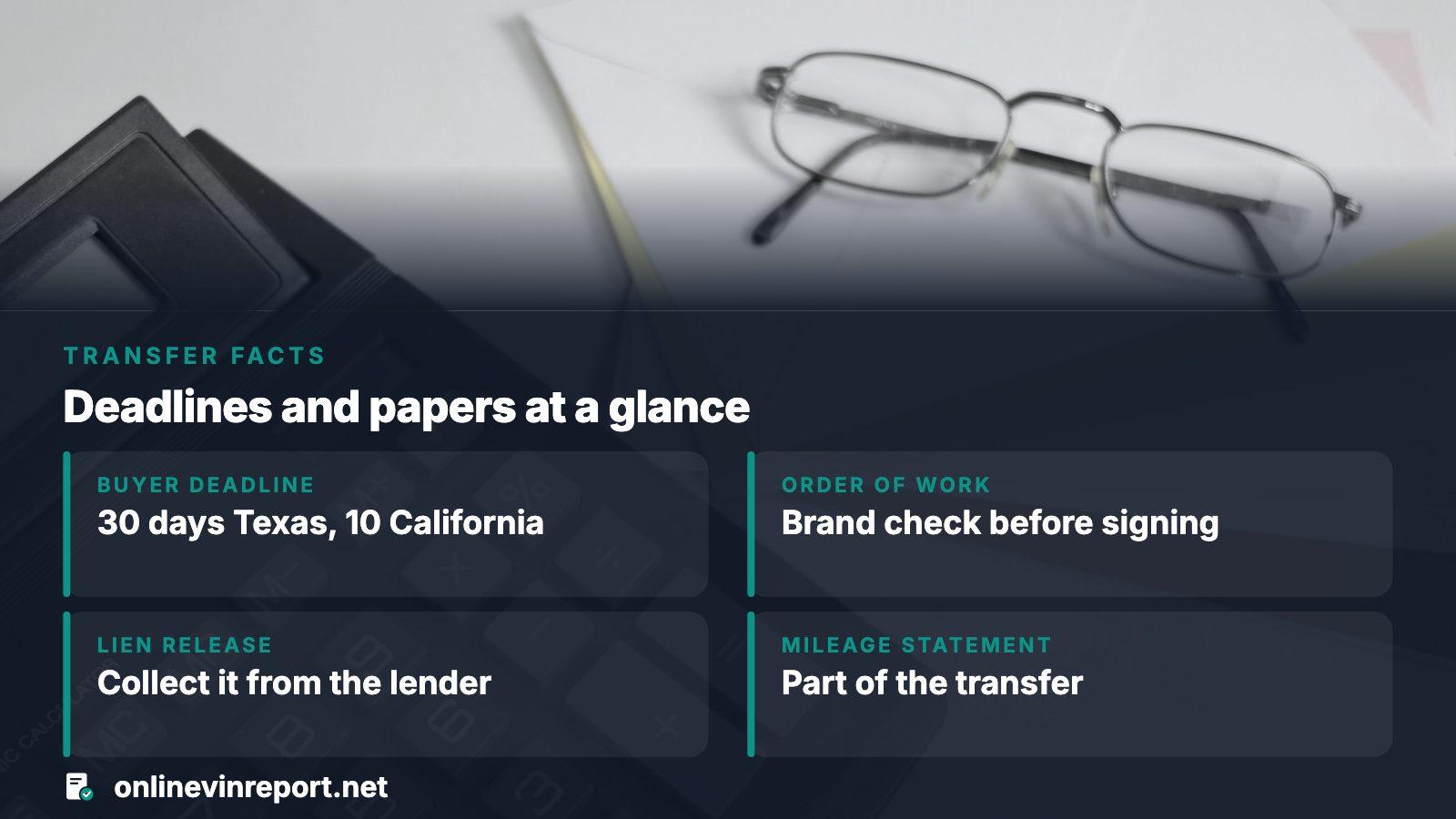
- File inside your state's window: 30 days in Texas, 10 days in California. Texas also wants proof of liability insurance, or a title-only application.
- Pay the tax and fees, then wait. Texas says to allow at least 20 business days, and California usually mails within 15 to 30 days.

Read the title brands before anyone signs
Most guides stop at paperwork, yet a transfer hands you the car's past too. A brand that a state applies lingers in the national title record, and a move across state lines does not wipe it. A paper title can still look clean, since a brand may drop off when a state retitles a car without asking earlier states.
| Brand on the VIN record | Meaning in Texas's glossary |
|---|---|
| Salvage | Repair costs passed the share of retail value set by the jurisdiction; the car can be rebuilt |
| Rebuilt | A former salvage car that has passed its inspections |
| Junk | Unsafe on roads and never eligible for a title or registration |
| Water damage | Damage from flood water alone |
| Odometer | The mileage on record is reported as not true |
An online title check reads the VIN and returns these brands with the reporting state and dates, along with salvage and auction entries that carry photos. Run the preview before you settle on a price. The preview costs nothing. If you go on to the full report, you pay once, and the pricing page shows the choices.
The federal database holds about 87 percent of vehicles, and not every state reports to it, so a clean result can still be wrong.
What a title transfer costs
Each state sets its own fee for recording the new owner, and the DMV's schedule beats any figure on a blog. Two states show how the bill is built.
| State | What its pages list |
|---|---|
| California | A $15 transfer fee, an $8 smog transfer fee, and a Transportation Improvement Fee from $33 to $231 that climbs with the car's value |
| Texas | Tax of 6.25% on the price or the state's estimated value, whichever is higher, plus title, registration and county charges quoted by the tax office |
| Texas gifts | A $10 gift tax for certain relationships, with an affidavit both sides sign |
Because Texas taxes the higher of price and estimated value, a low price written on the form does not shrink the tax by itself. California publishes the parts and leaves the total to a fee calculator. Late paperwork costs money too: Texas warns of penalties when a buyer misses the 30-day window.
Deadlines, and the seller's side of the clock
Two clocks run after a sale. The buyer owes the state an application, and the seller owes it word that the car has gone. California allows 10 days to report a change of ownership and 5 days for the seller's release-of-liability notice. Texas gives the buyer 30 days and lets the seller file an online notification in that same span.
Why the seller's notice matters
Tickets and lawsuits arising after the sale date shift to the buyer once California has the notice. A missing detail, such as the odometer reading at sale, can cost the seller that protection.
In Texas the plates stay with the seller, so a weekend sale may call for a transit permit good for five calendar days.
The odometer statement is part of the transfer
Under federal rules the mileage statement lives on the title itself. A seller who holds the title writes the reading there, signs and prints a name, and the buyer signs the same statement. It also lists both parties with addresses, the date, and enough detail to identify the car, VIN included. One of several co-sellers may sign, and outside narrow exceptions no one signs for both sides of a deal.
The seller certifies one of three things: the reading is true, the odometer has rolled past its mechanical limit, or the reading cannot be relied on. Older vehicles skip the statement: models from 2010 or earlier after 10 years and newer models after 20, with the clock starting on January 1 of the model year.
Hold the title's number beside the odometer readings logged against the VIN. A reading that drops between records is the pattern to chase.
When the title is missing, carries a lien or comes as a gift
- No title: Texas tells buyers never to finish a private sale without one. California begins a missing-title case with form REG 227, notarized in one section when a lienholder is listed.
- A lien: Texas wants the lender's release with the packet where a lien applies. California lists form REG 166 for a satisfied lien, and the lienholder can sign on a payoff.
- A gift: the title is still signed over. Texas adds an affidavit and, for some relationships, the $10 gift tax. California asks for form REG 256 or an affidavit with the transfer fee.
When the owner has died, the steps change again. California asks for a death certificate and form REG 5, with value limits.
Where this information comes from
- TxDMV: Buying or selling a vehicle — Texas deadlines, buyer paperwork, tax rate, gift rules and the seller's notification.
- TxDMV: Title check, look before you buy — Texas's glossary of title brands and its advice to run a title check first.
- California DMV: Transfer vehicle ownership — California deadlines, signers, the forms for missing titles and gifts, and mailing times.
- California DMV: Registration and service fees — The transfer fee, smog transfer fee and the value-based surcharge.
- California DMV: Notice of transfer and release of liability — What a seller files, when, and what the notice does and does not change.
- eCFR: 49 CFR 580.5, disclosure of odometer information — What the federal mileage statement must contain and who signs it.
- NMVTIS: Consumer information — How brands persist, how they can be washed, and where the database has gaps.
Sources and photos: Facts checked against the sources above in November 2026. Photos by Carrie Allen www.carrieallen.com, Richard R and Cht Gsml on Unsplash; diagrams by OnlineVINReport.
Keep reading
- What is a branded title? How to read salvage, flood and rebuilt brands by VINThe brands that can sit on a title and how to read each one by VIN.
- Bill of sale for a car: the deal it proves and the history it can'tWhat a bill of sale records, and why it does not move the title by itself.
- Check title and lien by VIN: brands first, then who holds a claimConfirming a loan is cleared before the seller signs the title over.
- Transfer a car title after death: what to check before you fileThe different steps when the owner who held the title has died.
Frequently asked questions
How do I title transfer a car I just bought?
Get the title signed over with the mileage written in, then take it and your state's application form to the DMV or county office before the deadline. Bring proof of insurance if your state asks. Pay tax and fees, and the new title comes by mail. In Texas, a dealer files the application for you.
What is title transfer?
It is the legal step that moves a vehicle's ownership from one name to another in the state's records. Until the buyer files, the old owner can still appear on the record even though the car and the money have changed hands.
What is title transfer fee?
It is the charge a state makes to record the new owner and print the new title, separate from sales tax and registration. California lists $15 for the transfer itself. Texas adds tax at 6.25% plus fees its county offices quote. Check your own DMV's fee page for today's figure.
What is title transfer document?
It is the paper that carries the change of ownership, usually the certificate of title with the seller's signature, the buyer's name, the date and the mileage. Some states add an application, lien release or bill of sale. Texas names Form 130-U, and California uses REG 262 for transfer and reassignment.
Can I transfer a title if the car has a salvage brand?
It depends on the brand and the state. Texas says a junk-branded vehicle can never be titled or registered, while a salvage vehicle can be rebuilt. Brands also stay on the federal record after a transfer. Read the VIN record first, so the brand is a choice you made and not a surprise at the counter.
Now check the car itself
The guide explains what to look for. The report shows what this VIN has on record.