THE SHORT ANSWER
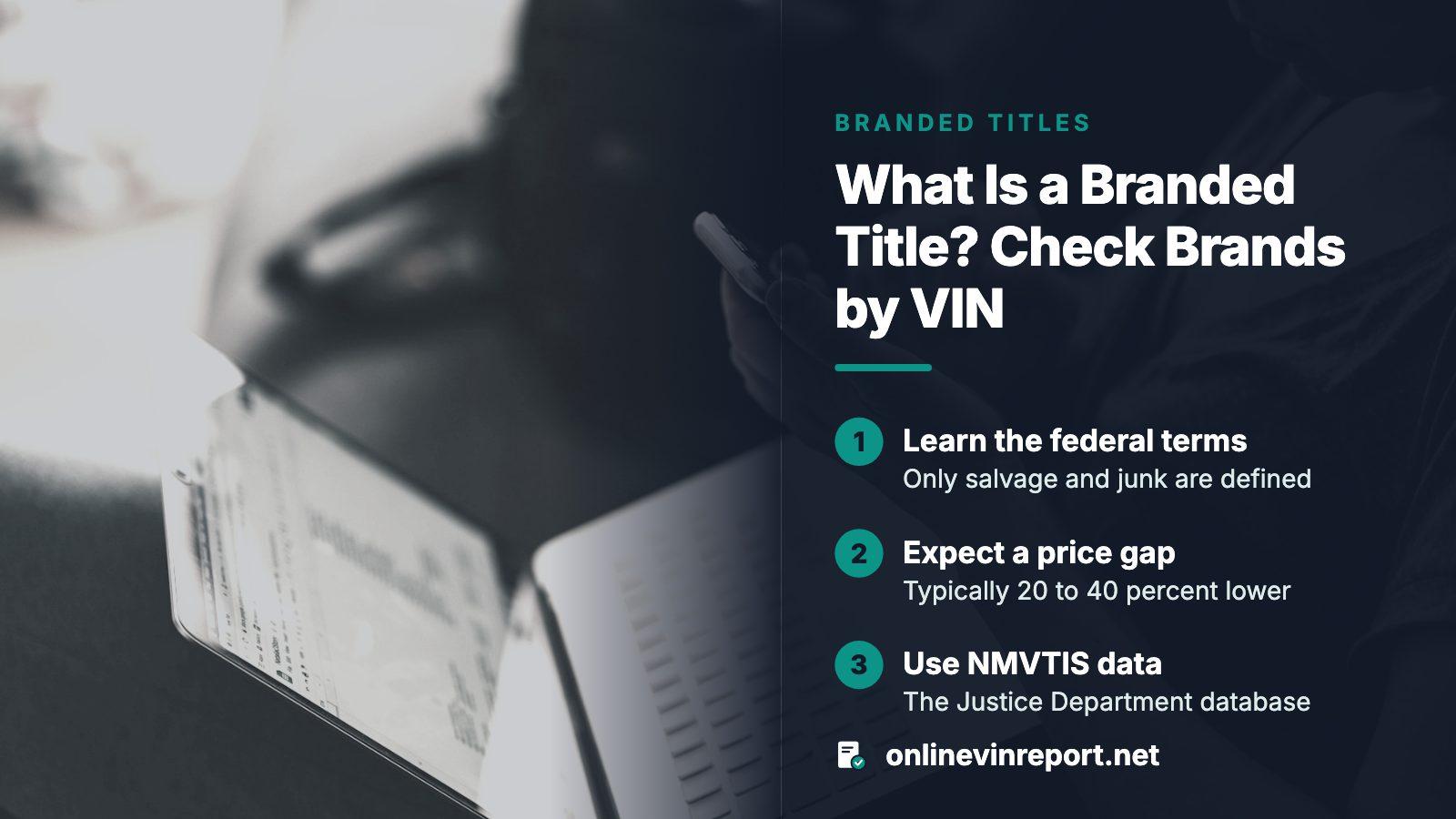
A brand is a note a state motor vehicle agency adds to a title when something major happened to the car. The usual ones are salvage, rebuilt, flood, junk or non-repairable, lemon buyback and odometer. Brands are meant to last for the life of the car, so a title with none is clean on paper only. Run the VIN through a national title record to see what the states recorded, because the seller's paperwork may not show it.
- Federal terms
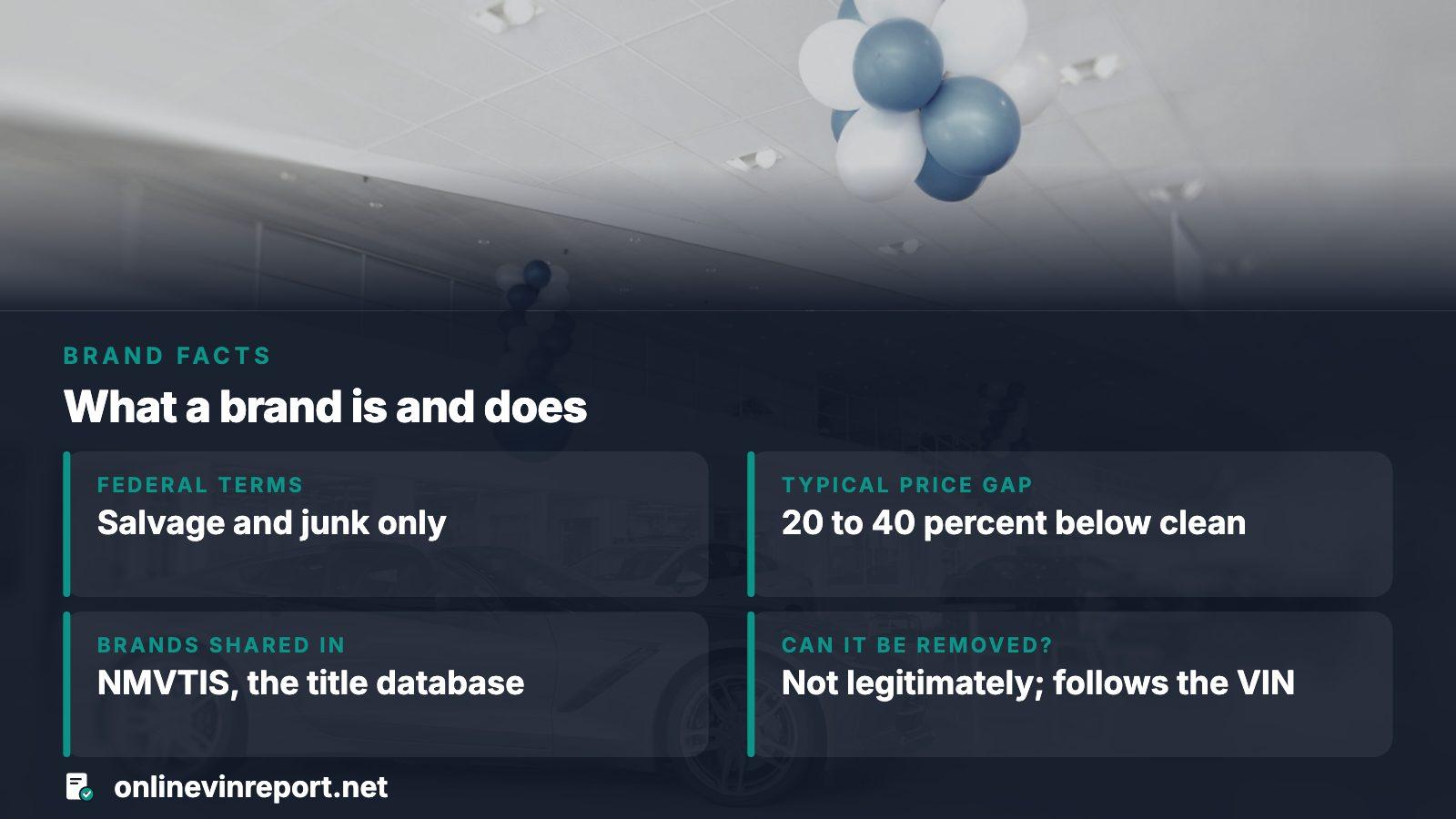
- Salvage and junk only; every other label is a state word
- Typical price gap
- 20 to 40 percent below a clean-title car
- Where brands are shared
- NMVTIS, the Justice Department's title database
- Can a brand be removed?
- Not legitimately; it follows the VIN
A brand is a state's note, and federal law knows only two words
When a state titling agency learns that a vehicle was written off, flooded, bought back by its maker or given a doubtful odometer reading, it can print that fact on the title. That print is the brand. A title otherwise only says who owns the car, so the brand is the one line describing its past.
Here is what trips buyers up. Federal law defines two vehicle conditions in this area, a salvage automobile and a junk automobile. Every other word you will see, whether rebuilt, reconstructed, flood, hail or lemon, was chosen by an individual state. Two states can describe one event in different words, so judge the event behind the label.
The four brands an online VIN title check turns up most
These four labels cause most of the hits that change a buying decision. The last column is what each usually asks of you.
| Brand | What happened | What it asks of you |
|---|---|---|
| Salvage | Its insurer wrote it off as a total loss | Find the cause. Ask for damage photos and repair invoices before you treat it as a driver. |
| Rebuilt or reconstructed | A salvage car was repaired and passed a state inspection | Pay for an independent look at the structure. |
| Flood | Immersion damage, either a standalone brand or the cause behind a salvage brand | Work out whether it was fresh or salt water. |
| Junk or non-repairable | The car can never legally be rebuilt or registered again | Walk away if it is offered as a daily driver. |
Salvage and junk are tests of money, not of how badly the car was hurt
The federal salvage definition is arithmetic. A car qualifies when two figures added together, what the wreck would fetch and what it would cost to repair it for legal use, come to more than the car's market value in the moment before the loss. States set their own total-loss line, commonly somewhere between 70 and 100 percent of the car's value, and some apply a formula rather than a flat share.
Because the test depends on value, a decade-old sedan worth a few thousand dollars can be totaled by damage a newer car would absorb. Junk is stricter, with two tests that must both be met: the vehicle is unable to run on public roads, and it is worth nothing beyond parts or scrap.
Rebuilt and flood: where the VIN record stops and your inspection starts
A rebuilt brand says a salvage car was repaired and a state inspector cleared it for registration. That exam tends to cover basic roadworthiness and parts sourcing, not whether the structure returned to factory spec, so the brand answers one question and opens another.
Flood is unlike a crash. Water reaches wiring harnesses, control modules and hollow body sections, and corrosion keeps working for years, so faults surface after the sale and come and go. Look for:
- Dried silt where it should not be, such as the trunk floor or beneath the seats
- Moisture marks or a waterline behind the lamp lenses
- Fresh carpet in an otherwise worn cabin
- Corroded plugs, screws or bare metal
Salt water is close to a deal-breaker
No repair reliably stops salt-water corrosion. If the car came out of a coastal storm-surge region, treat it as a no unless there is proof it never went under.
Brands that say nothing about a crash
An odometer brand tells you the mileage on file is unreliable. Wordings vary, with phrases such as true mileage unknown or not actual mileage. The cause can be innocent, such as a replaced instrument cluster, or deliberate rollback, which is a federal offense. Price the car on inspection and service records instead of mileage.
Lemon-law buyback brands are different: the manufacturer took the car back under a state statute after repeated faults it failed to repair. Ask what the fault was and whether the repair is documented. Some states also brand hail, fire or theft recovery, which range from cosmetic to serious.
What a brand does to value, insurance and lending
Buyers commonly expect 20 to 40 percent off what an equivalent clean-title car would cost. That is a market habit, not an official figure, and the discount is inherited rather than banked: your own buyer will apply the same cut when you sell. Branded cars also sell slowly and are often declined at trade-in. Insurance and lending can be harder than the price:
- Liability cover is usually available, but damage cover for the car itself may be declined or need a dated-photo inspection first
- A future total-loss payout rests on the reduced branded value
- Large banks often refuse to lend on a branded car; some credit unions and specialist lenders will, usually at a higher rate
- Extended warranties and service contracts are often unavailable on a branded title
Get the insurance answer first
Phone your carrier and read out the VIN before you sign, so you can still back out.
Run the VIN yourself before you pay
A paper title shows what one state wrote on one date. The VIN lets you ask the national record instead of the seller. This order works:
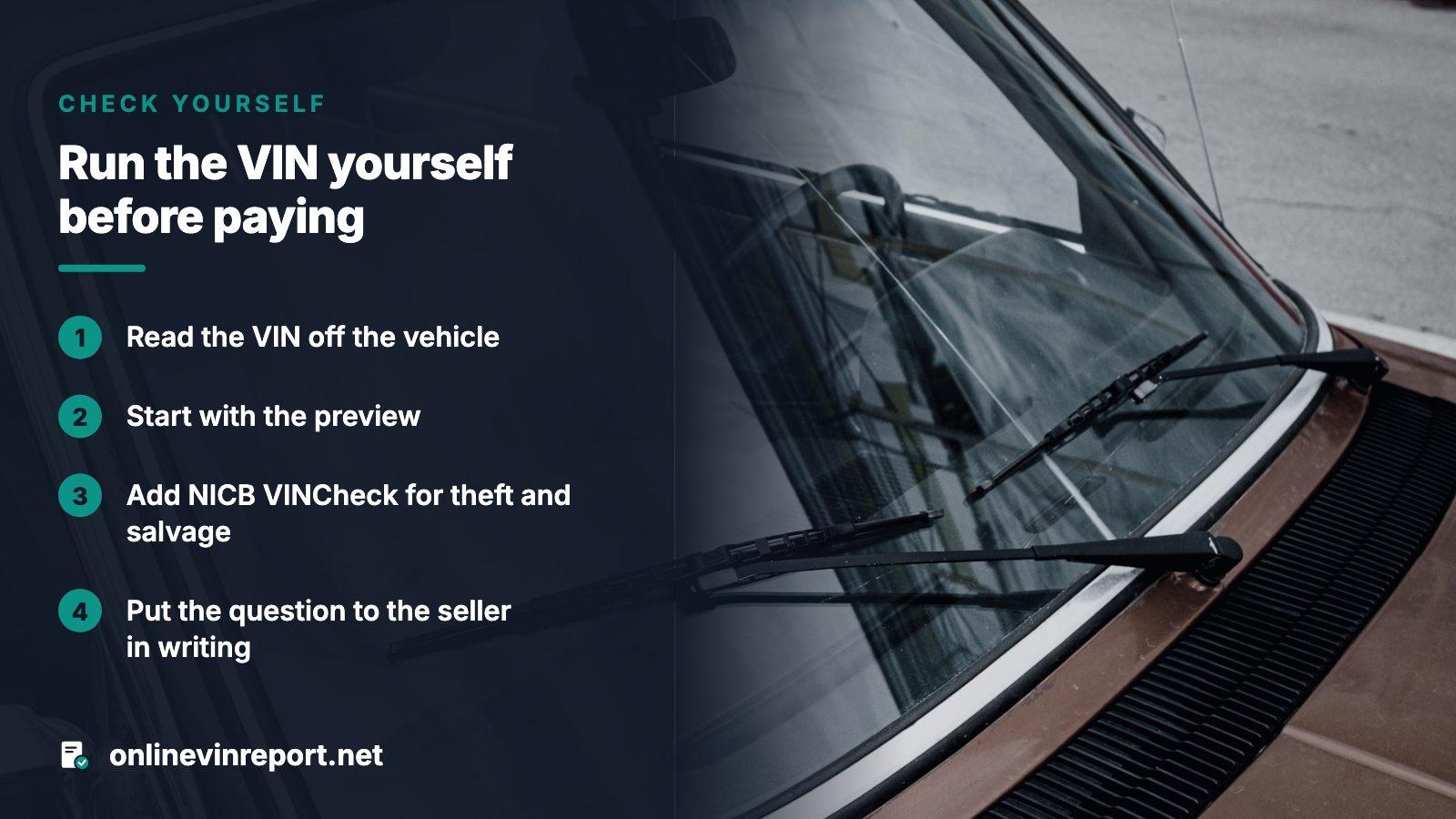
- Read the VIN off the vehicle: at the dash corner visible through the windshield, and on the door-frame sticker by the driver's seat. Check that the two agree, and that they agree with the title.
- Start with the free preview on OnlineVINReport. A full report afterward is a single payment, never a subscription, and the pricing page has the options. It covers title brands plus accident, odometer, salvage and auction records.
- Add NICB VINCheck, a no-cost search of insurer-reported theft and salvage data.
- Put the question to the seller in writing: has the car been totaled, flooded or bought back by its maker? Then compare the reply with the record.
- Book an independent inspection, which can catch repairs and water exposure that never produced a claim.
If a brand appears, the next question is the cause, not the label. Photos, repair invoices and a mechanic's opinion decide whether the price cut is fair.
Where this information comes from
- 49 U.S.C. 30501: definitions — The statute text that defines a salvage automobile and a junk automobile, the two conditions behind the federal vocabulary.
- 49 U.S.C. 30503: state participation — Sets the instant title verification a state must run before titling an out-of-state purchase, and what information it passes along.
- 49 U.S.C. 30505: penalties — States the civil penalty for a violation of the title information rules.
- NMVTIS: National Motor Vehicle Title Information System — The Justice Department's page on the database that lets a brand recorded in one state be seen from another.
- NICB VINCheck — A lookup of theft and salvage records from participating insurers, useful as a second opinion on a VIN.
Sources and photos: Facts checked against the sources above in November 2026. Photos by Michal Biernat, Max Tokarev and Richard R on Unsplash; diagrams by OnlineVINReport.
Keep reading
- Salvage title VIN check: run it online before you payRun a salvage check by VIN and see what the record shows before you pay.
- What is a rebuilt title? What it means and what a VIN title check showsThe brand you will meet most often on cars for sale, and what its inspection covers.
- Flood damaged car: what a title check shows and what it missesHow to spot water damage, including the kind no title brand ever recorded.
- Title washing: how a brand vanishes and what a VIN title check can showHow a brand gets laundered through other states, and how to catch it.
Frequently asked questions
Can a branded title be removed?
Not legitimately. Brands are meant to be permanent and to follow the VIN from state to state. Anyone offering to clear one is describing title washing, which is fraud. A brand can look gone on a reissued paper title, but the national record still holds the history.
Is a car with a branded title always a bad buy?
No, but it always costs you value and it always raises a question. On an older car, hail damage may be merely cosmetic, while salt-water flooding is close to disqualifying. Treat the brand as a reason to investigate, then price the car on the repair file and an independent inspection.
Is a rebuilt title the same as a branded title?
A rebuilt title is one kind of branded title. The car is legal to register and drive, yet it stays permanently marked. Ask your insurer and any lender what they will offer on that specific VIN before you agree to buy.
Does a clean title rule out an earlier crash?
Yes. A clean title only means no brand was recorded. A car can be wrecked and repaired several times and keep a clean title unless an insurer wrote it off as a total loss. Accident and damage records answer a different question from the title.
How do I check for a branded title using a VIN?
Use the VIN printed on the vehicle, not the one typed into the listing, and run it through a title record that draws on NMVTIS. Add the NICB lookup, then ask the seller to answer in writing about any total loss, flood or buyback. Compare all three before you pay.
Now check the car itself
The guide explains what to look for. The report shows what this VIN has on record.