THE SHORT ANSWER
Selling a salvage title car is allowed. Expect a smaller pool of buyers: rebuilders, parts buyers and informed shoppers. State law sets the disclosure duty, and California, for one, requires every seller to disclose the salvage history. Tell the buyer in writing, sign the title with the true odometer reading, and run a VIN title check so your description matches the national record.
- Disclosure
- Set by state law; California covers every seller
- Odometer
- Written on the title, signed by the seller
- Best first step
- Check what the title record shows by VIN
Yes, you can sell it, with conditions
Nothing stops an owner from selling a car that carries a salvage brand. What changes is who will want it and what you owe them. A salvage car is one where repair costs ran past the value it had before the damage, and the call is usually made by an insurer. The brand then follows the VIN into the national title record.
Texas explains the practical limit well: a branded car must go through a rebuild and an inspection before it is legal to drive again. Before then, the only paper available is a salvage title, a nonrepairable title, or disposal authority. So a salvage car on your driveway is, in most cases, a project or a parts source, and your listing should say so.
Who actually buys these cars
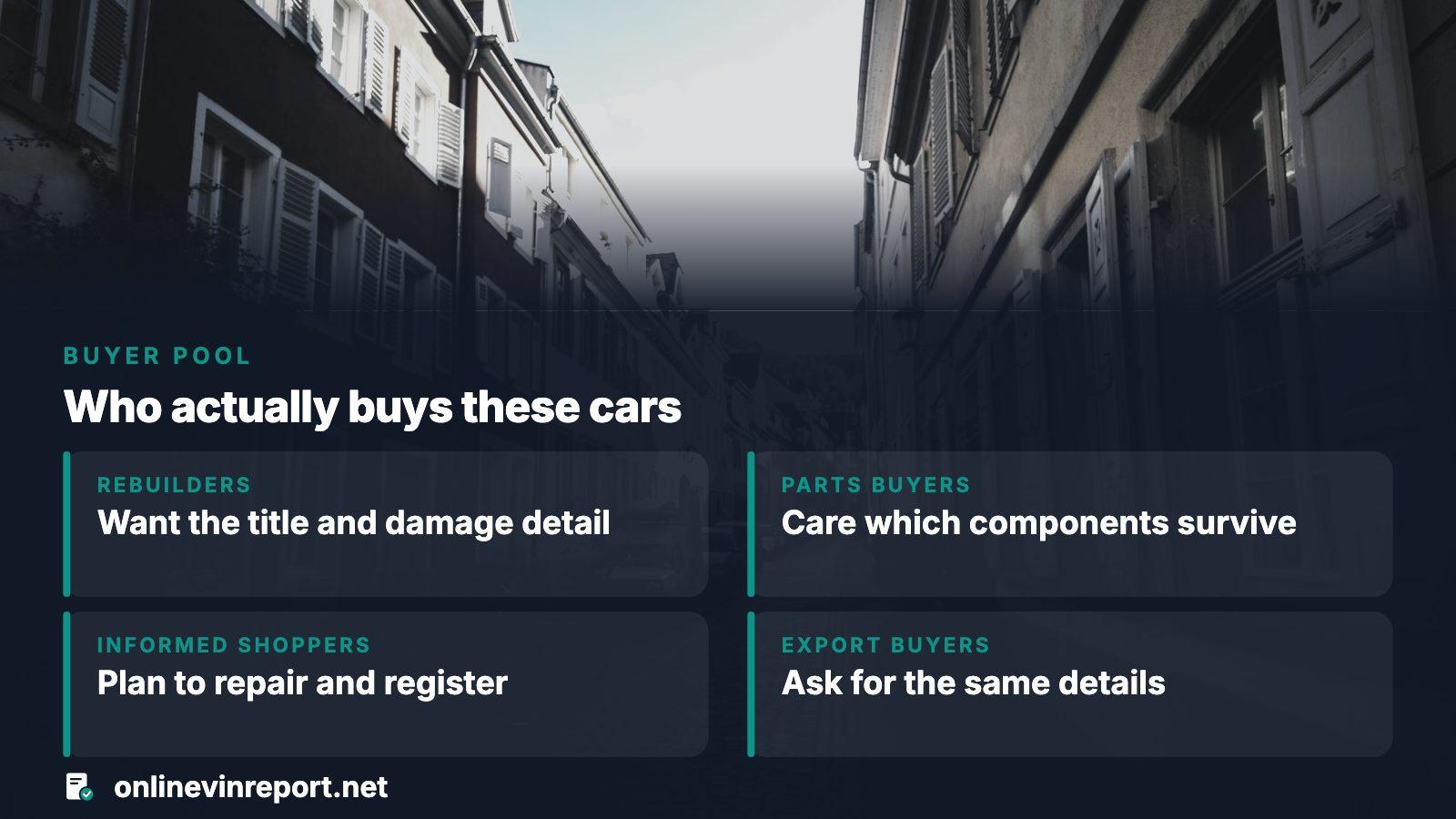
The audience is narrower than for a clean-title car, and each group wants different things from you.
- Rebuilders, who want the title, a clear damage description and photos of the worst areas.
- Parts buyers and yards, who care about which components survived and whether the VIN can be matched to a donor.
- Informed shoppers who plan to repair, inspect and register the car themselves.
- Export or wholesale buyers, who will ask for the same documents but rarely for a test drive.
A retail commuter-car shopper is the wrong target. They will ask about insurance and resale within a minute, and a branded car is a hard answer on both.
What you have to tell the buyer
Disclosure is a state matter, so read your own state's motor vehicle agency pages. California states the duty bluntly: every seller, dealerships among them, is legally bound to reveal a salvage title and the history behind it. The DMV also admits that enforcement is hard when the car crossed a state line, which is exactly why buyers lean on title records instead of trust.
Dealers face an extra step there. A licensed California dealer has to obtain a national title report before offering a used car, and if it shows salvage or junk, a disclosure statement goes on the vehicle while it is on display. Private sellers get no such script, but the safest habit matches it: name the brand in the advertisement, write it again on the bill of sale, and file a copy of both.
A note on the law
This page explains how titles work; it is not legal advice. Penalties for hiding a brand differ by state. If a sale has already gone wrong, the state attorney general or a local attorney is the right contact.
Pull the title record before you list
The national title system, NMVTIS, draws on state title offices, recyclers, wrecking and salvage lots, and insurers. It shows the title, the latest odometer reading and the brand history, and it was built so a brand cannot be washed away by retitling the car somewhere else. Whatever you type into your ad, a serious buyer will compare it against that record.
Running the VIN yourself gives you three things. You learn whether the brand is salvage, junk, flood or something else, because the word on your paper may not match the national label. You see whether the odometer history is consistent with what you plan to write on the title. And you find out early if the record holds a surprise, such as a theft or lien entry you had forgotten. Our preview shows at no charge whether a brand is on file; the full report is one payment, with the amount on the pricing page.
The paperwork that closes the deal
Sloppy paperwork is the usual reason a salvage sale falls apart after the handshake. Texas lists what a seller hands over, and most states ask for something similar. Use this as a checklist, then confirm your state's version.
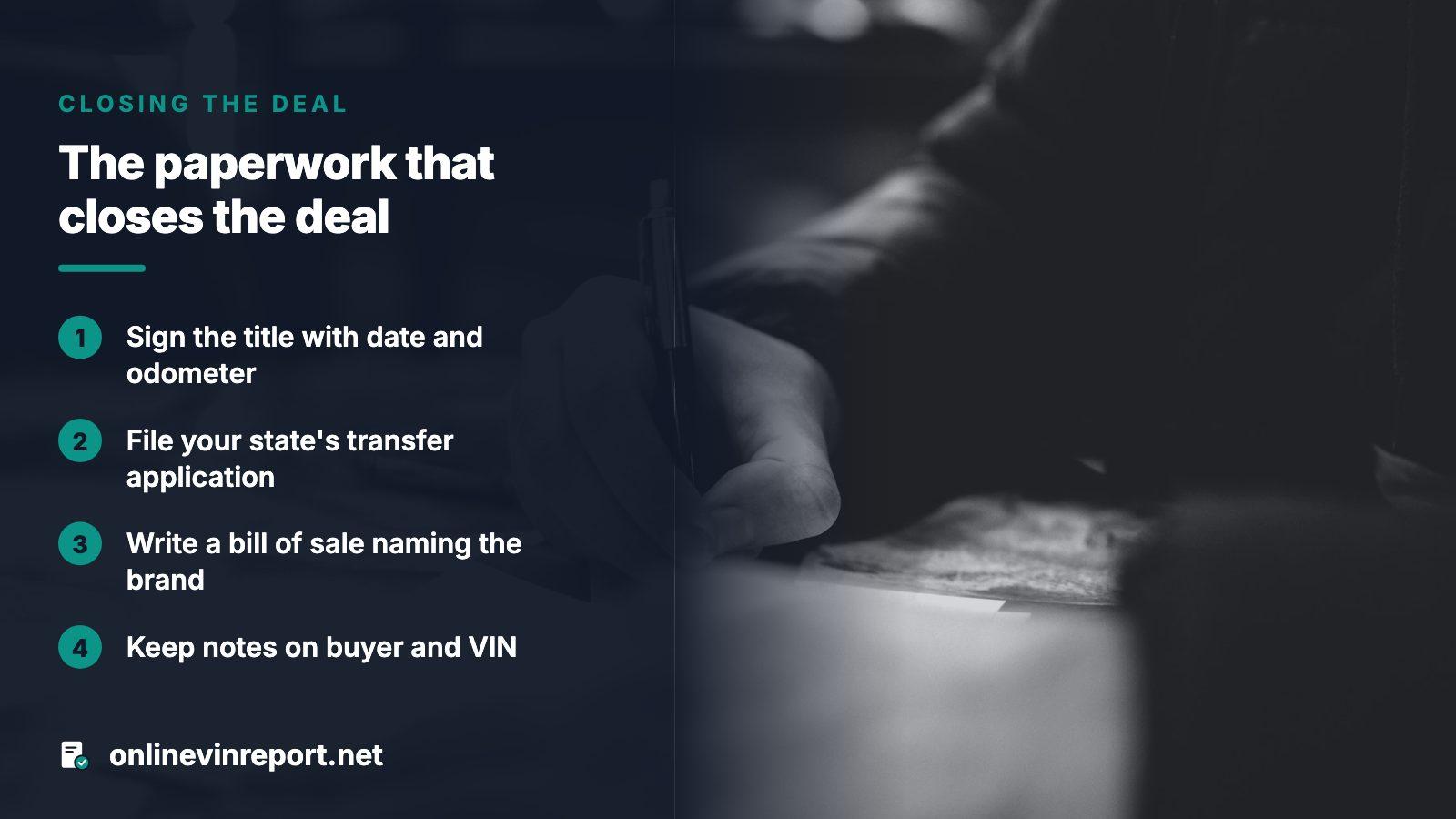
- The signed title, with the sale date and the odometer reading filled in.
- Your state's transfer application, if it has one. In Texas that is Form 130-U, with the sales price shown clearly.
- A bill of sale that names the brand, states the car is sold as is, and lists the VIN.
- A release of lien or power of attorney, if either applies.
- Your own notes on who bought it, when, and which VIN.
On the odometer, federal rules put your mileage statement on the title document, with your signature and printed name. Expect to write whole miles only, the transfer date, names and addresses for you and the buyer, and details that identify the vehicle. If you suspect the reading is off, the form lets you say so, and you should. Paper forms warn that false information can bring fines, prison, or both.
Closing out your side after the car leaves
Once the buyer drives or tows the car away, protect yourself from what comes next. Texas allows a seller to pull the plates and registration sticker, then move the plates to another car, keep them, or deface them if they will not be reused. It also offers a vehicle transfer notification: filed within 30 days of the sale, it shields the seller from parking tickets and toll charges the buyer racks up.
Not every state works this way, so look for a similar notice on your own agency's site. Even without a form, a dated bill of sale proves the car was no longer yours.
Why hiding the brand backfires
Some sellers hope the word salvage will stay off the page. The record does not cooperate. NMVTIS describes how flooded cars were once hauled to states with no flood brand, dried out and resold, and warns that saltwater exposure makes electrical parts, sensors for the airbags too, likelier to give out.
Physical clues give it away too. California's DMV tells shoppers to look for repair marks on inner fender structures, mud or mold under the trunk carpet, a VIN plate fastened any way but with rivets, an airbag warning light that never goes out, and missing NHTSA labels. A buyer who finds those on a car sold as clean will not stay quiet.
| What you tell the buyer | What happens next |
|---|---|
| Brand stated up front, in the listing and in writing | Buyers arrive informed; haggling is about repair cost |
| Brand mentioned only when asked | Trust drops, and buyers search the record anyway |
| Brand left out | Risk of a dispute, a reversal or a legal claim after the sale |
Know which kind of branded car you hold
Salvage, rebuilt and junk are not interchangeable. Texas treats several brands as salvage, among them fire damage, owner retained, stolen with an insurance payout, and an abandoned car towed at police request. California separately calls a repaired and re-registered salvage car revived salvage, and says some of those were not repaired or tested properly.
Write the exact term from your title in the listing. If the car has been repaired and inspected, keep the inspection papers, because they are the best proof you can offer. If it has not, say so plainly and let buyers price the work. Either way, a VIN title check shows how the national record labels your car, so your wording lines up with what a buyer will find.
Where this information comes from
- California DMV: Branded Titles — Seller disclosure duty, dealer report rule and the physical clues of hidden salvage history.
- TxDMV: Salvage Vehicles — What counts as salvage in Texas and what a salvage car may do.
- TxDMV: Buying or Selling a Vehicle — Seller paperwork, plates and the transfer notification.
- NMVTIS: Information for consumers — What the national title system records and why brands persist.
- GovInfo: 49 CFR Part 580 — Federal odometer statement contents.
Sources and photos: Facts checked against the sources above in November 2026. Photos by Zoshua Colah, Owen Michael Grech and Karwin Luo on Unsplash; diagrams by OnlineVINReport.
Keep reading
- Do you have to disclose a rebuilt title when you sell a car?The disclosure question again, for a car that has already been repaired.
- Salvage title car value: what a branded car is really worthHow the brand affects what a car is worth.
- Bill of sale for a car: the deal it proves and the history it can'tWhat to put in the written record of the sale.
- Salvage title VIN check: run it online before you payLook up the brand on the title record before you list.
Frequently asked questions
Is it legal to sell a car with a salvage title?
Yes. The brand does not ban a sale, but it does bring duties. State law sets them, and California says sellers must disclose salvage history. Texas adds that a salvage car cannot return to the road until it is rebuilt and inspected. Describe the car honestly and put it in writing.
Do I have to tell a private buyer the title is salvage?
Check your state's rules, since they differ. California's DMV says sellers, dealerships included, must disclose it. Even where the wording is looser, naming the brand in the listing and again on the sale paperwork protects you if the buyer later disputes the sale.
Can I sell a salvage car without a title?
Rarely. Buyers and state offices want the signed title, and the odometer statement goes on it. When the title is missing or a lender holds it, ask your state agency about a duplicate or a lien release before you list, not after you agree on a price.
Who buys salvage title cars?
Mostly rebuilders, parts buyers, yards and informed shoppers who plan to repair and register the car. Retail buyers who need a daily driver usually walk away once they learn about insurance and resale limits, so aim the listing at the first group.
Should I run a VIN check on my own car before selling?
It is a good idea. A VIN title check shows the brand the national record holds, the latest odometer reading and any other flags. Compare it with your title and your ad, fix any mismatch, and you will not be surprised when a buyer runs the same search.
Now check the car itself
The guide explains what to look for. The report shows what this VIN has on record.