THE SHORT ANSWER
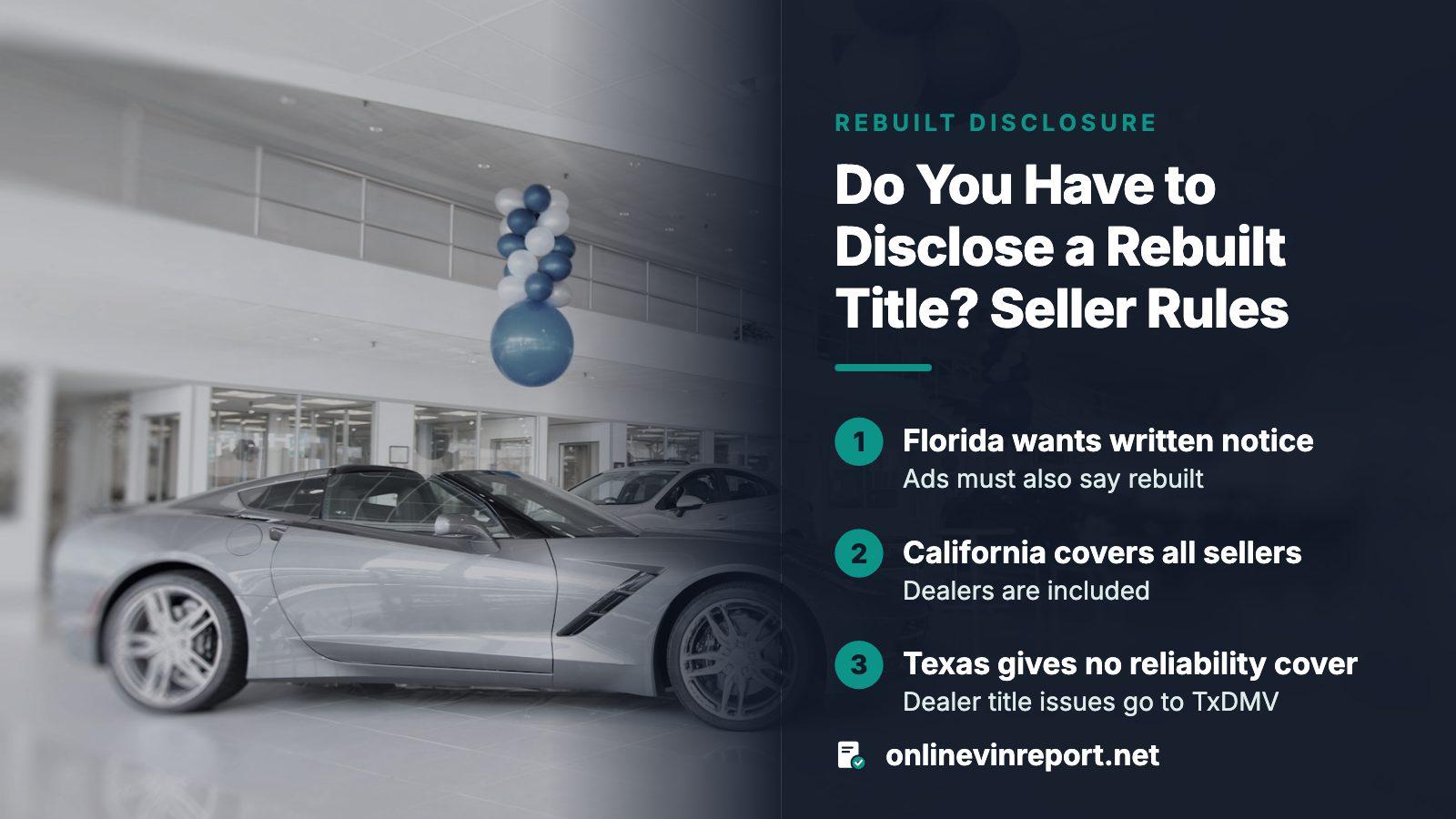
Usually yes. Disclosure rules are set state by state. Florida bars a knowing sale of a rebuilt vehicle without written notice to the buyer, and California says sellers, dealerships included, must disclose a salvage title and its history. Even where no rule bites, the brand sits on the title and in the VIN's record, so silence tends to be found out.
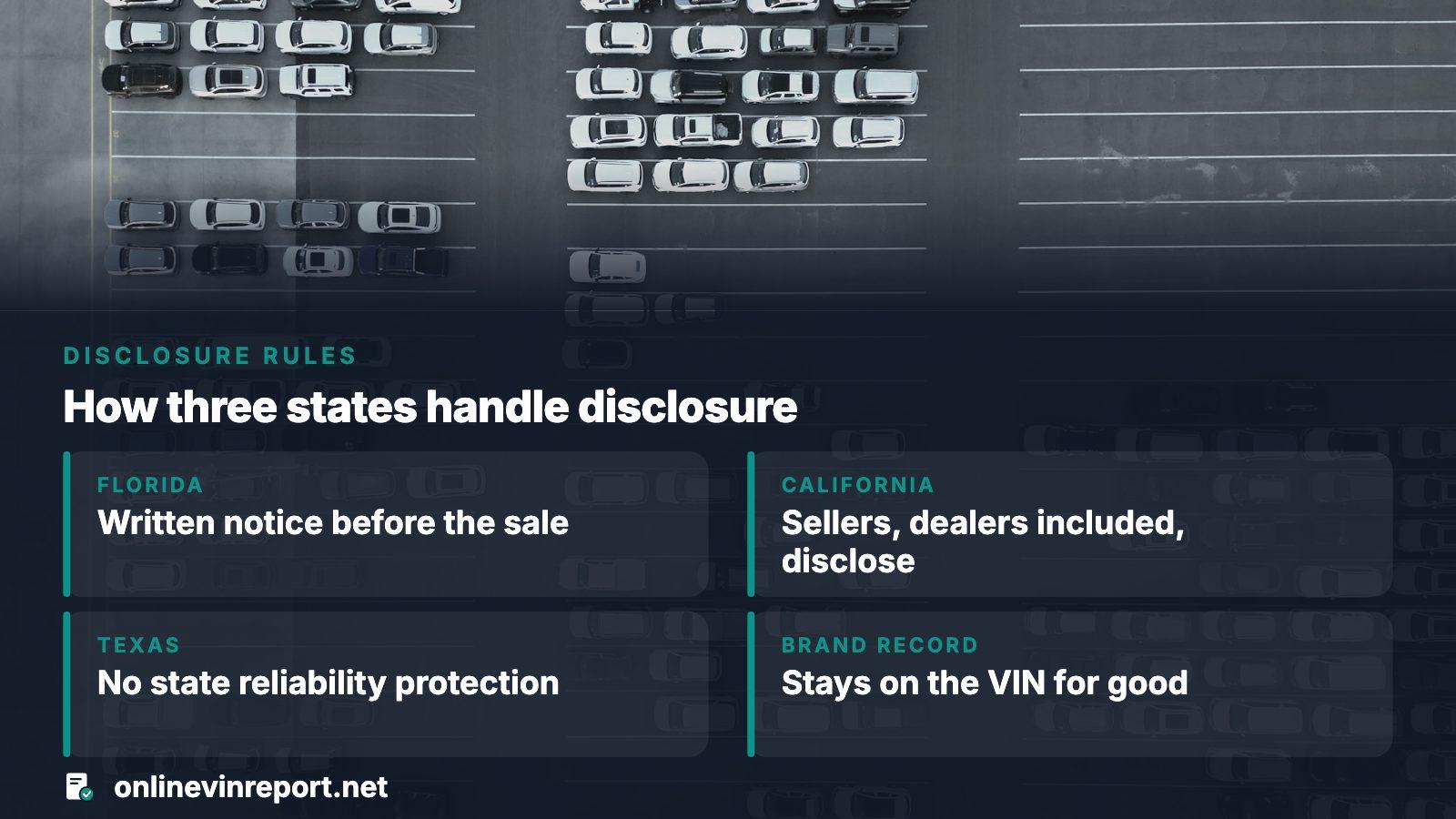
- Florida
- Written notice before the sale, and ads must say rebuilt
- California
- Sellers, dealers included, must disclose salvage history
- Texas
- No state reliability protection; dealer title complaints go to TxDMV
- The record
- A brand stays on the VIN's national record for good
The rule is set state by state, not nationally
No federal rule in the sources behind this guide orders every seller to announce a rebuilt brand. The national title record only collects what states report, and each state keeps its own laws and wording.
| Layer | What it does | Where it stops |
|---|---|---|
| State title | Carries the brand, in that state's own word for rebuilt | Wording and cutoffs vary |
| National title record | Holds every brand any state applied to the VIN, permanently | Sets no sale rules and can miss unreported cars |
| FTC Buyers Guide | A dealer's sticker: sold as is, or with a warranty | A warranty notice, not title status |
| State law | Decides who must disclose, how and when | Hard to enforce across state lines |
Florida spells it out: written notice before the sale
Florida's statute on rebuilt vehicles, section 319.14, is the clearest text among the sources read. It covers 'a person', so dealers and private owners are treated alike.
- A seller has to put it in writing for the buyer ahead of closing: the vehicle is rebuilt, built up from assorted parts, or a flood vehicle.
- Ads must state the status clearly. A knowing sale without the notice, or an ad that hides the status, is a second-degree misdemeanor.
- Peeling off the rebuilt decal with intent to conceal is a third-degree felony.
- A seller escapes civil liability for a condition missing from the title they received, unless they actively concealed it.
The statute was read in its 2024 text, so check the current wording.
California and Texas come at it differently
California's DMV says sellers, dealerships included, must disclose a salvage title and history, and admits the law is hard to enforce when a car comes from another state. Licensed dealers must also pull a national title report before offering a used car and, with a few exceptions, post a disclosure statement on any car with a salvage or junk history or a branded title.
The Texas DMV is blunter: the state gives no reliability protection on used cars, from a dealer or an individual, so the buyer does the checking. A buyer from a Texas dealer who finds a title-history problem can file a complaint with the TxDMV Enforcement Division.
Dealer or private owner: who owes what
Dealers carry extra duties. Under an FTC rule, used cars on a dealer's lot need a Buyers Guide on them, and California adds the title-report check. Private owners face fewer printed duties, but the Florida and California wording reaches sellers in general.
A private buyer should never leave without the signed title, and should confirm the seller's name is on it. California's DMV says a seller who is not the owner needs paperwork proving authority.
An as-is box settles who pays for repairs later. It says nothing about whether the history was described honestly.
Why silence rarely holds: the title and the VIN tell the story
A brand is not a secret the seller controls. Florida carries a title brand onto the registration and every later title for the life of the vehicle, and California prints the vehicle history in a red box on the title.
Nationally, a brand becomes a permanent part of the VIN's record, fed by state agencies, insurers, salvage yards and recyclers. A buyer who runs the VIN, or who applies to retitle the car, will usually see it.
Where the trail breaks: other-state titles and washed brands
The national title site warns that moving a car to a state that never checks earlier records can produce a paper title with no brand on it. States do not agree on what earns a brand, and not every reporter feeds the system, so a search can come back clean for a car with a past. The state's own title record is worth reading too.
Texas shows the repair side: an owner who thinks a brand sent in from another state is wrong can get a statement from that state and ask TxDMV to review. California's DMV lists signs of history nobody mentioned:
- Repair marks on the inner fender structures.
- Mud, mold or rust under the trunk carpet.
- A VIN plate that is not secured with rivets.
- Airbag covers that look resealed, or a restraint light that stays lit.
What buyers report when nobody said a word
Some NHTSA complaints describe a brand surfacing only after payment.
From an NHTSA owner complaint
An owner of a 2014 Ford Focus told NHTSA they paid $4,100 to what they call a private dealer, 'without being told what was wrong' with the car. Trouble followed, including hard starts and a transmission module the owner says needs replacing. The owner calls the title salvaged. The complaint is silent on what the seller told them about the title.
The faults and the brand arrived together, after payment. Nobody can prove later what was said, but a check before paying puts the brand on the table while walking away is still free.
From an NHTSA owner complaint
An owner of a 2012 Nissan Altima told NHTSA that, after buying it in September 2014, a history report showed it had been 'flipped' while in Los Angeles, in the owner's word. The owner was unable to learn if the title said rebuilt or salvage.
Learning the status after the sale leaves a buyer chasing paperwork; the title and a VIN check answer it first.
If you are the seller: say it in writing
Florida demands written notice; anywhere, a written record is the best proof of what you said.
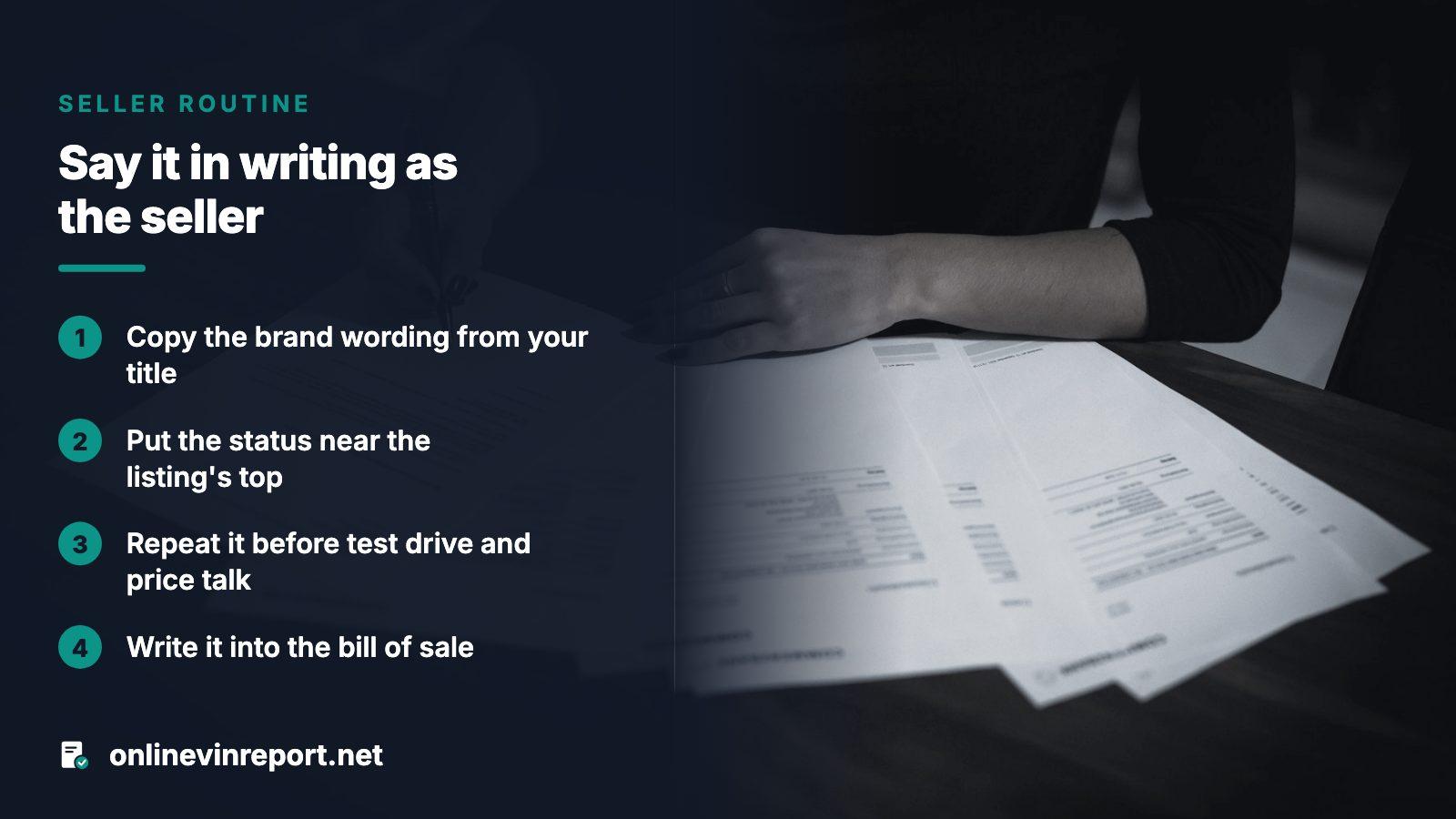
- Copy the brand wording exactly as your title prints it.
- Put the status near the top of the listing.
- Repeat it before the test drive and before any price talk.
- Write it into the bill of sale, with any repair and inspection papers you hold, and keep copies.
Expect a lower offer. That is the whole cost of honesty; a concealed brand can lead to a state complaint, a civil claim or, in Florida, a criminal charge.
If you are the buyer: check the VIN, and know your next step
An online title check reads the brand history tied to the VIN, so it does not rest on the seller's memory or on a paper title that crossed state lines. Start with the preview, which carries no charge; the full report is a one-time payment, with the plans listed on the pricing page. It sets title brands beside salvage and auction photos and odometer readings.
Then compare: does the brand match the seller's story, and does the paper title agree? Ask for repair records, book an independent inspection and phone your insurer with the VIN before agreeing a price.
If a seller did hide it, keep the listing, messages, bill of sale and report. A buyer from a Texas dealer can complain to TxDMV Enforcement. For a dealer problem the FTC says to go to your state attorney general, and a consumer attorney can explain local remedies. Treat this page as background, not legal advice.
Where this information comes from
- California DMV: Branded Titles — Seller duty to disclose salvage history, the dealer disclosure statement and the signs of hidden repairs.
- Florida Statutes: section 319.14 (2024) — Written notice before a sale, the advertising rule, the penalties and the civil-liability exception.
- TxDMV: Title Check, Look before you buy — No state reliability protection, the dealer complaint route and the process for removing a brand.
- NMVTIS: Information for consumers — Brands are permanent on the national record, how washing happens and why a clean search is not final.
- FTC: Buying a used car from a dealer — The Buyers Guide, what as-is means and where to turn with a dealer problem.
- NHTSA owner complaint 11739649 — owner experience, paraphrased
- NHTSA owner complaint 10676988 — owner experience, paraphrased
Sources and photos: Facts checked against the sources above in November 2026. Photos by Richard R, Dimitri Karastelev and Iain on Unsplash; diagrams by OnlineVINReport.
Keep reading
- What is a rebuilt title? What it means and what a VIN title check showsWhat the brand means, how a car earns it and what the state inspection covers.
- Title washing: how a brand vanishes and what a VIN title check can showHow a brand drops off a paper title when a car crosses state lines.
- Bill of sale for a car: the deal it proves and the history it can'tWhat belongs in the paperwork that records what the seller told you.
- Rebuilt title check by VIN: is the car clean or rebuilt?Run the VIN and read the rebuilt record before you agree on a price.
Frequently asked questions
Can I sell a rebuilt-title car without telling the buyer?
In Florida a knowing sale without written notice before the deal closes breaks the statute. Other states differ, but the title carries the brand and the buyer will see it when retitling. Hiding it risks a complaint or civil claim, while saying it only lowers the price.
Does selling as is let me skip the rebuilt title?
No. The FTC describes as is as the dealer declining to pay for repairs after the sale. That concerns warranty cost, not whether the history was told truthfully, and Florida's disclosure subsection never mentions as-is sales.
Do private sellers have to disclose a rebuilt title too?
Florida's statute covers 'a person', and California says sellers, dealerships included. Texas offers no reliability protection in dealer or individual sales. Since rules differ, assume nobody will volunteer the brand and check the VIN yourself.
How can a buyer spot a rebuilt title without asking the seller?
Run the VIN through an online title check, then ask to see the paper title and match the wording. A clean result helps but is not final, because reporting gaps exist, so the state's own title record adds a second look.
What if a seller hid a rebuilt title?
Collect the listing, messages, bill of sale and a history report. Buyers from Texas dealers can complain to TxDMV Enforcement; elsewhere the FTC advises taking a dealer problem to your state attorney general. A consumer attorney can describe remedies where you live.
Now check the car itself
The guide explains what to look for. The report shows what this VIN has on record.