THE SHORT ANSWER
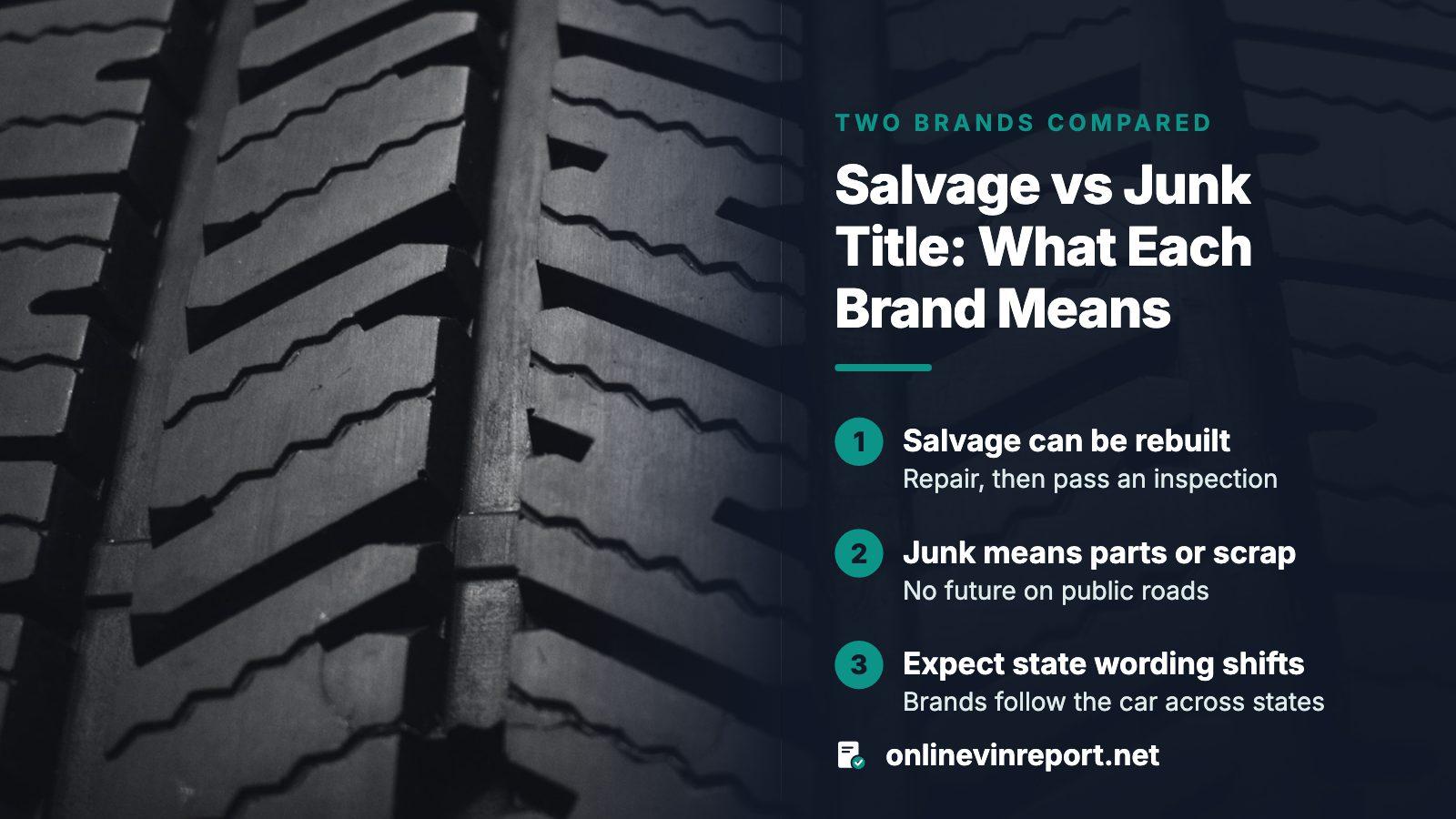
Salvage means a damaged car whose repair bill plus leftover value outweighs its prior worth, so it can be rebuilt and inspected. Junk means it cannot run on public roads and is worth only spare components or metal, and some states make that final. Names vary by state, so read the exact label on a VIN title check.
- Salvage
- Damaged past its worth, can be rebuilt and inspected
- Junk
- Parts or scrap only, no road future
- State wording
- Junk, nonrepairable and scrapped can mean the same end status
- Brand history
- A national database keeps every brand a state applied
Two labels, two very different futures
Shoppers often treat the two words as shades of the same problem. They are closer to a fork in the road. A salvage car still has a path back: someone repairs it, the state looks it over, and a new title follows. A junk car has no such path. The brand marks the end of the vehicle's life as a vehicle.
That difference decides what you are really buying. A salvage-branded car is a gamble on the quality of a rebuild. A junk-branded car, if one is being offered to you as transportation, is a warning that something is wrong with the listing, the seller or the paperwork.
How federal law words each term
Congress gave the national title system its vocabulary. In that statute a junk automobile has two traits together: it is incapable of running on public roads, and nothing about it is worth money apart from spare components or scrap metal. Salvage is framed differently. The car has been hurt by a crash, blaze, flood, trespass or comparable event, and adding its leftover salvage worth to the repair bill for legal road use lands above what it was worth right before the harm.
Put the two definitions next to each other. Salvage is arithmetic about repair cost. Junk is a verdict on condition: the vehicle is no longer a road vehicle at all. States write their own rules on top, so the wording printed on a real title can drift from the federal text.
Salvage and junk compared point by point
| Question | Salvage | Junk |
|---|---|---|
| Can it be repaired for the road? | Yes, in most states, after inspection | No, the car is treated as finished |
| Typical cause | Crash, fire, flood or a recovered theft that tipped the repair math | Stripped, burned out or surrendered for scrap |
| Who usually decides | An insurer after a total loss, or the owner | Often the owner or a yard handling a scrapped car |
| Can a new title follow? | A rebuilt title can follow where state rules allow | In states with a permanent junk status, never |
| What the buyer is taking on | Repair quality, resale and insurance trouble | The value of components only |
Use the table as a map, not a rulebook. The right column in particular shifts from state to state, so the title's own wording and your state's agency page carry the final word.
Why your state may use different words
The federal database does not translate state language. To it, a brand is simply a tag a state puts on a car to record how it looks now or looked earlier, and each state keeps its own standard. Two neighboring states can treat the same wreck differently when their value thresholds differ, so one calls it salvage and the other says nothing.
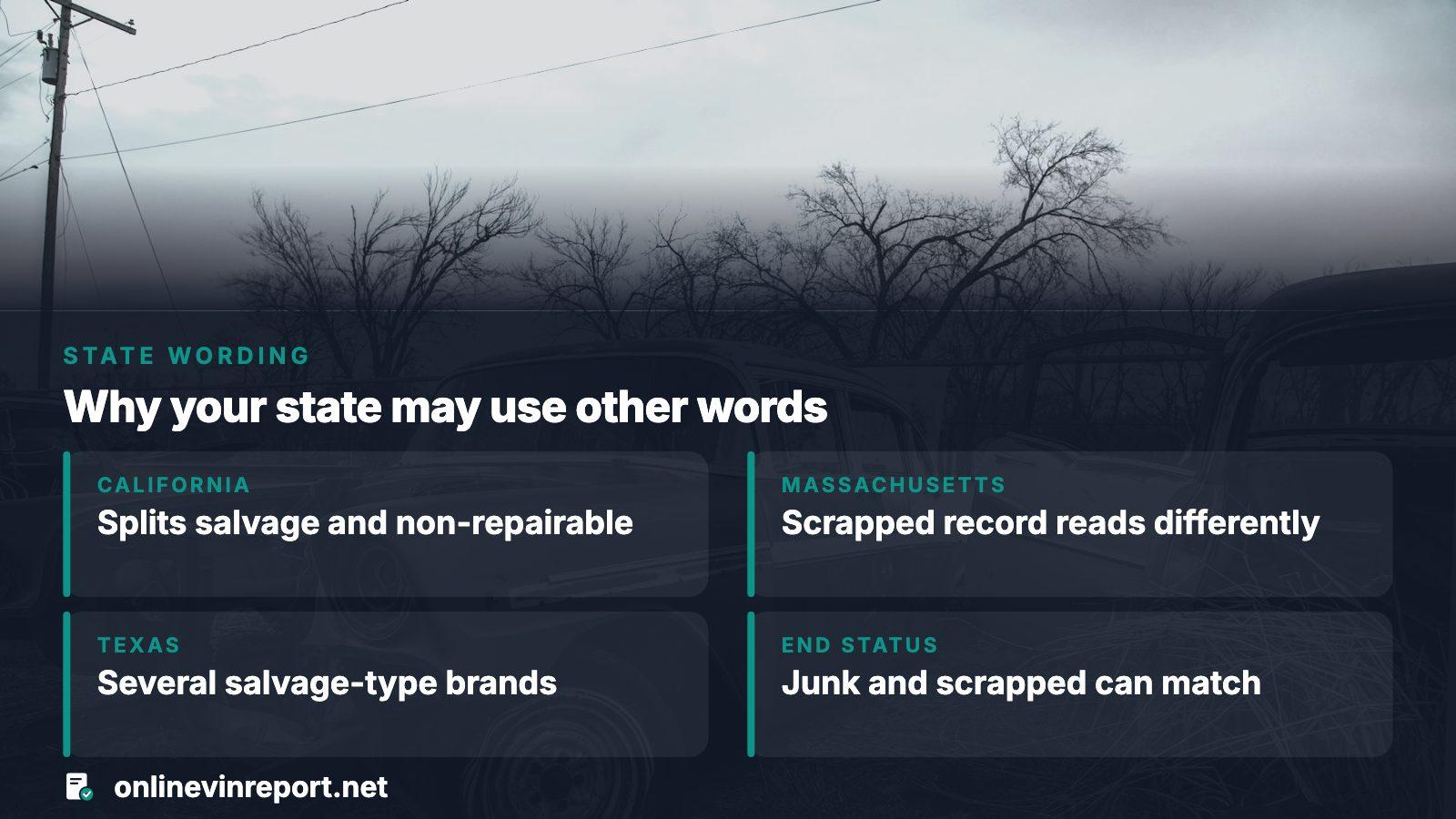
- California splits the two ideas in two. A Salvage Certificate covers a write-off that may be fixed. A Non-Repairable Vehicle Certificate covers a car its owner declared solely as a donor of spare components or scrap, a stripped hulk or a gutted burned shell.
- After a non-repairable certificate is issued in California, that car is closed off from any later title as junk or as a revived salvage vehicle.
- In Massachusetts the record of a scrapped vehicle reads JUNK. That car has no future title or registration in the state, and the owner must hand in proof of ownership inside 10 days.
- Texas recognizes several salvage-type brands, including fire damage, owner retained, salvage retention and stolen, and wants a branded car rebuilt and inspected before it sees road use.
So a state's junk and another state's non-repairable status can describe the same dead end under two names. When a report uses a word you do not recognize, look it up on the issuing state's agency page rather than guessing.
Why a brand does not disappear when the car moves
Some sellers hope that titling a car in a new state will leave its brand behind. The national system was built to stop that. It retains each brand that any state ever assigned to a VIN, with data coming from state titling offices, recyclers, junk and salvage yards, and insurers.
That spread of sources is why a title check answers this particular question well. A yard that accepted a wreck, an insurer that paid it off and a state that branded it may each file a record under one VIN. The resulting report is short by design: where the car was titled and when, any brands, its odometer, and whether a total loss or salvage event was recorded.
A short report is a good sign
When a title report lists no brands, no total loss and no salvage history, there is simply little to show. Short does not mean something was left out. It means nothing was recorded.
Steps for a buyer holding a listing with a brand
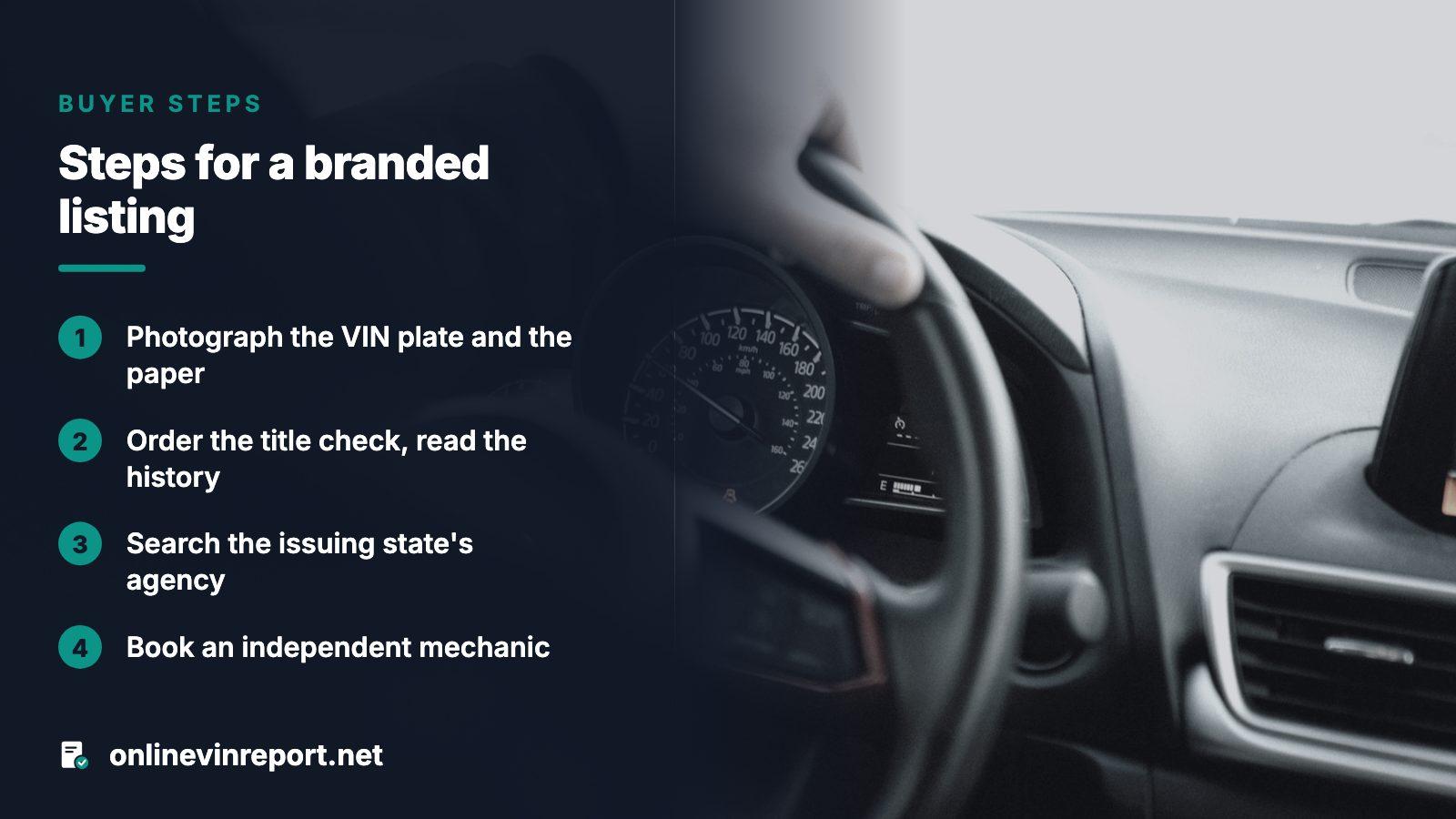
- Photograph the VIN plate on the car and the number printed on the title, then compare them character by character.
- Order the online title check and read the brand history one line at a time, writing down the precise label used.
- When a brand shows up, search the issuing state's agency pages for that label, since one word can carry different consequences elsewhere.
- Ask whether a rebuilt inspection was passed, and request the paperwork.
- Book an independent mechanic, because a total loss generally signals serious damage.
This site shows a free preview first, which tells you whether title brands exist for the VIN. Going further costs one payment, with no recurring plan, and the pricing page shows the choices. Do it before any deposit changes hands.
What each result tells you
If the report shows salvage, ask whether a rebuilt title followed. A car stuck at salvage should not be on the road in states that require a rebuild and inspection first. If it shows a total loss with no brand, the car may have been repaired and never branded, so look closely at the damage and photo records.
If the report shows junk, nonrepairable or a scrapped record on a car being sold as a daily driver, stop. Either the label is stale and wrong, the VIN belongs to a different car, or the vehicle is not eligible for a road title in the first place. In each case the next move is the issuing state's agency, not the seller.
Where this information comes from
- NMVTIS: For consumers — defines a brand and where the national title data comes from
- NMVTIS: Understanding a vehicle history report — lists what a title report covers and why a clean one is short
- 49 U.S.C. 30501 definitions — federal wording for junk and salvage automobiles
- California DMV: Total loss salvage and non-repairable vehicles — salvage certificate versus non-repairable certificate
- Massachusetts RMV: Junk vehicles — permanent junk status in one state
Sources and photos: Facts checked against the sources above in November 2026. Photos by fr0ggy5, Miles Loewen and Leo_Visions on Unsplash; diagrams by OnlineVINReport.
Keep reading
- What is a branded title? How to read salvage, flood and rebuilt brands by VINthe wider family of brands beyond these two
- Total loss threshold by state and what it means for a VIN title checkhow each state decides a car is a write-off
- Title washing: how a brand vanishes and what a VIN title check can showwhy moving a car across state lines does not erase a brand
- Salvage title VIN check: run it online before you payrun the salvage question against a specific VIN
Frequently asked questions
Is a junk title worse than a salvage title?
Usually yes for a buyer who wants to drive the car. A salvage car can be repaired and inspected, then retitled in many states. A junk status is the end of the line in states that treat it as permanent, leaving only parts or scrap value.
Can a junk title car ever be registered again?
It depends on the state. Massachusetts says a junked car can never again be titled or registered there. In California, a non-repairable certificate closes off a later title as junk or revived salvage. Look up the rule on the issuing state's agency page.
Does a VIN check show both salvage and junk brands?
A title check pulls brand history reported by states, insurers, yards and recyclers, so either brand appears if it was recorded. Wording follows the state that issued it, so read the exact label and look it up on that state's site.
Who decides a car is salvage?
Often an insurer, after a settlement on a total loss, though an owner is responsible when no insurer pays. The test is that repair cost plus remaining salvage value exceeds the car's worth before the damage, and each state sets its own threshold.
Does moving the car to another state remove the brand?
No. The national title database retains every brand any state placed on the VIN, so retitling elsewhere does not clear it. A seller who claims otherwise is worth walking away from.
Now check the car itself
The guide explains what to look for. The report shows what this VIN has on record.