THE SHORT ANSWER
A parts only title marks a wrecked, burned or flooded vehicle as beyond repair. States that use the label refuse to title or register such a car again, and states that receive one from elsewhere usually treat it the same way. Sellers sometimes bury the wording in a listing or a stamp on paper, so a VIN title check is the faster way to see whether a brand sits on the record.
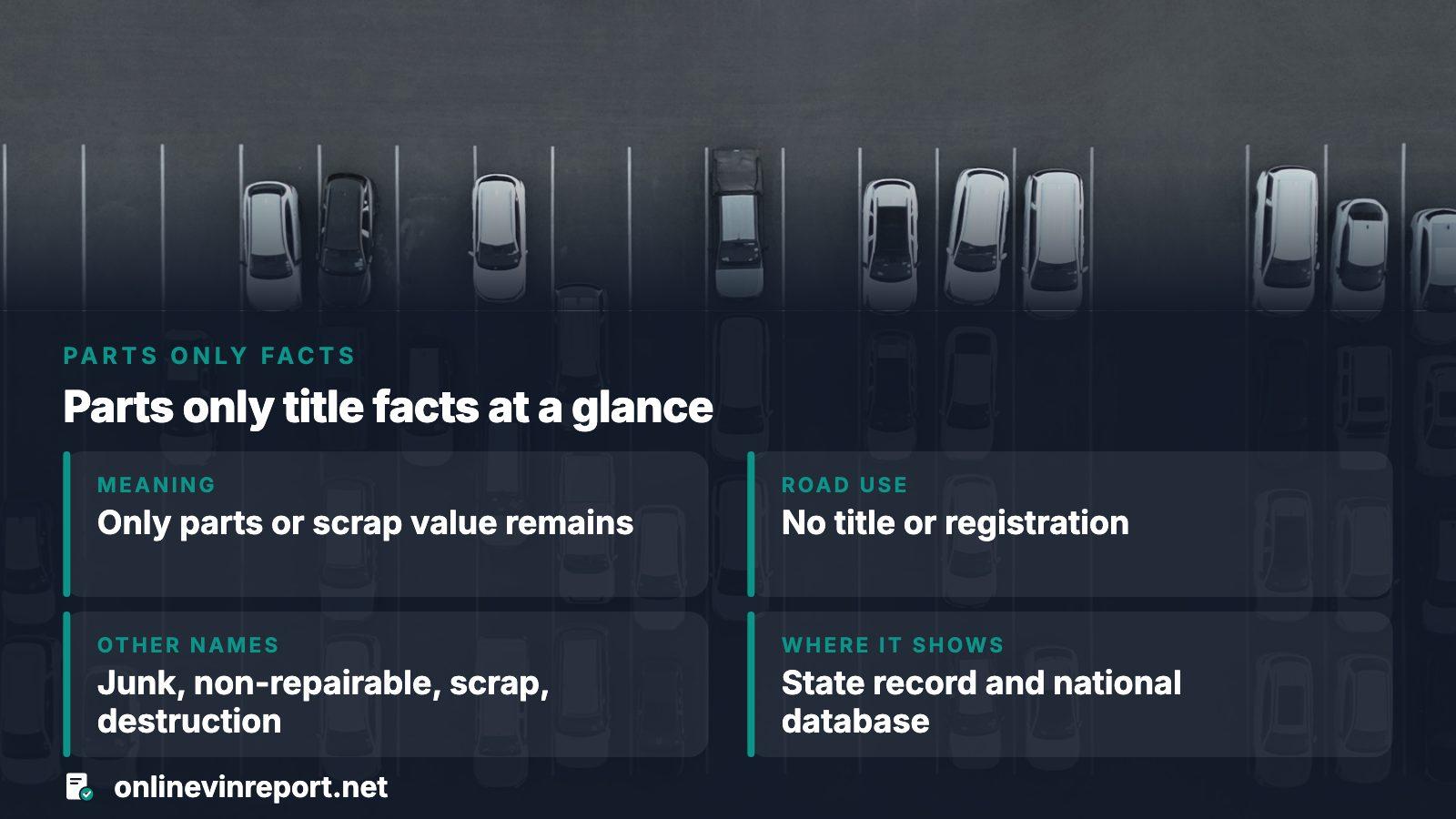
- Meaning
- Only parts or scrap value is left
- Road use
- No title or registration in states that use the brand
- Other names
- Junk, non-repairable, scrap, for destruction
- Where it shows
- State title record and the national title database
What a parts only brand tells the next owner
Alaska's motor vehicle division describes the label plainly. The vehicle was damaged, wrecked or burned to the point where its only leftover worth is as a source of components or scrap metal. It adds that such a vehicle cannot be titled or registered in the country again. That is a much harder stop than a salvage brand, which still leaves a path back to the road through repair and inspection.
Federal law sets a similar two-part test for a junk automobile. First, the vehicle cannot be driven on ordinary public roads. Second, nothing about it is worth more than its spare components or scrap. Both conditions have to hold. A car that looks bad but could be fixed does not meet that test, which is why parts only is reserved for the worst cases.
Many words for one dead end
Titling is a state matter, so the vocabulary changes at every border. Oregon's DMV lists junk, non-repairable, parts only and scrap as ways another state may describe a vehicle it has given up on. Virginia's code goes further and names junk, for destruction, for parts only and not to be repaired as designations that count as a nonrepairable certificate.
| Wording you may see | How it is usually read |
|---|---|
| Parts only | Same outcome as a nonrepairable record in the receiving state |
| Junk or scrap | Parts or metal only; federal law gives a formal definition |
| For destruction or certificate of destruction | Meant to be dismantled or crushed |
| Salvage | A different brand; repair and re-inspection may still be possible |
When a listing says only that a car comes with a parts title, ask for the exact words printed on the document and then compare them with what the VIN record shows.
Why a car lands in this category
Fire, a hard crash and flood are the usual causes. Alaska gives flood as its example: wiring and electronics may be damaged, and the only safe repair would mean replacing every bit of the electrical system. That cost is out of reach for nearly any vehicle, so the state closes the road to it instead.
Owners can also choose the route. In Virginia, an owner of a titled vehicle may apply to declare it nonrepairable, and an insurer that takes a vehicle through a claim has to apply within 15 days after paying the owner or lienholder. The state issues the certificate without a fee, and it bars plates.
Why moving the car to another state does not help
The Justice Department's title database was built to stop that move. A brand applied by a state titling agency stays in the vehicle's national record for good. Washing, as the department describes it, works only when a later state fails to consult the earlier ones.
- Oregon refuses a title when a different state has ruled the vehicle beyond repair.
- Virginia counts another state's for-parts-only brand as though it had handed out a nonrepairable certificate itself.
- A buyer can ask the issuing state whether the status can be lifted; if it cannot, the car stays untitleable.
A seller who suggests that a fresh title in the next state will solve the problem is describing a move the rules were written to block.
Running the VIN title check before money moves
Read the seventeen characters off the windshield corner or the door jamb sticker and hold them against the title. A mismatch ends the conversation. Next, put the number into the preview here to learn whether any title brand is on file. When the answer matters, the paid report adds the brand history, plus salvage auction records and photos.
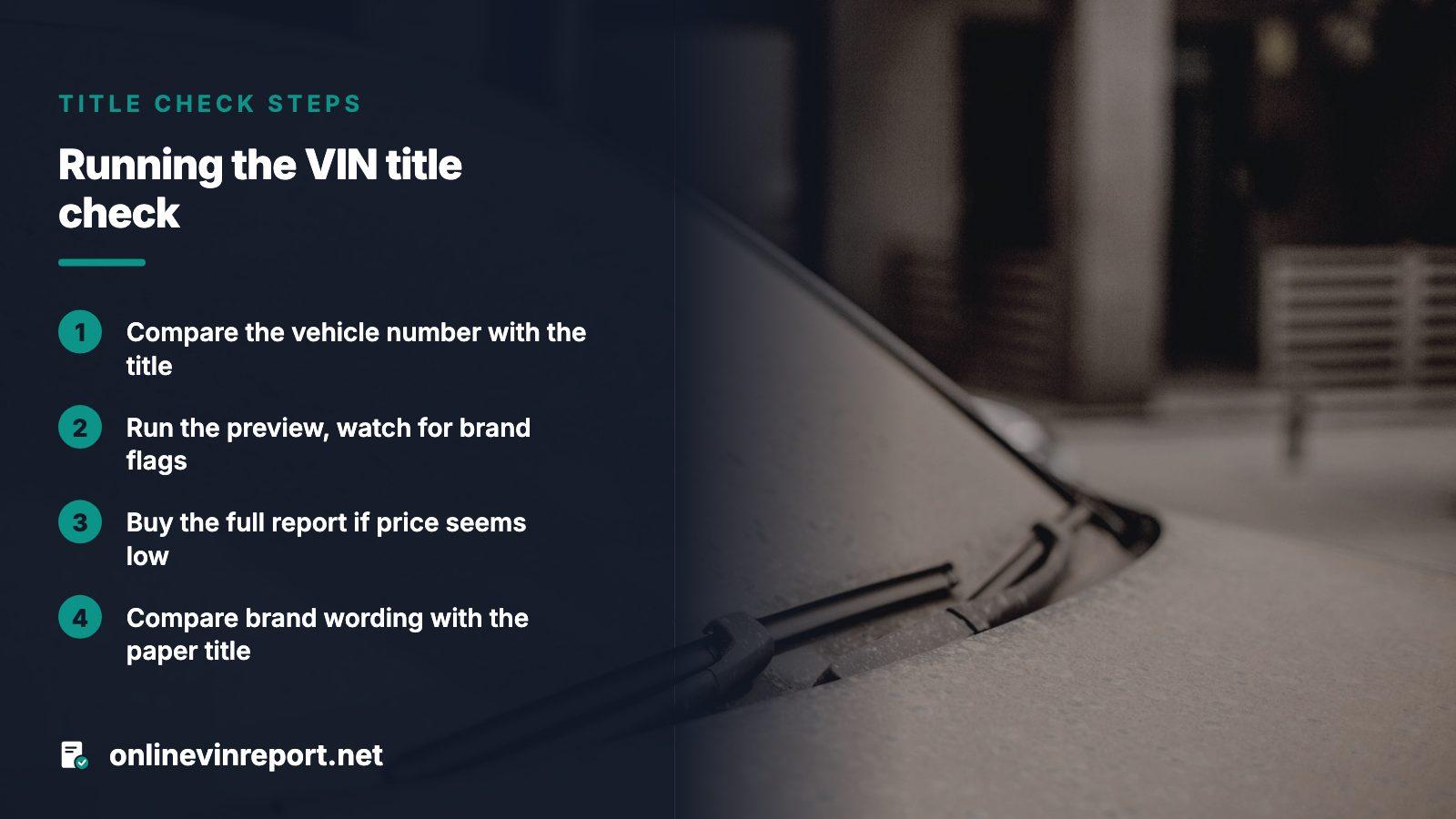
- Compare the number on the vehicle with the number printed on the title.
- Run the preview and watch for a brand or a total-loss flag.
- Buy the full report when the preview shows something, or when the price seems too low.
- Compare the brand wording with the physical title the seller hands you.
The pricing page lists what the report costs. You pay once per report or pack, and nothing renews.
What a clean result can and cannot promise
Coverage in the federal title system is wide but not total: 87 percent of vehicles are in it, yet only a bit over half of states send data. Roughly 20 million salvage or total-loss entries sit in its files. The Justice Department cautions that a search can come back falsely reassuring, showing nothing for a car that has a history.
Read the gaps
A yard handling a car does not oblige a state to brand it. A state record can hold more than the national database does. Ask the seller for the title in hand, and look at the state's own record where it can be reached.
A clean result shrinks the risk without erasing it. Keep the paper title and a hands-on inspection in the plan.
Signs a listing is steering around the brand
- The seller offers a bill of sale and promises the title later.
- The price sits far below similar cars and the story is vague.
- The title is from a state different from where the car sits, with no clear reason.
- The seller calls it a project car but will not photograph the title.
- A flood is mentioned, and electronics behave oddly.
Any one of these is reason enough to pause and run the VIN. Several together mean the sale should wait until the record is on your screen.
When buying a parts only vehicle makes sense
Someone who wants a donor body, a set of seats or a drivetrain for another build has a legitimate reason. The brand is honest about what the vehicle is, and the price should reflect it. What matters is that the buyer knows the car will never carry plates and treats it as spare components.
The harm comes from the opposite case, a buyer who believed they were purchasing a driver. If you are shopping for a car to drive, a parts only record is a reason to walk away, however clean the body looks in photos.
Where this information comes from
- Alaska DMV: reconstructed and parts only vehicles — meaning of the parts-only title and the flood example
- Oregon DMV: junk vehicles — no Oregon title for a vehicle another state called junk
- Code of Virginia 46.2-1603.2 — nonrepairable certificate and how out-of-state brands are treated
- 49 U.S.C. 30501 definitions — federal wording for a junk automobile
- Justice Department NMVTIS: consumer guidance — permanent brands, state differences, coverage gaps
Sources and photos: Facts checked against the sources above in November 2026. Photos by Jake Kling, JavyGo and Iain on Unsplash; diagrams by OnlineVINReport.
Keep reading
- Junk title: what the brand means and how to spot one by VINThe closest brand, with its own state examples.
- Non-repairable certificate: what it means and how to find one by VINThe certificate that often carries this wording.
- Salvage title VIN check: run it online before you payRun the number before you commit.
- Title washing: how a brand vanishes and what a VIN title check can showHow sellers try to hide a brand.
Frequently asked questions
Can you register a car with a parts only title?
Generally no. Alaska says such a vehicle cannot be titled or registered again, Oregon refuses to title one, and Virginia treats an outside parts-only brand as a nonrepairable certificate. Confirm the exact rule with the agency in your state before paying, since terms differ.
Is a parts only title the same as a salvage title?
No. Salvage usually means a written-off car that might be repaired and inspected, while parts only means the state sees no road future at all. Texas, for example, lets a rebuilt and inspected salvage vehicle return, but only salvage, nonrepairable or disposal paperwork otherwise.
Will a VIN check show a parts only brand?
Often, when the state or a reporting yard sent the record in, but not every time. The federal database itself concedes that a search can miss a junk or salvage past. Pair a report with the paper title and a request to the state.
Can the brand be removed?
Oregon points buyers to the state that issued the document to ask whether junk status can be lifted, and says the car can never be titled if not. Treat any seller who promises an easy fix with suspicion.
Is it legal to sell a parts only car?
Selling one as parts is usually allowed; passing it off as a roadworthy car is the problem. Rules on disclosure vary by state, so read your state's law, keep the title in writing and make sure the buyer sees the wording before payment.
Now check the car itself
The guide explains what to look for. The report shows what this VIN has on record.