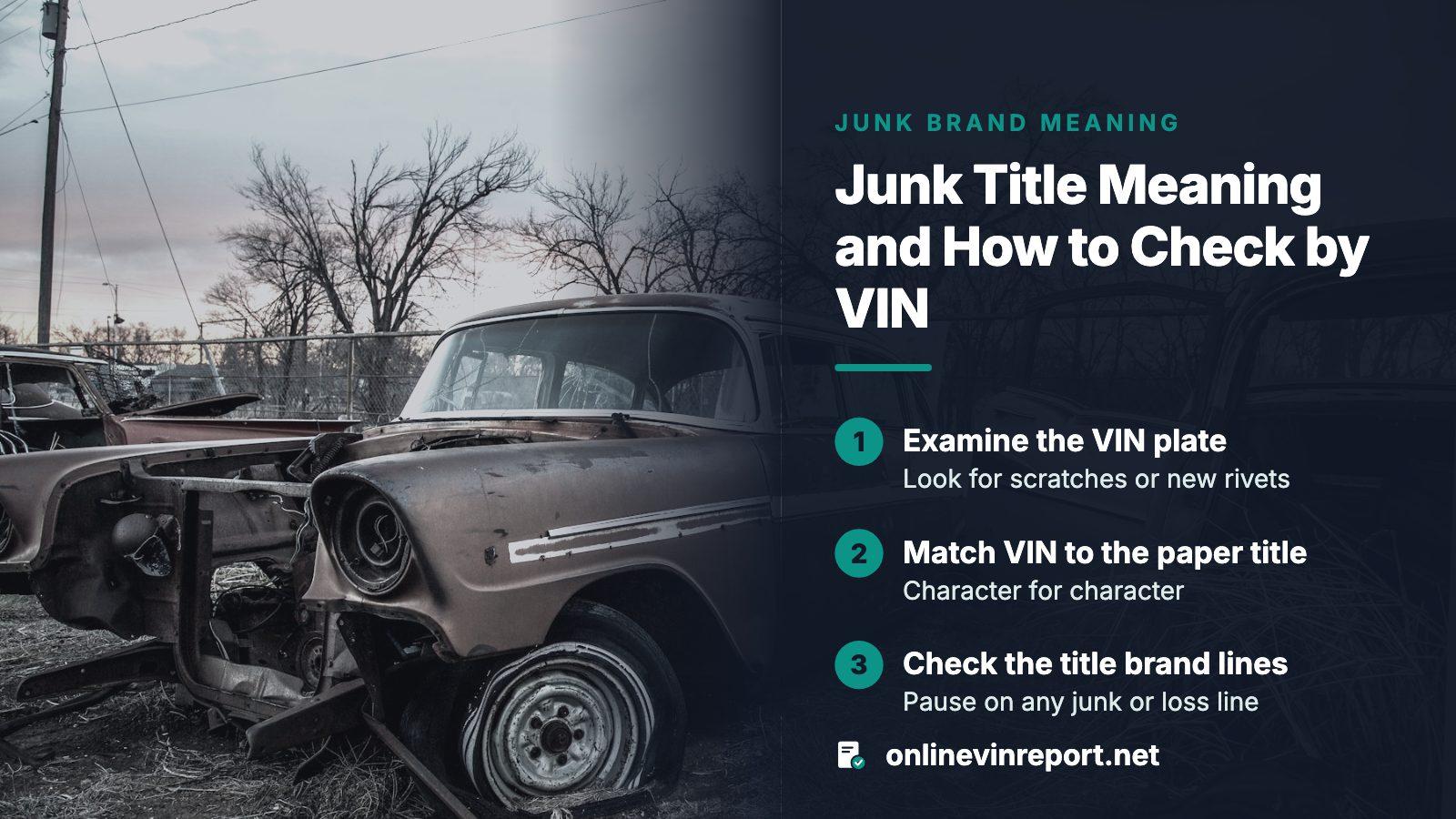
THE SHORT ANSWER
A junk title, sometimes called a junk certificate or a nonrepairable certificate, tells every later buyer that the vehicle cannot return to the road. Federal wording describes a vehicle that can no longer run legally on public roads and whose only remaining worth is as spare components or metal. States differ on names and on exceptions, but the national title database keeps the brand, so a VIN title check is the quickest way to see it.
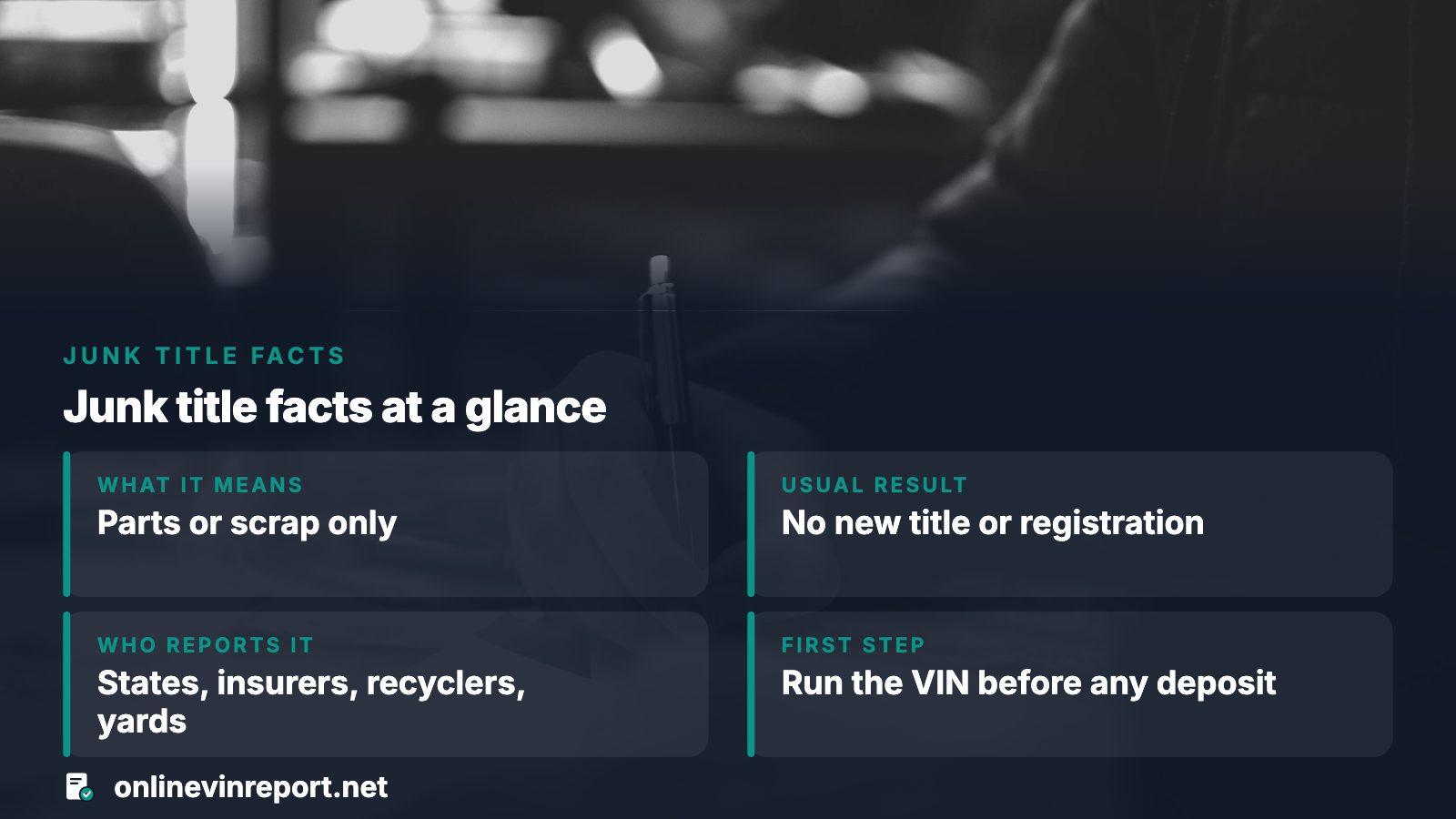
- What it means
- Parts or scrap only, not a road vehicle
- Usual result
- No new title or registration in the state
- Who reports it
- States, insurers, recyclers, junk and salvage yards
- Best first step
- Run the VIN before any deposit
What a junk brand actually says about the vehicle
Title brands are labels that state titling agencies attach to a vehicle's record. The Justice Department's vehicle history site lists junk, salvage and flood as typical examples. Of those three, junk is the bleakest. Salvage says a car was written off but may be repaired. Junk says the car is done.
Federal law gives the term a two-part test. Two things must both be true. The vehicle cannot operate on the public road network, and it holds no value other than what its pieces or its metal would fetch. A car that merely looks rough does not qualify. One that someone has stripped, crushed or burned out does.
Junk, nonrepairable, parts only: the names change by state
The national title system does not rewrite state vocabulary. Each state keeps its own laws and wording, so the brand you see on a paper title may not match the word on a report. One state writes junk, another writes nonrepairable certificate, a third uses a parts-only label.
| State example | Wording | Effect |
|---|---|---|
| Massachusetts | JUNK in the registry record | The state will not title or register it again, ever |
| California | Nonrepairable vehicle certificate | Titling and registration are closed off after issue |
Read the underlying event, not just the label. A vehicle that one state calls junk and another state has never branded is still the same vehicle with the same history.
How a car ends up with a junk brand
In California, a vehicle qualifies for the nonrepairable certificate when its owner declares it only a source of parts or scrap, when it has been stripped to the bare body, or when fire has left an empty hulk with no repairable pieces. When an insurer pays out a claim, the certificate becomes the insurer's job, due within 10 days of that payout. A car with no claim payment leaves the filing to its owner.
Massachusetts starts from the yard side. A person who takes in a vehicle for scrapping has 10 days to give the registry the title, salvage title or other proof of ownership, along with a junking form or a stamped title. The registry then marks the record and shuts off retitling.
Either way, the decision is deliberate. It is paperwork someone filed, which is why it should show up in a title history.
Can a junk title be reversed or washed?
Mostly no. Massachusetts states that once a title is surrendered for junk, the vehicle cannot be put back on the road legally, and California takes the same line after a nonrepairable certificate. Some states carve out narrow exceptions, so check the state that issued it, but plan on the brand sticking.
Why moving states does not help a seller
The national system retains every brand any state applied, so shipping a vehicle across a state line does not erase the junk record. A seller who offers a clean paper title on a car once junked may be relying on a gap in your checking, not a real change in its history.
That is the point of a VIN title check. A paper title can be reissued or forged. The record attached to the VIN is harder to rewrite.
Warning signs of a junk past the seller left out
- An asking price well below the going rate, paired with an explanation about a misplaced title.
- A seller who stalls on sharing the VIN, or a VIN plate with scratches, new rivets or odd glue.
- A title issued only weeks ago by a state other than the one where the car lived.
- Panels that differ in color or gap, or seams that suggest two bodies were joined.
- Only a handwritten bill of sale on offer, with the title promised for later.
Massachusetts requires the VIN to stay on the vehicle through its destruction, so a junked shell still carries an identity that a dishonest seller could try to reuse. Spot any of these and run the number first, then talk price.
Running the VIN title check
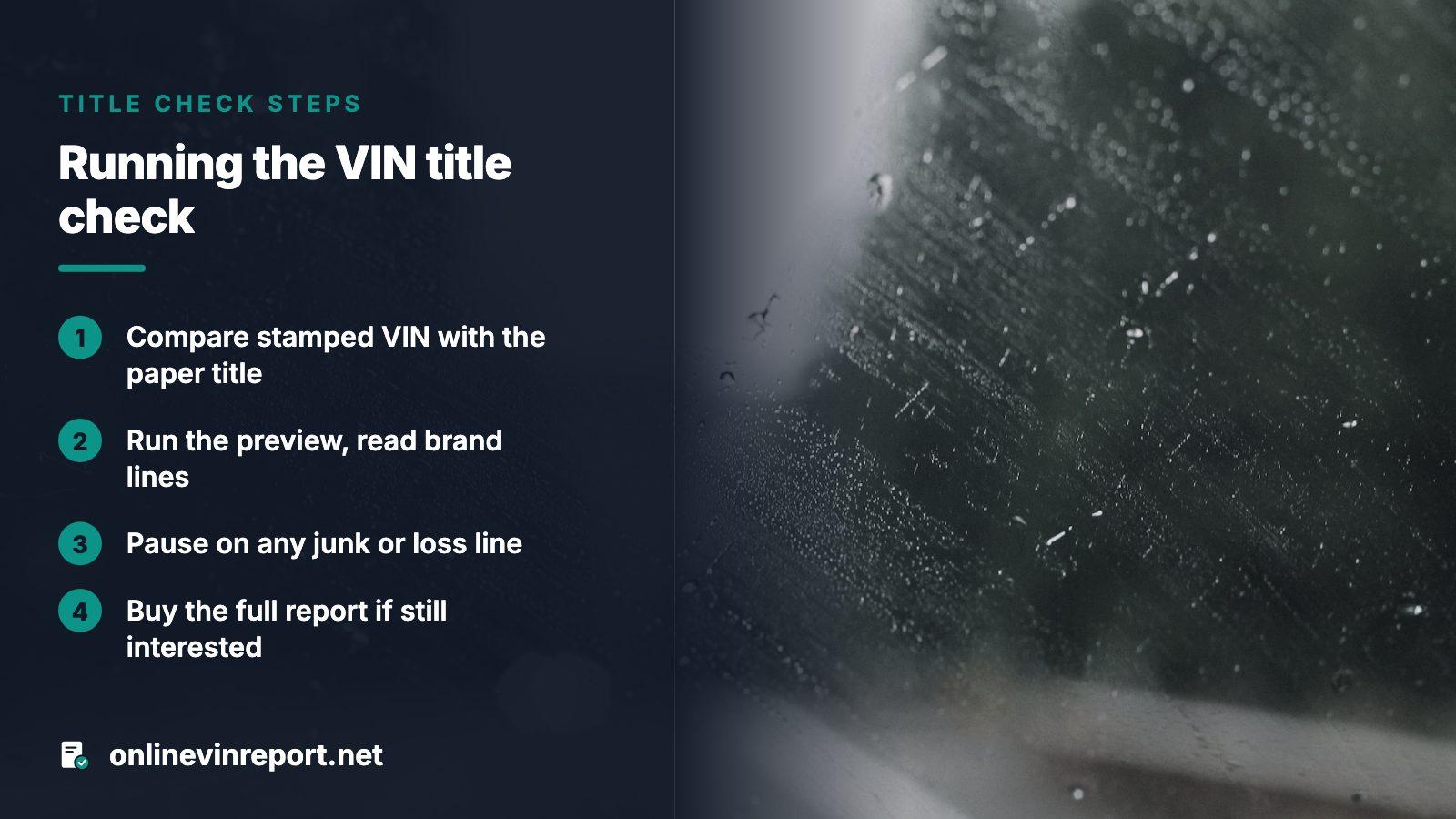
- Compare the number stamped on the vehicle with the one printed on the paper title; they must agree character for character.
- Type it into the preview on this site and look at the title brand lines.
- Any junk, salvage or total-loss line deserves a pause while you hold it up against what the seller told you.
- Still interested after a clean preview? Buy the full report and read the odometer entries, auction history and the rest.
The preview costs nothing to view. After that, one payment buys the full report, nothing recurs, and the pricing page lays out the options. The federal record behind this kind of check spans title status, brands, mileage, total losses and salvage.
Reading what comes back
A junk entry is simple to interpret: walk away from any plan to drive the vehicle. Salvage or total-loss history without a junk brand is a separate matter, because that car may have been repaired and cleared by the state. See our page on the difference between salvage and junk titles if you cannot tell which you have.
A clean result is encouraging, not a guarantee. The Justice Department describes a clean national report as a good thing, though it warns that certain states do not title older vehicles at all, which can leave an aging car with sparse records. Pair the report with an independent inspection.
When a junk-titled vehicle is still worth buying
Some buyers want exactly this: a donor for parts, a project for a closed course, or scrap value. That is legitimate when everyone knows what it is. The problems begin when it is sold as a roadworthy car.
If you are buying for parts, confirm the junk brand is disclosed in writing and price the car as metal and components. Keep your own copy of the check. If you are buying to drive, a junk brand ends the conversation.
Where this information comes from
- Justice Department NMVTIS site: reading a history report — brand examples, five report indicators, who must report
- Justice Department NMVTIS site: consumer guidance — state naming differences and why brands are not washed by moving
- Massachusetts RMV: Junk vehicles — surrender rules and the permanent JUNK record
- California DMV page on nonrepairable certificates — what qualifies as nonrepairable and the effect of the certificate
Sources and photos: Facts checked against the sources above in November 2026. Photos by Leo_Visions, Cole Keister and Owen Michael Grech on Unsplash; diagrams by OnlineVINReport.
Keep reading
- Salvage vs junk title: which brand means the car can still be drivenSorts out which brand you are looking at.
- Non-repairable certificate: what it means and how to find one by VINThe state certificate that often replaces a junk title.
- Parts only title: what it means and how a VIN check finds itAnother name for the same dead end.
- Salvage title VIN check: run it online before you payRun the number before you pay.
Frequently asked questions
Can you drive a car with a junk title?
Generally not. Both Massachusetts and California close the door on retitling a vehicle with a junk or nonrepairable record. With no registration possible, legal driving is off the table. Rules differ elsewhere, so ask the state agency that issued the brand.
Are junk and salvage titles the same thing?
No. Salvage means a vehicle was written off by cost, and many states let it be repaired, inspected and retitled as rebuilt. Junk means parts or scrap only. Some states use other words for the second case, so compare what the record says happened.
Will a VIN check show a junk title from another state?
It should. The national title database keeps each brand a state reported, and junk yards, salvage yards, recyclers and insurers must report to it. A vehicle crossing state lines does not erase the record, though a gap in reporting is possible.
Who decides a car is junk?
It depends on the state. An owner can declare a vehicle parts or scrap only, an insurer may file after paying a total-loss settlement, and a recycler can surrender the title. The state agency then records the brand.
What if the seller says the junk title was cleared?
Ask which state cleared it and request the paperwork, then run the VIN. In the states we read, the record cannot be reversed once issued. A claim that it was removed is a reason for more checking, not less.
Now check the car itself
The guide explains what to look for. The report shows what this VIN has on record.