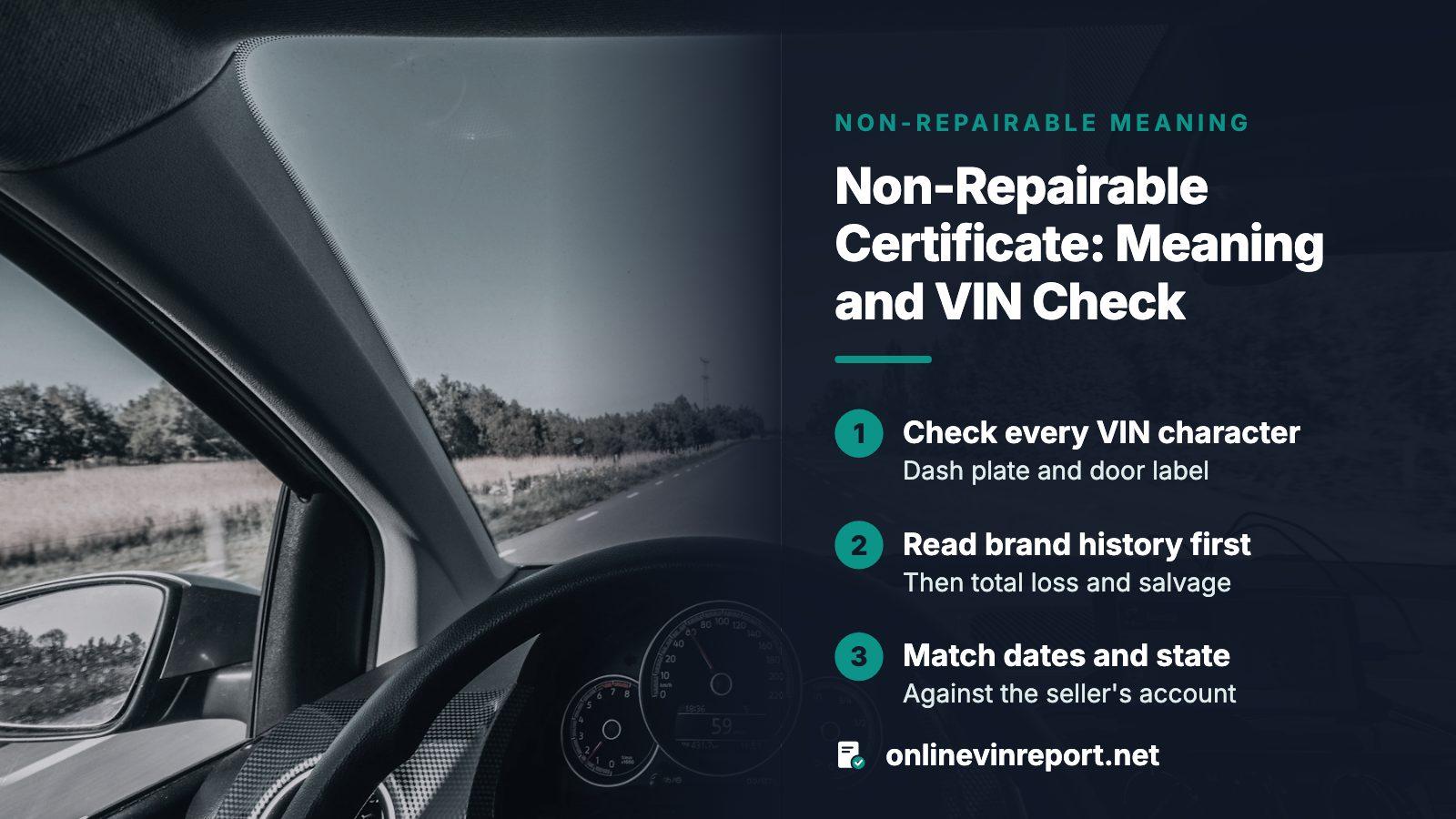
THE SHORT ANSWER
A non-repairable certificate, called a nonrepairable vehicle title in some states, says a vehicle has no future on the road. In California it covers cars declared parts-only, stripped to the bone or burned down to a shell. In Texas the title itself says the car cannot be rebuilt, registered or driven. Because the state brand feeds a national title database, a VIN title check is the fastest way to see it.
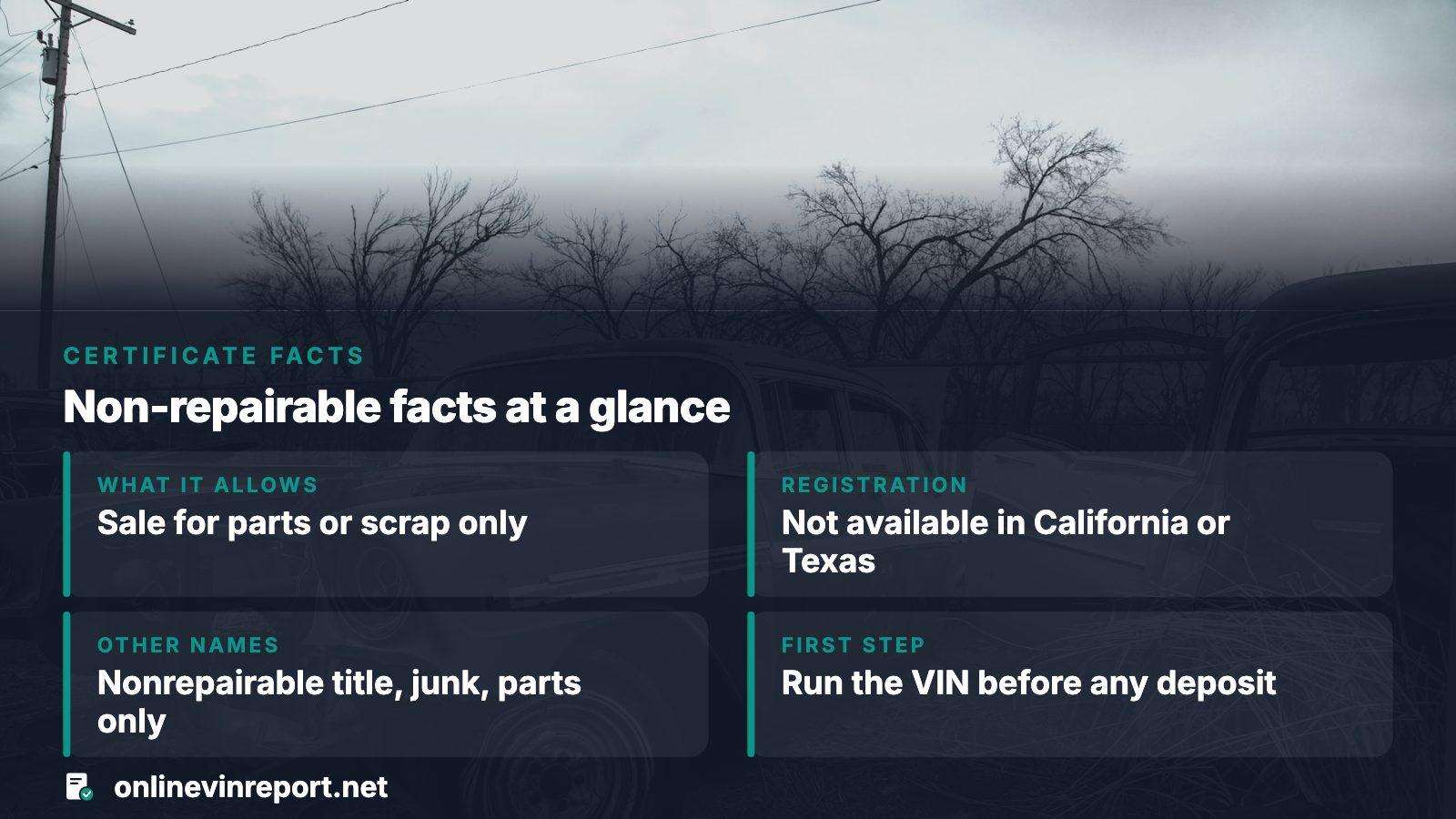
- What it allows
- Sale for parts or scrap only
- Registration
- Not available again in California or Texas
- Other names
- Nonrepairable title, junk, parts only
- Best first step
- Run the VIN before any deposit
What the paper actually tells you
Most title brands describe an event. Flood, hail, fire, theft recovery. A non-repairable certificate describes a verdict. The state looked at the vehicle, or took the owner's word, and decided that the only thing left worth selling is the pieces.
That is why the document matters more than the damage photos. A salvage car can be repaired, inspected and registered again in many states. A car holding this certificate is handled as a source of spare components. If a seller calls it a project, a cheap commuter or a flip, the paper in their hand says otherwise.
How California defines it
California's DMV sets three triggers. The owner can declare the car good only for spares or metal. It can be stripped completely, which the agency calls a surgical strip. Or it can be a burned shell with nothing usable left. After issue, the state will not title or register that vehicle again as a revived junk or salvage car.
Either party can apply, depending on the case. A self-insured owner files for it. If an insurer pays out a settlement, it has 10 days from that payment to obtain the certificate. The request goes in on form REG 488C with proof of ownership, and a missing title means extra paperwork such as a notarized replacement application.
How Texas words the same idea
Texas calls it the Nonrepairable Vehicle Title, issued on form VTR-222-NR. Printed on the document itself is a list of bans: no repair or rebuild, no ordinary title, no registration, no driving in Texas. Used parts and scrap are the only uses left.
Two Texas details catch buyers out. The body and frame of such a vehicle cannot go into building or fixing another one, so buying the shell as a donor chassis is out. Old paper also behaves differently: the state treats a document of this kind issued before September 1, 2003 as salvage, which leaves a rebuild possible. Check the issue date.
Export only is a separate door
Texas also files vehicles sold for export only under its nonrepairable category. A stamp or remark about export on a title is another reason to run the VIN and read the state record rather than trust a verbal explanation.
Same dead end, different labels
Federal title data does not rename what states do. Each state keeps its own vocabulary and its own damage thresholds, so the label on a paper title may not match the word on an online report.
| Where you see it | Typical wording | What to read for |
|---|---|---|
| California paper | Non-repairable vehicle certificate | Parts or scrap, no later registration |
| Texas paper | Nonrepairable vehicle title | No rebuild, no regular title, no road use |
| Online title report | Junk or salvage brand history | Which agency applied it and when |
Read the restriction, not the heading. If the permitted uses are dismantling or scrap, treat it as this category whatever the state chose to print on top.
How an online VIN title check finds it
The Justice Department runs the national title system that these checks draw on. Title agencies, insurers, recyclers, junk yards and salvage yards all feed it, and a brand applied by any state stays in the vehicle's record. Moving the car across a state line does not erase it.
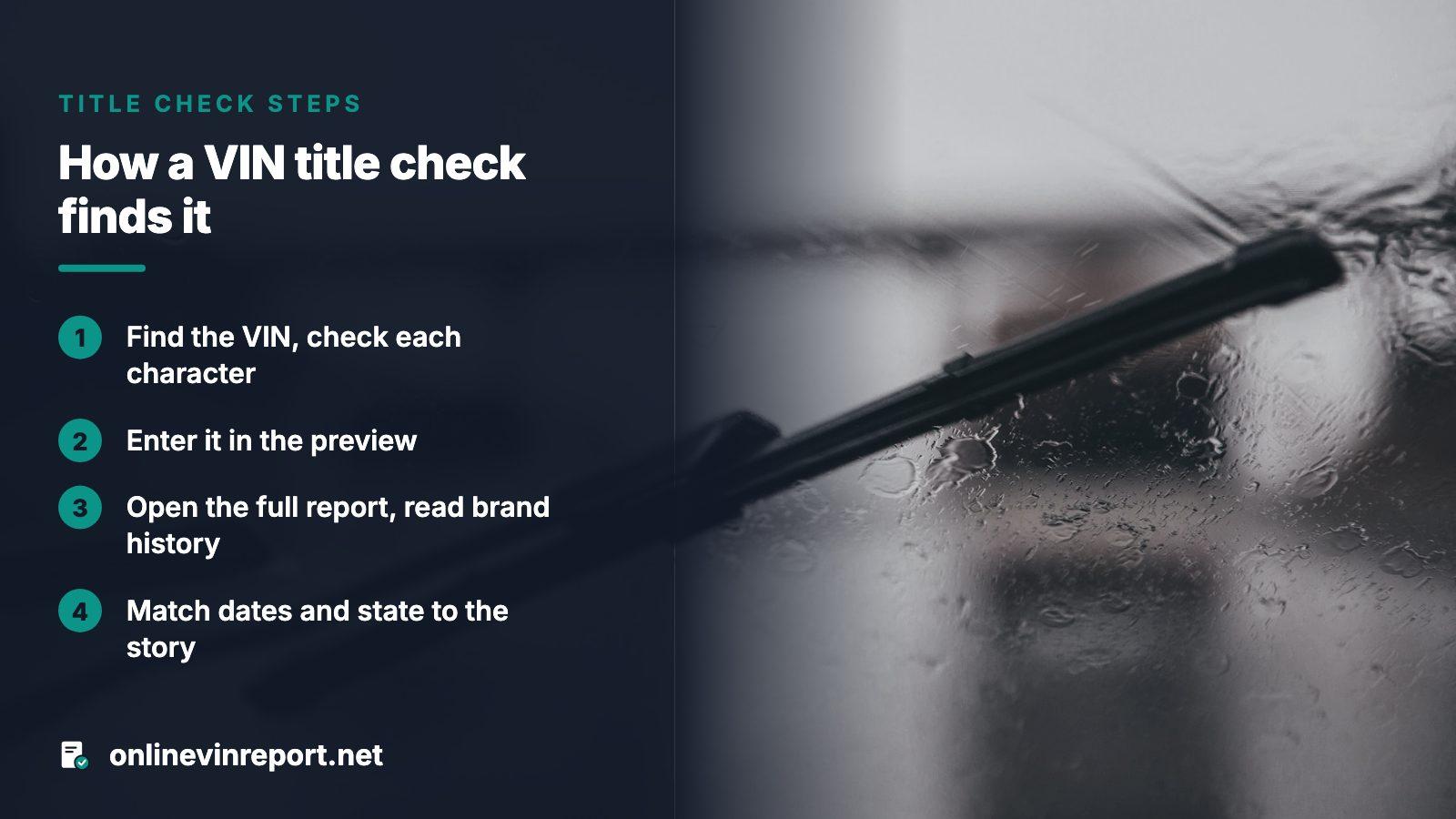
- Find the VIN on the dash plate seen through the glass, or on the driver's door frame label, then check every character against the title.
- Enter it into the preview here. The preview costs nothing and tells you whether brand records exist.
- Open the full report if you are serious, and read the brand history and the total loss and salvage entries first.
- Match the dates and the state against what the seller told you.
Reading a clean result with care
The federal system says a clean report is a good thing, and it is meant to be short. It also has gaps. Coverage reaches about 87 percent of vehicles, and only some states feed it, which means a vehicle whose brand never arrived can still look clean.
An insurer's total loss label can mislead in the other direction. An unrecovered stolen car can be labeled that way and later turn up undamaged. So read the report beside the state's own title record, which each federal report links to, and add a hands-on inspection.
Red flags when a car may have been through this
- A seller who has a bill of sale but cannot produce the title.
- A title issued in a different state from where the car was last registered.
- A VIN plate held on with something other than rivets.
- Mud, mold or rust under the trunk carpet, or resealed airbag covers.
- An airbag warning lamp that stays lit.
- A price far below similar cars, with a story that does not match the paperwork.
California's DMV lists several of these as clues to an undisclosed salvage past. Dealers there must pull a title history before offering a used car and post a disclosure if it shows junk or salvage, but the agency admits the seller disclosure rule is hard to enforce when the car arrives from elsewhere.
When buying one is legitimate
Dismantlers, parts sellers and scrap buyers deal in these vehicles every day, and the paper exists to let that trade happen openly. If you need a door, an engine or a set of seats and the seller shows the certificate up front, the sale is honest. The trouble starts only when the same car is pitched as transportation.
Ask yourself one question before paying. Can this car legally go on the road under the paper I am looking at? If the answer is no, price it as parts, and decide whether a VIN check is still worth running to confirm the seller's account.
Where this information comes from
- California DMV: Total loss salvage and non-repairable vehicles — what qualifies, the effect on registration, who applies and the form
- California DMV: Branded titles — brand wording, dealer disclosure duty and physical clues
- TxDMV: Salvage and nonrepairable motor vehicle manual — definition, wording on the title, body and frame rule, 2003 name change
- NMVTIS: For consumers — permanent brands, state differences, coverage gaps
- NMVTIS: Understanding a vehicle history report — the five indicators and who must report
Sources and photos: Facts checked against the sources above in November 2026. Photos by Sander Jeurissen, Thibault Valjevac and Leo_Visions on Unsplash; diagrams by OnlineVINReport.
Keep reading
- Salvage vs junk title: which brand means the car can still be drivenSorts out which of the two brands you are looking at.
- Parts only title: what it means and how a VIN check finds itAnother label for a vehicle with no road future.
- Salvage title VIN check: run it online before you payThe step-by-step check to run before you pay.
- Title washing: how a brand vanishes and what a VIN title check can showHow brands get hidden and why the national record helps.
Frequently asked questions
Can a car with a non-repairable certificate be registered?
Not in the two states checked for this page. California will not title or register it again as revived junk or salvage, and the Texas document bans registration and driving there. Other states differ, so ask the agency that issued yours.
Is a non-repairable certificate the same as a salvage title?
No. Texas separates them by damage level: salvage means repair cost beyond the car's pre-damage value and allows a rebuild, while nonrepairable means only parts or scrap value is left. Salvage can lead to a rebuilt title after inspection. This certificate cannot.
Will a VIN check show a non-repairable brand?
Often, yes, because states, insurers and salvage yards report to a national title database and brands stay on the record. It can still miss a car whose state never reported, so compare it with the state title record and get an inspection.
Who applies for the certificate after a total loss?
In California a self-insured owner applies, and an insurer that pays a settlement must apply within 10 days. Texas also places the duty on the insurance company or the owner. The exact timing and forms are set by each state, so check the current rules with the DMV.
Can I use the shell of a non-repairable car to rebuild another?
In Texas, no. The state bars using a nonrepairable body and frame to fix, rebuild or put together another vehicle. Loose parts such as seats or an engine can be sold on. Check your own state's rule before buying any shell.
Now check the car itself
The guide explains what to look for. The report shows what this VIN has on record.