THE SHORT ANSWER
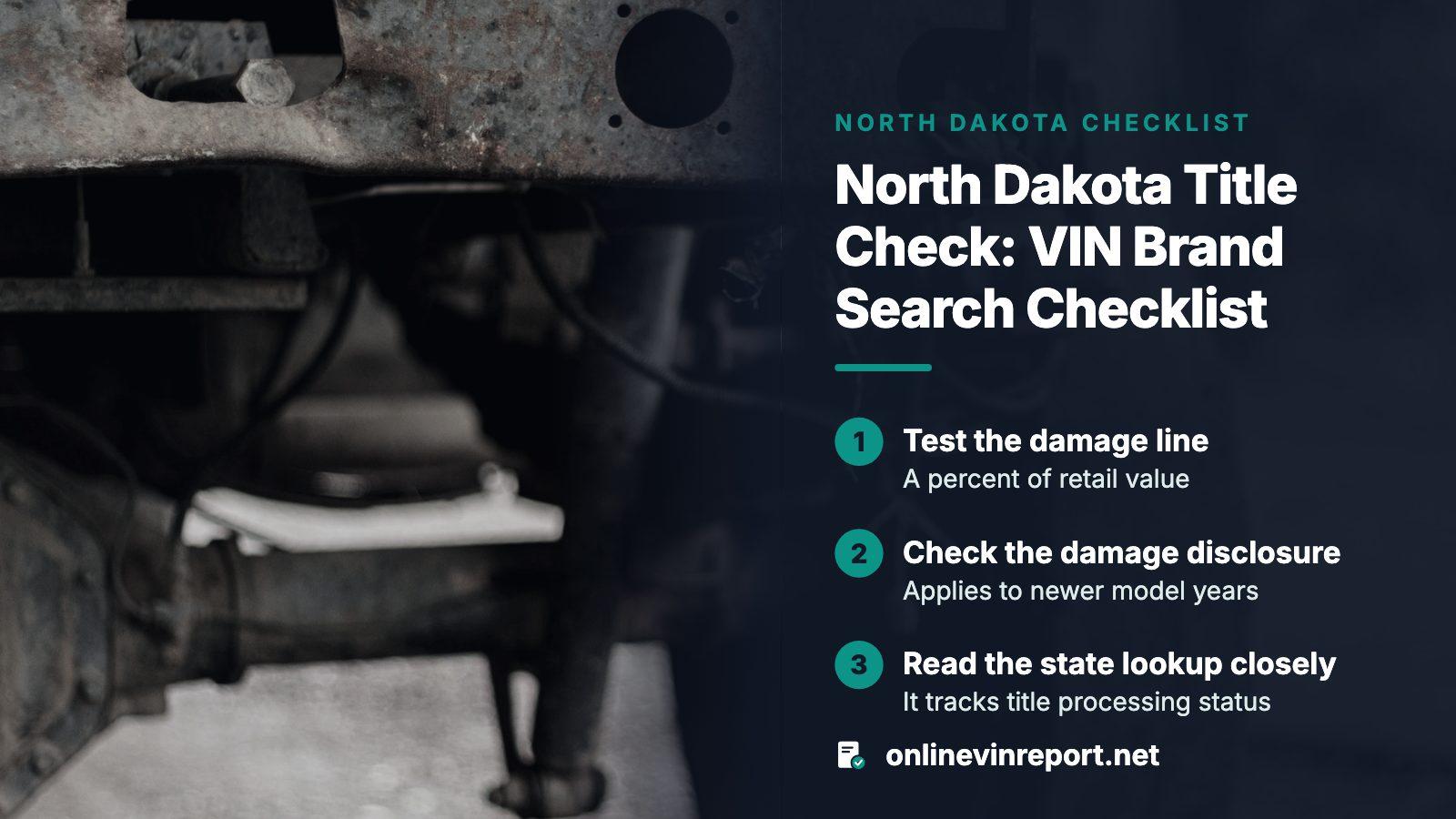
To check a North Dakota title, copy the VIN from the car, run it through an online title search, and write down each brand with the state that issued it. Then test the paper title against that list: the Salvage or Previously Salvaged wording, a lender still named, clean signatures, and a damage disclosure on cars under nine model years old. NDDOT describes its own online lookup as a processing-status search.
- Salvage line
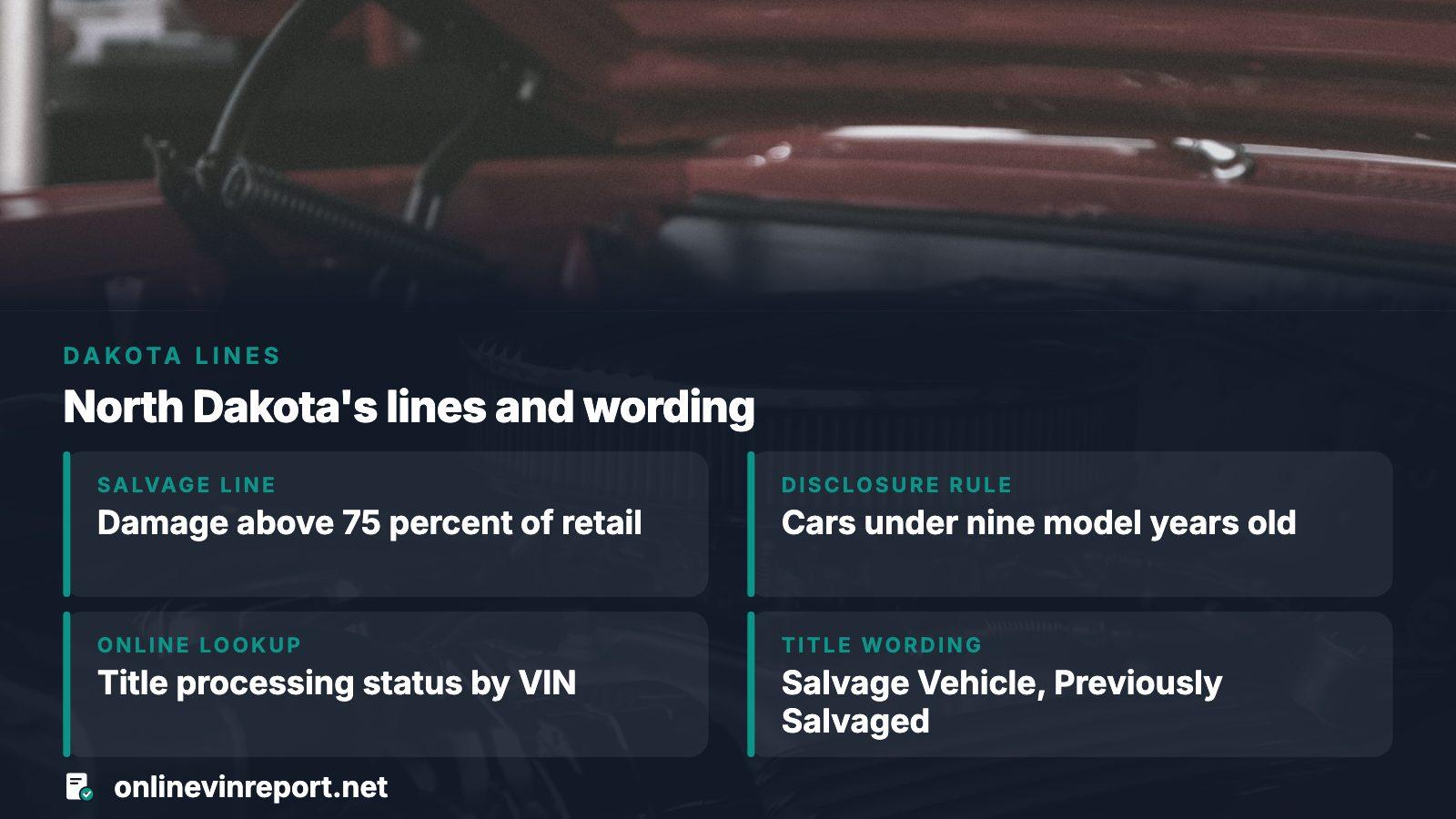
- Damage above 75 percent of retail value
- Damage disclosure
- Greater of $10,000 or 25 percent, on cars under nine model years old
- State online lookup
- Described as a title processing-status search, by VIN
- Preview
- Free; the report is one payment
Four North Dakota title answers and what each leaves out
No single record settles a North Dakota title. Each source answers one question and leaves another open.
| Source | What it tells you | What it leaves out |
|---|---|---|
| Online VIN title search | Brand, total-loss and salvage-yard entries tied to the VIN, from any reporting state. | Repair work, and states that have not reported. |
| NDDOT Title Status Check | Where a title application stands, searched by VIN. | Damage history; NDDOT calls it a processing-status search. |
| Paper title | North Dakota's damage wording, any lender named, the seller's signed assignment. | Anything another state recorded. |
| Form SFN 51269 | Registered owner and lienholder on the state's file, for a $3 fee. | Release runs through exceptions in the administrative rules. |
The seven checks, in order
Run these before a deposit changes hands.
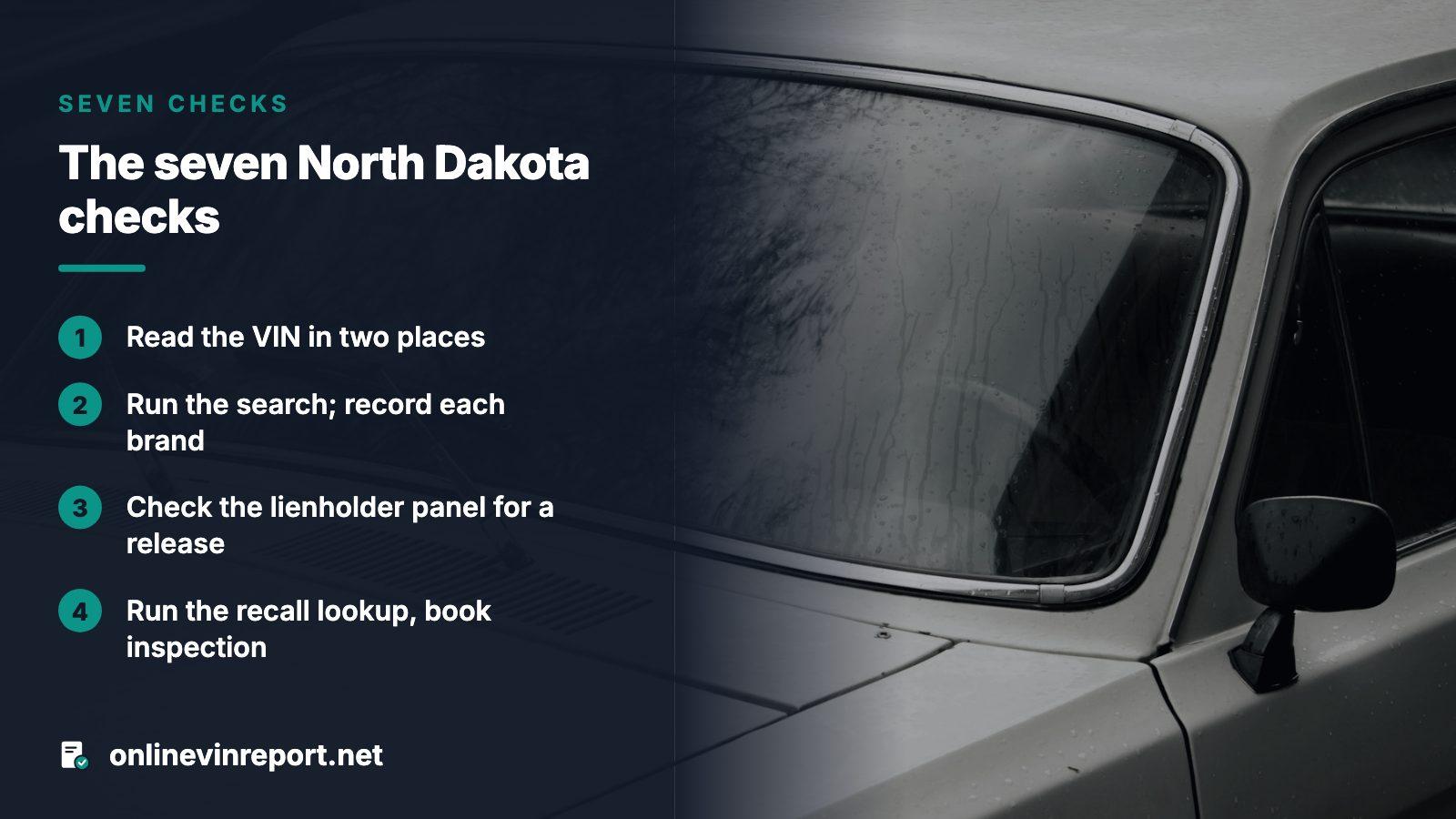
- Read the VIN from two places on the vehicle and match both against the title and the sales paperwork.
- Run the VIN search. Record every brand with its state and date.
- Compare with the title's wording: Salvage Vehicle, Previously Salvaged or Previously Damaged.
- Find the lienholder panel. If a lender appears, ask for the signed release before paying.
- Inspect the assignment: every box filled, nothing crossed out or whited out, and a mileage statement for model year 2011 or newer.
- On a car under nine model years old, ask for the seller's damage disclosure, form SFN 18609.
- Run the free federal recall lookup NDDOT recommends, then book an independent inspection.
What North Dakota prints on a damaged vehicle's title
The state uses three phrases for a damaged vehicle, and a fourth category never reaches a North Dakota title.
| On the title or the search | What it usually means here | Your move |
|---|---|---|
| Salvage Vehicle | Title returned after damage passed the 75 percent line; no registration until inspected. | A project car. Ask for the inspection certificate first. |
| Previously Salvaged | Reconstructed, then inspected by a different repair business; the words repeat on later titles. | Price it as a former write-off; ask for major-part receipts. |
| Previously Damaged | Damage on record, with a pointer to the department for details. | Ask the department and the seller for the disclosure. |
| Junk, parts only, non-rebuildable or certificate of destruction (other states) | North Dakota refuses these titles. | Not a road car. |
The manual's title wordings never include flood. A flood car shows up as another state's flood entry on the VIN search, or through the water clause in the damage rules. Some states have no flood designation at all, so a quiet title proves little on a car that lived elsewhere.
Where the 75 percent and 25 percent lines fall
Two thresholds shape a North Dakota title. Damage past 75 percent of retail value, per the dealers' used-car guide, gives the owner ten days to send the title in, after which the division issues a salvage certificate. Hail and glass damage stay out of the count.
The lower line is the disclosure rule. On a car under nine model years old, the seller must disclose body damage from a crash, fire, vandalism, weather or submersion once it hits $10,000 or 25 percent of the pre-damage value, whichever is larger. The manual's examples:
- A $15,000 car: 25 percent is $3,750, so $10,000 governs. Damage of $7,000 needs no disclosure.
- A $50,000 car: 25 percent is $12,500, which is higher. Damage of $13,000 must be disclosed.
A repaired car can look clean on paper
Damage under those lines leaves no notation, and a disclosure can come off after more than eight years for $5 if the car has no salvage history. Insurance and auction entries on a VIN report can show damage the paper never did.
Liens, duplicates and the seller's signature
- The title shows that a lien exists and who holds it; the amount need not appear. The lender named stays the legal owner until the lien is released.
- A lender has ten days after demand to sign a release, and thirty days at most after payoff. Ask for the signed paper.
- A duplicate title carries a warning that someone may hold rights under the original, so ask why it was issued.
- The sample title says erasures, alterations or mutilations void it, and forging an assignment is a class C felony. Reject a corrected title.
If the seller cannot produce a title
A resident who owns a car with no proper title can ask North Dakota to establish ownership, and the first step is a history check bought from an approved provider. If any state shows a title or ownership record, the route stops. The division then searches all states and the National Crime Information Center, and the Bismarck office mails the title after review. Same-day issue is not possible.
For a buyer, the lesson is timing: a car with no title is not yours on a handshake. Cars more than 40 years old can substitute an affidavit of ownership for some of that paperwork, and every applicant must be a North Dakota resident.
Reading the search against the paper
- A brand on the search that the title never mentions: ask which state handled the claim.
- Salvage wording from a seller who says it was repaired: ask for the inspection certificate and major-part receipts.
- A rebuilt car with an unfamiliar VIN: the division may assign a North Dakota number to a rebuilt vehicle, so ask for the original and search both.
- A junk or parts-only entry from elsewhere: the state refuses that title, so question the paper on offer.
- A mileage figure on the report above the dash reading, or no mileage statement on a 2011-or-newer car.
Silence on a search proves less than it seems
The federal title system warns that a search can return no brand because states have not reported, and it holds no repair history. Treat silence as one good sign, then pay a mechanic to look underneath.
Preview first, then the report
Run the preview first. It shows at no cost whether the VIN carries brands, salvage entries or auction photos. For a car still on your list, buy the report once. Packs of 3, 5 or 10 exist for comparing several cars, and nothing renews. See the pricing page for amounts.
Read the brand entries first, then odometer readings, salvage photos and any lien or impound line, and take each finding to the seller with the paper title. State law gives the buyer thirty days from receiving the title to file it, so plan that visit before paying.
Where this information comes from
- NDDOT: Motor Vehicle Registration Manual — Source for the title wordings, the salvage and disclosure thresholds, inspection duties and form numbers.
- North Dakota Century Code chapter 39-05: Title registration — Source for the salvage and reconstruction rules, grounds for refusing a title, lien release timing and the filing window.
- NDDOT: Title Status Check — Shows what the state's online lookup is described as doing and how the VIN is entered.
- NDDOT: Vehicle Recalls and History Reports — Source for the state's pointer to the recall lookup and to history reports sold by approved providers.
- NDDOT: Vehicles more than 40 years old — Source for the older-vehicle route and its residency rule.
- NMVTIS: Consumer information — Source for what title records hold, how state brands differ and the warning about empty results.
- NMVTIS: Frequently asked questions — Source for the missing repair history and what a blank result likely means.
Sources and photos: Facts checked against the sources above in November 2026. Photos by Zoshua Colah, Tigran Shishmanyan and Victor Hughes on Unsplash; diagrams by OnlineVINReport.
Keep reading
- What is a branded title? How to read salvage, flood and rebuilt brands by VINWhat each brand label signals and how it moves a car's value.
- Check title and lien by VIN: brands first, then who holds a claimHow to confirm who really holds the title and whether a lender is still on it.
- Rebuilt title inspection: what the state checks and what a VIN title check addsWhat an inspection of a rebuilt car proves and what it cannot.
- Registering a car without a title: what the VIN check shows firstThe options when a car arrives with no paper title.
Frequently asked questions
How do I do a North Dakota title check?
Copy the VIN, run it through an online title search and note each brand with its state. Compare the list with the paper title, ask for a signed lien release if a lender is named, and request the damage disclosure on newer cars. Then get an independent inspection.
Does North Dakota have an online title search?
NDDOT lists a Title Status Check among its online services, searched by VIN. The page calls it a search for current processing status, so it shows where a title application stands rather than what damage the car had. A VIN history search covers brand entries from other states.
Can I register a salvage car in North Dakota?
Not until it passes inspection. The Salvage Vehicle wording says inspection comes before registration. A repair shop other than the one that rebuilt the car signs the certificate of vehicle inspection, and the later title carries the words Previously Salvaged.
Will North Dakota title a car branded junk in another state?
No. The state refuses titles from other states or countries marked certificate of destruction, junk, parts only, non-rebuildable or unrepairable. A salvage-branded title is accepted and becomes a branded North Dakota title, so a salvage entry follows the car across the border.
Is a North Dakota title clean if it shows no damage notation?
Not necessarily. Disclosure applies to cars under nine model years old and needs damage of at least $10,000 or 25 percent of value, whichever is higher. Repairs below that leave no notation. Insurance and auction entries on a VIN report can show what the paper omits.
Now check the car itself
The guide explains what to look for. The report shows what this VIN has on record.