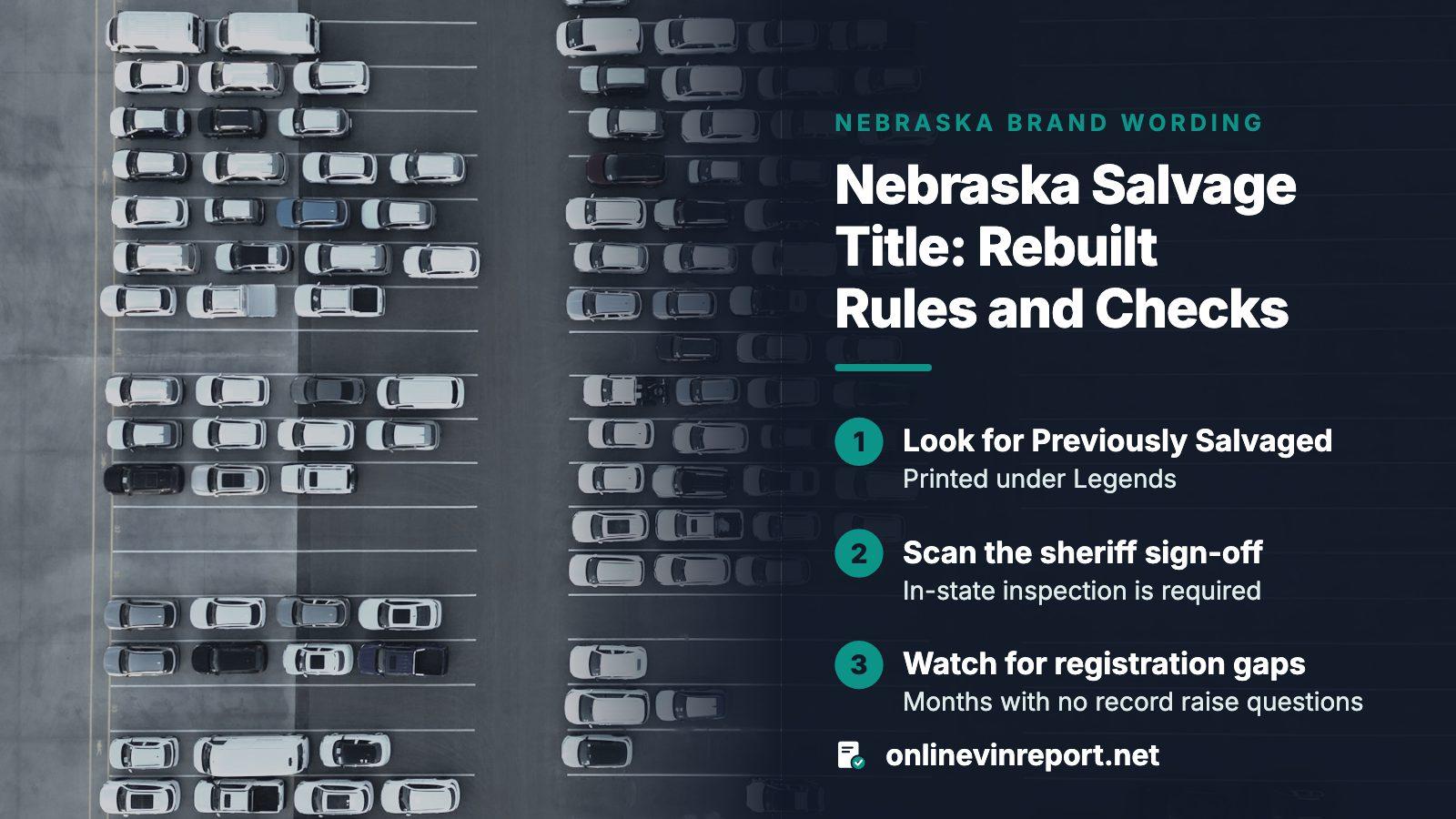
THE SHORT ANSWER
In Nebraska a late model car is salvage when repairs would run past 75% of its retail value. The owner or insurer gets a Salvage Certificate of Title. Once the car is fixed and passes a sheriff inspection inside the state, the title is reissued as Previously Salvaged, and that wording follows the car onto every later title and registration. Check the VIN before buying.
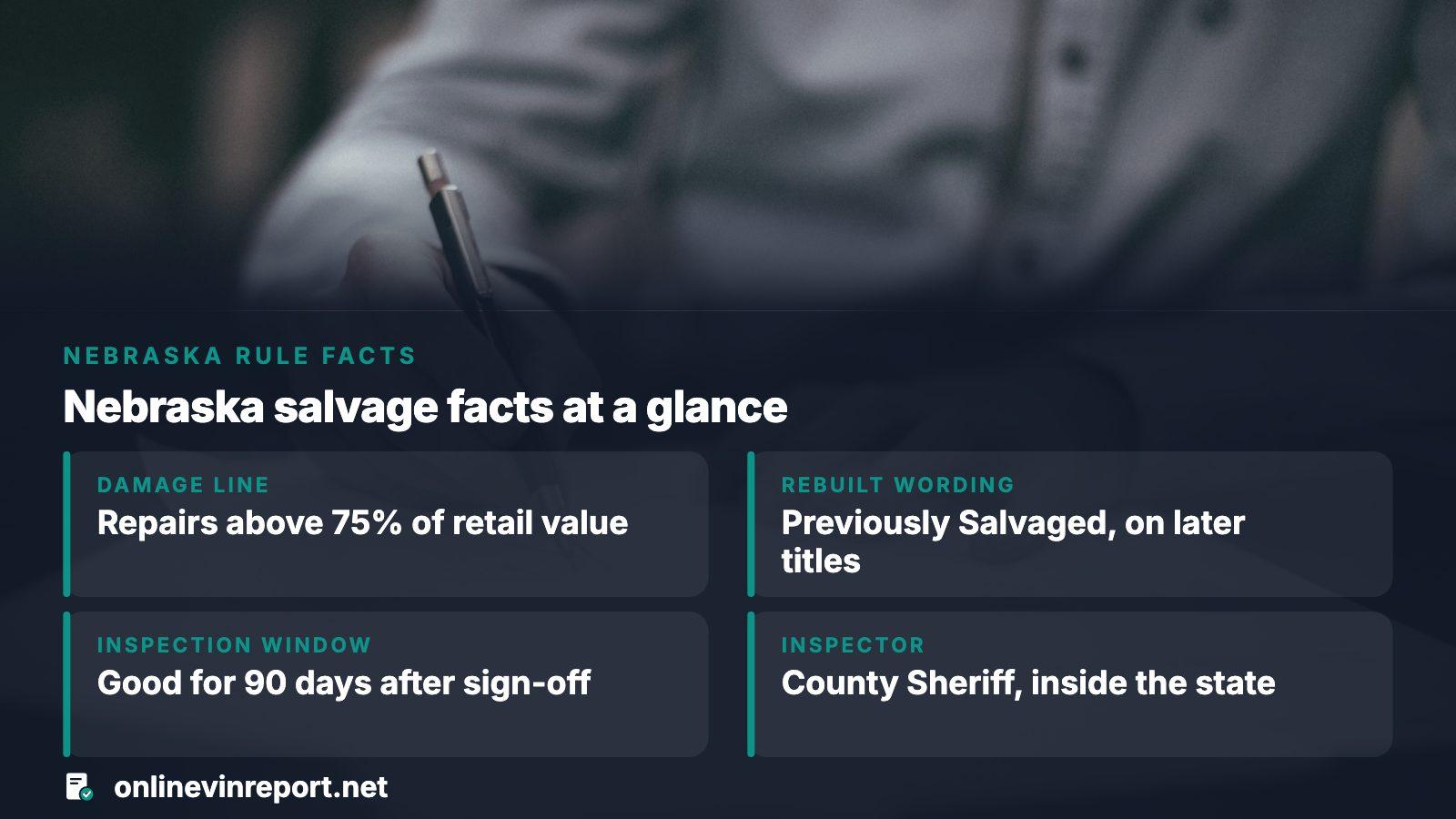
- Damage line
- Repair cost above 75% of retail value
- Rebuilt wording
- Previously Salvaged, kept on all later titles
- Inspection window
- Good for 90 days after the sheriff signs off
- Preview
- Free look, paid report afterward
What Nebraska means by a salvage vehicle
The state's definition has two tests, and a car has to pass both. First, the damage: the estimated cost to restore the car to its pre-damage condition must come in above 75% of what it was worth just before the loss. Second, the age or value: the car must be a late model vehicle, which the DMV defines as seven model years old at most, or one with a retail value above $12,500. On January 1, 2030 that $12,500 line moves to $13,000.
The repair estimate adds parts at retail prices and labor at the usual hourly rates, and it may come from collision estimating manuals or the software insurers already use. Value can come from a national pricing compilation or from a survey of comparable cars. An older, cheaper car can be wrecked past the percentage and still fall outside the legal definition, so a missing salvage brand does not prove the car escaped damage.
Who gets the salvage title, and when
When an insurance company pays a total loss claim and takes the car, the Salvage Certificate of Title is issued in the company's name. If the previous owner cannot produce a properly signed title, Nebraska has an affidavit the insurer can file in its place.
Owners who keep the wreck have a deadline attached. The insurer reports the car to the DMV electronically and has 30 days after settling to tell the owner that a salvage title is now required. The fee is $10.00, paid with the title application at any County Treasurer. Some owners also request the brand on purpose, and the state allows that whatever the car's age, damage or value, which is one more reason a salvage entry can sit on a car that was barely scratched.
From salvage certificate to rebuilt title
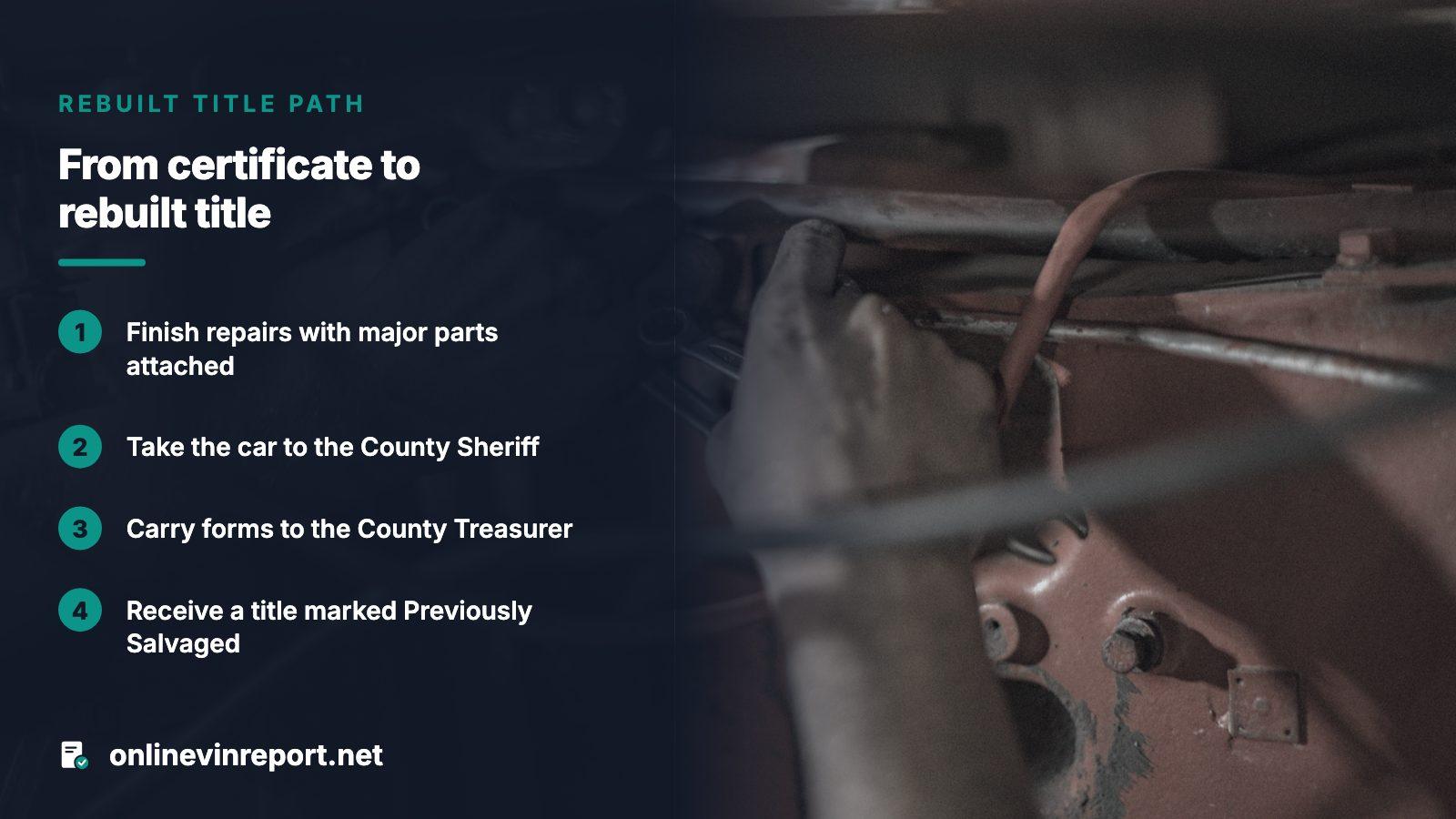
A car on a salvage certificate cannot go back on public roads as it stands. Nebraska wants it repaired, inspected and retitled first. The steps run in this order:
- Finish the repairs, with every major component attached where it belongs.
- Take the car to the County Sheriff for a vehicle inspection, bringing proof of ownership.
- Carry the signed inspection form, the Salvage Certificate of Title and a title application to the County Treasurer.
- Receive a new title with Previously Salvaged printed under Legends on its face.
- Apply for registration, which will also show the brand.
Nobody gets to skip the inspection or choose a softer label. The Previously Salvaged wording is carried onto every title issued after this one.
What the sheriff inspection covers
The inspection is an identity check, not a quality check. The deputy matches the number stamped on the vehicle to the number on the title paperwork and records the odometer. Nothing in the DMV's description says the inspector looks at brakes, frame repairs or airbag work, so a passed inspection tells you the paperwork matches the metal and little more.
| Detail | What Nebraska says |
|---|---|
| Who inspects | The County Sheriff |
| Fee | $10.00 |
| Shelf life | 90 days from the inspection date, then a repeat is needed |
| Location | Inside Nebraska for a salvage-to-rebuilt conversion; an out-of-state inspector is not accepted |
| Precondition | All major component parts must be attached in the right place |
Because the paperwork is what gets inspected, a buyer who wants to know how well the repair was done still needs an independent mechanic.
Why a junk entry is a dead end
Salvage can be recovered. Junk cannot. In Nebraska's wording a junk vehicle is one that cannot operate on a highway and is worth nothing beyond scrap or parts. Every owner named on the title signs it over to a buyer listed as JUNK, an open lien needs the lender's permission first, and the County Treasurer sends the paperwork on to the DMV. At the state office the status goes into the computer system and the paper title is shredded.
No way back
After a Nebraska title is surrendered as JUNK, it stays out of service for good. The vehicle can supply parts and nothing else. If a VIN check shows a junk entry on a car advertised as a daily driver, hold off on paying and ask the seller for documents first.
Brands that arrive from other states
Nebraska does not wait for its own salvage process to apply. When an out-of-state title shows any hint of damage, the brand is copied onto the Nebraska title, together with the issuing jurisdiction's name. Among the notations the DMV lists are damaged, flood, junked, manufacturer buyback, rebuilt, reconstructed, repaired and total loss, along with any further phrasing that signals damage.
Every car brought in from elsewhere also needs a sheriff inspection, including cars another state only registered. That makes Nebraska a harder place to launder a brand than some neighbors, but it does nothing for a car that sat in a lot in a state with looser standards and is now being sold to you by a private party.
Run the VIN before you look at the paper
Copy the 17-character VIN off the Nebraska car itself, not the ad, then enter it into a title check. The federal NMVTIS system gathers data from titling agencies, insurers, recyclers and salvage yards, so it can show brand history, the latest odometer reading, whether an insurer declared a total loss or salvage, and any handover to a salvage yard. This site's full report pulls those records together. You get a free preview first and decide about buying afterward.
- A salvage or junk entry on a title the seller calls clean.
- A total loss date with no matching Previously Salvaged wording after it.
- A gap of several months where the car seems to have no registration.
- An odometer reading that drops between records.
A single report or a pack of several is priced on the pricing page. You pay once, with no subscription attached.
What a clean result cannot promise
The Justice Department's NMVTIS page is frank about gaps. Reporting is not yet universal, so a search can return nothing for a car that has a salvage or junk past. A car that spent time at a wrecking yard does not have to carry a brand either, because state laws differ on when one is required.
Total loss labels cut the other way. A stolen car that nobody finds within a month may be declared a total loss by its insurer, and that label survives even when the car is recovered without a scratch. Read the date and the reason, not just the word. Then compare the report to the seller's title, and book a mechanic to inspect the car on a hoist. A rebuilt car priced sensibly, with repair records you can read, is a reasonable buy. A rebuilt car sold as a normal one is not.
Where this information comes from
- Nebraska DMV: motor vehicles salvage titles — Where the salvage definition, late model test, certificate fee and Previously Salvaged wording come from.
- Nebraska DMV: vehicle inspection — Who inspects, what is compared, the fee, the 90-day expiry and the in-state rule.
- Nebraska DMV: junked title — The steps for surrendering a title as JUNK and why that is permanent.
- Justice Department NMVTIS: consumer page — What the national title database holds, and the cases where it misses a brand.
Sources and photos: Facts checked against the sources above in November 2026. Photos by Iain, Nina Mercado and Scott Graham on Unsplash; diagrams by OnlineVINReport.
Keep reading
- Nebraska title check: search a car's brands by VIN before you buyThe VIN search itself, with Nebraska's lien and odometer wording.
- Rebuilt title inspection: what the state checks and what a VIN title check addsWhat a rebuilt car should be looked at for beyond the paperwork.
- Salvage title VIN check: run it online before you payHow a VIN search surfaces salvage entries in any state.
- Salvage vs junk title: which brand means the car can still be drivenA closer look at the difference between the two brands.
Frequently asked questions
What makes a car salvage in Nebraska?
Repairs estimated above 75% of the car's retail value just before the damage, on a late model vehicle: seven model years old at most, or retail value over $12,500. Owners may also request the brand voluntarily, whatever the car's condition, so a salvage entry does not always point to a heavy wreck.
Is Previously Salvaged the same as a rebuilt title in Nebraska?
In practice yes. Nebraska prints Previously Salvaged on the face of the title once a repaired salvage car passes inspection, and keeps it on later titles. Other states use the word rebuilt. Nebraska also copies rebuilt notations from other states' titles onto its own, so you may see either word.
Can a Nebraska salvage title be removed?
No. Nebraska's rules say the brand carries forward on all later titles, and the federal database keeps a brand permanently once a state applies it. Selling the car in another state does not erase it from the record, though a state with no branding rule may leave it off a paper title.
Can I drive a car that only has a salvage certificate?
Not on public roads. Nebraska requires the repairs, a sheriff inspection and a title branded Previously Salvaged before the car can be registered and driven. Only that final title lets the owner apply for registration, and the registration will carry the brand too.
How can I tell if a car I'm buying has a Nebraska salvage brand?
Enter the VIN in an online title check, then read through the brand history and any insurer total loss entries, previewing what turns up before you pay. Compare the result with the seller's paper title, since a check can miss reports from entities that have not yet submitted data.
Now check the car itself
The guide explains what to look for. The report shows what this VIN has on record.