THE SHORT ANSWER
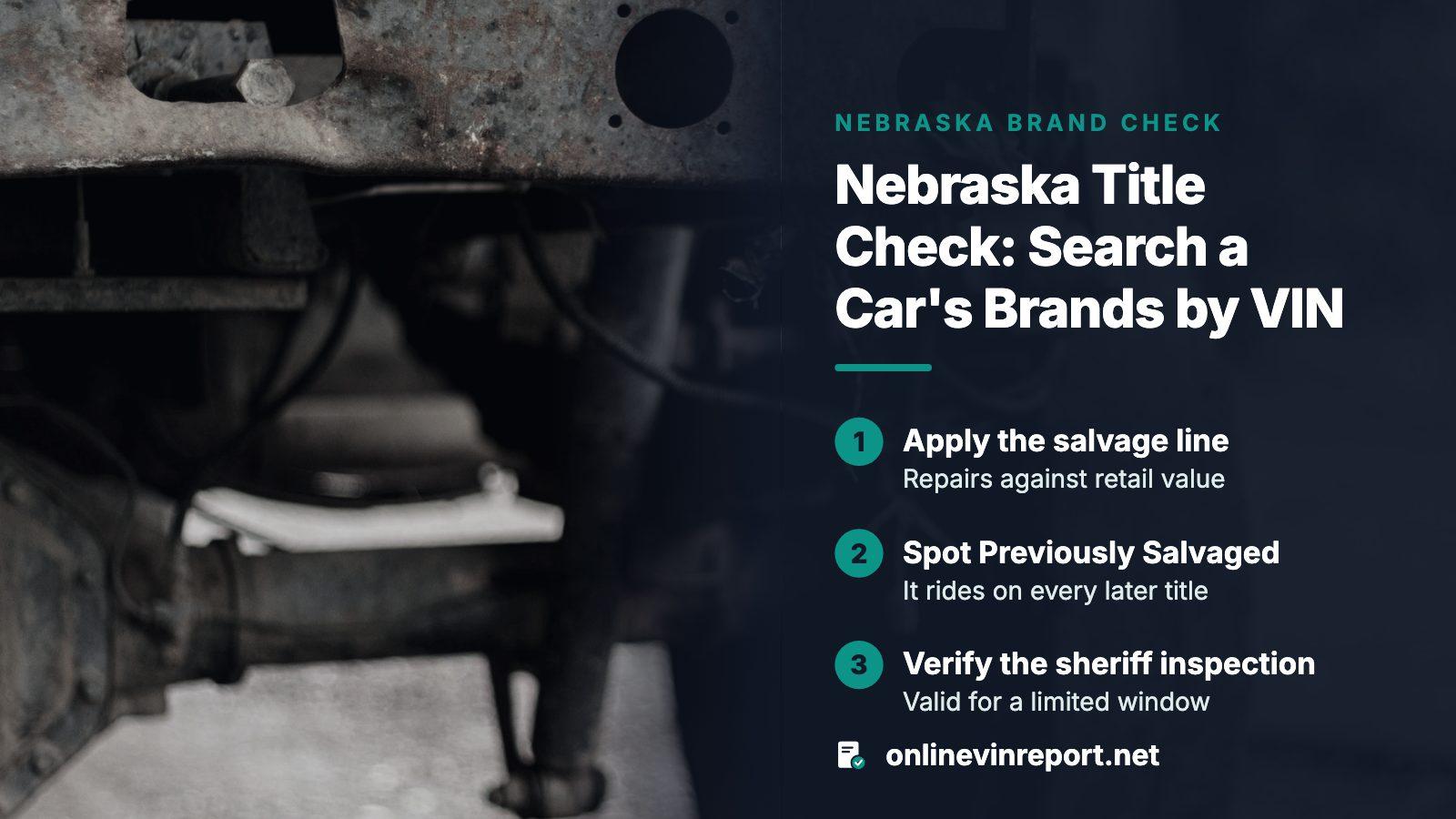
Start with the 17-character VIN on the vehicle itself, run an online title check for salvage, flood, rebuilt and junk brands, then hold the result up against the paper title. Nebraska copies another state's damage notation onto its own title and keeps its Previously Salvaged brand on every later title. A clean paper title over a branded history means pause and ask questions before paying.
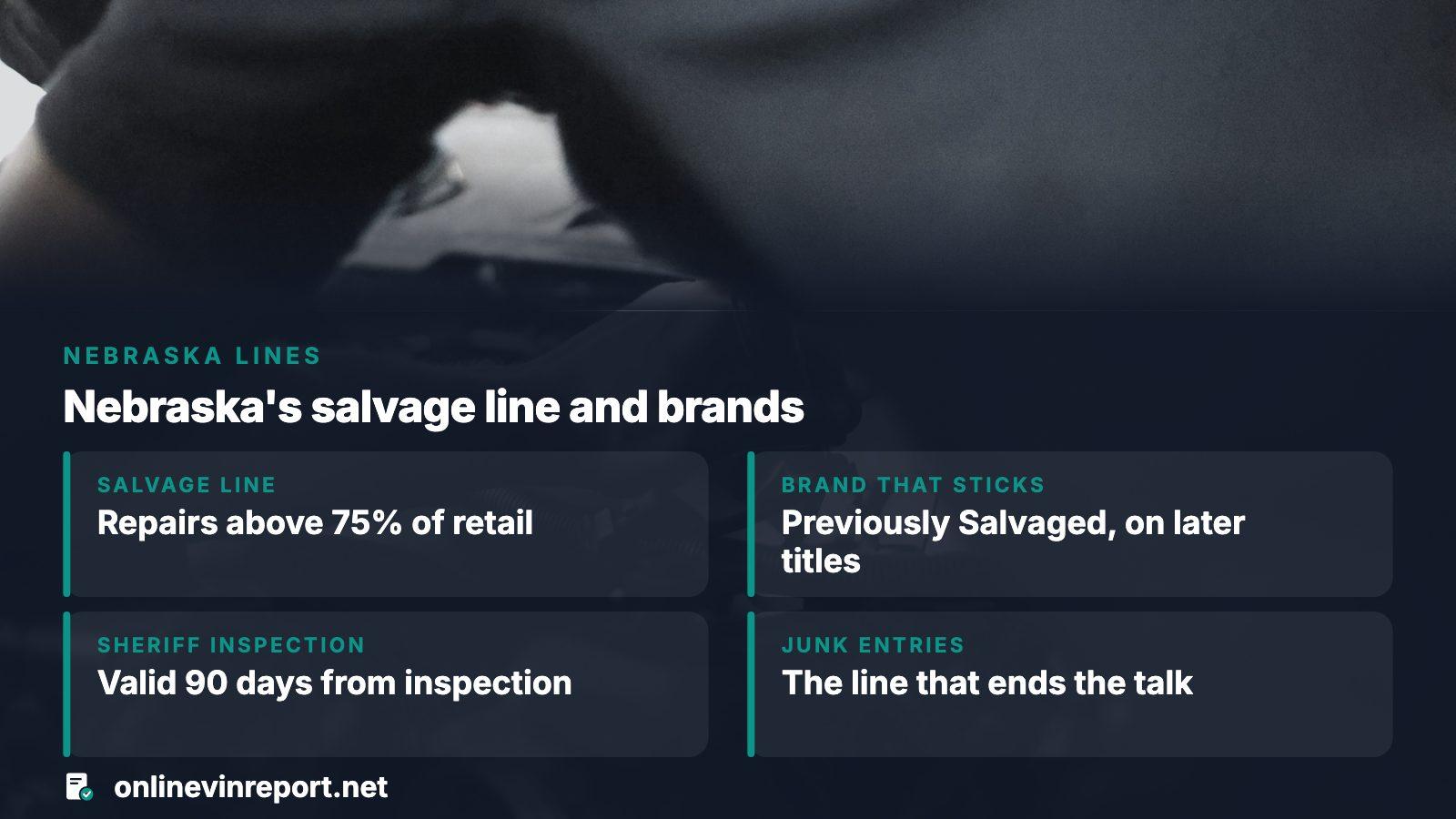
- Nebraska salvage line
- Repairs above 75% of retail value
- Brand that sticks
- Previously Salvaged, carried on every later title
- Sheriff inspection
- Valid for 90 days from the inspection
- Preview
- Free; the full report is one payment
Four places to look, and what each can and cannot see
No single record tells the whole story, so a Nebraska title check is a stack of small ones. The paper shows what its issuing state printed. The DMV keeps a short vehicle record. An online VIN search gathers brand entries, total-loss flags and odometer readings reported by titling agencies, salvage yards, recyclers and insurers. Every layer has a blind spot.
| Source | What it shows | Where it falls short |
|---|---|---|
| Paper title | Owner names, VIN, brand wording, odometer notation, lender | Anything another state recorded that never reached this sheet |
| DMV vehicle record | VIN, title number, issue dates, odometer reading with status code, lien and registration details, at $3.00 a record | Its description lists no brands, and a Nebraska-only history is generally withheld from private buyers |
| Online VIN title check | Brands from any reporting state, total-loss and salvage flags, yard and recycler entries, the latest odometer reading | Blind to anyone who never reported; a clean result is no guarantee |
| County sheriff inspection | The VIN on the car matched to the title, odometer noted | Needed only in set cases; says nothing about past brands |
The check, step by step
Take these in order.
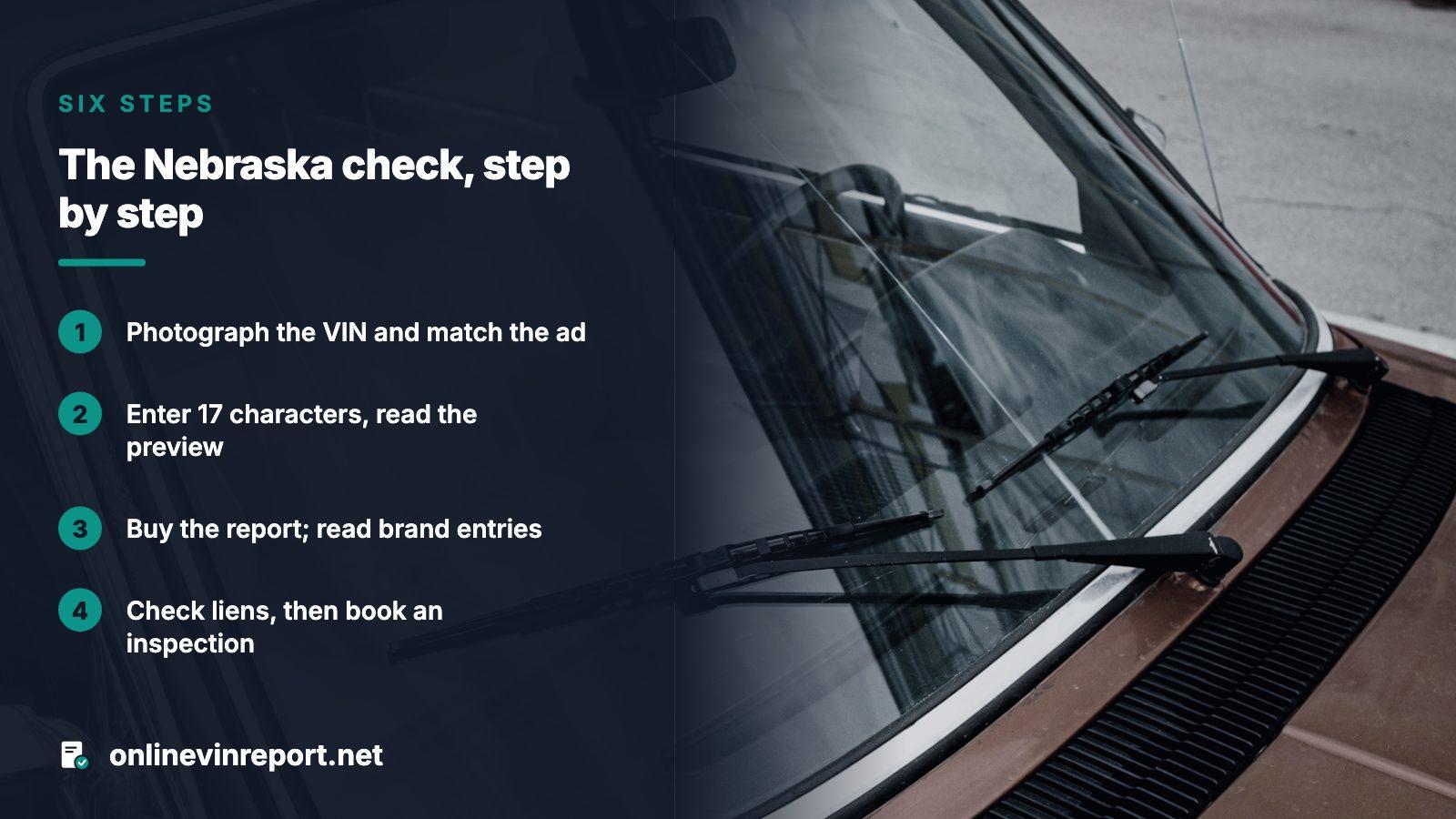
- Photograph the VIN on the vehicle itself, then match it to the ad and the title; one wrong character stops the deal until it is explained.
- Enter the 17 characters in the form and read the free preview. Screen every car on your shortlist this way.
- Buy the report for finalists. Read brand entries and total-loss flags first, then odometer readings and dates, noting which state wrote each line.
- Ask whether a lender is involved. A financed Nebraska car may have no paper title, since the DMV holds it electronically until the loan is paid off.
- Check lien status in the DMV's online title and lien inquiry. If paper exists, compare names, VIN, brand wording and odometer notation.
- Book an independent inspection before money moves, and test any repair story against receipts.
Brand wording you may see, and what Nebraska does with it
Nebraska writes brands of its own and also copies notations from other states' titles onto its paper, adding the name of the issuing state.
| Wording | What it signals | What to ask for |
|---|---|---|
| Salvage Certificate of Title | An insurer total loss or a voluntary brand; not yet through the inspection that leads to a regular title | Whether repairs are done and a regular title issued |
| Previously Salvaged | Repaired and inspected after salvage; the brand follows every later title | Receipts and the inspection certificate |
| Junked | Title surrendered for good; the vehicle can only supply parts | A written explanation, or a walk-away |
| Flood, Rebuilt, Reconstructed, Total Loss, Manufacturer Buyback | Earlier-state notations that Nebraska carries forward with that state's name | The earlier title and the repair history |
| Non-Highway Use | The DMV lists it as not eligible for registration | Proof the car can be registered |
Where Nebraska draws the salvage line
Nebraska calls a vehicle salvage when restoring it would cost more than 75% of its retail worth right before the damage, counting parts and labor at ordinary shop rates. The rule covers late model vehicles: no more than 7 model years old, or valued above a dollar line the DMV sets. An owner can also request the brand voluntarily.
For a buyer, two things follow. After an insurer settles a total loss, the Salvage Certificate of Title goes in the insurer's name. An owner who keeps the car must obtain that certificate, pass an inspection and receive a Previously Salvaged title before driving on public roads. Second, an older, cheaper car with heavy damage can fall outside the definition and never be branded in Nebraska at all.
A brand records paperwork, not damage
Previously Salvaged says the car went through the salvage route. It does not measure the damage or the quality of the repair. The federal title database also warns that a car can be treated as salvage without ever being branded, so ask for photos and receipts.
Junk entries: the line that should end the conversation
Nebraska treats a junk vehicle as one that cannot operate on any highway and has no value beyond scrap or parts. The owners assign the title to JUNK, a County Treasurer sends it to the DMV, and the DMV records the status and destroys the title. The DMV says that title cannot return to active status.
So a junk entry on a car being sold as roadworthy needs an answer in writing. A seller with none is selling you the problem. Junked parts can legally go into an assembled vehicle, which gets its own inspection, so ask whether this car is a build.
Cars that arrive from another state
Cars titled elsewhere are where an online check earns its place, because the earlier state's paper is what the County Treasurer works from. The Nebraska side:
- Every vehicle brought in from another state needs an inspection, even one the other state only registered.
- The County Sheriff does it for $10.00, comparing the title against the VIN on the car and noting the odometer reading.
- The inspection lapses 90 days after it is done, so time it close to the title application.
- Damage notations on the earlier title travel onto the Nebraska title with the issuing state's name.
- A car heading for Previously Salvaged status needs its inspection inside Nebraska, so an inspector in another state will not do.
Reading the odometer and lien lines
Nebraska titles carry one of four odometer notations: Actual, Not Actual, Exceeds Mechanical Limits or Exempt. Model years 2010 and older need no seller mileage statement, and once a title says Exempt, no later title can record mileage. Set the notation beside the report's reading history. A reading that drops between entries, or a Not Actual note nobody mentioned, deserves a direct question.
On liens, a financed car's title stays in electronic form at the DMV until the loan is cleared, and the lender has 15 days after the last payment to release it. A seller who says the title is still coming should name the lender, and the lien inquiry will confirm the status.
Paying for the report, then acting on it
Nothing is charged for the preview. The report itself is paid once, with no recurring plan: buy one report, or step up to a 3, 5 or 10 report pack if you are weighing a longer shortlist. Current amounts sit on the pricing page. Then act on what came back:
- Clean result and matching paper: book the mechanic and proceed.
- A brand the seller disclosed: ask for repair records and the inspection certificate, then adjust your offer to match.
- A brand the seller left out: stop and ask. The omission is information too.
- A junk entry or a VIN that does not match: walk away.
Where this information comes from
- Nebraska DMV: motor vehicle salvage titles — The 75 percent salvage line, who applies, the Previously Salvaged brand and the list of out-of-state notations carried forward.
- Nebraska DMV: junked title — What counts as a junk vehicle and why a surrendered junk title cannot become active again.
- Nebraska DMV: vehicle inspections — When an inspection is needed, what the sheriff checks, the fee and the 90-day expiry.
- Nebraska DMV: odometer certification — The four odometer notations and the exemption for older model years.
- Nebraska DMV: lien notations — Electronic lien titling, the lender's release window and the online lien inquiry.
- Nebraska DMV: obtaining a vehicle record — The per-record fee, the exempted-use certification and the limit on Nebraska-only history.
- NMVTIS: consumer information — What the federal title database holds, who reports to it and why a clean search is not proof.
Sources and photos: Facts checked against the sources above in November 2026. Photos by Zoshua Colah, Max Tokarev and Mustafa Sheikhmouss on Unsplash; diagrams by OnlineVINReport.
Keep reading
- Salvage title VIN check: run it online before you payHow to run a VIN search aimed at salvage brands, in any state.
- Title washing: how a brand vanishes and what a VIN title check can showHow a brand can disappear from a paper title when a car changes states.
- How to transfer a car title: documents, fees and the VIN check firstThe signatures and paperwork that follow a clean check.
- PricingReport options, pack sizes and the single payment, with no subscription.
Frequently asked questions
Is there a free Nebraska title check by VIN?
Partly. The preview costs nothing, and the Nebraska DMV points to its online title and lien inquiry for lien status. Brand history from every reporting state sits in the paid report, which you buy once; there is nothing to cancel. Screen with the free steps, then pay for the cars you would actually buy.
Does Nebraska use a salvage title?
Yes. After an insurer pays a total loss, a Salvage Certificate of Title is issued, and the DMV lists a $10.00 fee. Once the car is repaired and inspected, it can receive a regular title branded Previously Salvaged. Owners may request the salvage brand voluntarily, so it can appear on a car that was never a total loss.
Will another state's brand show on a Nebraska title?
It should. The DMV carries forward any damage notation on an out-of-state title and adds the name of the issuing state; Flood, Rebuilt, Reconstructed and Total Loss are on its list. If a car shows a branded history while the Nebraska paper is silent, ask why before you pay.
Can I order a Nebraska-only title history from the DMV?
Generally not. For $3.00 the DMV sells the current vehicle record to a requester who certifies an exempted use, but a record holding only Nebraska history is generally unavailable except for court, government agency or self-regulatory body proceedings. For other purposes it points people to NMVTIS, the federal title database.
How long does a Nebraska vehicle inspection last?
A sheriff's inspection stays valid for 90 days; a lapsed one means a second inspection before you file for title. The sheriff checks the car's VIN against the title and notes the odometer. That is not a damage or brand check, so a mechanic is still worth hiring.
Now check the car itself
The guide explains what to look for. The report shows what this VIN has on record.