THE SHORT ANSWER
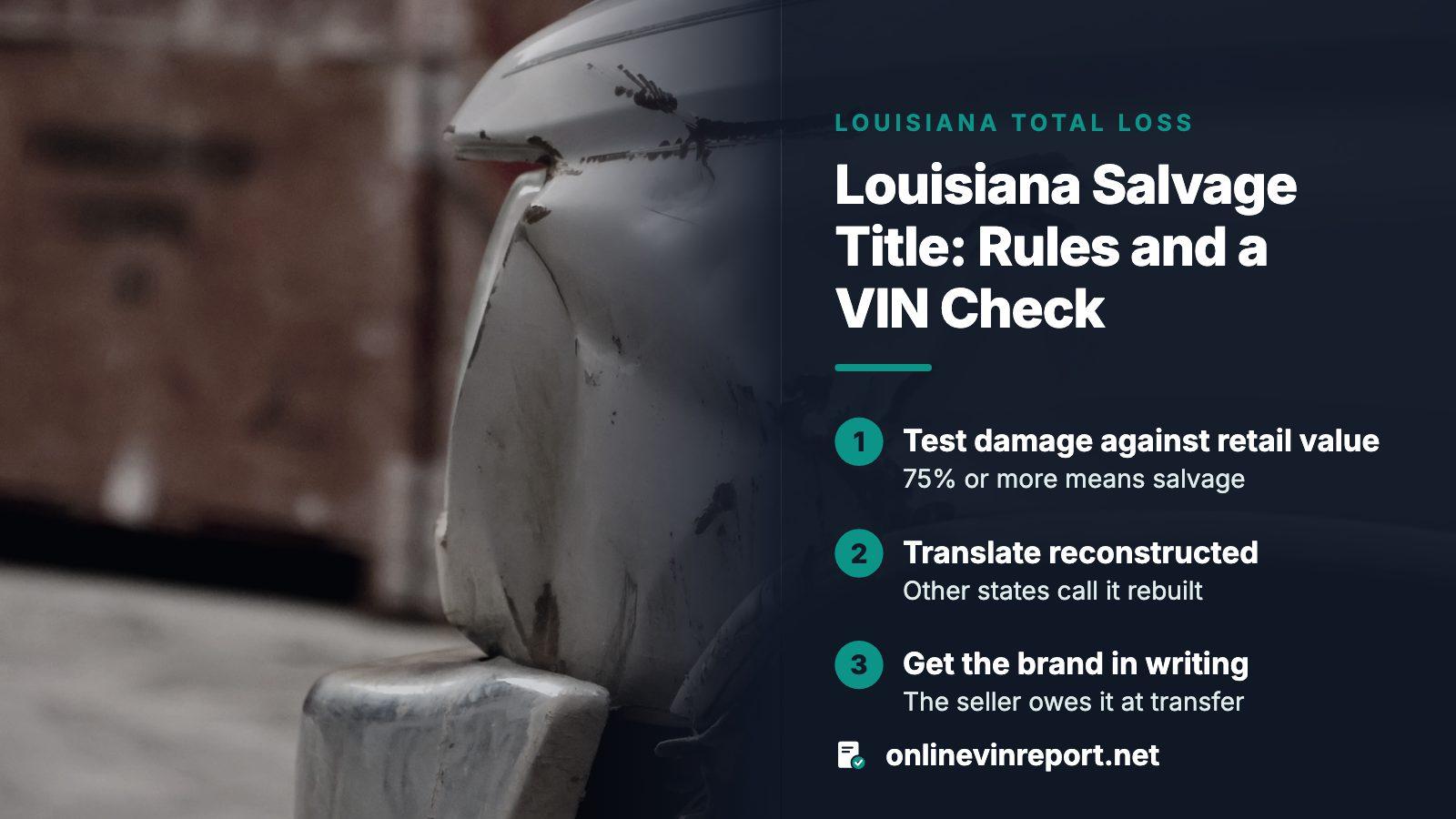
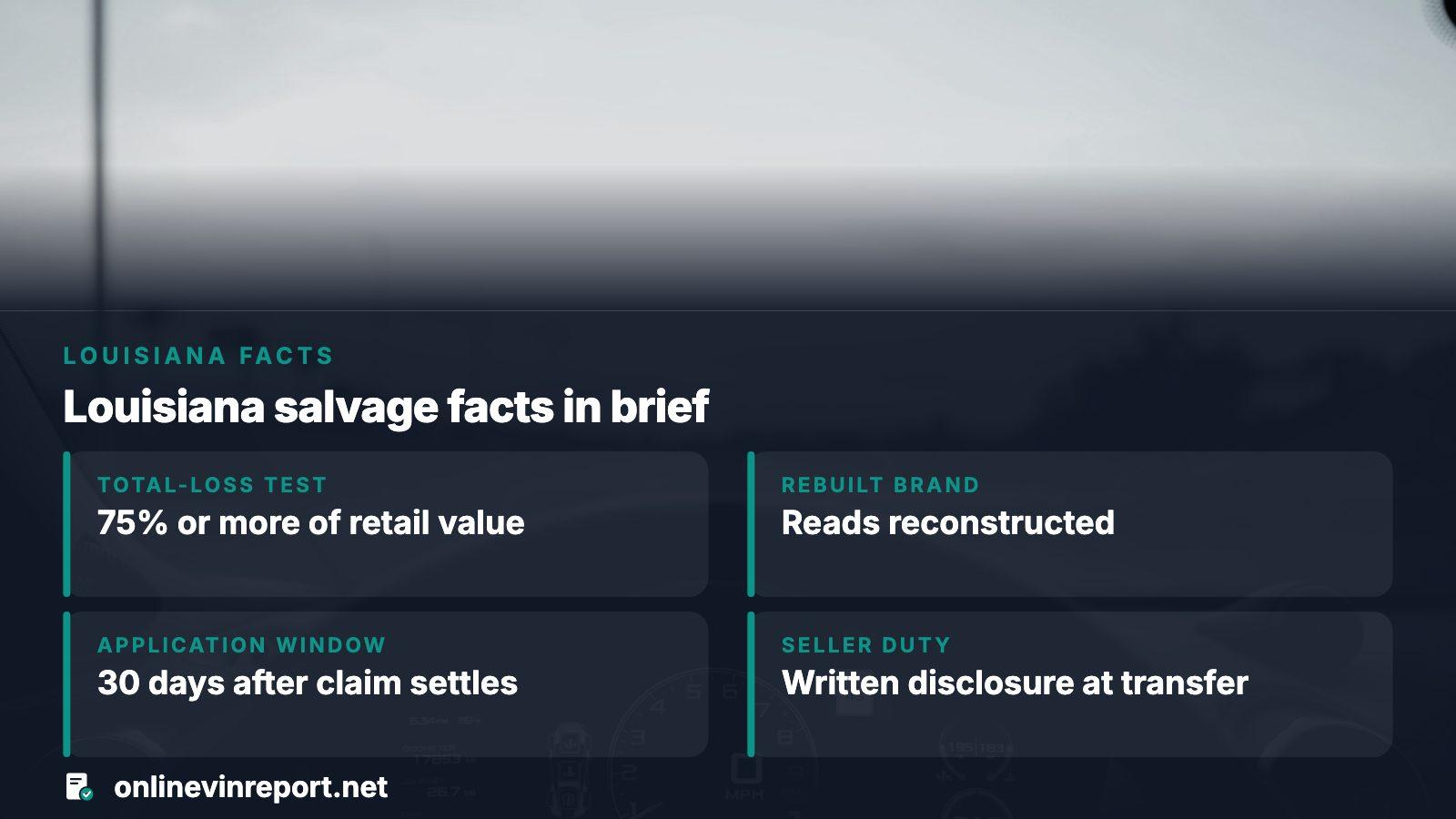
In Louisiana a car is a total loss when damage reaches 75% of its retail value, and the title then reads salvage. After repairs and a police-officer inspection, the state issues a title branded reconstructed, which is what other states call rebuilt. Sellers must disclose either brand in writing, and a VIN title check shows whether the record carries one.
- Total-loss test
- Damage of 75% or more of NADA retail value
- Rebuilt brand
- Shown as reconstructed on a Louisiana title
- Application window
- 30 days after the claim settles
- Seller duty
- Written disclosure of the brand at transfer
What a salvage brand says about the car
By Louisiana's definition, a salvage title is the certificate marking a car that an insurer has paid out as a write-off. The yardstick is damage equal to 75% or more of the retail value in the current NADA handbook. Anything under that line is not a salvage case, although other brands can still apply.
Whoever the title is made out to, be it the insurer, its agent or the owner, may then strip the car, sell it, or fix it. That matters when you shop. Salvage says nothing about repair quality. It tells you only that no plate is possible until the repairs are done and the brand changes.
How the title gets issued after a total loss
The clock starts when the property damage claim settles. Insurer, agent or owner then has 30 days to file with the Office of Motor Vehicles. The file holds a vehicle application marked Salvage Title in large letters, the signed-over title bearing the same marking, a copy of the loss paperwork from the insurer that gives the loss date, and the disclosure part of the salvage-reconstructed application.
- If a lender sits on its lien for 60 days after the loss, the insurer can file through an electronic lien provider and show that the payoff went through.
- If the insurer cannot get the paper title in 30 days, a notarized salvage affidavit showing two written requests can stand in.
- An owner who keeps a written-off car sets off a retention flag. The record stays frozen until the owner asks for a salvage title or a dismantling permit.
Reconstructed is Louisiana's word for rebuilt
Search for a rebuilt title in Louisiana and the state's paperwork answers with a different word. A vehicle that was written off and then repaired or restored is called reconstructed. When a car arrives from another state with a rebuilt brand, the OMV carries it forward and prints reconstructed on the Louisiana title instead.
| Where you see it | Wording | What it means |
|---|---|---|
| Louisiana, after an insurance total loss | Salvage | Unrepaired, no plate possible |
| Louisiana, after repair and inspection | Reconstructed | Rebuilt, may be registered |
| Another state's title | Rebuilt or similar | Carried onto a Louisiana title as reconstructed |
| California certificate | Salvage Certificate | Still unrepaired in Louisiana's eyes |
What a rebuilder has to prove before the brand changes
Public roads are off limits to a repaired salvage car until the reconstructed title, plate and registration all exist. A rebuilder alone may let a buyer test the finished car earlier. To earn the new brand, the applicant assembles a stack of paper rather than a single form.
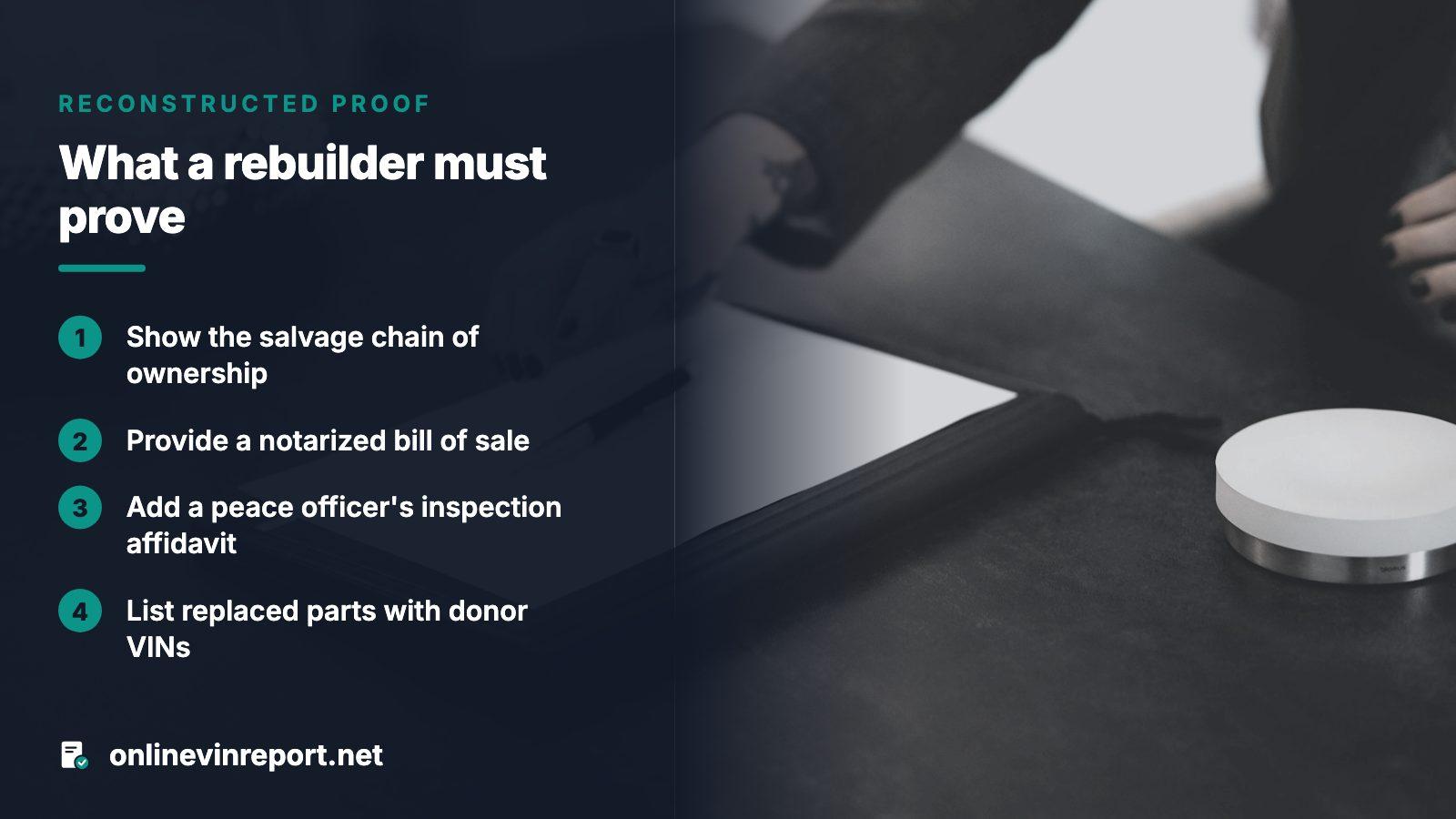
- The salvage chain of ownership: a Louisiana salvage title, an original certificate of salvage, or an out-of-state salvage title.
- A bill of sale or act of donation, notarized.
- An affidavit of physical inspection, signed by a full-time peace officer whom State Police has certified to inspect vehicles.
- The salvage-reconstructed application with a statement of repairs.
- A parts list naming each major component replaced, with the donor vehicle's VIN and the seller and date for any used part.
Inspectors may pick cars for a closer look at the repaired or replaced major parts. That is a spot check of paperwork against the metal, not a guarantee of workmanship.
Disclosure: what the seller owes you in writing
Under R.S. 32:706.1, a person handing over a car whose title says salvage has to say so in writing. Reconstructed titles carry the same duty. When the seller skips it, the new owner can ask for the sale to be undone and get back the price, plus the fees and taxes paid for the transfer.
Water damage has its own rule
Floodwater in the drivetrain, computer or wiring can bring a separate water damage brand even short of a total loss. Sellers must put flood history in writing. A buyer left in the dark has one year from the sale to go to court and undo it.
Read the disclosure before you sign, then compare it with what the VIN search shows. A seller who disclosed nothing on paper while the record carries a brand has handed you the argument you may need later.
Brought in from another state
Brands do not stay behind at the state line. Louisiana carries an out-of-state brand onto its own title, and the file needs a disclosure statement plus the chain of ownership. The OMV may also ask for the officer's inspection affidavit.
Some titles never make it. A car marked unrebuildable or unrepairable elsewhere gets no Louisiana salvage or reconstructed title unless the issuing state permits rebuilding. Texas non-repairable titles dated after 9/1/2003 are shut out of the reconstructed brand, and out-of-state certificates of destruction or bonded titles are turned away entirely. If a seller says a car can simply be retitled here, check which brand the other state used.
Running the VIN check before you pay
Read the 17 characters stamped on the car itself and compare them with the title and bill of sale. Then enter them into an online title search. The preview costs nothing and tells you whether a brand exists. A single payment, no subscription, buys the full report, with brand dates, total-loss entries from insurers and salvage auction photos where they exist.
Many of these entries come from the federal NMVTIS database, which pulls from state agencies, insurers and salvage yards. That pooling is why a brand applied in one state tends to follow the car into the next. The pricing page explains the one-time payment.
What a search can miss, and the next step
The Justice Department's NMVTIS page cautions that a lookup may come back falsely empty, showing no salvage history where some exists. After Hurricane Katrina, authorities reported flooded Louisiana vehicles being taken to states that do not brand flood damage. A clean search narrows the risk but does not close it.
- File OMV form DPSMV1958 naming the VIN to get the state's own title history. The form puts the fee at $10.00 a vehicle, and certified pages add $2.00 each.
- Choose the last transaction, the last two, or all available documents.
- Book a mechanic's inspection whenever any brand shows up.
That request goes by mail to Baton Rouge, so allow for the wait before you commit.
Where this information comes from
- Louisiana OMV: Policy 42.00 Salvage Vehicles — total-loss test, 30-day filing, documents, disclosure duty
- Louisiana OMV: Policy 42.01 Rebuilt Salvaged Vehicles — reconstructed brand, inspection, parts list, refused titles
- Louisiana OMV: Policy 42.02 Out-of-State Branded Titles — how other states' brands are carried over
- Louisiana OMV: Insurance Salvage Retention — what happens when an owner keeps a total loss
- Louisiana OMV: Policy 76.00 Water Damaged Vehicle — water damage brand and flood disclosure
- Louisiana OMV: Title History Request Form — how to order a state title record by VIN
- NMVTIS: For consumers — federal brand data and its gaps
Sources and photos: Facts checked against the sources above in November 2026. Photos by Everett Pachmann, Annika Wischnewsky and Dennis Eusebio on Unsplash; diagrams by OnlineVINReport.
Keep reading
- Louisiana title check by VIN: salvage, water and reconstructed brandsThe full Louisiana title check, step by step.
- Salvage title VIN check: run it online before you payHow a VIN search finds a salvage brand.
- Rebuilt title check by VIN: is the car clean or rebuilt?Reading rebuilt records on any state's title.
- Total loss threshold by state and what it means for a VIN title checkHow other states set their total-loss line.
Frequently asked questions
What is a salvage title in Louisiana?
It is the certificate issued after an insurance settlement declares a car a total loss, meaning damage of 75% or more of its retail value. The car cannot be registered for road use until it is repaired, inspected and retitled with a reconstructed brand.
Is a reconstructed title the same as a rebuilt title?
In practice, yes. Louisiana uses the word reconstructed for a total loss that was later repaired or restored, and it prints that word on titles for cars arriving with a rebuilt brand from elsewhere. A VIN check shows which wording each state used.
Can I drive a salvage car in Louisiana?
Not on public roads. The car must be rebuilt, receive a reconstructed title, and carry a valid plate and registration first. A rebuilder may show a finished car to a buyer before applying for the new title.
Does the seller have to tell me about a salvage or reconstructed title?
Yes, in writing, under R.S. 32:706.1. If the seller does not, you can demand the sale be rescinded and recover the price plus the fees and taxes paid on the transfer.
How do I find out if a Louisiana car has a salvage brand?
Enter the VIN in an online title search to see the free preview of brand records, then order the OMV title history on form DPSMV1958 if anything looks off. A clean search can still miss records, so inspect the car as well.
Now check the car itself
The guide explains what to look for. The report shows what this VIN has on record.