THE SHORT ANSWER
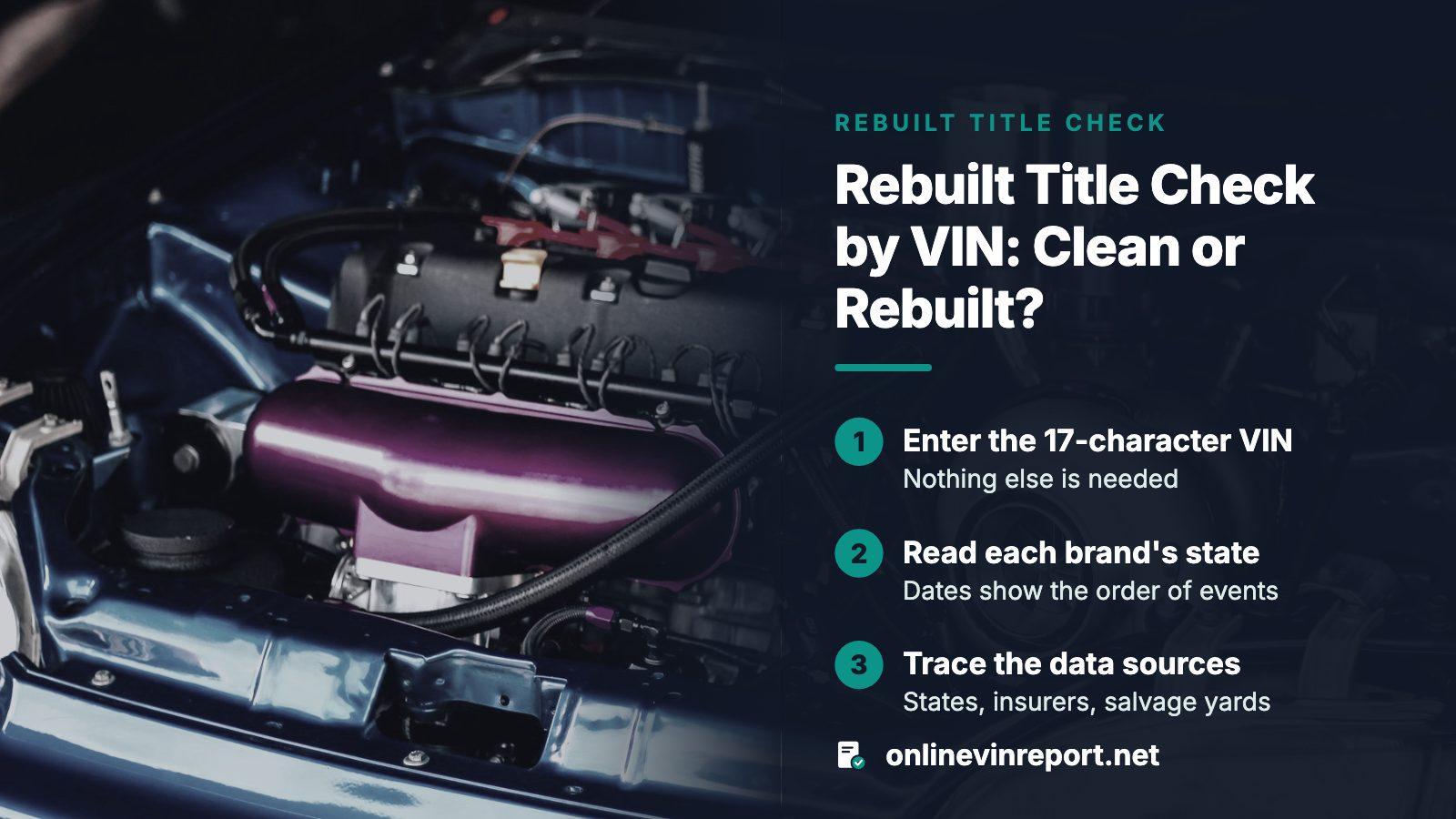
Enter the VIN and read the brand list. A rebuilt brand means a state recorded the car as written off and later cleared it for the road again, so a salvage entry normally sits earlier in the history. An empty brand list reads as clean. Neither result grades a repair, and a paper title can omit a brand the record carries, so compare the two and inspect the car.
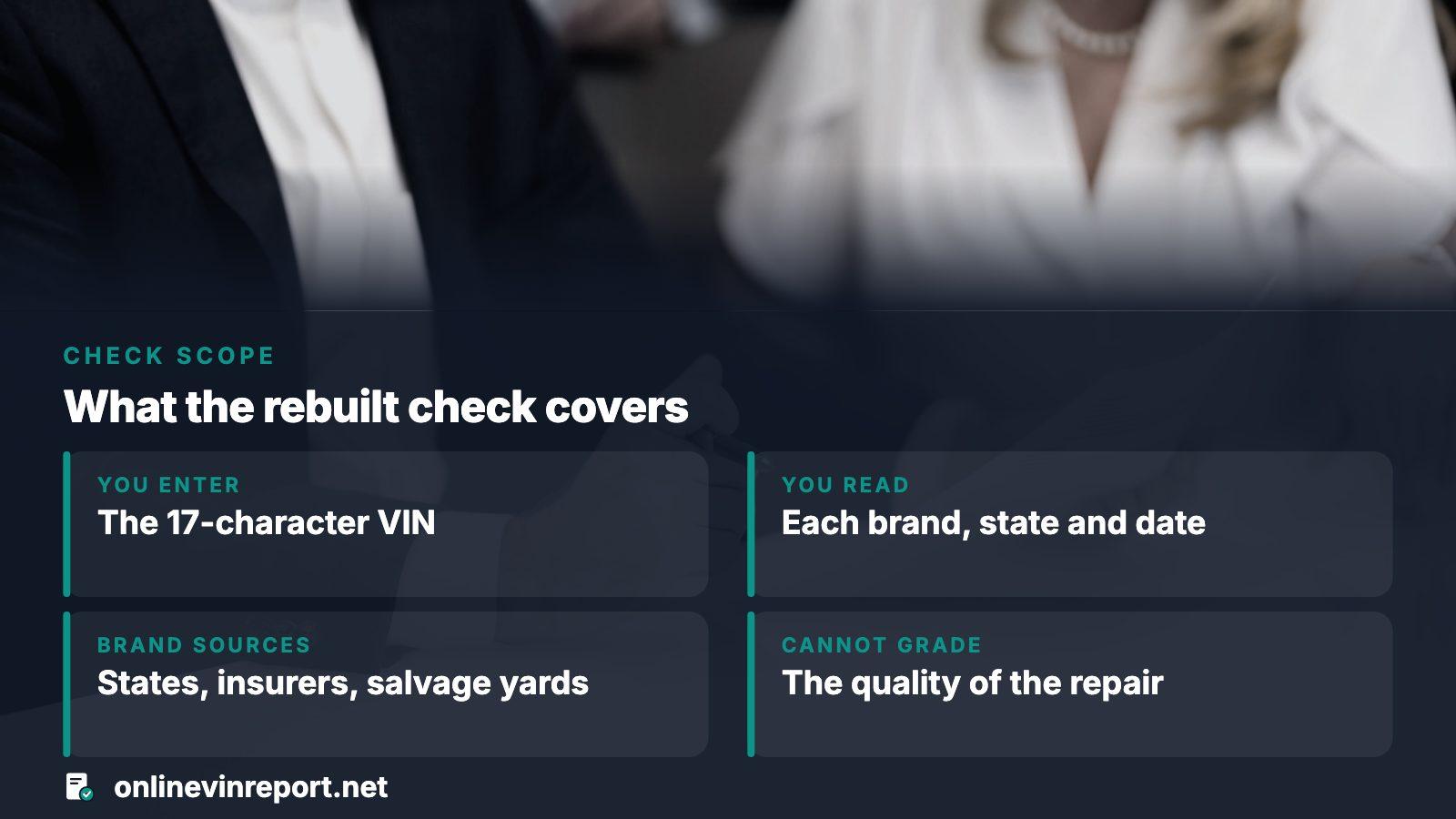
- What you enter
- The 17-character VIN
- What you read
- Each brand, with its state and date
- Where brands come from
- States, insurers and salvage yards
- What it cannot grade
- The quality of the repair
Clean or rebuilt: the one question the check answers
A title is clean when no state has ever attached a brand to the car's record. It reads rebuilt when the car was written off, repaired and sent back to the road under a new title. The check does not judge the car. It lists brands, each with the state that applied it and the date.
Order matters, and federal rules explain why. A salvage automobile is one where repair cost plus what the wreck would fetch as salvage exceeds the car's value before the damage. The word rebuilt appears nowhere in that definition, so each state names the repaired stage itself. A rebuilt car's history normally opens with a salvage entry.
Three records that can show a rebuilt brand
Each record knows something the others miss. Only the VIN search crosses state lines, which makes it the natural first step.
| Record | What it can show | Where it falls short |
|---|---|---|
| The paper title | The brand the issuing state chose to print, in its own wording | A brand from an earlier state that a clerk failed to carry over |
| A VIN title check | Brands any reporting state has sent, insurer total-loss decisions, salvage-yard entries, the latest odometer reading | Data a state has not yet reported, and how the repair was done |
| The titling state's own record | The official status where the car is registered today | Its history in other states |
Four steps from VIN to answer
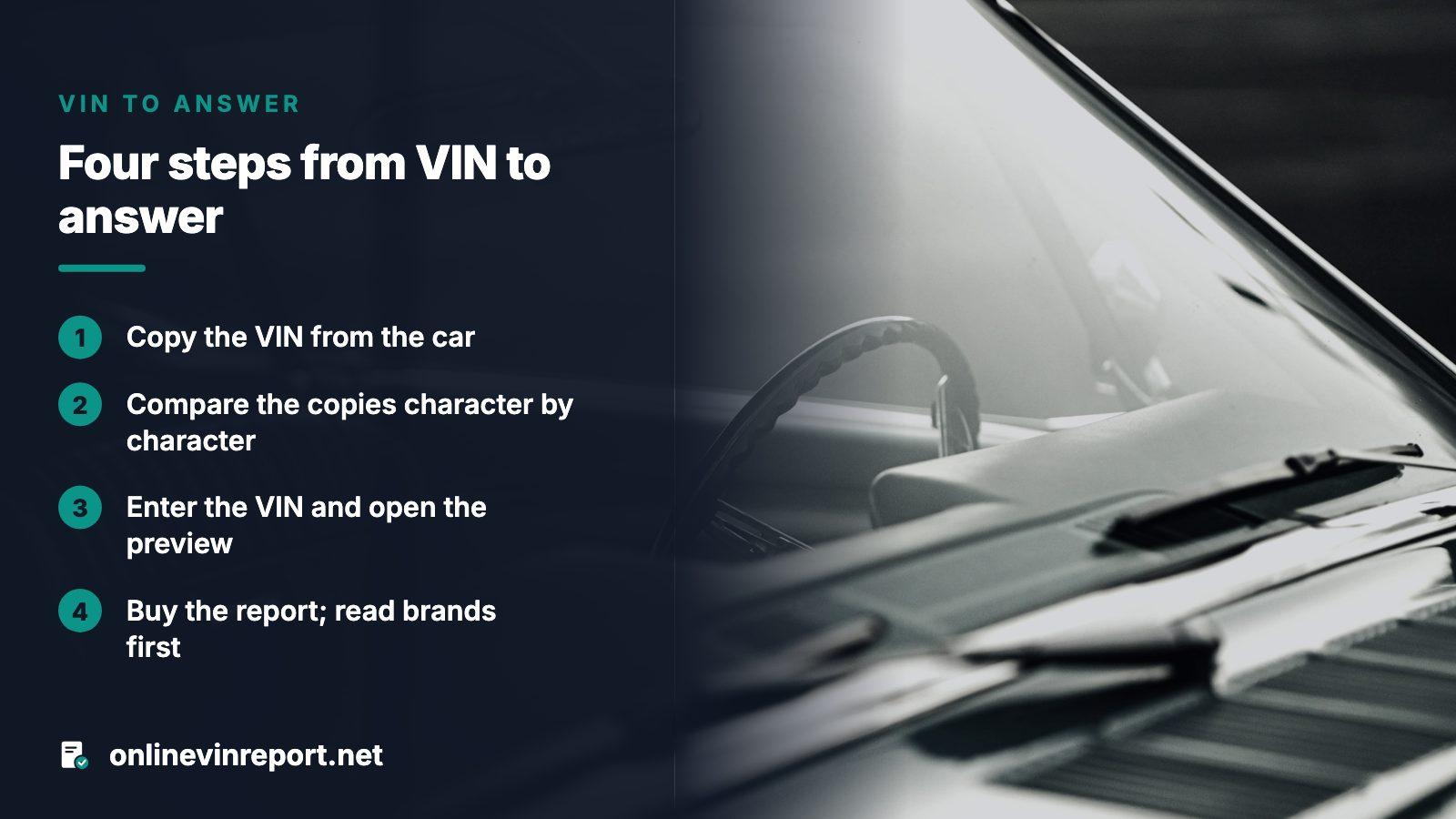
- Copy the VIN from the car. On recent models, federal rules put it in view through the glass beside the driver-side windshield pillar. Then copy the one printed on the title.
- Compare them character by character. A real VIN runs exactly seventeen long and skips I, O and Q altogether, so a typed letter O should be a zero.
- Enter the VIN and open the preview, which is free. It shows whether title and salvage records exist for that number.
- Buy the full report for any car you are serious about. Read brands first, then the state and date beside each, then any salvage or auction listing.
Do this before the test drive. If the car and the paperwork show different VINs, stop and ask the seller why.
Reading what comes back
| What the record shows | What it suggests | Your next move |
|---|---|---|
| No brand at all | No reporting state has branded the car | Encouraging, but inspect anyway |
| Salvage, nothing after it | A write-off not shown as back on the road. A salvage brand means repair and a state inspection must come before a new title | Ask to see the current title before talking price |
| Salvage, then rebuilt or a state equivalent | Repaired and retitled | Reprice, ask for repair papers, book an independent inspection |
| Water damage, odometer or junk | A different problem from a plain wreck | Read the brand and decide whether to walk |
| Thin or empty record | Data may be late or missing | Open the state's record and rerun the VIN before paying |
A blank result is only as good as the reporting behind it. On a car with a doubtful story, take the question to the state rather than dropping it.
One status, several labels
States do not share a vocabulary. California requires the brand Salvaged, treats a revived salvage as the repaired stage and shows the brand in a red panel labeled Vehicle History on recent titles. Wisconsin's reviewers refer to rebuilt, repaired and prior salvage brands. The national record maps every state's wording onto one standard list of more than sixty brands, with rebuilt among the seven most common.
From an NHTSA owner complaint
An owner of a 2009 Volkswagen Jetta wrote that the car was bought in 2016 from a dealer who had rebuilt it, and that the title read reconstructed and prior collision. In late 2022, after a brake control module fault, the owner reports the dealership was told the warranty would not apply because Volkswagen considered the car a total loss. The owner disputes that.
The lesson is narrow: a label accepted at purchase can still shape coverage years later, so ask what warranty applies before you pay.
Why a clean paper title is not a clean record
Federal rules have states upload title records to the national database daily, brands included, and check the VIN there before titling an out-of-state purchase.
The system's operator reports what Texas caught in one fiscal year: 2,617 out-of-state titles that arrived without a brand the national record held, and another 18,916 transactions where a clerk had left off a brand that cuts a car's value, though the old title printed it. A buyer holding only paper has no such backstop.
Errors run both ways: Wisconsin also finds titles from elsewhere with salvage printed on the paper that the national record lacks. When they disagree, the state titling the car today decides, and its motor vehicle agency takes direct questions.
What the check cannot see: the repair
A rebuilt brand says a repair happened and a state accepted the paperwork. The national record holds no repair history, and its FAQ advises an independent inspection before you buy. If the car went through an auction, the listing photos can show where the damage was before the work.
From an NHTSA owner complaint
An owner of a 2012 Ford Focus wrote that the car had a rebuilt title and a lit airbag warning light when it was bought. A Ford service department's diagnostic called for a new airbag. After about $1,000 of work the light stayed on, and the shop then blamed the sensors, a further repair the owner priced at roughly $2,000. The family "would have never made this purchase" had they known, the owner wrote.
On a rebuilt car an airbag light is first a matter of price, then a matter of repair. Get the full restraint-system quote in writing before you agree on a number.
The preview, the report and what one payment covers
The free preview at OnlineVINReport shows whether title and salvage records exist for the VIN you entered. Buying is a one-time payment, never a subscription, and the pricing page covers a single report and the 3, 5 and 10 packs. Read these parts first:
- Title brands with state and date, so you can see salvage before rebuilt
- Salvage and auction sales, including any photos on file
- Accident and damage entries, plus insurance and theft records
- Odometer readings over time, set against the dashboard
- Open recalls on the VIN
If the result says rebuilt: three moves before you pay
- Ask for the paper trail: the salvage title, repair invoices and parts receipts.
- Hire a shop that earns nothing from the deal to lift the car, measure the structure and scan the airbag system.
- Phone your insurer with the VIN to learn what coverage it will write, then ask a dealer for the maker what warranty still applies.
Then price it as a rebuilt car, on the brand, the repair evidence and the inspection result, not the seller's pitch.
Where this information comes from
- NMVTIS: information for consumers — Describes what a federal title search covers, how brands work and why a blank result can be a false negative.
- NMVTIS: frequently asked questions — Source for what a report contains, the missing repair history and the differences in how fast states report.
- NMVTIS 2024 annual report — Shows how state brands map to one list, rebuilt among the common ones, and the Texas and Wisconsin examples.
- eCFR: 28 CFR part 25 subpart B — The federal definition of a salvage automobile and the rule that states report title data every 24 hours.
- California DMV: branded titles — Lists common brand names, shows where the brand prints on a California title and explains the dealer disclosure rule.
- NHTSA owner complaint 11499216 — owner experience, paraphrased
- NHTSA owner complaint 11164879 — owner experience, paraphrased
Sources and photos: Facts checked against the sources above in November 2026. Photos by Willian Cittadin, Dylan Michaud and Carrie Allen www.carrieallen.com on Unsplash; diagrams by OnlineVINReport.
Keep reading
- What is a rebuilt title? What it means and what a VIN title check showsWhat the brand means for value, insurance and loans once the check has found it.
- Rebuilt title inspection: what the state checks and what a VIN title check addsWhat a state inspection covers, and the independent one you arrange after a rebuilt result.
- Title washing: how a brand vanishes and what a VIN title check can showHow a brand drops off a paper title and how a VIN search catches the gap.
- Sample reportThe sections a full report contains, before you decide to buy one.
Frequently asked questions
How do I check if a car has a rebuilt title?
Run the VIN through a title check and read the brand list for rebuilt, salvage or a state's equivalent such as reconstructed or revived salvage. Compare each brand with the paper title and note states and dates. If anything disagrees, open the titling state's own record.
Can a rebuilt title go back to clean?
The national record keeps every brand a state reports. A paper title is different, since brands can drop off it, as the Texas counts above show. A later title with no brand is a reason to question the seller, not proof the car recovered. Compare the paper with a VIN search.
Does a clean result mean the car was never in a wreck?
No. Brands come from reported events such as insurer total-loss decisions and salvage-yard intake. A car damaged and repaired without either can read clean on a title check. Accident and damage entries and a hands-on inspection cover that ground, so read all three before trusting a quiet record.
Does a dealer have to tell me a car is rebuilt?
That depends on the state. In California, a licensed dealer must get a national title report before offering a used vehicle and post a disclosure on the car if the report or title shows junk, salvage or another brand, with exceptions such as no record of the vehicle. Elsewhere, ask in writing and run the VIN yourself.
How soon does a new brand show up in a title check?
Federal rules have states send title data every 24 hours, but the national system's FAQ says reporting speed varies: some states post changes at once, others take a day or several. A brand applied last week may be missing, so rerun the VIN just before you pay.
Now check the car itself
The guide explains what to look for. The report shows what this VIN has on record.