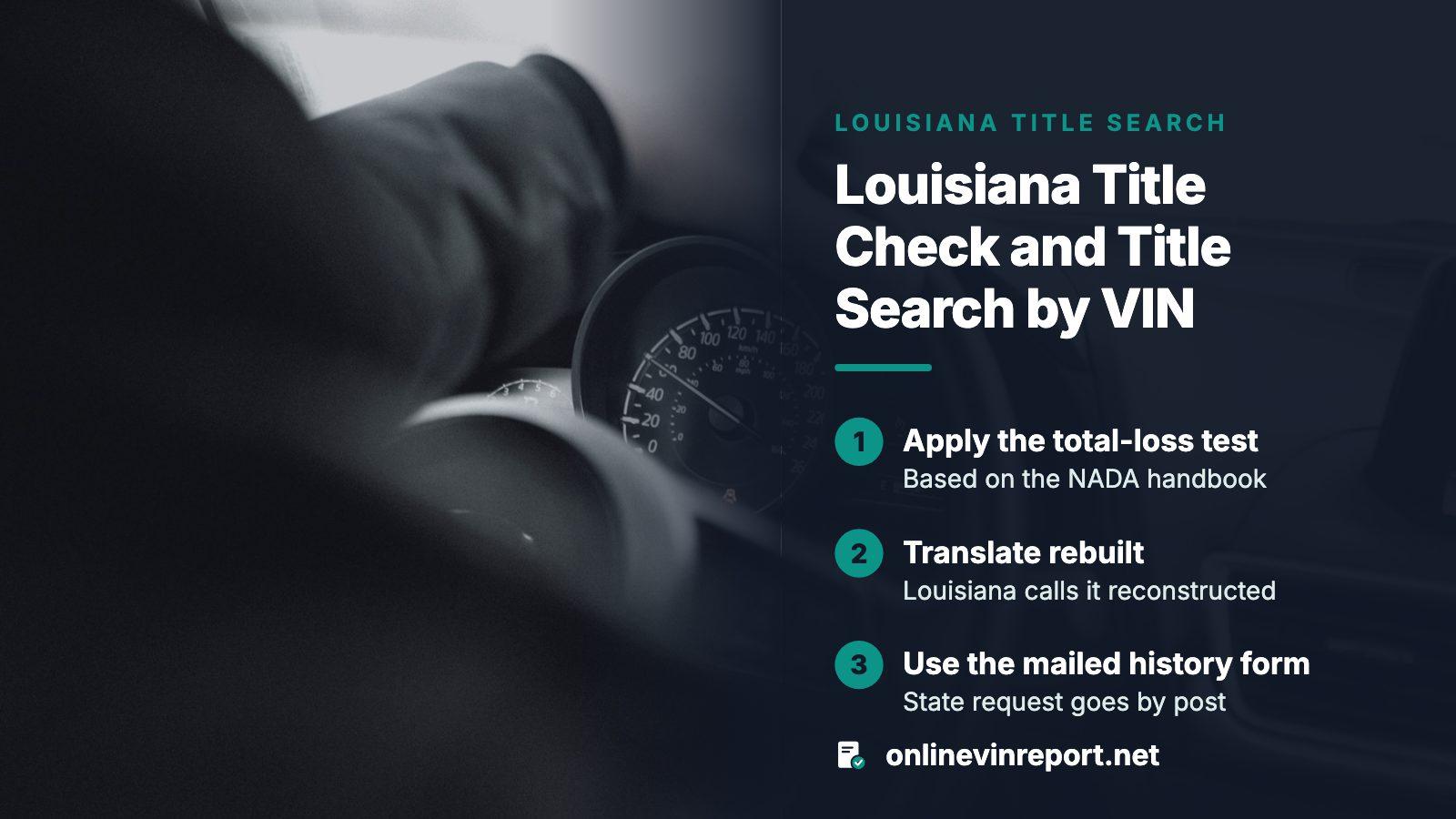
THE SHORT ANSWER
Copy the 17-character VIN, run it through an online title search and read the brand lines first. Louisiana's own labels are salvage, reconstructed, water damage and certificate of destruction. Then ask the OMV for the car's title history with its request form, and compare both records against the paper title and the seller's written disclosures before any money moves.
- Total-loss test
- 75% of retail value, per the NADA handbook
- Rebuilt brand
- Called reconstructed in Louisiana
- State title search
- Title History Request Form, sent by mail
- Preview
- Free; the report is a single payment
The Louisiana title check in seven steps
A Louisiana title is one entry in a car's record. Insurers, other states and salvage yards add their own, which is why the order below matters: each step gives the next one something to test.
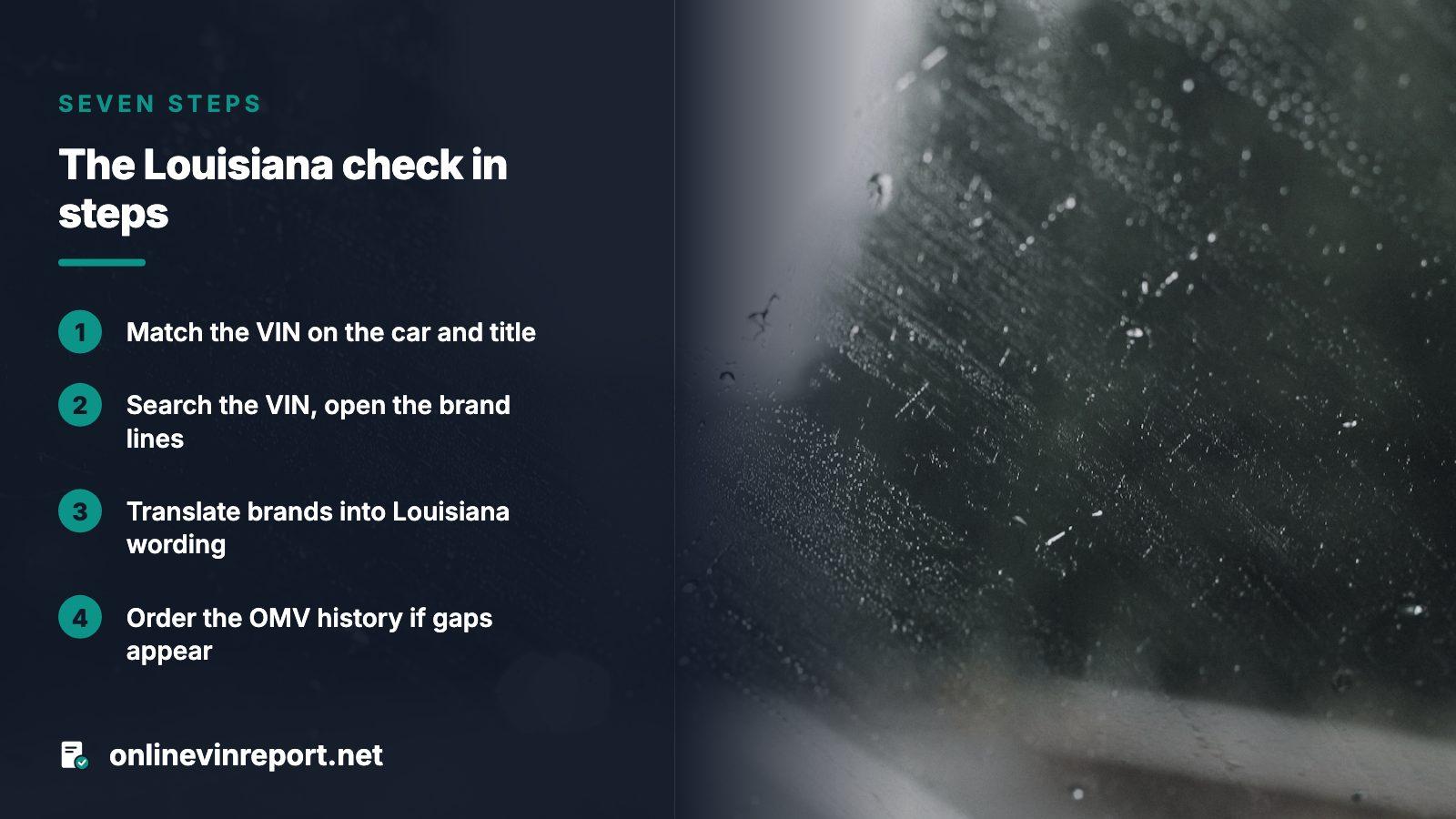
- Compare the VIN on the vehicle itself with the number typed on the title and the notarized bill of sale.
- Search the VIN online and open the brand lines before anything else.
- Translate each brand into Louisiana's wording.
- Test the paper title and the seller's disclosure forms against the search.
- Order the title history from the OMV if a brand or a gap appears.
- Confirm that any lien is released in writing.
- Pay a mechanic for an independent inspection before leaving a deposit.
Steps 1 and 2: match the number, then run the search
Two places carry the number on the car: a metal tag you can read through the glass and a sticker where the door latches. Each has to match the title and the sale paperwork exactly. A single wrong character is a reason to stop until the seller accounts for it.
Next, enter all 17 characters in the form on this page and open the preview. The search draws on federal title data that agencies, insurers, recyclers and junk yards report into. Coverage is patchy, and federal guidance concedes that a car with a junk or salvage past can still return nothing. A clean result is a good sign, but not a verdict.
Step 3: the labels Louisiana puts on a title
Louisiana does not say rebuilt. Its word is reconstructed, and the other labels follow the OMV's own policy memos.
| Label | When it applies | What to do with it |
|---|---|---|
| Salvage | Declared a total loss in an insurance settlement, with damage at 75% or more of retail value in the current NADA handbook. | Treat it as written off. It has to be repaired and re-titled before it can be plated. |
| Reconstructed | A total loss that was later repaired. The title issues only after an inspection affidavit, a statement of repairs and a list of replaced major parts. | Ask to see that paperwork. Repair quality is the open question. |
| Water damage | Any amount of water in the power train, computer or electrical system on a car that stops short of a total loss. | Electrical faults can show up late. Ask for the written disclosure and price accordingly. |
| Certificate of destruction | Flood damage to those systems from a governor-declared disaster, on a car declared a total loss. Insurers may also choose it for other total losses. | Stop. The car cannot be registered or resold at retail, and is meant for parts or the crusher. |
Step 4: test the paper title and the seller's paperwork
A used Louisiana car is titled with the OMV, and the seller signs the title over to the buyer before a notary. The state also wants an original notarized bill of sale showing the real price, unless the price is already on the title assignment. Check both documents for the VIN and for any lien release.
Then ask for the disclosure forms. Whoever transfers a reconstructed car must say in writing that the title is branded, and a seller must state in writing how much flood damage a car has taken. Under the OMV's water damage policy, a buyer who was not told has one year from the sale to sue to rescind it.
The mismatch worth chasing
A brand on the online search that appears nowhere on the paper title, and in no disclosure form, is the pattern to push on hardest. Make the seller put the explanation on paper, then order the state's title history.
Step 5: order the title history from the OMV
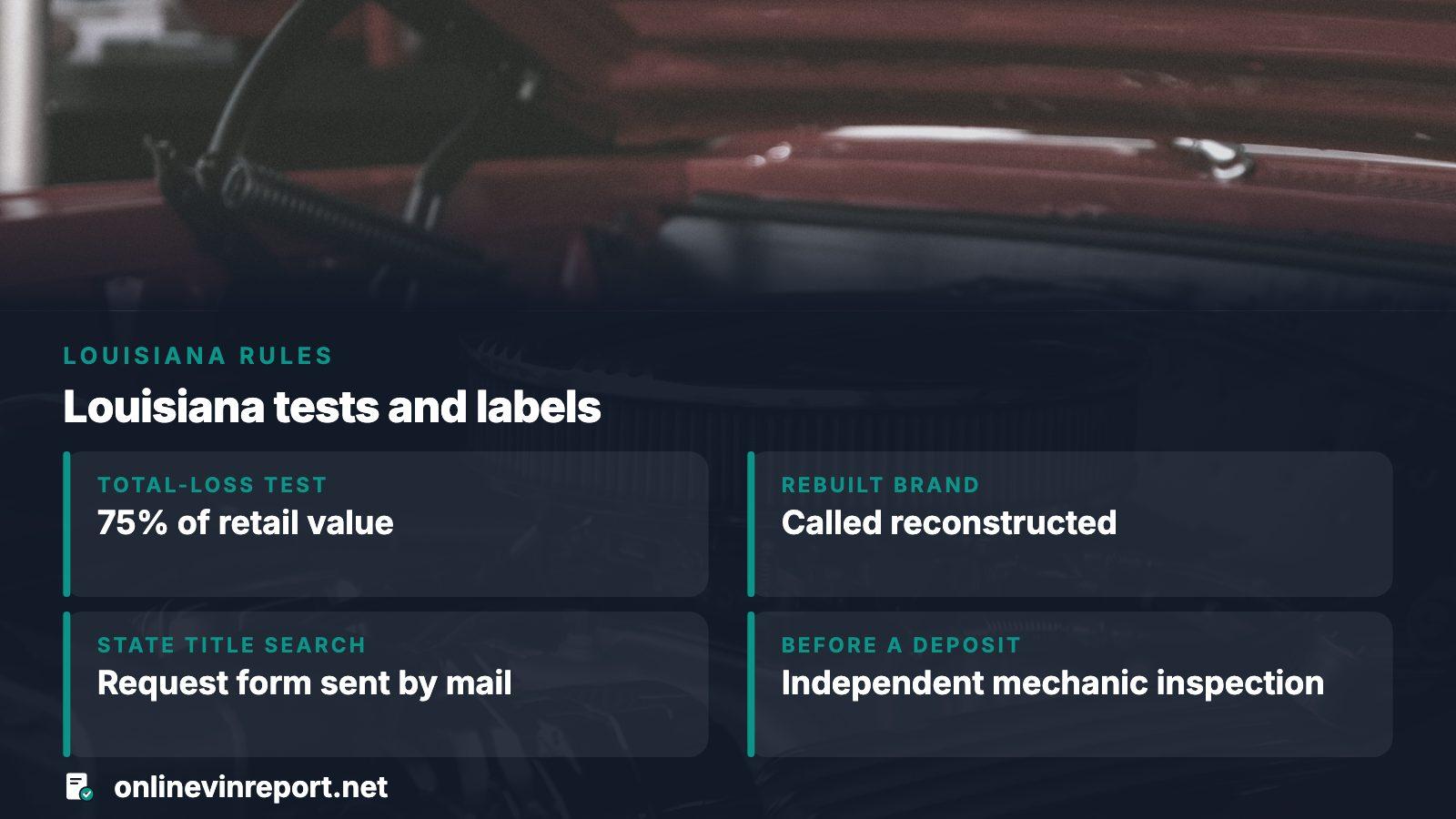
Louisiana's own title search is a paper process built around the Title History Request Form, DPSMV1958. You give the VIN and a reason, then choose how deep to go.
- The last title transaction, the last two, or every document the OMV holds
- Certified or uncertified copies
- Delivery by email or by mail
The form states a fee of $10.00 per vehicle, with $2.00 more per page for certified copies, and it goes by mail to the OMV's document management section in Baton Rouge. Fees change, so read the current form first. Order it when the search shows a brand, the odometer history looks off, or the seller's story does not fit.
Cars that arrive from another state
Louisiana copies other states' brands onto its own titles and swaps in the nearest local label, so a rebuilt brand reads reconstructed. Water damage shown on an out-of-state title must carry onto every later Louisiana title.
The OMV's memo on rebuilt cars also names titles it will not convert:
- Titles from elsewhere marked as beyond rebuilding, unless the issuing state itself permits a rebuild.
- Texas non-repairable titles issued after September 1, 2003.
- Out-of-state certificates of destruction, which cannot support any Louisiana title.
- Bonded titles from other states, which Louisiana does not accept for any type of title.
A seller who claims a car from one of those groups holds a clean Louisiana title owes you an explanation.
Step 6: liens and who really holds the title
The assignment before a notary is meant to come with any lien properly released. When a buyer finances, Louisiana records the lender's interest through a UCC-1 financing statement or a security agreement filed with the title paperwork.
Put three questions to the seller before paying: which lender, if any, is printed on the title; whether you can hold the lender's release; and whether the name on the title is the person selling. A lost-title story with a loan still open is grounds to pause until the lender itself confirms the payoff.
What each record shows, and what it misses
| Record | What it shows | What it misses |
|---|---|---|
| Online VIN title search | Dated brands, the most recent odometer figure, insurers' total-loss rulings and cars handed to junk or salvage yards | Repairs, and damage nobody reported |
| OMV title history | The last title transactions, or all the documents Louisiana holds, certified if you ask | Unreported damage and repairs |
| Paper title | Brands and lienholder as printed when issued, plus the notarized assignment | Anything recorded after it was printed |
| Seller disclosure forms | What the seller admits about salvage, reconstructed or flood history | Whatever the seller leaves out |
| Mechanic's inspection | Present condition, hidden repairs, structural work | The paper trail |
No single row settles it. Reporting speeds also differ, since some states post changes immediately and others take a day or several, which means a fresh total loss can be missing from the search.
Preview, report and the next move
The preview, which costs nothing, shows whether brand, salvage or auction entries exist for that VIN. After that, one payment covers a report, with no standing charge, and bundles exist for a long shortlist. Rates sit on the pricing page.
- Salvage on a car for sale: ask for the reconstructed title, since it cannot be plated without one.
- Reconstructed: request the repair statement, the parts list with donor VINs and the inspection affidavit, then hire a mechanic.
- Water damage: price in later electrical repairs, or pass.
- Certificate of destruction: walk away.
- Nothing on record: good news, and still worth an inspection.
Where this information comes from
- Louisiana OMV: Title History Request Form (DPSMV1958) — Shows what the state's title history request covers, the choices on the form, how it is sent and the fee it states.
- Louisiana OMV Policy 42.01: rebuilt salvaged vehicles — Defines total loss and the reconstructed brand, lists the paperwork for a reconstructed title and names out-of-state titles Louisiana will not convert.
- Louisiana OMV Policy 42.02: out-of-state branded titles — Explains that other states' brands carry onto Louisiana titles, with a rebuilt brand shown as reconstructed.
- Louisiana OMV Policy 76.00: water damaged vehicle — Sets the water damage brand, the written flood disclosure and the one-year window to rescind.
- Louisiana OMV Policy 76.01: certificate of destruction — Describes the title type for flood total losses and what may not be done with such a car.
- Louisiana OMV: used title and registration — Lists the notarized assignment, the bill of sale and the lien filings behind a used-car title.
- NMVTIS: consumer information — Lists what federal title data holds, where it comes from and why a search can miss history.
Sources and photos: Facts checked against the sources above in November 2026. Photos by Miles Loewen, Cole Keister and Victor Hughes on Unsplash; diagrams by OnlineVINReport.
Keep reading
- Check title and lien by VIN: brands first, then who holds a claimA closer look at liens and the name on the title.
- Flood car VIN check: find a flood brand before you buyHow to read a water brand and what to inspect on a flood car.
- What is a rebuilt title? What it means and what a VIN title check showsWhat a repaired total loss means for safety and resale value.
- Title washing: how a brand vanishes and what a VIN title check can showHow a brand can drop off between states and how to spot the gap.
Frequently asked questions
How do I do a Louisiana title check?
Read the VIN from the car, search it online and open the brand section, then compare the result with the paper title and the seller's disclosures. If anything does not line up, send the OMV a Title History Request Form. Finish with an independent inspection.
Does Louisiana have an official title search?
The OMV pages we read describe a mail-in Title History Request Form, not an instant online lookup. It returns the latest title transaction, the latest two or all available documents, for a stated $10.00 per vehicle. Confirm fees on the form.
What makes a car salvage in Louisiana?
A total loss. In the OMV's policy, that means damage equal to 75% or more of market value under the current NADA handbook. A salvage car must be repaired and given a reconstructed title before it can get a plate. Confirm the current threshold with the OMV.
What does Louisiana call a rebuilt title?
Reconstructed. A repaired total loss needs a title branded reconstructed before it can be plated, and an out-of-state rebuilt brand is shown as reconstructed on the Louisiana title. Anyone who sells such a car must disclose the brand in writing.
Can a flood-damaged car be titled in Louisiana?
It depends on the label. Water in the power train, computer or electrical system earns a water damage brand if the car is not a total loss. A flood total loss from a governor-declared disaster can carry a certificate of destruction, which bars registration and retail resale.
Now check the car itself
The guide explains what to look for. The report shows what this VIN has on record.