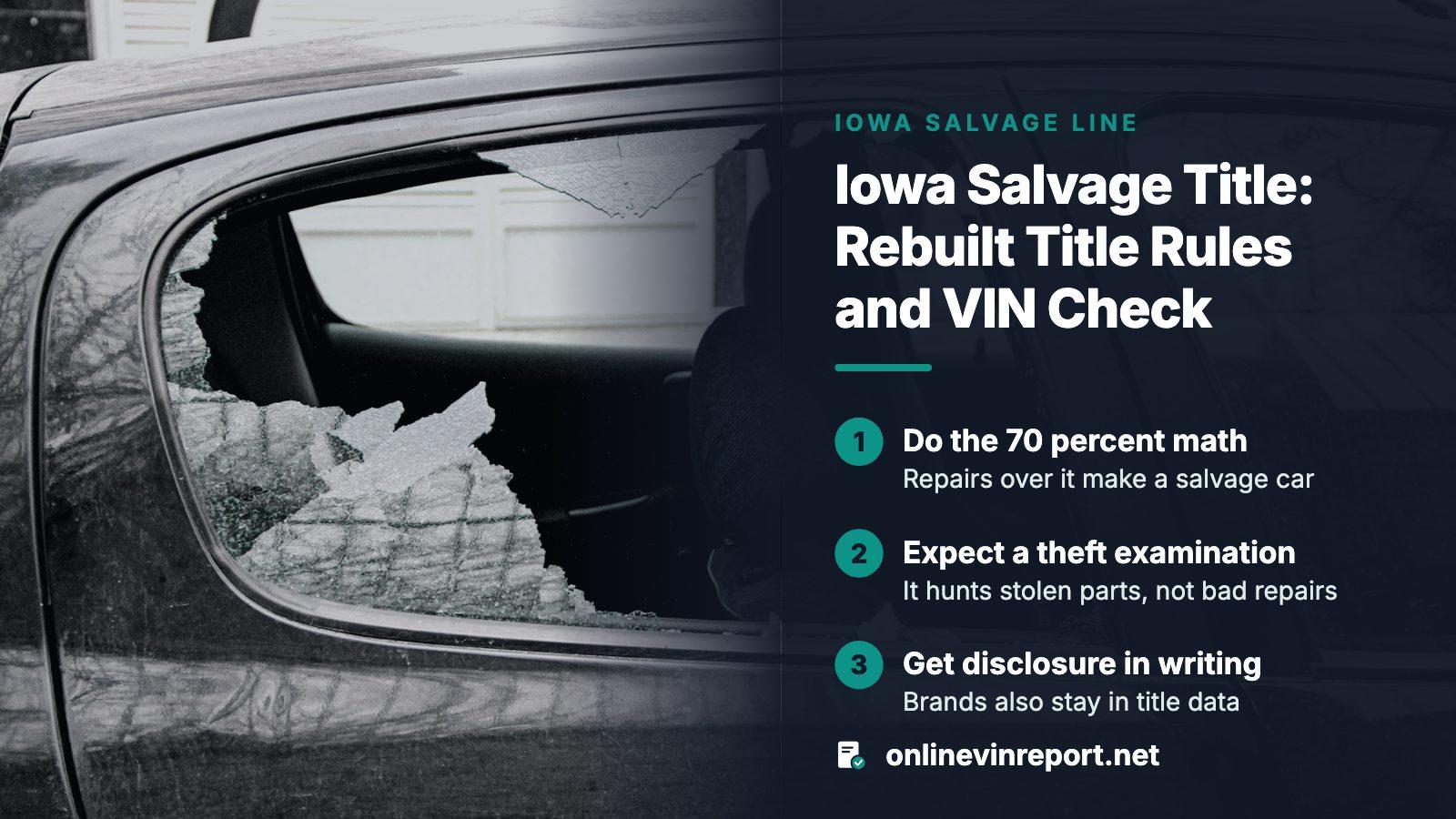
THE SHORT ANSWER
An Iowa salvage title means the state treats the car as a wreck that cannot be registered for the road. A repaired car can earn a regular title marked as previously salvage after a theft examination. Brands stay in national title data, so a VIN title check can show the record even when the seller says nothing.
- Salvage line
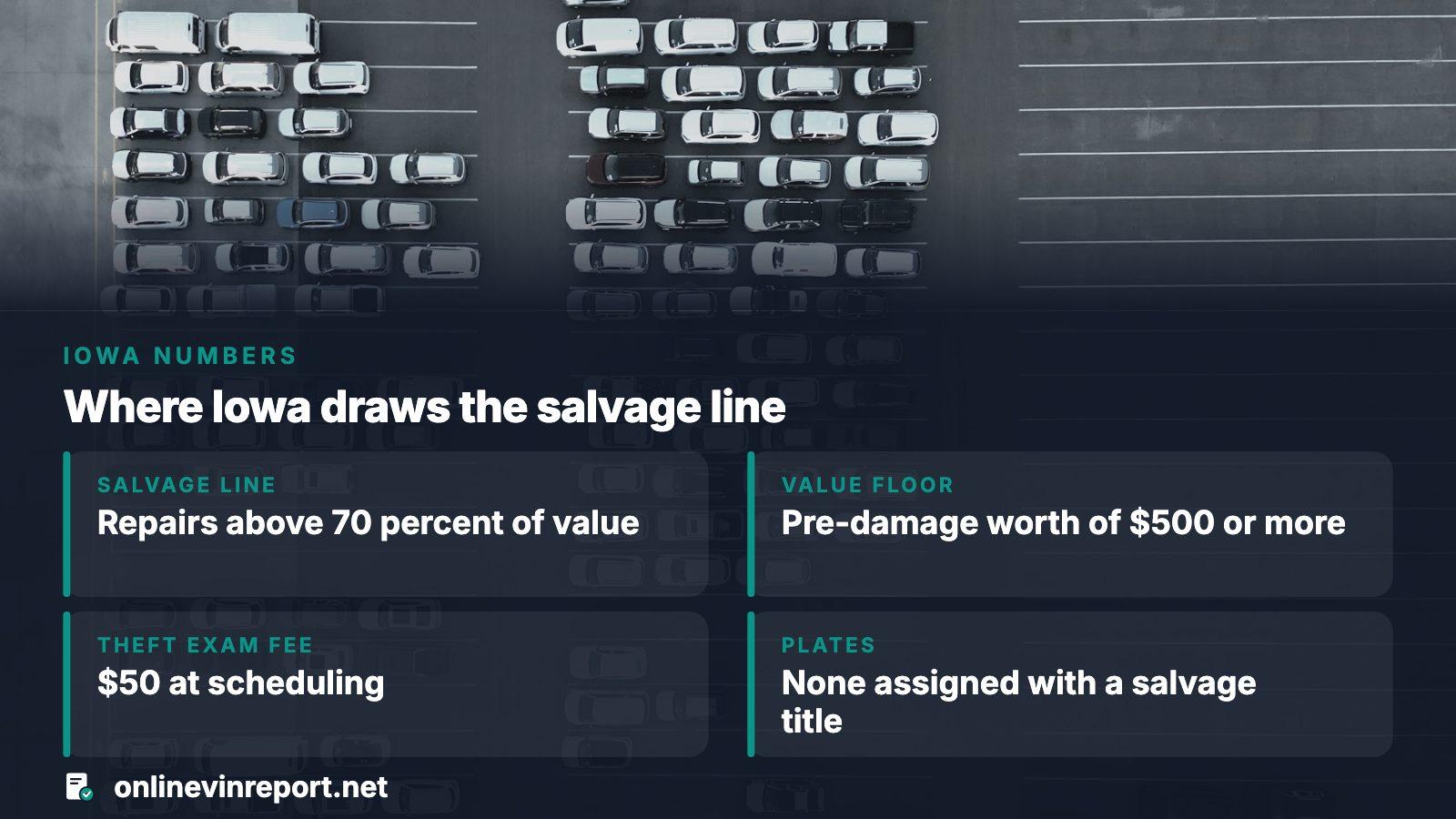
- Repairs above 70 percent of pre-damage value
- Value floor
- Pre-damage worth of $500 or more
- Theft exam fee
- $50, paid when you schedule
- Title check
- Free preview, then one paid report
Where Iowa draws the salvage line
The statute sets a number instead of leaving it to opinion. Repair cost beyond 70 percent of the market value the car had before the damage puts it in the wrecked-or-salvage class. The DOT rule adds a floor: the car must have been worth $500 or more at that earlier point.
So the brand measures money, not metal. An inexpensive car with costly parts can cross the line with modest structural harm, while another can sit just under it with a bent frame. Treat the brand as a flag and ask what was actually repaired.
Who applies for the salvage title
Whoever takes the car after the damage carries the paperwork. A rebuilder or dealer who buys it sends the assigned title and an application to any county treasurer within 30 days, pays $20, and gets a title printed with SALVAGE across the face.
Insurers run on the same 30-day clock after a claim settlement or an unrecovered theft payout. When an owner will not sign over a title, the insurer can still apply once 30 days pass from the settlement, provided it made at least 2 certified-mail attempts to reach the owner and lienholders and can show it paid the claim.
Why this matters to you
A salvage record is created when the car changes hands after the damage, often before any repair begins. A VIN history that lists an insurer or a salvage pool deserves a question even if the seller's title looks ordinary.
What a salvage-titled car cannot do
- The state assigns no registration plates with a salvage title.
- Registration for public roads is off the table while the car is titled or designated salvage.
- Assignment of the salvage title is limited to schools, licensed new-car dealers, scrap-metal buyers, salvage pools and licensed recyclers.
- Two groups, licensed recyclers and new-car dealers, can pass an Iowa or out-of-state salvage title on to any buyer.
A private seller offering a car on a salvage title is offering something you cannot legally drive home. Hold the actual paper title in your hands and read its front before any deposit changes hands.
How a repaired car gets back on the road
The owner takes the salvage title and a signed salvage theft examination certificate to a county treasurer and pays the fees. Only the very heaviest trucks, at the 30,000-pound rating, are excused from the exam.
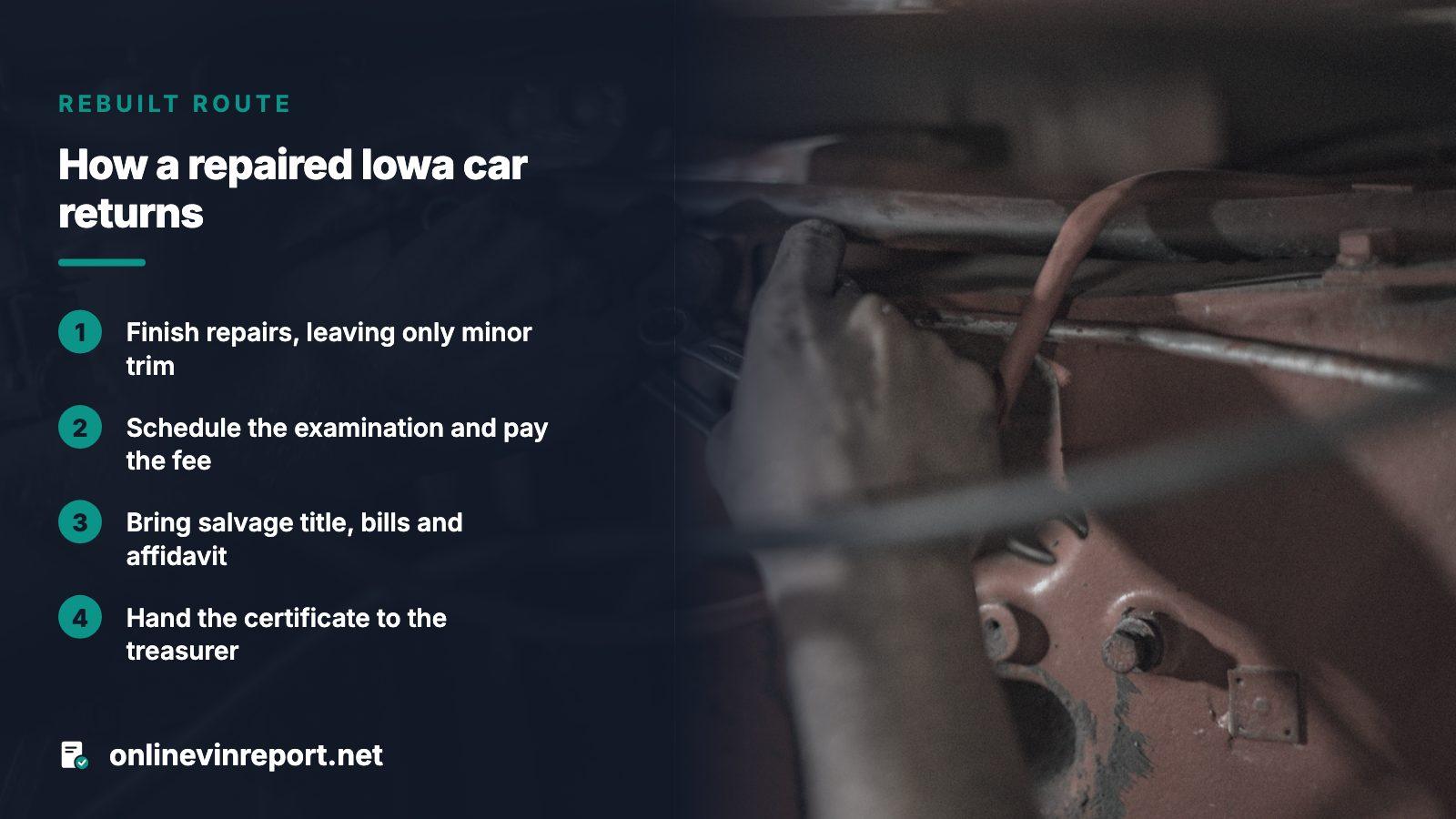
- Finish repairs, leaving at most minor items such as trim or paint.
- Schedule the examination and pay $50.
- Bring the salvage title, bills of sale for replaced parts and a repair affidavit.
- Collect the signed certificate if the car passes.
- Hand certificate and salvage title to the treasurer.
The new title does not wipe the slate. It prints a note, repeated on the registration receipt, that the car was previously on a salvage title, and every later Iowa title inherits that note.
The exam looks for stolen parts, not bad repairs
Sellers sometimes say a rebuilt car passed the state's inspection. In Iowa the examiner is a peace officer certified through the law enforcement academy, and his or her only question is theft: was the car, or anything bolted on during repair, taken from someone else? By the statute's own words the exercise is separate from any safety review, and no court may read a signed certificate as a roadworthiness finding.
What to take from that
A pass means nobody flagged the car or its parts as stolen. It says nothing about welds, airbag modules, frame alignment or paint hiding rust. Pay a mechanic you picked, ideally a collision-repair specialist, to put the car on a lift.
The owner can get a permit to drive to the exam by filing an affidavit that the car is reasonably safe. That affidavit is the owner's word, not an official finding.
Rebuilt, flood, junk and other labels
The DOT rule lists a family of title designations beyond salvage: rebuilt, flood, fire, vandalism, theft, and the lemon-law buy-back label. When a car qualifies for more than one, the rule picks the winner. Rebuilt outranks most of them. A car arriving from another state with a rebuilt title gets an Iowa rebuilt designation.
Junked is a separate track. Should the records check turn up a junked past, the county hands out a junking certificate rather than a title, at no charge, and no title follows except in a 14-day reversal window or on good cause shown to the DOT. A car offered to you with a clean title after such a certificate calls for a close look at the paperwork.
What the seller owes you in writing
No Iowa title issues without a damage disclosure statement from the seller, and you should receive it at or before the sale. First the seller states what he or she knows of the car's title life in any state: salvage, rebuilt, flood. If none of those brands is known, the seller then answers a second question, whether the car ever took damage heavy enough to meet Iowa's salvage test.
Ordinarily the seller completes it on the reverse side of the title. If the title is not on hand, or a salvage past from another state is missing from the Iowa title, a standalone form carries it. Lying on it, or skipping it when required, is a fraudulent practice under the Code.
Where the rule stops
Cars more than 7 model years old, motorcycles and heavy trucks are exempt. On an older car nobody has to volunteer anything, so your own history check is the only record you will hold.
Running the title check by VIN
The federal title system, NMVTIS, pools brands from state titling agencies, insurers, and salvage and junk yards, and a brand stays on record once a state applies it. It exists because brands get washed when a car is retitled somewhere that does not ask earlier states.
OnlineVINReport begins with a free preview from the 17-character number on the dashboard or door jamb. If a brand or an insurer total-loss entry turns up, the full report goes further: auction photos, salvage entries, mileage readings and liens. It is a one-time purchase with no subscription; the pricing page lists the packs.
Line the result up against the Iowa title the seller is holding. A VIN reporting salvage while the seller's title shows nothing is the clearest reason to walk away.
Where this information comes from
- Iowa Code 321.52: salvage vehicles — salvage definition, title deadlines, theft examination and the previously salvage designation
- Iowa Code 321.69: damage disclosure statement — what a seller must disclose, exemptions and penalty
- Iowa Administrative Code 761 chapter 405 — DOT rule on the value tests, designations, plates and junking
- DOJ: NMVTIS for consumers — what national title searches show and why brands persist
Sources and photos: Facts checked against the sources above in November 2026. Photos by Ali Aliakbari, Nina Mercado and Iain on Unsplash; diagrams by OnlineVINReport.
Keep reading
- Salvage title VIN check: run it online before you payHow a VIN search finds a salvage brand in any state.
- Rebuilt title inspection: what the state checks and what a VIN title check addsWhat an inspector should look at on a rebuilt car.
- Do you have to disclose a rebuilt title when you sell a car?A seller's duties when the title carries a brand.
- Total loss threshold by state and what it means for a VIN title checkHow states draw the line between repairable and total loss.
Frequently asked questions
Can I drive a car with an Iowa salvage title?
Not on public roads. The state hands out no plates with a salvage title, and registration waits until the car is no longer titled salvage. After repairs and a passed theft examination you can apply for a regular title carrying a previously-salvage note.
Does a rebuilt Iowa title ever lose the salvage note?
Generally no, since it repeats on every later title and registration receipt. One carve-out covers an insurer holding written repair estimates under $3,000. Buyers should assume the history will show and plan their price around it.
Is the salvage theft exam a safety inspection?
No. A certified peace officer looks only for theft. The statute bars reading the certificate as proof the car is roadworthy, so pay your own mechanic to judge structure, airbags and repair quality.
Will a VIN check show an Iowa salvage record?
Brands from state agencies, insurers and salvage yards feed the national title system and stay there. Reporting is uneven across states, so a clean result is no guarantee, but an existing brand will usually surface.
What if the seller never gave me a damage disclosure?
Raise it before you pay, since Iowa will not issue your title without one. The state keeps these statements and releases copies to the public on request. Older cars are exempt, so lean on your own history check and inspection.
Now check the car itself
The guide explains what to look for. The report shows what this VIN has on record.