THE SHORT ANSWER
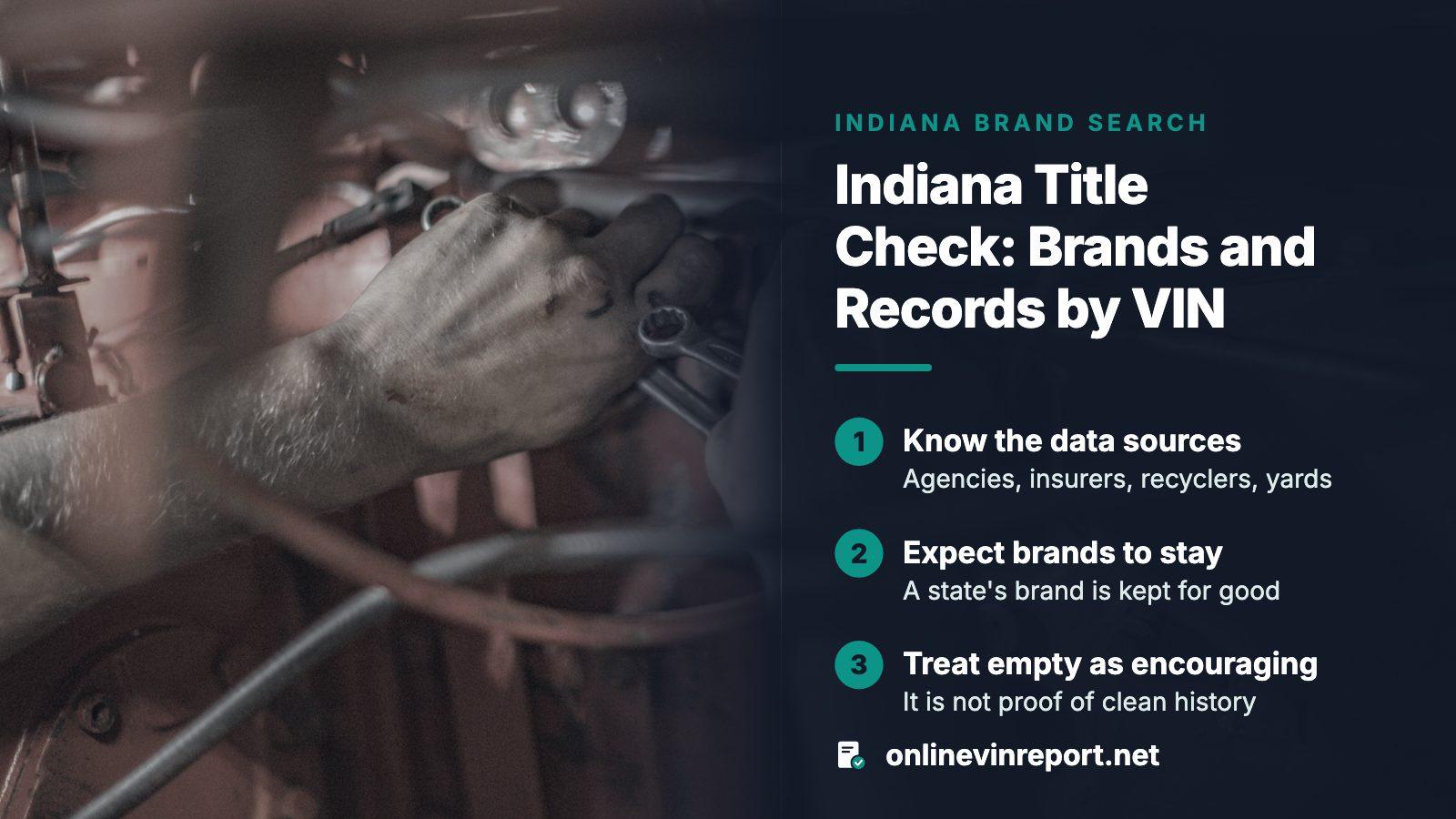
Start with the car's 17-character VIN: enter it in an online title search and read the brand section before anything else. A salvage, junk or flood entry, or an insurer's total-loss ruling, points to a write-off somewhere in the car's past. Then compare the result with the Indiana paper title, ask the BMV for its own record, and treat an empty result as encouraging rather than proof.
- Data behind the search
- State title agencies, insurers, recyclers, junk and salvage yards
- Brands in the record
- Kept for good once a state applies one
- Empty result
- Encouraging, but not proof of a clean history
- Preview
- Free; the report is a single payment
What an online Indiana title search reads
The search runs your VIN against NMVTIS, a national title database the Justice Department oversees. It pools records from state title agencies, insurers, auto recyclers and junk and salvage yards, and it holds about 20 million salvage and total-loss records. A car titled in Indiana this year may have been branded in Ohio the year before, and the search reads both.
- Title brands, each with the date applied and the state of title.
- The newest odometer reading on file.
- Total-loss and salvage decisions made by insurance companies, self-insurers included.
- Reports of the car passing to a recycler, junk yard or salvage yard.
- Theft history, in some cases.
Repair history is not in the data, and owners' personal details never reach a buyer.
Run the check in this order
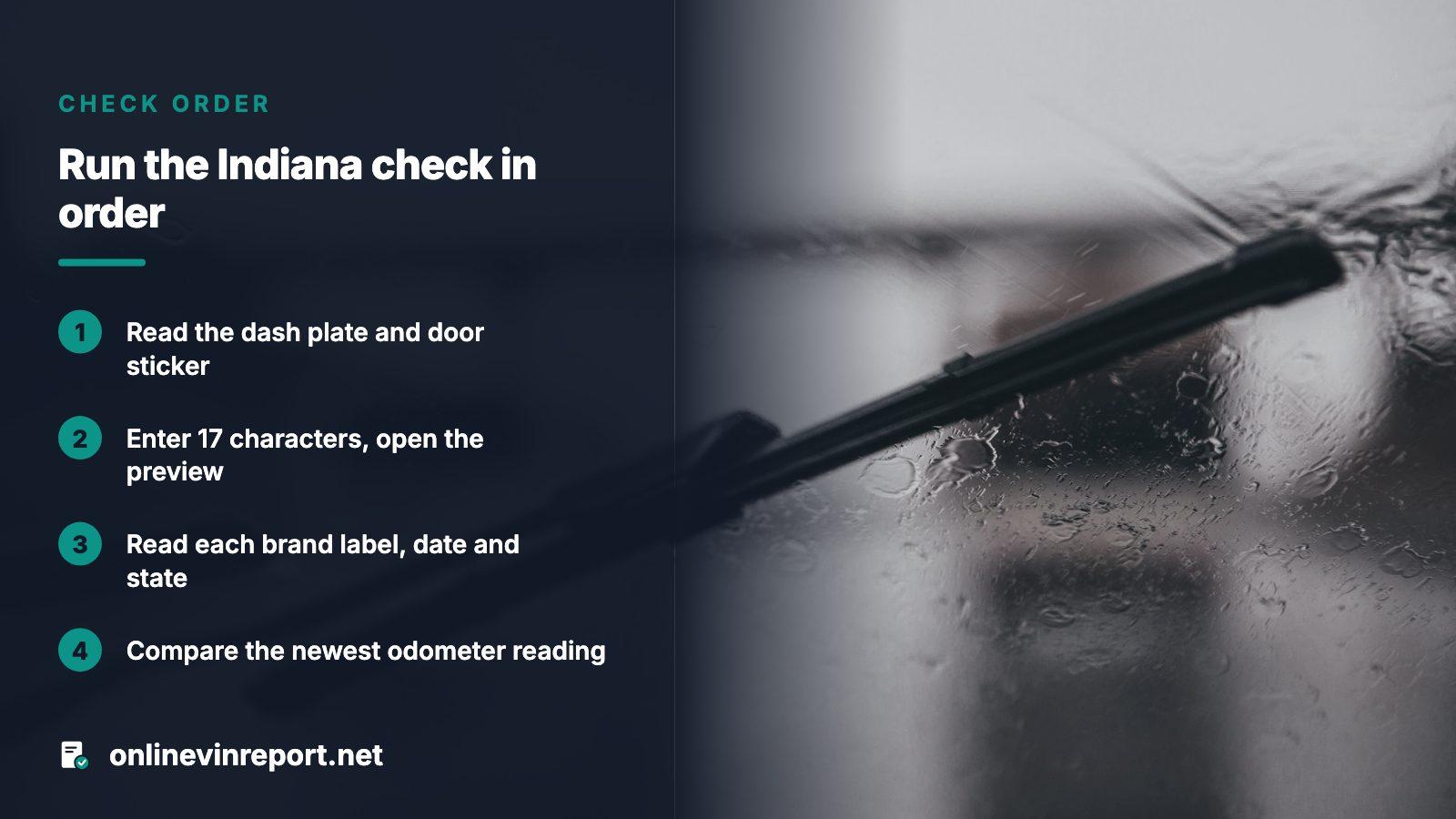
- Look at the plate atop the dash and the sticker on the door pillar, and make sure the title and sale paperwork show the identical 17 characters. Stop if they differ.
- Type all 17 characters into the form on this page and open the preview.
- Open the brand section before anything else. Write down each label, its state and its date.
- Compare the newest odometer reading with the dash today. A reported figure above the dash needs an explanation.
- Set the wording on the Indiana paper title beside the results. A brand in the search that the paper does not show is a question for the seller and the BMV.
- Ask the BMV for its own record of the car, and book an independent inspection before any deposit.
What each kind of entry tells you, and what it leaves open
| Entry in the results | What it tells you | What it leaves open |
|---|---|---|
| Brand applied by a state | A titling agency branded the car, and the national record keeps that brand permanently. | The event behind it. Ask for repair invoices and photos. |
| Insurer salvage ruling | An insurance company or self-insurer judged the car a salvage or total loss. | Whether it was a wreck. A stolen car that stayed missing for 30 days can earn the label and keep it after recovery. |
| Transfer to a junk or salvage yard | The car passed through a yard or recycler at some stage. | Whether a brand followed. A yard visit alone does not brand a car. |
| No entries at all | Participating states most likely reported nothing for that VIN. | Whether every state the car lived in reports in full. |
The federal FAQ admits that what counts as salvage differs from one state to the next, so read the event behind rebuilt, salvage or junk instead of the word alone.
When the paper title and the search disagree
A mismatch is the most useful thing a check can find. Once a state brands a car, the federal record retains the brand, so a car arriving in Indiana with one should still show it in the search. Washing happens where a state skips the call to the state that issued the brand, or to every earlier title state.
The scale is not small. Federal pages cite Experian Automotive's tally for the first half of 2008: over 185,000 cars branded by one state and then titled in another with no brand attached.
A clean paper title is not a clean history
If the search shows a brand and the paper does not, hold the payment. Ask the seller where the car was titled before, and ask the BMV what its own file says. The paper shows what the last office wrote down; the record shows every office that wrote something.
Why an empty result is not a clean bill
Federal figures say NMVTIS holds 87 percent of vehicles nationwide, and a majority of states send it data. That leaves room for a VIN that looks spotless in the search while the car carries a salvage past. The FAQ says a blank result usually means participating states reported nothing, which can occasionally happen until every state takes part. Some states also exempt older vehicles from titling.
Timing is a second gap. How fresh the data is depends on the state: a few push each title change straight through, while others send a batch roughly every 24 hours or within days. Yards and recyclers report monthly, and a small yard that takes in under five salvage or junk cars in a year is excused from reporting. A recent loss can sit outside the data for a while.
Pair the search with the BMV's own record
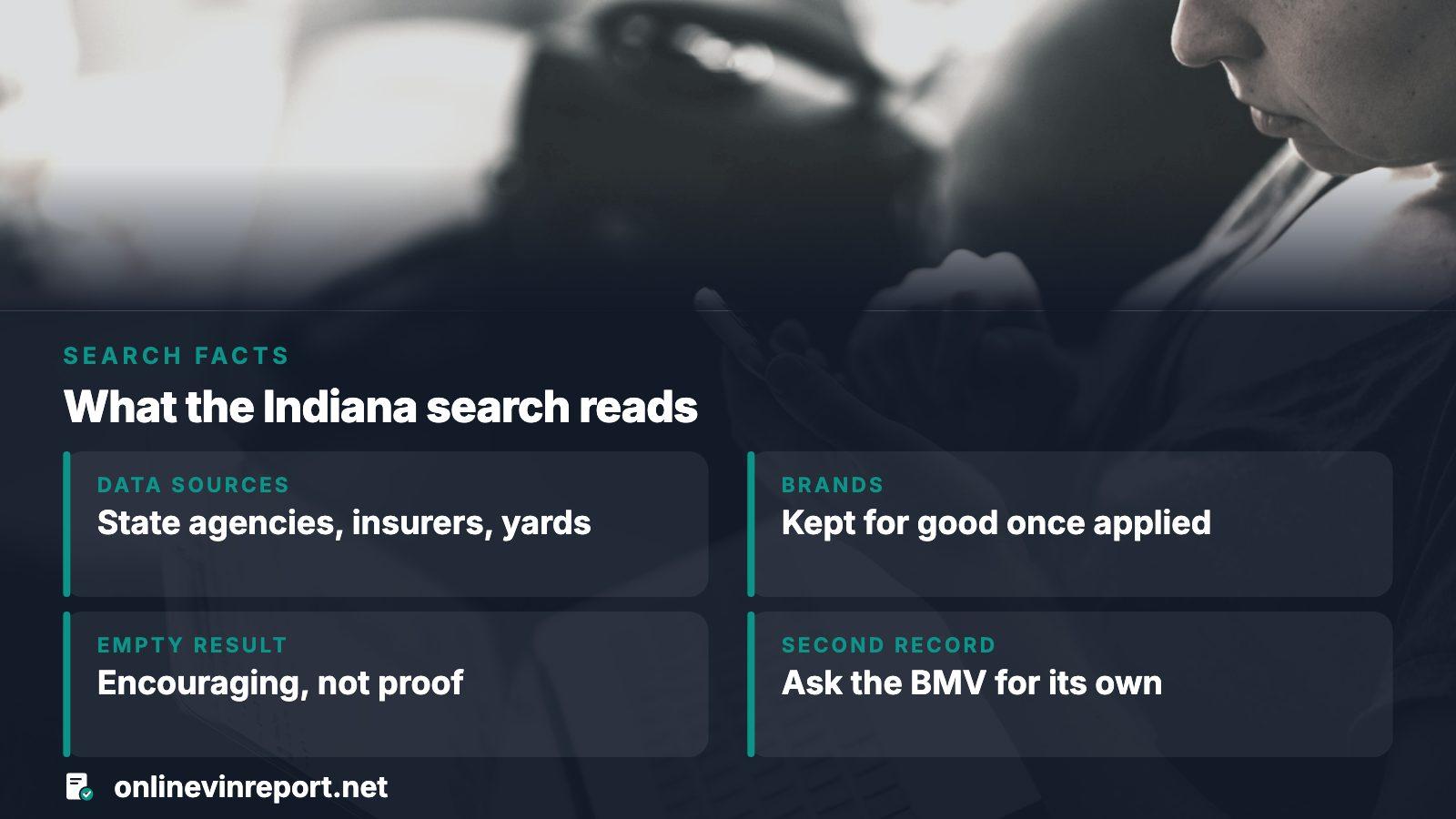
The Justice Department tells buyers to consider the actual state title record, because the national database does not hold everything a state does. In Indiana that means the Bureau of Motor Vehicles. NMVTIS's list of state record-request routes includes an Indiana entry that links to the BMV's title forms page, a sensible place to start. Ask the BMV who may order a record for a car and what the order requires.
What this page does not quote
Indiana's salvage and rebuilt deadlines, application fees and the cases where a vehicle cannot be titled are set by the state and can change. This page does not repeat them. Read them on the BMV site, or ask a branch, before you rely on any figure a seller gives you.
Four checks side by side
| Check | Best at | Misses |
|---|---|---|
| Paper title from the seller | The wording the issuing office used that day | Brands added later, or never printed |
| BMV record for the car | What Indiana itself holds on the title | What happened under another state's title |
| Online VIN title search | Brands, odometer, insurer rulings and yard transfers from many states | Repairs, and any state or yard that reports late or not at all |
| Independent mechanic | Present condition and hidden repair work | The paper trail |
According to the FTC, a history report does not replace a mechanic's inspection; such reports tend to cover accidents and flood damage more than mechanical faults. Have the mechanic put findings on paper with the VIN and a repair estimate for price talks.
Preview, report and cost
Preview first. The preview is free and signals whether brand entries, salvage records, auction photos or odometer readings exist for that car. The report itself is a one-time buy with nothing recurring, plus bundles of 3, 5 or 10 for a longer list of cars. Prices are on the pricing page.
In a report, read the brand entries first, then salvage and auction history with photos, odometer readings, and any lien or impound entry.
If a brand appears: reprice, verify or walk
- Salvage or junk entry: ask for repair photos and invoices, then pay a mechanic for a structural look before any deposit.
- Flood entry: treat it as a walk-away unless an inspector who has seen the car says otherwise.
- Total loss with no brand: find out what the insurer decided and why. A recovered stolen car can carry that label.
- Brand in the search, none on the paper: stop, and take the VIN to the BMV.
- Nothing found: encouraging, and still worth an inspection.
Where this information comes from
- NMVTIS: Consumer information — Lists what a federal title search returns, who supplies the data, how brands persist and where the gaps are.
- NMVTIS: Frequently asked questions — Explains empty results, uneven state participation, update timing and the missing repair history.
- NMVTIS: Reporting entities — Sets out how junk and salvage yards report, how often, and which small yards are exempt.
- NMVTIS: State vehicle record request information — Lists states with NMVTIS data and links each to its own record route, Indiana's through the BMV forms page.
- NMVTIS: State participation — Describes what counts as state compliance: supplying data, checking titles and paying fees.
- FTC: Buying a used car from a dealer — Backs the advice to pair a history report with a written mechanic's inspection.
Sources and photos: Facts checked against the sources above in November 2026. Photos by Nina Mercado, Thibault Valjevac and Michal Biernat on Unsplash; diagrams by OnlineVINReport.
Keep reading
- What is a branded title? How to read salvage, flood and rebuilt brands by VINWhat each brand means and how it follows a car.
- Title washing: how a brand vanishes and what a VIN title check can showHow a brand drops off between states and how to spot the gap.
- Check title and lien by VIN: brands first, then who holds a claimLiens and who really holds the title.
- Rebuilt title inspection: what the state checks and what a VIN title check addsWhat an inspector looks at on a rebuilt car.
Frequently asked questions
How do I run an Indiana title check?
Begin at the car: note its VIN, confirm the title matches, and search it online. Open the brand section first and note each label with its state and date. Then weigh the result against the paper title and request the Indiana BMV's own record before paying.
What does an Indiana title search show?
It reads a national database fed by state title agencies, insurers, recyclers and salvage yards. You see title brands with dates, the newest odometer reading, insurer salvage or total-loss decisions, yard transfers, and sometimes theft history. Repairs are not included.
Does a clean result mean the car was never salvage?
No. Not every state reports in full, updates land on different schedules, and small yards may not report at all. A blank result usually means nothing was reported, which is encouraging but not proof. Back it with the BMV record and an inspection.
Can a salvage brand vanish when a car is retitled in Indiana?
The national record keeps a brand once a state applies it, so a search should still show it. Washing can occur where a state does not check earlier title states, which is why a brand in the search that is missing from the paper deserves questions.
Where do I get the state's own record for an Indiana car?
From the Indiana Bureau of Motor Vehicles. NMVTIS's state record page includes an Indiana entry linking to the BMV's title forms. Ask the BMV who may order a record and what it costs, since this page does not quote Indiana fees or deadlines.
Now check the car itself
The guide explains what to look for. The report shows what this VIN has on record.