THE SHORT ANSWER
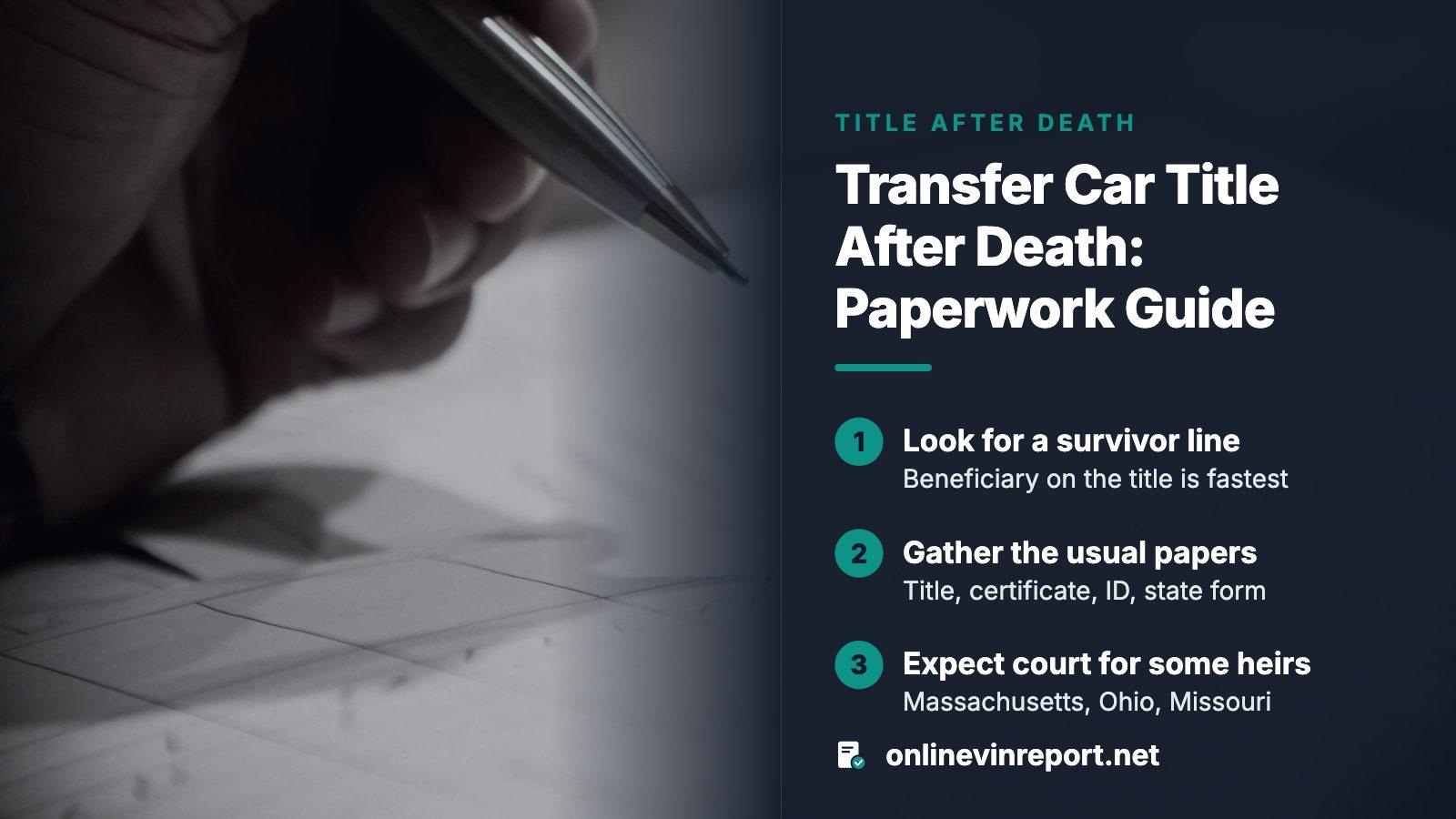
A title that lists a beneficiary or shows a survivorship legend usually needs only a certified death certificate and your ID. Without either, a surviving spouse or heir normally signs the state's affidavit, and a court document replaces it when an estate is open or the state offers a non-spouse heir nothing else. The affidavit is sworn, so learn the owner's debts first, then run the VIN for liens and title brands.
- Fastest route
- A beneficiary or survivorship line already on the title
- Usually needed
- Title, death certificate, your ID, the state's form
- Court first for non-spouse heirs
- Massachusetts, Ohio, Missouri
- Check before signing
- Liens and title brands, by VIN
Three title situations, three different counters
Your title puts you in one of three positions.
| What the title shows | Where that leaves you | What to bring |
|---|---|---|
| A named beneficiary or a survivorship legend | The owner already made the choice | Certified death certificate, ID, the title |
| Only the dead owner's name, and no estate opened | You need the state's affidavit for a spouse or heir | The affidavit, title, death certificate and other heirs' signatures |
| Only the dead owner's name, and an estate is open | The personal representative signs for the estate | The court's appointing papers and the title |
Appointing papers go by different names. Michigan says Letter of Authority, Wisconsin says Personal Representative Papers, Pennsylvania says Short Form Certificate, so use the local term on the phone. Once an estate is opened the affidavit routes mostly close, and Indiana writes that condition into its own vehicle affidavit.
The dollar figure you were told to check is rarely the gate
Of the 17 states reviewed, 10 set no dollar limit on their smallest transfer form, because the statute lifts cars out of the count or the form never asks. A true estate-wide threshold governs in only 4, and in 3 more the limit belongs to vehicles rather than the estate.
- Minnesota gives a spouse one automobile regardless of worth, and California leaves registered vehicles out of its count.
- New York covers a single vehicle worth up to $25,000 once any lien is deducted.
- Ohio caps combined value at $65,000 with no limit on the number of cars, while Wisconsin's spouse route stops at five.
Three states are the real exception. Massachusetts, Ohio and Missouri give a surviving spouse a generous form and any other heir nothing, so those heirs go through the probate court.
Signatures, not dollars, set the pace
Of 15 forms opened for the research, 6 had a single signer and no notary block: Florida, Massachusetts, Virginia, California, Michigan and Wisconsin. Michigan still means a queue, since a Secretary of State examiner verifies its form at the counter: a wait rather than a fee. Another 3 go the opposite way and make every heir sign before a notary.
- Texas' VTR-262 fits three heirs on a sheet, so a big family needs several, and it bars a power of attorney from that section.
- Pennsylvania's MV-39 can need every adult child and climbs to cousins when there are none.
- North Carolina's MVR-317E1 has five heir rows and four notary blocks. In all three, relatives set the schedule.

Waiting periods and the courthouse route
Where no affidavit exists for you, the court route has clocks of its own. Missouri's $40,000 small estate requires a 30-day wait, then a clerk filing and the clerk's certificate, and publication is also triggered above $15,000. Massachusetts voluntary administration carries a 30-day wait and a filing fee. Ohio sends the heir to a county probate court for a Release from Administration or a Certificate of Transfer.
Indiana shows how much one drafting choice can save. Its general small-estate affidavit waits 45 days after the death, while the vehicle carve-out in IC 29-1-8-1(c) waits 5 days.
When the official page is behind the law
An agency's own page is not always current. Virginia's DMV page says $50,000, yet the statute it links to was raised to $75,000 in 2025. On 26 September 2025 Arizona raised its personal-property limit to $200,000, from $75,000. California prints three small-estate figures at three addresses: the statute, the DMV manual and the form. Michigan's vehicle cap is now indexed, and its form leaves the amount off.
Bring the form and check its date
When a county page, an older guide and the agency's current PDF disagree, the PDF controls. Print it from the agency's site and check the revision stamp.
What the research could not read
Illinois is left out because its agency and legislature sites could not be reached during research, so nothing here applies to it. Arizona's forms and Indiana's State Form 18733 were unreadable too, so only their statutes appear. Wisconsin's transfer-on-death statute went unread; ask that agency directly.
What the affidavit commits you to
Each affidavit is a sworn statement, and several states name who pays if it proves false. California's § 5910 imports Probate Code § 13109, which makes whoever receives the car answerable to the owner's creditors, capped at the car's fair market value. Wisconsin's MV2300 has the affiant accept personal liability for the decedent's debts, limited to what the vehicles are worth (§ 859.25). Georgia asks the signer to affirm that the estate carries no debt, and Pennsylvania's signer swears every debt is paid, with 18 Pa.C.S. § 4904 penalties attached.
Learn what the person owed first
That question matters more than the probate question. Signing for an estate with unpaid creditors makes you their target. When the debts are a mystery, the court process is the protective choice.
Check whose deadline the warning describes
Late-transfer warnings are mostly written for buyers, not heirs.
- Florida says no penalty fee is due on deceased applications, and North Carolina's 28-day, $20 late penalty does not apply to inheritance transfers.
- Texas' 30 days and Michigan's 15 are keyed to a purchase, and Pennsylvania lets the car stay on the dead owner's registration, renewed for the estate.
- Washington is the real exception: its 15-day rule names inheritance and charges $50 on day sixteen, then $2 a day up to $125. Missouri's clock starts when you acquire the car, and only good cause earns a waiver.
Run the VIN before you swear to anything
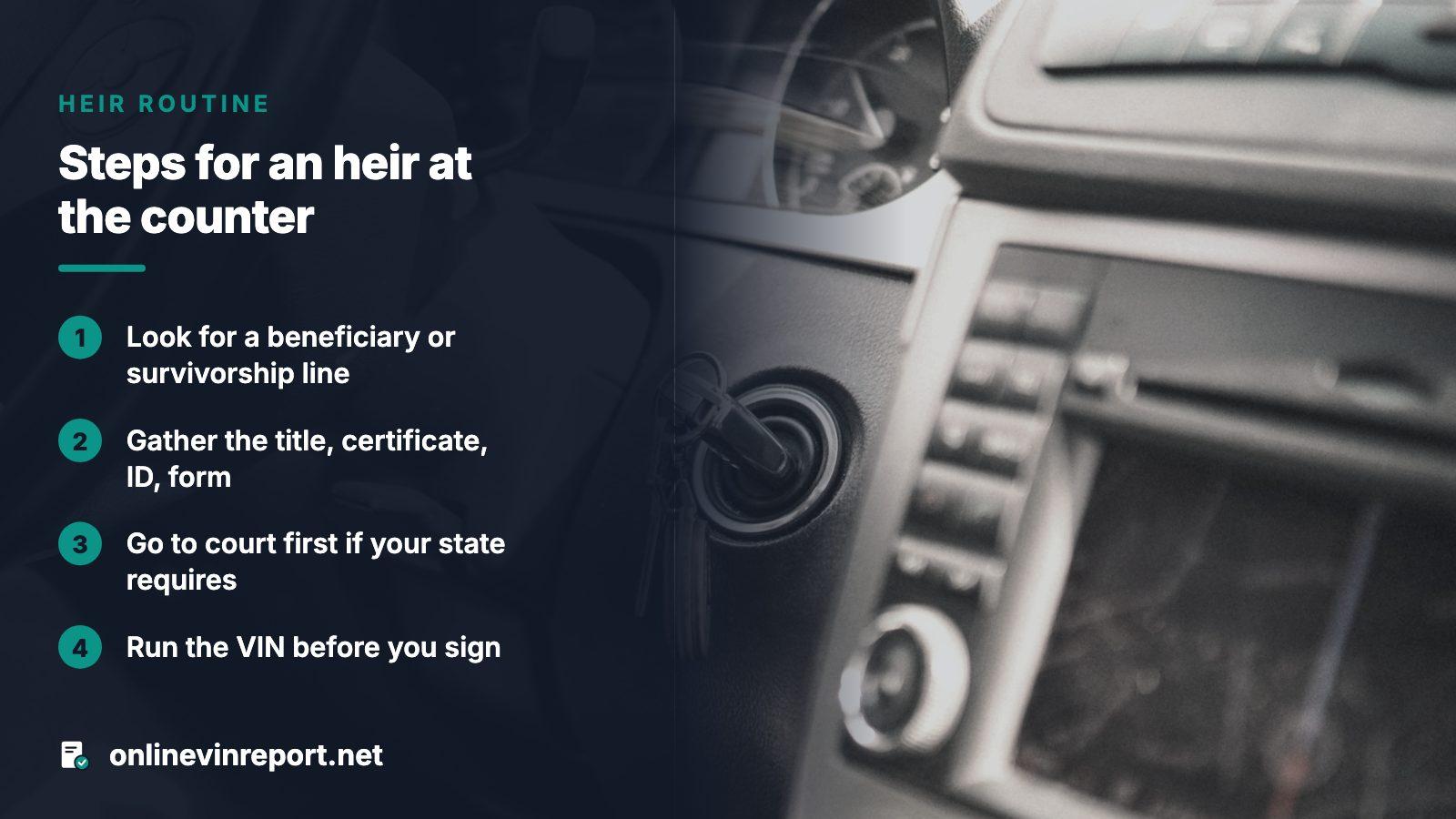
Two facts about the car can be checked before the counter visit, and both can change your route. A lien matters because New York measures its limit net of loans and Virginia's beneficiary option fails when one exists. The title record matters because none of the states reviewed brands a car for being inherited, while any salvage, flood, rebuilt or junk brand from earlier years stays with the car. A survivorship note or transfer-on-death line printed on some titles is not a brand.
The 17-character VIN is stamped at the dashboard corner nearest the driver, visible through the windshield, and printed on the door-frame label. Type it into the search box and open the preview, which charges nothing. A paid report, bought once with no subscription, lists title brands with state and date, liens and impounds, odometer readings and salvage and auction history with photos. See the pricing page for options.
A lien search is not a debt search
It shows liens recorded against the car. A credit card balance or an unsecured loan never appears, so what the person owed stays your question to answer.
If you are buying a car out of an estate
Expect the seller's signature to differ from the name printed on the title, a pattern that looks like title jumping. The difference is paperwork, so ask to see the affidavit or court papers and the death certificate. Florida lets a surviving spouse assign the title straight to a buyer, and Missouri allows it for a transfer-on-death beneficiary. Georgia does not, so a Georgia heir needs the title issued in their own name before passing it on.
Where this information comes from
- California Legislature: Vehicle Code § 5910 — The state's transfer-without-probate rule and its link to creditor liability for the person who takes the car.
- FLHSMV: transferring a title after a death — Florida's own account of the spouse form, the missing penalty fee and assigning a title straight to a buyer.
- PennDOT: form MV-39, notification of assignment of vehicle to heirs — Covers the tiers of relatives who sign and the sworn statement about the decedent's debts.
- Washington Legislature: RCW 46.12.650 — The transfer deadline that names inheritance outright, with the late fees and the illness waiver.
- Indiana General Assembly: IC 29-1-8-1, small estates without administration — The statute behind the short vehicle waiting period compared with the general small-estate wait.
Sources and photos: Facts checked against the sources above in November 2026. Photos by Masjid MABA, tim and Anastasiia Nelen on Unsplash; diagrams by OnlineVINReport.
Keep reading
- Car title check online: salvage, flood, rebuilt and junk by VINRead the brands on the document you are about to inherit before you decide to keep the car.
- Title jumping: what an online VIN title check can and cannot showWhen a mismatched name on the title is a warning sign, and when an estate explains it.
- Duplicate title: what it means and how to check the car by VINWhat to do first if the dead owner's paper title cannot be found.
- Bill of sale for a car: the deal it proves and the history it can'tThe paper to write up if the estate sells the car rather than keeping it.
Frequently asked questions
Is probate required to retitle a car after the owner's death?
Often not. Many states have a small-estate or spouse affidavit that moves a single car without a court. Massachusetts, Ohio and Missouri send an heir other than the spouse to probate court. Check your agency's own form before assuming either way.
Which documents does the counter want after a car owner dies?
Plan on the title, a certified death certificate, your photo ID and the state's completed form. With an estate open, add the court's appointing document. Some states also want notarized signatures from several heirs, so read the form's own instructions.
How long do I have to retitle a dead owner's car?
Often the deadline you read about does not reach inheritances, though Washington and Missouri are real exceptions. Indiana gives an inheritor longer than a buyer: 45 days generally and 60 for a transfer-on-death car. Ask the agency which clock covers you.
Should I name a beneficiary on my own car title?
For the family left behind, yes. Eight of the 17 states reviewed offer it, California at a $10 fee. A Texas designation survives a contrary will, Ohio creates one on a notarized affidavit, and Minnesota requires a spouse's consent to name anyone else.
Who signs the form when there is no surviving spouse?
It depends on the state. Pennsylvania starts with the children, then moves outward through parents, siblings, aunts, uncles and finally first cousins, and the operative tier signs before a notary. Texas lets a spouse skip the children only when they are also the spouse's own.
Now check the car itself
The guide explains what to look for. The report shows what this VIN has on record.