THE SHORT ANSWER
A hail damage title is a brand a few states print when a young vehicle is hurt only by hail and the repair estimate passes a set share of its value. Many states have no such brand, and a hailed car there may carry nothing, or a plain salvage brand if an insurer wrote it off. A VIN check shows whichever brand was recorded.
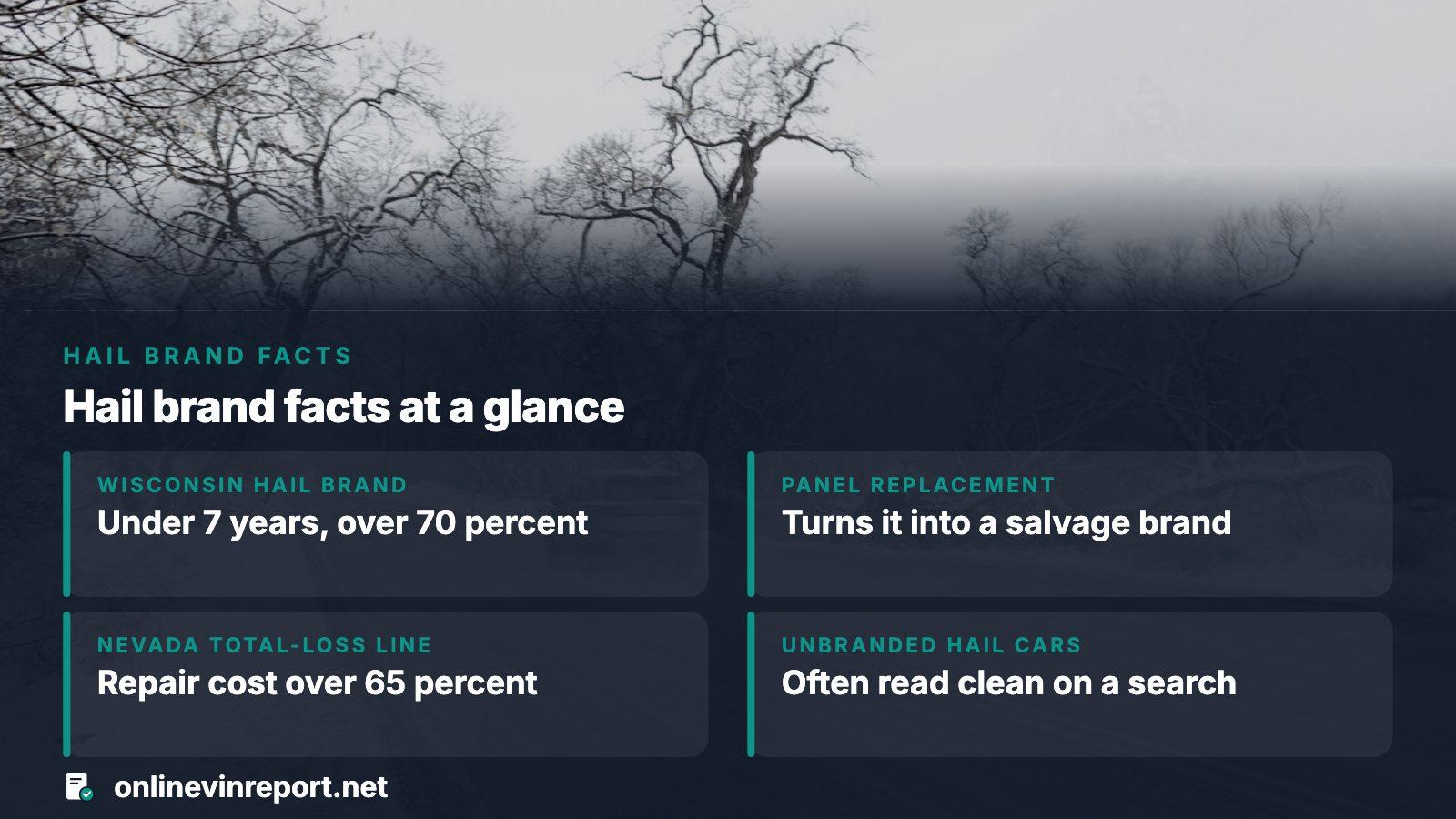
- Wisconsin hail brand
- Under seven years old, hail only, repair above 70 percent of value
- Panel replacement
- Swapping exterior panels turns it into a salvage brand
- Nevada total-loss line
- Repair cost over 65 percent of value, hail not named
- Unbranded hail cars
- Often read clean on a title search
What a hail damage brand actually is
Most people picture one universal list of title brands: salvage, rebuilt, flood, junk. Hail is not on every state's list. A few states made a dedicated hail category, since a car pitted by a storm is a different animal from one that folded in a collision.
The clearest example I read directly is Wisconsin's transportation department page. Its hail damaged brand covers a vehicle younger than seven years where hail alone did the harm, and the repair estimate or final bill (the higher one counts) exceeds 70 percent of fair market value. The car also has to be fixable, or already fixed, with no replacement of non-mechanical exterior metal or plastic, inner or outer panels included.
The panel test that flips hail into salvage
Wisconsin draws a line that is easy to miss. Once a shop replaces any exterior body panel or plastic part, the state requires a salvage vehicle brand in place of the hail one. Its salvage definition also carves hail out of the ordinary collision test, which is why hail needs a separate rule.
| What happened to the car | Brand under Wisconsin's rules | Why |
|---|---|---|
| Hail only, repairable with no panel swaps, cost above 70 percent | Hail damaged | Matches the hail definition |
| Hail only, but exterior panels get replaced | Salvage | State rule overrides the hail brand |
| Collision, cost above 70 percent, under seven years old | Salvage | Standard salvage test |
| Older car, hail only | No hail brand described | Brand covers young vehicles only |
That last row matters for shoppers. The page describes these brands for vehicles younger than seven years, so an older hailed car has no hail category there.
States that never mention hail
Nevada's DMV shows how different the picture gets elsewhere. Its salvage page sets the total-loss line at repair cost beyond 65 percent of pre-damage market value, painting excluded, and says damage below that is not salvage. Hail never appears, so I cannot say how Nevada treats a hailed car, and a generic article cannot either.
Nevada also treats cars ten or more model years old more gently. When just a hood, a trunk lid and at most two items among doors, grille, bumpers or lamps need work, the car stays outside the salvage definition. Bigger repair lists fall back on the 65 percent rule.
Do not assume your state matches
Wisconsin's 70 percent figure and Nevada's 65 percent figure are different numbers for different laws. Read your own state motor vehicle agency's page on brands before you treat a hailed car as branded or clean.
Why an insurer payout still matters
A hail claim does not automatically produce a brand. An insurer can repair the car, pay the owner and leave the title alone. A brand appears when a state's own hail or salvage rule is met, and the insurer's decision to take the car as a total loss is usually what starts that process.
Wisconsin adds one more layer worth knowing: a claim paid brand for a car under seven years old whose repair cost exceeds 30 percent of its value and which was transferred to an insurer after a claim. That brand does not apply to a vehicle already meeting the salvage definition. So a severely hailed, insurer-owned car in that state can pick up a brand in several ways, depending on the numbers.
What an online title check can and cannot tell you
Title brands move between states through NMVTIS, a federal database run under the Justice Department. Reports from states, insurers and salvage yards go in, and that pooling is why a brand written in one state usually shows up again after the car is retitled elsewhere.
Wisconsin notes that its titles also show brand information from a previous jurisdiction where it is available. That carry-over is how a hail or salvage mark can survive a retitle, and it is what a VIN search is testing.
- A hail or salvage brand in the result means a state or insurer logged a serious loss.
- A clean result means nothing was reported, not that the roof is smooth.
- A salvage auction entry with photos can show hail pitting even when no brand exists.
Owners describe what happens after hail repairs
Owners sometimes report that trouble began only after the hail work. Two NHTSA filings show what that can look like.
From an NHTSA owner complaint
A 2021 Subaru Outback owner told NHTSA the car sat at a body shop for hail repair from late April to mid-July 2022, with the battery and a relay worked on. At pickup the electronic door locks were dead, and a dealer later found a faulty body control module. The dealer declined warranty cover, blaming outside influence, and the owner said the car was mostly unusable.
The takeaway for a buyer: ask for the repair invoice on any hailed car, and ask which shop did the work and whether any electrical items were disturbed. A clean title does not tell you that.
Total loss status can follow the car into a warranty dispute
From an NHTSA owner complaint
A 2019 Toyota RAV4 owner told NHTSA the vehicle had been declared a total loss because of hail. According to the complaint, the maker would not assist with a differential problem covered by a service bulletin on other trucks, citing the total loss status. The owner argued the title status was irrelevant to a part that was defective before the storm.
That is one owner's account and I cannot say how the maker would rule today. It shows a practical risk, though. A car with a total-loss history can meet resistance on goodwill repairs and recall-adjacent fixes, even if the defect is unrelated to the hail.
If a discounted hailed car tempts you, ask a dealer of that make how the warranty treats it before you pay.
A buyer's routine for any hail-history car
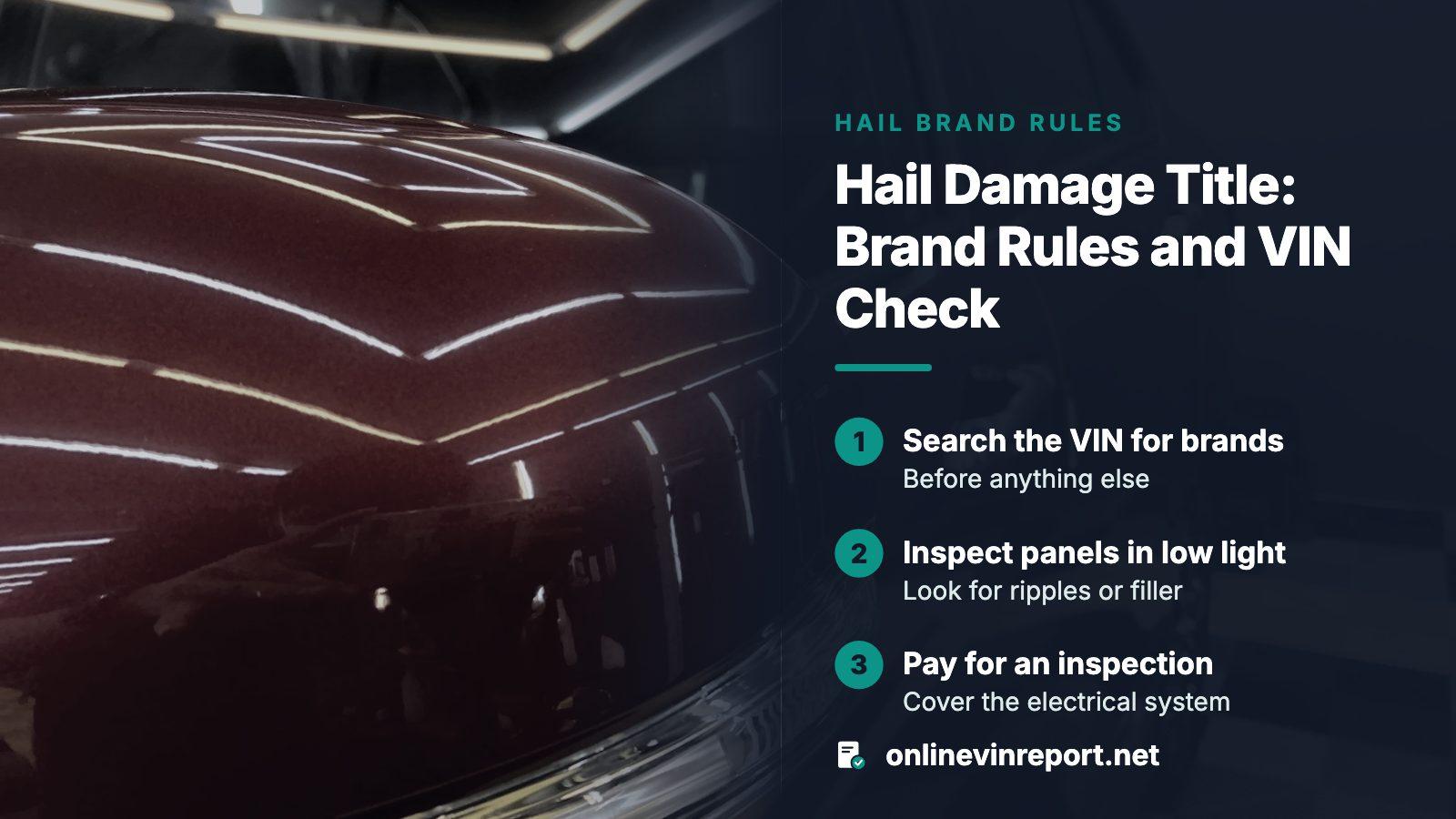
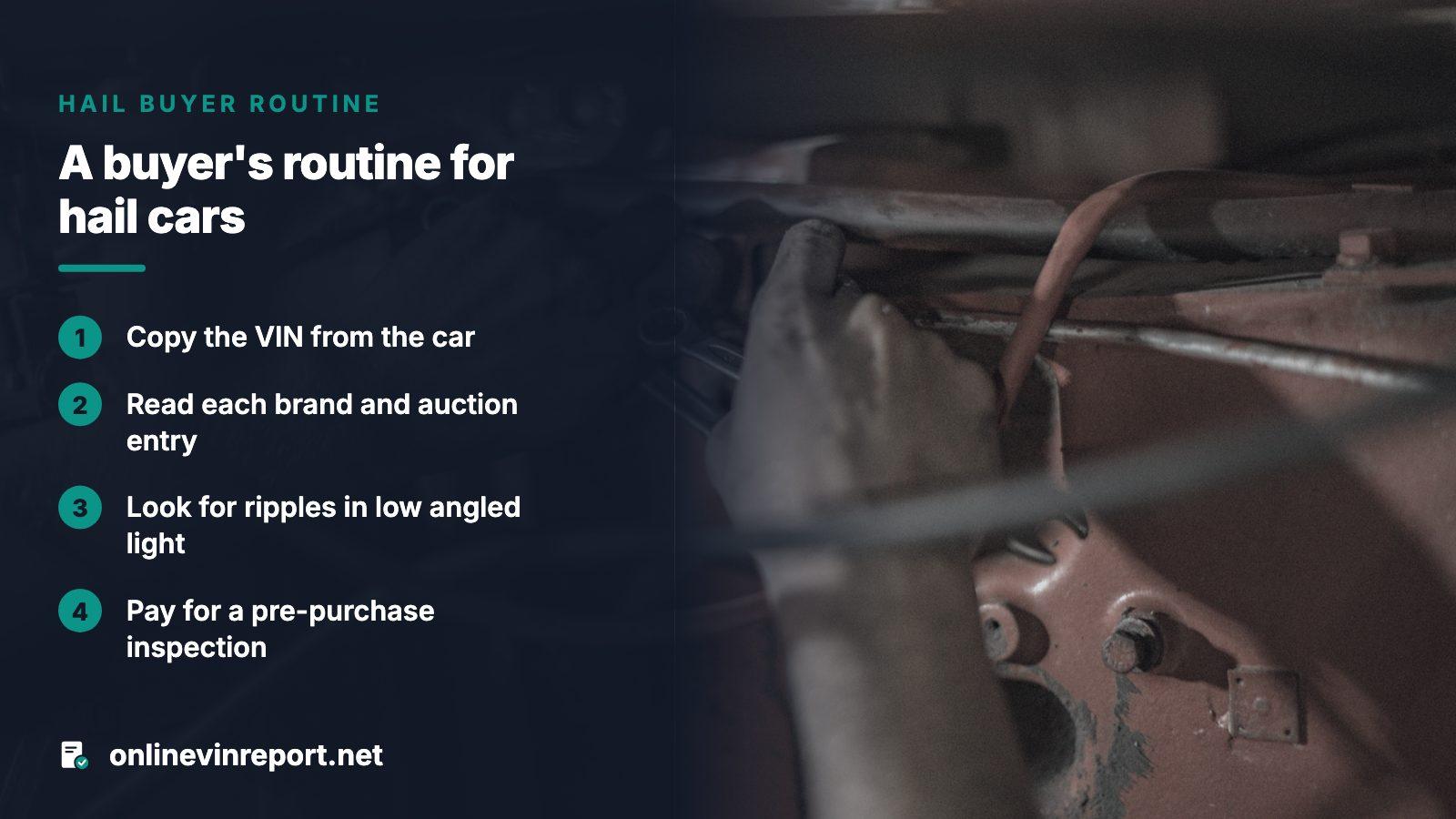
- Copy the VIN from the car, not from the listing, and search it for brands before anything else.
- Read each brand line and any auction or insurer entry, then compare the dates against what the seller says.
- Put the brand question to the seller directly, since Wisconsin tells buyers to raise it at transfer.
- Look along the roof, hood and trunk lid in low, angled light for ripples or body filler.
- Pay a shop for a pre-purchase inspection that covers the electrical system.
Disclosure rules push the same direction. Wisconsin says an owner who fails to disclose a brand can face a fine up to 5,000 dollars, and it marks brands as permanent on every title the state issues for that vehicle.
Running the VIN check on a hailed car
Type the 17-character VIN into the OnlineVINReport search box and the preview costs nothing. The full report is one payment, with options on the pricing page, and no subscription comes with it.
On a hailed car, read the brand lines, the damage and insurance entries, and any salvage auction record with photos first. If all of those come back empty and the seller still mentions a storm, the inspection and the repair invoice become your main evidence.
Where this information comes from
- Wisconsin DOT: flood damaged vehicles and other title brands — Source for the hail damaged, salvage and claim paid definitions and the disclosure fine.
- Nevada DMV: salvage vehicles — Shows a state total-loss rule that never mentions hail.
- VehicleHistory.gov: National Motor Vehicle Title Information System — The federal title database behind brand reporting between states.
- NHTSA owner complaint 11484811 — owner experience, paraphrased
- NHTSA owner complaint 11606143 — owner experience, paraphrased
Sources and photos: Facts checked against the sources above in November 2026. Photos by Clarence Tioh, Nina Mercado and Zoshua Colah on Unsplash; diagrams by OnlineVINReport.
Keep reading
- What is a branded title? How to read salvage, flood and rebuilt brands by VINThe full set of brands and what each one means.
- Flood damaged car: what a title check shows and what it missesAnother weather loss, with a brand that is more widely recorded.
- Total loss threshold by state and what it means for a VIN title checkWhy the repair-cost line that creates a brand differs by state.
- Salvage title VIN check: run it online before you payHow to search a VIN for salvage brands.
Frequently asked questions
Does hail damage go on a car's title?
Only in some states, and only when a rule is met. Wisconsin, for one, has a hail damaged brand for young vehicles. Other states print nothing for hail unless an insurer declared a total loss. Check your own state agency's page on brands, then run the VIN to see what was recorded.
Can a hail damaged car have a clean title?
Yes. If the owner paid out of pocket, or the insurer repaired the car and kept it off the total-loss path, nothing may have been filed. A clean search then reflects missing records, so inspect the panels and ask for the repair invoice.
Is a hail damage title the same as a salvage title?
Not in Wisconsin, where hail has its own brand and the salvage definition excludes hail. If the repairs replace exterior panels, though, that state requires a salvage brand instead. Other states may fold hail into ordinary total-loss rules.
Does a VIN check show hail damage?
It shows what was reported: a hail or salvage brand, an insurer total loss, or an auction entry with photos. It cannot see dents that were never reported. Treat a clean result as one input and add a physical inspection.
Should I buy a car with a hail damage brand?
It can be reasonable when the price reflects the history and an inspection finds sound repairs. Ask who did the work, check the electrical system, and confirm with the maker's dealer how warranty coverage treats the car. Walk away if the seller dodges any of that.
Now check the car itself
The guide explains what to look for. The report shows what this VIN has on record.