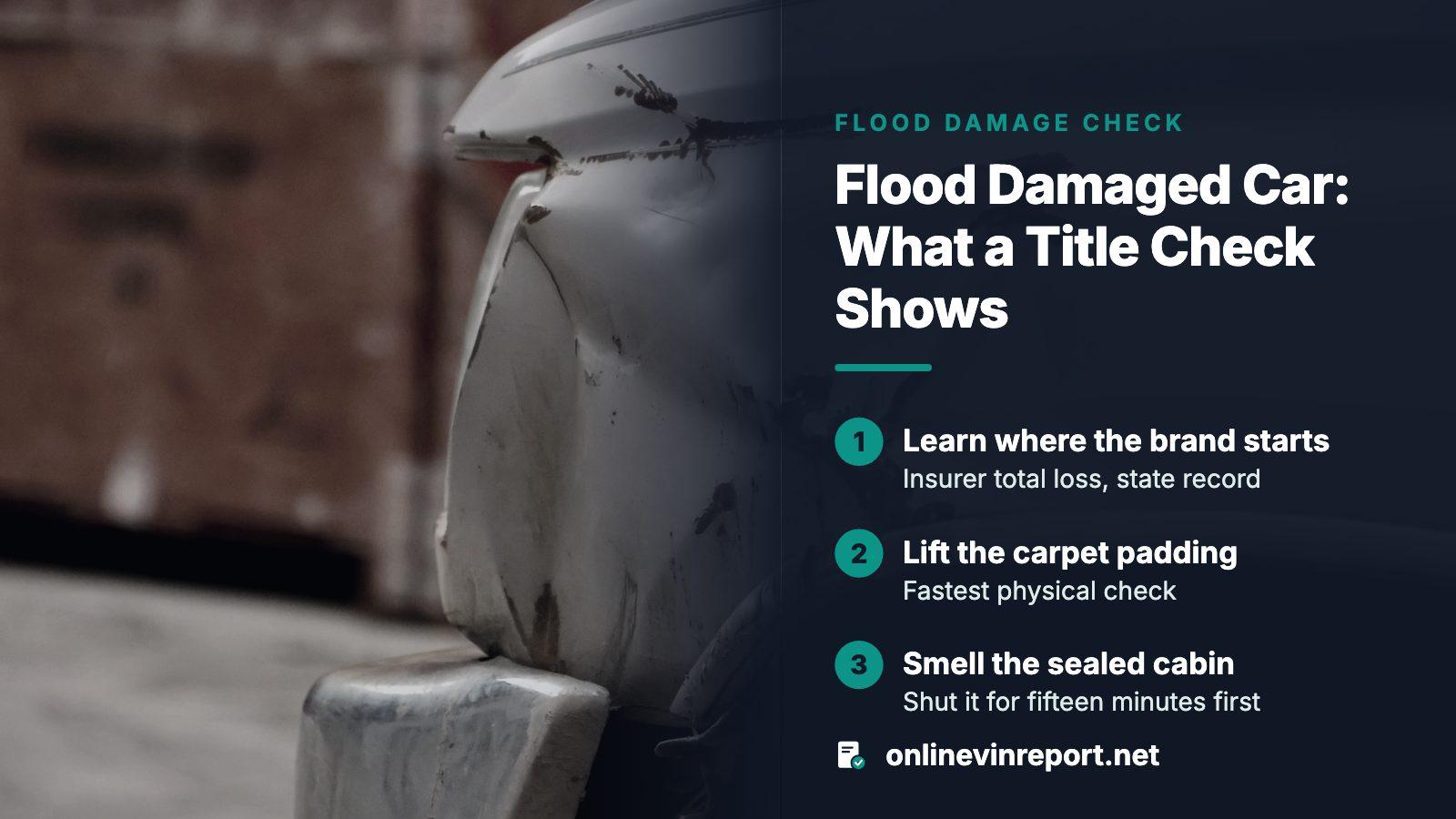
THE SHORT ANSWER
Search the VIN for a flood or salvage brand and look at the salvage auction history. Then inspect the car: lift the carpet to see the padding, pull each seat belt to its stop, and smell the cabin after it has stayed shut for fifteen minutes. A clean title does not prove a dry car, because uninsured or quickly sold flood cars often never get branded.
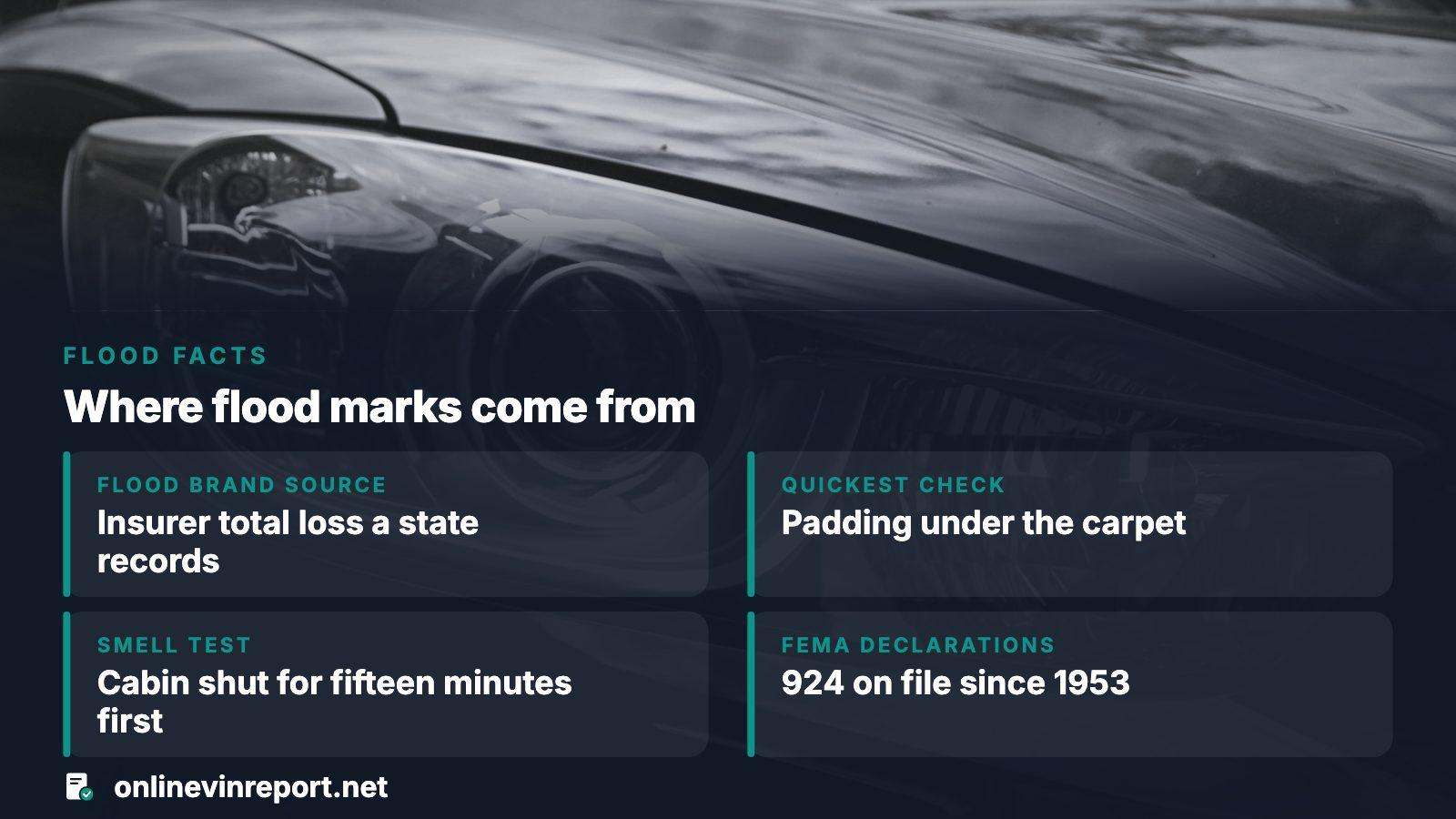
- Where a flood brand comes from
- An insurer total loss that a state records
- Quickest physical check
- The padding under the carpet
- Smell test
- Cabin shut for fifteen minutes first
- FEMA flood declarations
- 924 on file since 1953
What a flood brand is and who decides to issue one
A flood brand is a state's note on the title record that a vehicle was written off after water damage. It starts with an insurer's total-loss declaration, the same trigger that produces a salvage brand.
NMVTIS, the federal title system, passes flood and salvage brands between states, so a car branded in one state should still show it after a retitle elsewhere. A VIN title check reads those records, and a flood brand in the result is a documented water loss.
Why a flooded car can still read clean
No insurer, no brand. An owner with liability-only coverage never files a water claim, and a seller who dries the car out and lists it right away never opens one either. Both cars search clean, correctly, because nothing was recorded.
The check screens documented cars and nothing else. A damage-reported flag reflects one vendor's wording, not a legal finding, so follow it up when it appears and take no comfort from its absence.
From a buyer on Reddit
A buyer on Reddit's r/alberta pulled a history report the day before buying a used vehicle from a private seller. It listed a recovered theft and an auction sale, with nothing about water. Almost a year later a new report carried a flood damage claim dated the day of that auction. Replies said proving the seller knew would be the hard part.
Entries can land after the sale, so search the VIN again just before you pay.
Reading the title check for signs of water
The 17-character VIN is stamped on a plate at the dashboard corner and printed on the driver's door jamb. Enter it for a free preview; the full report is a one-time purchase, with options on the pricing page. It covers title brands, damage and insurance records, odometer readings, and salvage and auction history with photos.
| In the report | What it suggests | What to do |
|---|---|---|
| Flood brand | A state logged a water-related total loss | Walk away |
| Salvage brand or auction entry | Written off or salvage-sold, for water, a crash or theft | Read the auction photos and notes |
| Rebuilt brand | A written-off car was repaired and passed inspection | Find the original loss |
| Damage or insurance record | An insurer or vendor logged a loss | Ask for claim and repair papers |
| Nothing on record | No insurer or state filed a water loss | Do the physical checks |
The ten-minute walk-around that finds what records miss
Carry a flashlight. Detailers clean what shows, so go where cleaning rarely reaches.
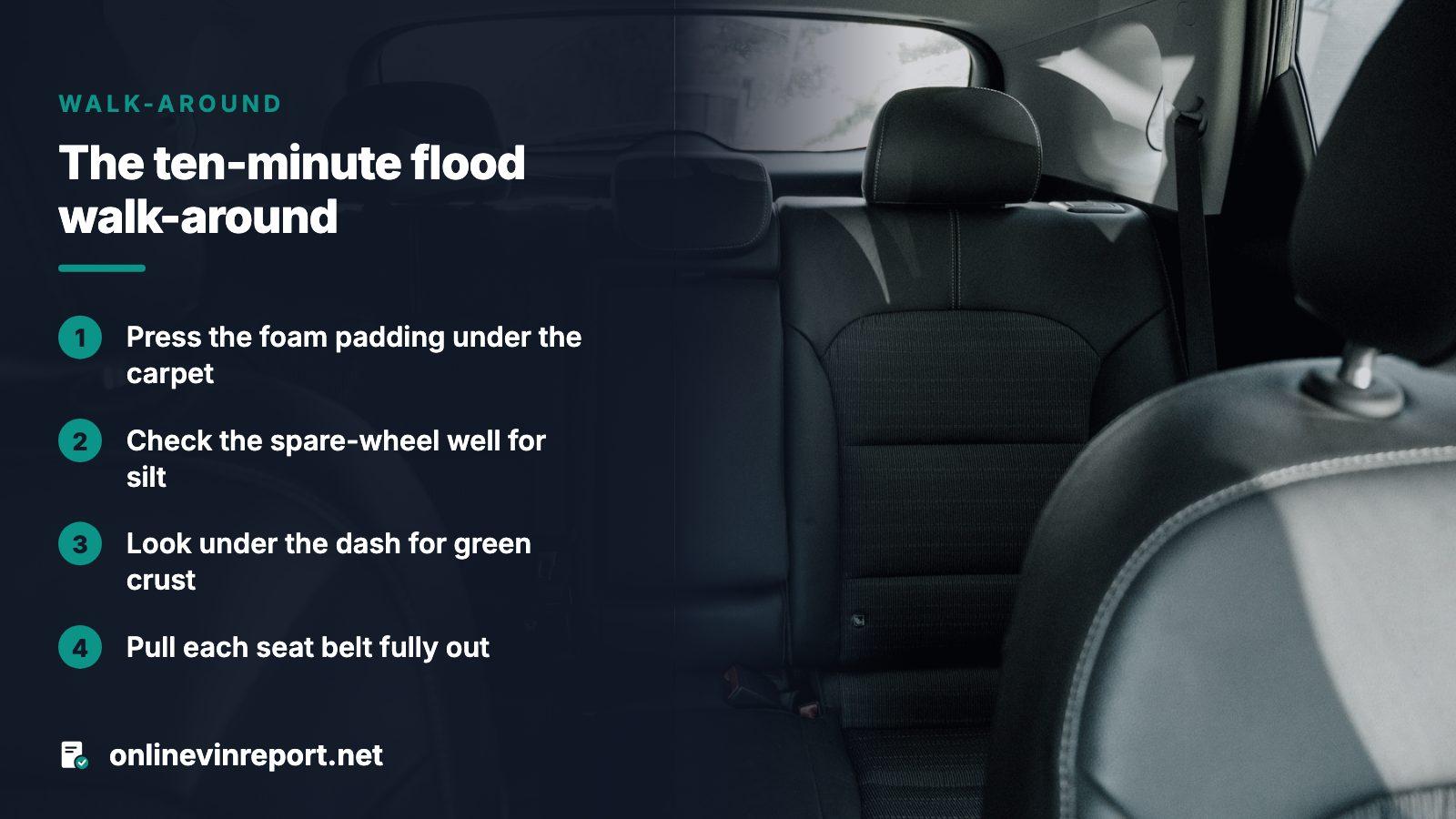
- Peel back a corner of carpet and press the foam padding underneath. Dampness, silt or a stain line means water got there.
- Look into the spare-wheel well for standing water, silt or a rusted jack.
- Check the seat rails and floor bolts: bare steel rusting where it should be dry is a flag.
- Pull every seat belt all the way out. A stained line, grit or a damp odor near the spool is hard to fake.
- Look behind the kick panels and under the dash for green crust on connector pins, and check the fuse box and ground points for rust or suspiciously new parts.
- Headlight and taillight lenses: a waterline inside the glass, or moisture that will not clear.
- Under the hood, new bolts beside badly rusted ones mean parts were replaced.
The sealed-cabin smell test
The usual sniff on arrival is the weakest version, because a cabin aired out all morning or sprayed with deodorizer smells fine. Instead, close every door and window when you arrive and let the cabin sit shut for a quarter of an hour during the walk-around. Then open the driver's door and breathe in at the footwell. Mustiness returns in a sealed cabin because it lives in the padding, not the air. A heavy wave of air freshener on an otherwise ordinary car deserves a question for the seller.
Make the wiring prove itself on the test drive
Corrosion creeps through connector pins and wire strands slowly, so a flooded car can behave for weeks. Work the electrical system on the drive: windows, sunroof, mirrors, seat motors and heaters, wipers at each speed, the infotainment screen and every light. A feature that cuts out now and then tells you more than one that simply works.
Then have an independent mechanic read the stored codes in every module. Faults scattered over unrelated systems suggest wiring, not parts. The FTC agrees that a history report does not replace an independent inspection and typically will not list mechanical problems.
Why neither the season nor the state clears a car
Hurricane season dominates flood-car advice, but the OpenFEMA file of federal disaster declarations shows a broader pattern. Counted once per declaration, not once per county, it lists 924 flood declarations and 454 hurricane declarations for fiscal years 1953 through 2026.
Inland states appear often: Washington has 35 flood declarations, North Dakota 33 and Minnesota 31, while Louisiana has 29 beside 38 for hurricanes. The recent years shifted too.
| Fiscal year | Flood declarations | Hurricane declarations |
|---|---|---|
| 2021 | 8 | 32 |
| 2022 | 10 | 10 |
| 2023 | 23 | 10 |
| 2024 | 21 | 8 |
| 2025 | 14 | 4 |
A declaration records federal action in a county, not the number of ruined cars, so read five years as a caution, not a trend. It still undercuts two shortcuts: a far-inland title history and a spring purchase do not make a dry car.
How flood cars reach a lot far from the water
Damaged cars from one flood hit the market together. Salvage auctions sell them over the following weeks, and buyers truck them to other states, clean them and list them far from the water. Retail listings tend to surface months later, once the news has faded.
That is the case for a title check that includes auction history: a car that went through a salvage sale leaves photos and a record, the strongest documentary hint a report gives. Cars that skipped the auction leave nothing, so the walk-around belongs on every candidate.
If the check or the car shows water
- Walk away. The damage keeps progressing and can reach safety systems, and no discount covers a fault that has not shown up yet.
- Tell the seller what you found, once, then leave. If they did not know, they do now.
- If the title paperwork misdescribes the car, report it to your state DMV or attorney general's office, which accept title-fraud complaints.
- Keep looking, and give the next car the same checks, brand search first.
From a buyer on Reddit
A buyer on Reddit's r/orlando bought a used truck from a local dealership, then had a shop go over it. The write-up cited corrosion in electrical parts and other signs of earlier flooding, yet the dealer denied any water damage. The buyer filed complaints with Florida's motor vehicle agency and the attorney general. Replies stressed inspecting before signing, and one self-described mechanic doubted the photos showed flooding.
Finding water after signing is the expensive way to learn it. Search each candidate's VIN before you drive out; the preview is free, and a full report is only worth buying for the car you are serious about.
Where this information comes from
- FEMA: OpenFEMA disaster declarations summaries — The federal data file behind the flood and hurricane declaration counts on this page.
- NMVTIS: national title record — The federal title system that carries flood and salvage brands between states.
- NICB: flood vehicle guidance and VINCheck — A no-cost VINCheck search for insurer-reported total losses, flood write-offs included.
- FTC: buying a used car from a dealer — Federal advice on independent inspections, what history reports leave out and the Buyers Guide.
- Reddit r/alberta: Carfax started showing a flood claim after purchase — owner experience, paraphrased
- Reddit r/orlando: Bought a used truck, mechanic says undisclosed flood damage — owner experience, paraphrased
Sources and photos: Facts checked against the sources above in November 2026. Photos by Everett Pachmann, THLT LCX and Tristan Beischel @Autoily.com on Unsplash; diagrams by OnlineVINReport.
Keep reading
- What is a branded title? How to read salvage, flood and rebuilt brands by VINWhere a flood brand sits among salvage, rebuilt and junk brands.
- Salvage title VIN check: run it online before you payHow to run the title search that surfaces salvage brands by VIN.
- Title washing: how a brand vanishes and what a VIN title check can showHow a branded car can end up with a title that looks clean.
- Total loss threshold by state and what it means for a VIN title checkWhy the point where damage becomes a total loss decides whether a brand exists.
Frequently asked questions
Will a VIN check show if a car is flood damaged?
Only if the loss was recorded. A check can surface a flood or salvage brand, damage and insurance records, and auction photos. Water that no insurer or state filed leaves nothing to find, so use the check to rule out documented cars and the inspection for the rest.
How do you tell if a car was flooded without a report?
Look for signals that stack up: a tide line or silt on the padding or seat-belt webbing, rust on bare steel under the seats, and mustiness that returns once the cabin is shut. One sign alone may be innocent. Several together rarely are.
Is a flood damaged car ever worth buying?
Rarely, and not at a modest discount. Salt water is close to terminal for wiring and connectors, and fresh water above the floor pan can reach modules, seat-belt pretensioners and airbag parts. Corrosion keeps advancing while the car looks fine.
How soon do flood problems appear in a car?
Typically months to years. Faults come and go across unrelated systems, so a short drive rarely exposes them, while a mechanic's scan of stored codes can. Ask for the scan before you pay; afterward, an intermittent fault is hard to trace to the flood.
Does a rebuilt brand mean the car was in a flood?
Not by itself. Rebuilt means a written-off car was repaired and passed inspection; the original loss might be a crash, theft or water. Check the salvage auction photos and damage records behind the brand to rule water in or out.
Now check the car itself
The guide explains what to look for. The report shows what this VIN has on record.