THE SHORT ANSWER
A fire damage title is not a standard brand. Fire counts as one of the events that can make a car salvage under the federal title-system rule, and state law then decides the label: salvage, total loss, or non-repairable when the car is burned beyond restoration. Searching the VIN shows which record exists, and a clean result still calls for an inspection.
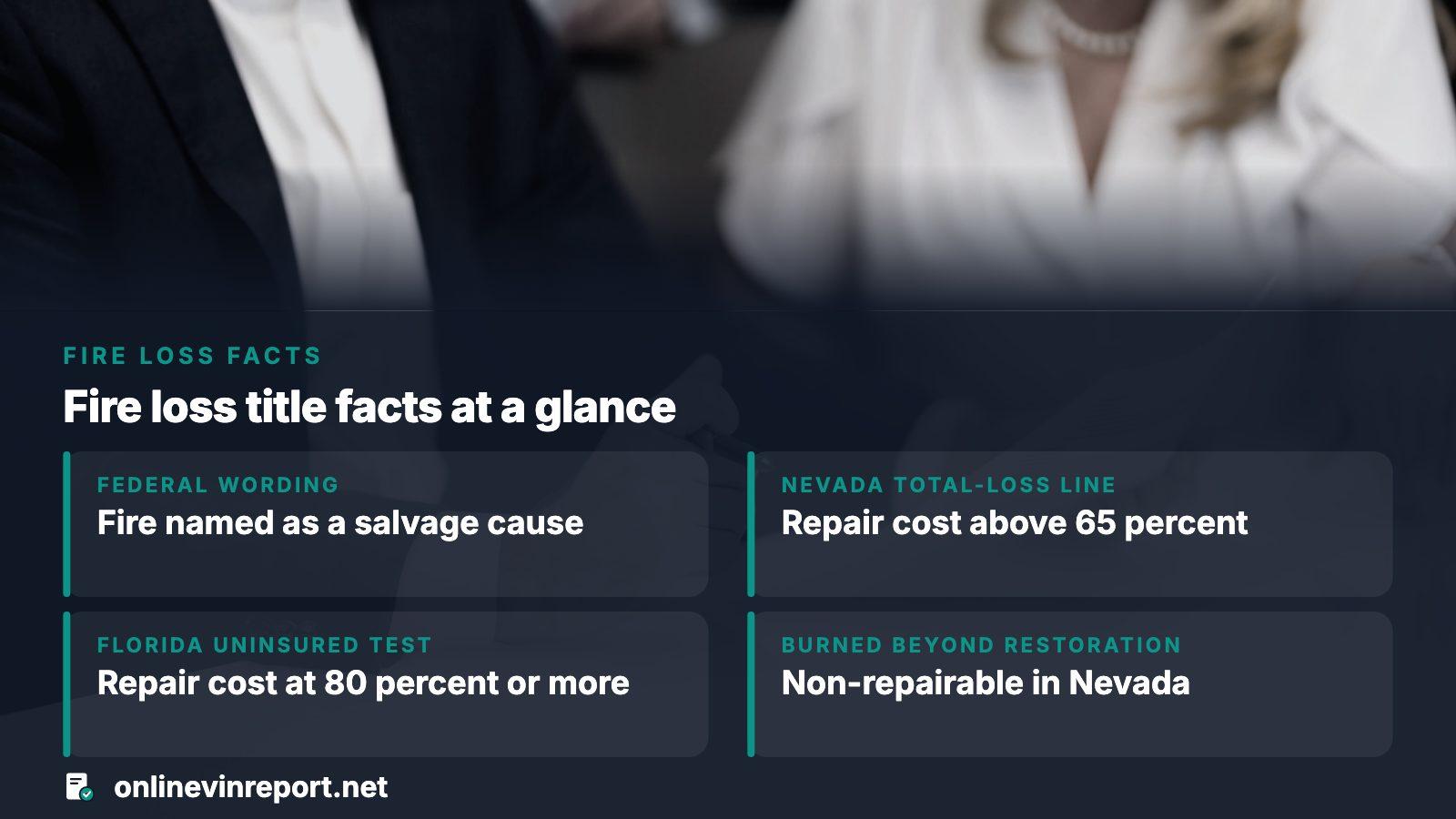
- Federal wording
- Fire is named as a cause of a salvage automobile
- Nevada total-loss line
- Repair cost above 65 percent of value
- Florida uninsured test
- Repair cost at 80 percent or more of replacement
- Burned beyond restoration
- Non-repairable in Nevada, may never return to the road
Fire is a cause, and the title carries a label for the result
Shoppers often search for a fire damage title as if it were a stamp like flood or hail. In the state pages I opened, none names fire as a brand of its own. Wisconsin's brand list, for instance, has hail, flood, salvage and claim paid entries but nothing built around fire.
What the title records is the outcome. A burned car that an insurer writes off becomes a total loss. A car the state judges too far gone gets a non-repairable or destroyed record. A car whose repair bill stays small may never be branded at all. The cause, fire, tends to sit in the insurer's claim file, the salvage auction listing and the photos, rather than printed on the title.
Where fire enters the federal definition
The Justice Department's title-system rule describes a salvage automobile as one hurt by collision, fire, flood, accident, trespass or some other event. The test is arithmetic: add what the wreck is worth as salvage to the bill for making it street-legal, and if the sum beats the car's market value immediately beforehand, it qualifies. Fire is named outright.
The same rule also sweeps in cars that state law deems a total loss or that an insurer labels one, even if the insurer never takes the car. It also describes a junk automobile as one that cannot run on public roads and has value only as parts or scrap. Insurers, salvage yards and salvage auctions are among the entities that send those reports, which is why a fire loss in one state tends to follow the car into the next.
Why this matters to you
The federal rule does not set a percentage. The cutoff that turns a burned car into a branded one comes from each state's law or from the insurer's own settlement math.
Nevada: when burning means the car can never be restored
Nevada's DMV gives one of the clearer statements. A vehicle is a total loss when the estimated repair cost tops 65 percent of its value before the damage, painting left out. Below that line, the car is not salvage at all. Fire appears in a second category, non-repairable, which covers a vehicle burned or destroyed beyond restoration, along with ones stripped of panels, doors and lights or designated for dismantling.
Nevada adds a hard limit: a non-repairable vehicle cannot be brought back to running order. So a charred shell sold in that state is a parts source, and a buyer who hears a pitch about rebuilding it should treat the pitch with suspicion.
Florida: two tests and a certificate of destruction
Florida's statute defines a total loss two ways. If an insurer pays the owner to replace the vehicle, it counts. If nobody insured the car, the vehicle becomes a total loss when repairing it would cost 80 percent or more of replacing it with a like car.
The statute also uses the word burned. When a total-loss car is damaged, wrecked or burned so that only its parts or scrap have any value, and it is either not a late model or was worth under 7,500 dollars before the damage, a certificate of destruction is required. A late model means a model year seven years old or newer. A certificate of destruction authorizes dismantling only, and no title can follow for that car.
Owners and insurers must also send the title in within 72 hours of a vehicle becoming salvage, and the insurer must report to the federal system.
How a fire loss can appear on a title search
| What happened to the car | Likely entry | What it means for a buyer |
|---|---|---|
| Insurer pays out and takes the car | Total loss or salvage | Expect an auction record, maybe with photos |
| Burned past any practical repair | Non-repairable, destroyed or certificate of destruction | Parts only, no road use where the state forbids it |
| Small fire, owner or insurer repairs it | Often nothing | Only the repair invoice and an inspection tell the story |
| Bought, repaired and re-inspected after a salvage brand | Rebuilt or equivalent | Brand stays on the record for later owners |
The third row is the trap. A modest fire that never reached a total-loss payout can leave no brand, so a clean search does not rule fire out.
What owners report after a car fire
Two owner filings with NHTSA show how these records start. Both involve a Hyundai Sonata and both ended with the car written off.
From an NHTSA owner complaint
An owner of a 2011 Sonata told NHTSA the car caught fire while being driven, and another motorist pointed out the flames. Firefighters and highway patrol came, a police report was filed, and the insurer declared a total loss. The engine had been replaced under a recall about seven months before.
From an NHTSA owner complaint
A driver of a 2013 Sonata reported that after the brakes failed at highway speed, flames appeared in the engine bay once the car was parked on the shoulder. Firefighters put it out and the vehicle went to a salvage yard, where it was deemed destroyed.
Both stories put the car on a path toward a total-loss entry. If a car like either one is later offered to you, the question is whether anyone repaired it, and whether that repair shows anywhere.
What to ask and inspect on a car with fire in its past
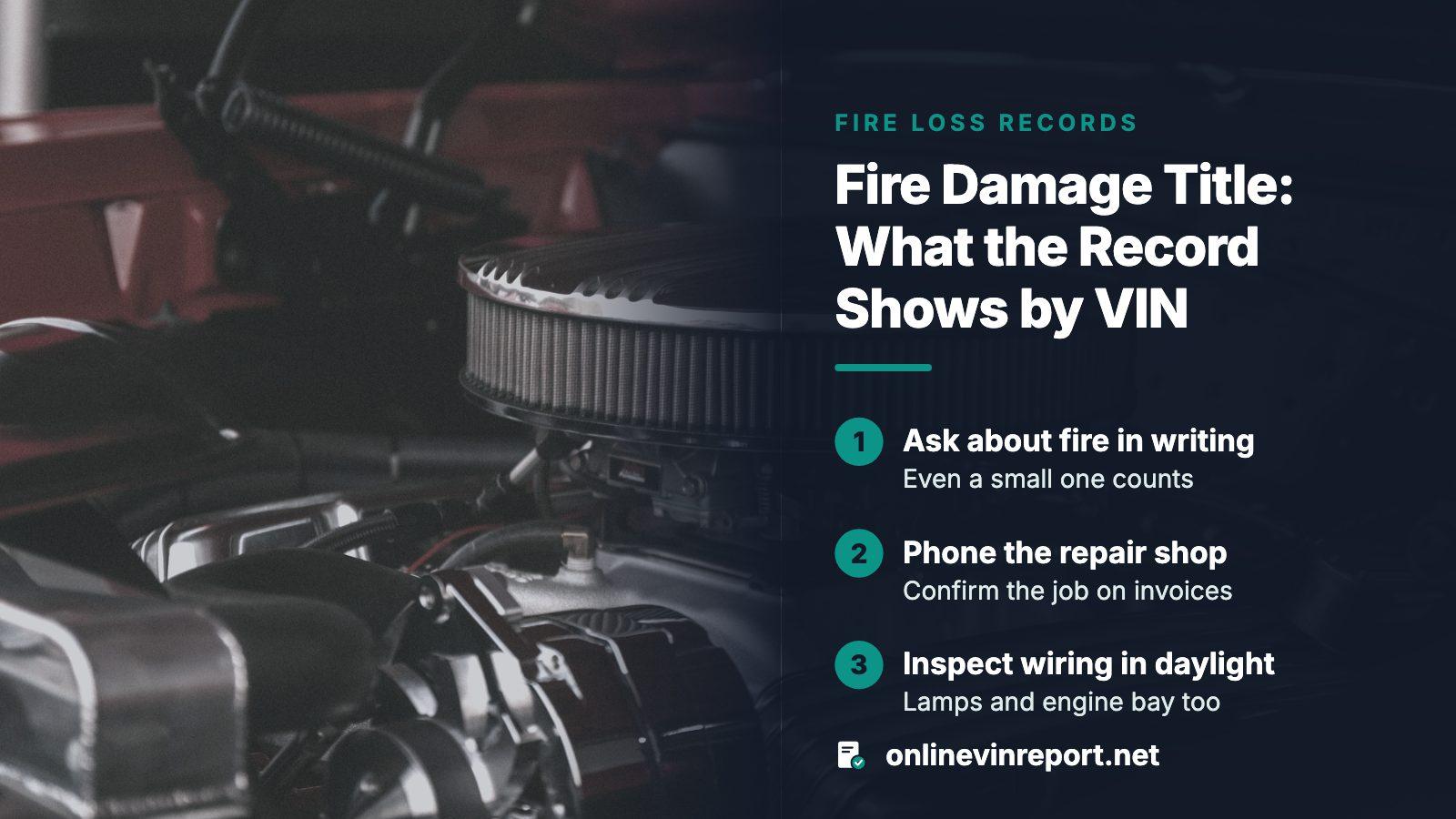
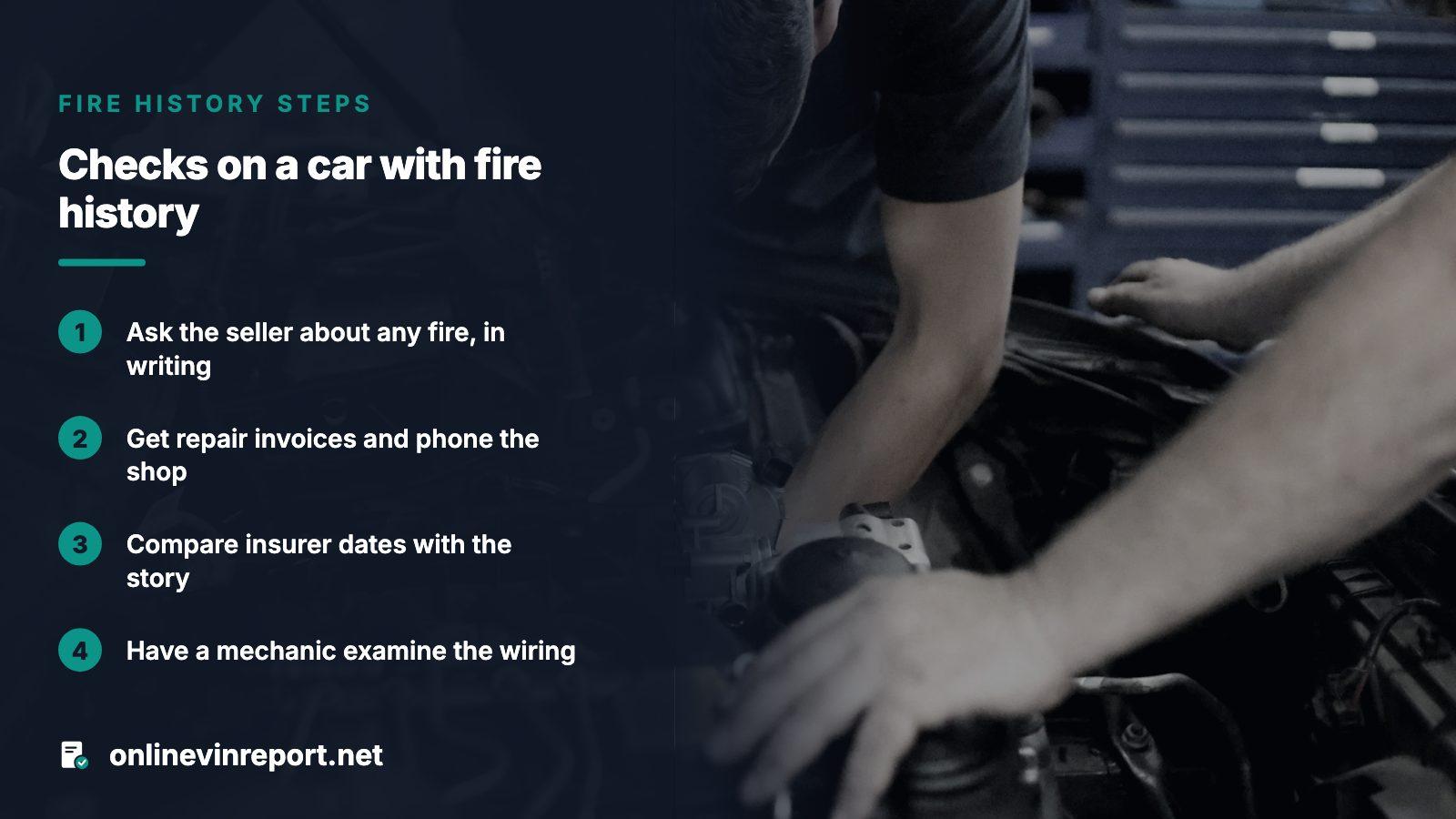
- Ask the seller directly whether the car ever had a fire, even a small one, and get the answer in writing.
- Get the repair invoices with the shop's name on them, and phone that shop to confirm the job.
- Compare the dates on any insurer or auction entry with the seller's story.
- Have an independent mechanic examine the wiring, the lamps and the engine bay in daylight.
- Leave the deal if the seller blocks an inspection or cannot explain a gap in the record.
A burned car that was fixed can look fine in a driveway. Paperwork and a hands-on inspection are the only things that separate a sound repair from a cover-up.
Running the VIN check before you pay
Type the 17-character VIN, copied from the car itself, into the OnlineVINReport search box. Only the preview costs nothing. After that you pay once for the report, there is no recurring charge, and the pricing page spells out the choices.
On a car you suspect was burned, read the title brand lines first, then the insurance and salvage auction entries and any photos. A salvage or total-loss line with auction images is the strongest sign. If everything is empty and the seller still hints at a fire, trust the inspection and the invoices over the blank screen.
Where this information comes from
- eCFR: 28 CFR 25.52, NMVTIS definitions — Where fire is named in the federal salvage automobile definition.
- VehicleHistory.gov: NMVTIS — The Justice Department program behind title records shared between states.
- Nevada DMV: salvage vehicles — Total-loss threshold and the burned-beyond-restoration category.
- Florida Statutes 319.30 — Total-loss tests, reporting duties and the certificate of destruction.
- NHTSA owner complaint 11530071 — owner experience, paraphrased
- NHTSA owner complaint 10930342 — owner experience, paraphrased
Sources and photos: Facts checked against the sources above in November 2026. Photos by Victor Hughes, Mustafa Sheikhmouss and Carrie Allen www.carrieallen.com on Unsplash; diagrams by OnlineVINReport.
Keep reading
- What is a branded title? How to read salvage, flood and rebuilt brands by VINThe full set of brands and what each one signals.
- Total loss threshold by state and what it means for a VIN title checkWhy the repair-cost line that creates a brand differs by state.
- Salvage title VIN check: run it online before you payHow to search a VIN for salvage entries.
- Flood damaged car: what a title check shows and what it missesAnother damage cause that often hides behind a clean-looking car.
Frequently asked questions
Is there a fire damage title brand?
Not as a standard, separate brand in the state pages I read. Fire is a recognized cause of a salvage loss, so a serious burn tends to show up under one of four labels: salvage, total loss, non-repairable, destroyed. Check your own state's motor vehicle agency for its exact labels, then search the VIN.
Can a car with fire damage have a clean title?
Yes. If the damage was small and the owner or insurer repaired it without a total-loss payout, nothing may have been filed. A clean result then reflects what was reported, so request the repair paperwork and send the car to a mechanic who will look at the wiring and engine bay.
Can a burned car be put back on the road?
It depends on the record. In Nevada a non-repairable vehicle cannot be returned to running order, and in Florida a certificate of destruction rules out any later title. A car with an ordinary salvage brand may be repaired and inspected under its state's rules.
Does a VIN check show a fire?
It shows what was reported: title brands, insurer total-loss entries and salvage auction records. It cannot show a fire that nobody recorded. Use it as a first filter, then add an inspection and the seller's own paperwork.
Should I buy a car that burned and was rebuilt?
Only with proof. Ask who did the repairs, read the invoices, confirm the brand on the record, and pay for an independent inspection. Price it as a branded car, and walk away when the seller dodges any of those steps.
Now check the car itself
The guide explains what to look for. The report shows what this VIN has on record.