THE SHORT ANSWER
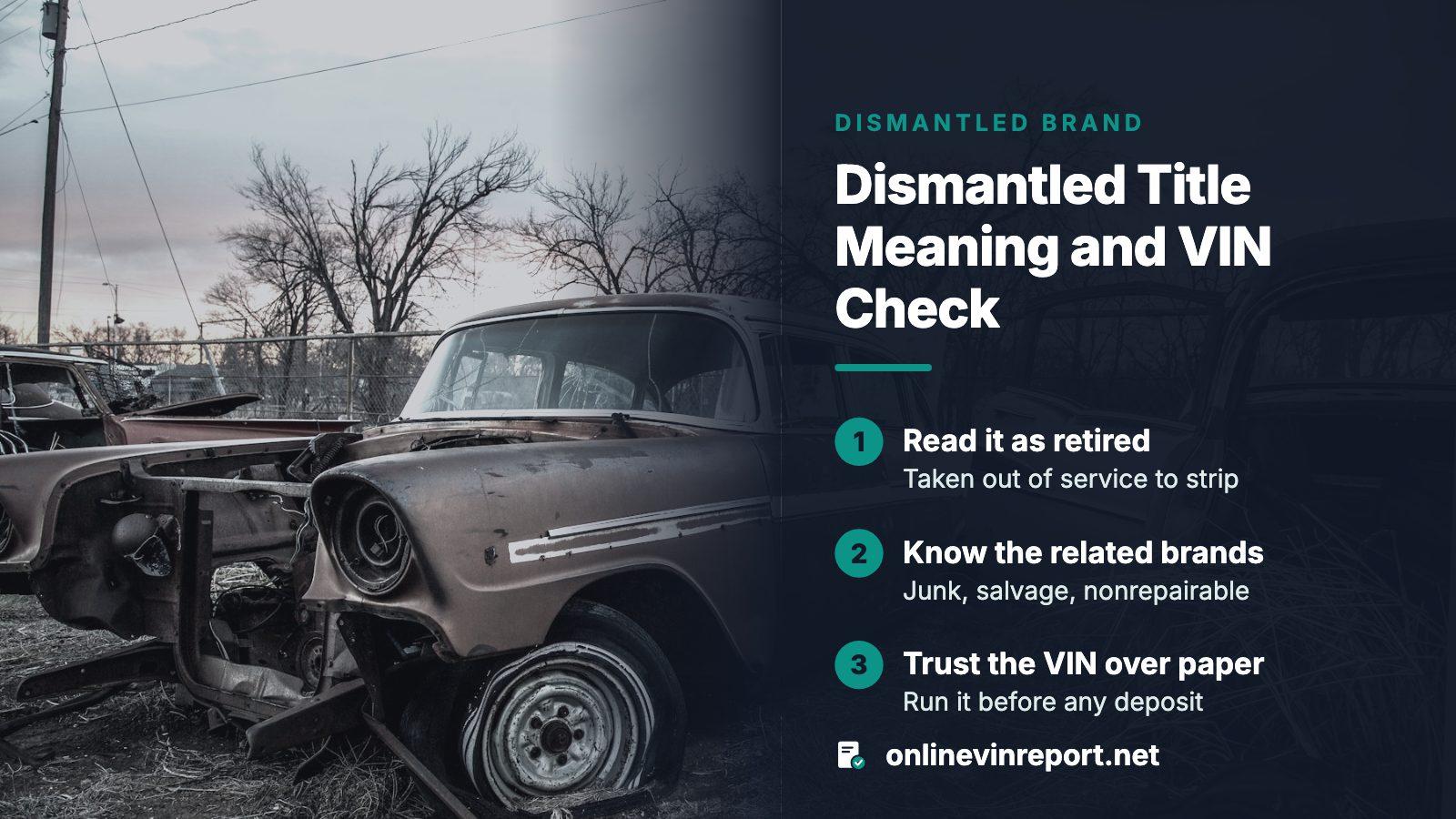
Dismantled is a title brand. It marks a vehicle that an owner or a licensed recycler took out of service to strip, wreck or scrap. California lists it among common brands, and Arizona issues a dismantle certificate of title for the job. Because brands travel with the VIN in the national title database, an online title check can show it even when the paper title says nothing.
- What it means
- Vehicle was retired to be taken apart or scrapped
- Where it appears
- State title brand, also kept in the national title system
- Related brands
- Junk, salvage, nonrepairable, revived junk
- Best first step
- Run the VIN before any deposit
What a dismantled brand tells you
Think of it as a one-way note in the file. Someone decided this vehicle was finished as transportation, and the state recorded that decision. California's DMV lists dismantled in its set of common brands, alongside damaged, junk, rebuilt and reconditioned. The label does not describe the damage. It describes the plan for the vehicle: strip it, wreck it or crush it.
A car with that history can still turn up for sale, usually with a story attached. Maybe the shell was bought cheap, fitted with new panels and sold on. Maybe the seller never knew. Either way, the brand is the part of the story the seller did not write.
How Arizona creates a dismantle title
Arizona is a clear example because the word sits in the statute. Under A.R.S. 28-2094, an owner who sells a vehicle as scrap, or for dismantling, signs the title over to the buyer. The buyer files with the state and receives a dismantle certificate of title in return. The statute lists a fee of four dollars, though you should confirm today's figure with the agency.
That certificate is a working document. It lets its holder move or hold the vehicle and pass ownership along by endorsement. A licensed recycler that submits an Arizona title showing no liens, or a signed release, can begin teardown after five days by mail or three days by hand delivery, provided the department has not flagged a competing claim.
Arizona also lets an owner dismantle without this certificate once a nonrepairable certificate of title already exists for the vehicle.
California: dismantled, junk and revived junk
California's DMV defines a dismantler as a firm trading in wrecked, junked and nonrepairable cars. A vehicle reported to the DMV as dismantled, whether by a private owner or by such a business, becomes a junk record. If someone later restores it, the DMV calls it a revived junk vehicle and requires registration again.
| Stage | What the record shows | What it means for a buyer |
|---|---|---|
| Reported dismantled | Vehicle retired by owner or dismantler | Not meant to return to the road |
| Junk receipt | DMV paper tied to the junked vehicle | Needed later if anyone tries to revive it |
| Revived junk | Restored and registered again | Brand stays on the history |
| Salvaged brand | DMV groups previously dismantled vehicles here | Treat as a rebuilt-risk car |
The salvaged brand on California's branded-title page explicitly includes previously dismantled vehicles, so the two words can describe one car.
Can a dismantled vehicle return to the road?
Sometimes, and the paperwork shows how. In California a revived junk registration needs a junk receipt issued by the DMV. When another person holds that receipt, they complete a Statement of Facts, form REG 256, describing the vehicle and explaining what became of the original. For ownership, the DMV accepts a bill of sale on REG 135, or REG 262 issued by a licensed dismantler and carrying that business's acquisition number for the vehicle.
Arizona's statute on restored salvage vehicles covers any vehicle restored after a salvage or a dismantle certificate was issued, which means a dismantle title may later be followed by a restored record.
The hard stop
Once California issues a nonrepairable certificate, the vehicle cannot be titled or registered again as a junk or revived salvage vehicle. A seller who says a car is simply being repaired should be asked which certificate it holds.
Why the VIN beats the paper title
Federal vehicle history rules describe brands as labels that state titling agencies apply, such as junk, salvage and flood. The national title system keeps a history of every brand any state has applied to a vehicle. States also keep their own wording, so a car dismantled in one state may read differently in the next.
Moving a car across a state line therefore does not erase anything in that database. A fresh paper title from another state may show a clean face while the VIN record underneath still tells the earlier chapter. That gap is exactly what buyers of cheap, newly titled cars fall into.
Signs a car may have been dismantled before
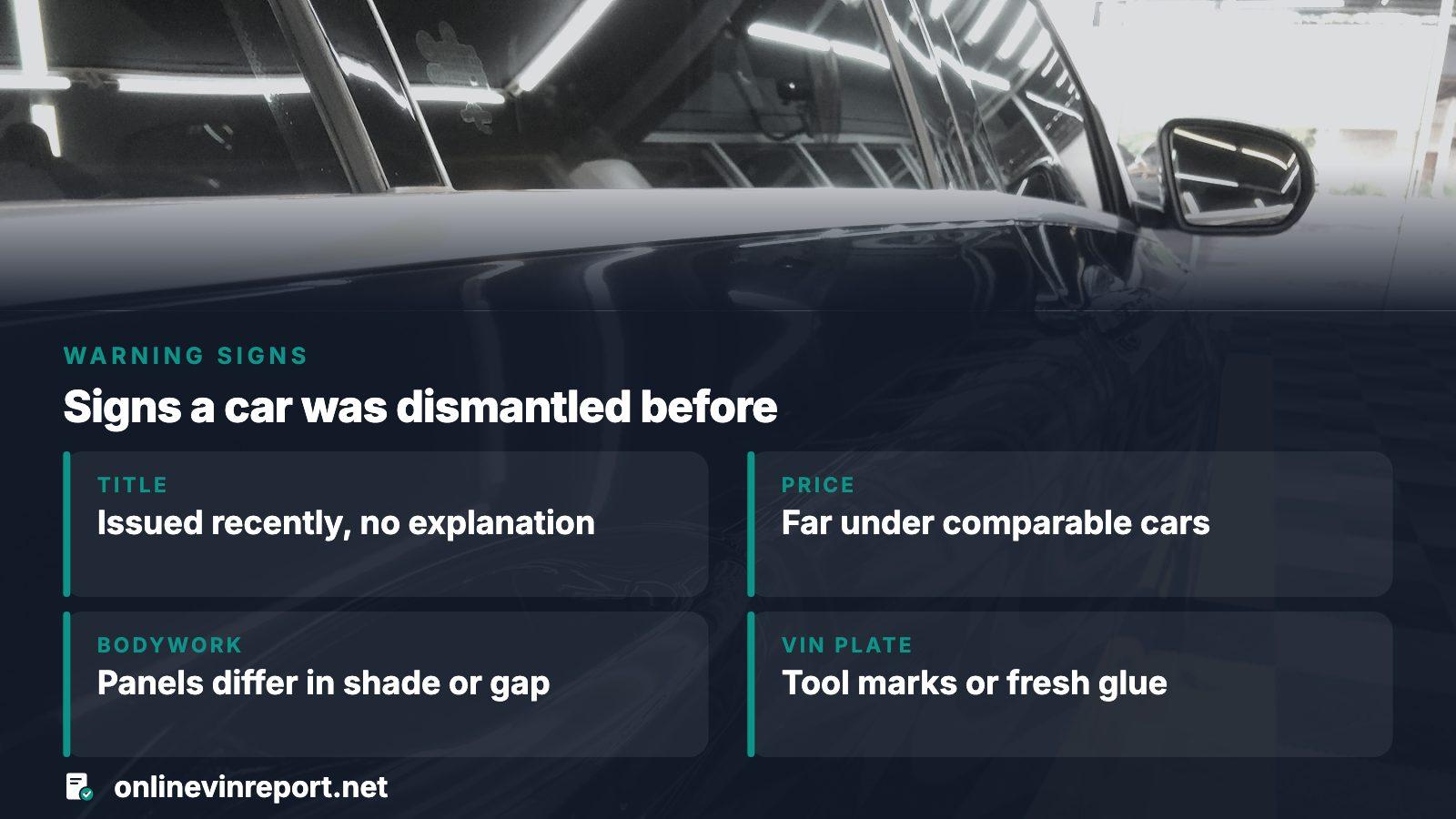
- The title was issued recently and the seller cannot explain the gap in ownership.
- The price sits far under comparable cars, with a rushed reason for selling.
- The seller offers a bill of sale from a dismantler instead of a regular title chain.
- Body panels differ in shade, gap or finish, or doors and fenders carry mismatched part labels.
- The VIN plate shows tool marks, fresh glue or odd rivets.
None of these proves anything alone. Several together are the cue to stop talking price and start checking the number.
Running an online VIN title check
- Copy the VIN off the vehicle and off the paper title, then compare the two character by character.
- Type it into the preview here and read the brand lines before anything else.
- Look for dismantled, junk, salvage or total-loss entries and compare them with what the seller said.
- Still keen after a clean preview? Buy the full report to read odometer entries, auction records and photos.
The preview is free to view. Buying the full report means paying once, with nothing recurring; see the pricing page for the packs on offer. A clean result is good news, though a physical inspection by an independent mechanic still belongs on your list.

What to do when the check shows a dismantled brand
Ask the seller for the paperwork behind the brand: the state certificate, any junk receipt, and records of the repairs. If the seller dodges, walk away. If they produce documents, call the state agency that issued the title and ask whether the vehicle is eligible for registration where you live.
Check how your own state treats the brand before you commit, because a car that registers in one state may be refused in another. Then weigh the price honestly. A vehicle with this history is hard to insure and harder to resell, so the discount has to be large to make sense.
Where this information comes from
- California DMV: Branded titles — dismantled listed as a common brand; salvaged brand includes dismantled vehicles
- California DMV: Junk and revived salvage vehicles — revived junk definition, junk receipt and forms
- California DMV: Total loss, salvage and non-repairable vehicles — effect of a nonrepairable certificate
- Arizona Revised Statutes 28-2094 — dismantle certificate of title process
- Justice Department NMVTIS site: reading a history report — what brands are and that every state brand is kept
Sources and photos: Facts checked against the sources above in November 2026. Photos by Leo_Visions, Alejandro Escamilla and Clarence Tioh on Unsplash; diagrams by OnlineVINReport.
Keep reading
- Junk title: what the brand means and how to spot one by VINThe closest brand and how states use it.
- Non-repairable certificate: what it means and how to find one by VINThe certificate that closes the road for good.
- Salvage vs junk title: which brand means the car can still be drivenSorts out which brand you are looking at.
- Title washing: how a brand vanishes and what a VIN title check can showHow sellers try to hide a brand and why it fails.
Frequently asked questions
Is a dismantled title the same as a junk title?
Often close, but not always identical. California lists dismantled and junk as separate common brands, and treats a vehicle reported as dismantled as a junk record. Arizona issues a dismantle certificate of title. Wording varies by state, so read the actual brand on the VIN report.
Can you register a car that has a dismantled title?
It depends on the state and on what certificate exists. California allows revived junk registration with a junk receipt and other documents, but never after a nonrepairable certificate. Ask the agency that issued the title before you buy.
Does a dismantled brand show up on a VIN check?
Usually, if a state reported it. The national title database keeps every brand a state applied, so a VIN title check can show it even when the paper title looks clean. Very old vehicles may have thin records.
Who can dismantle a vehicle?
In Arizona, an owner can apply for a dismantle certificate, and licensed automotive recyclers follow a set process with lien checks. California describes dismantlers as firms trading in wrecked, junked and nonrepairable cars. Check your own state's rules.
Is it safe to buy a car that was dismantled and rebuilt?
Treat it as high risk. A rebuilt car can be sound, but you cannot assume it. Get the repair records, a full title report and an independent inspection first, and expect insurance and resale to be harder.
Now check the car itself
The guide explains what to look for. The report shows what this VIN has on record.