THE SHORT ANSWER
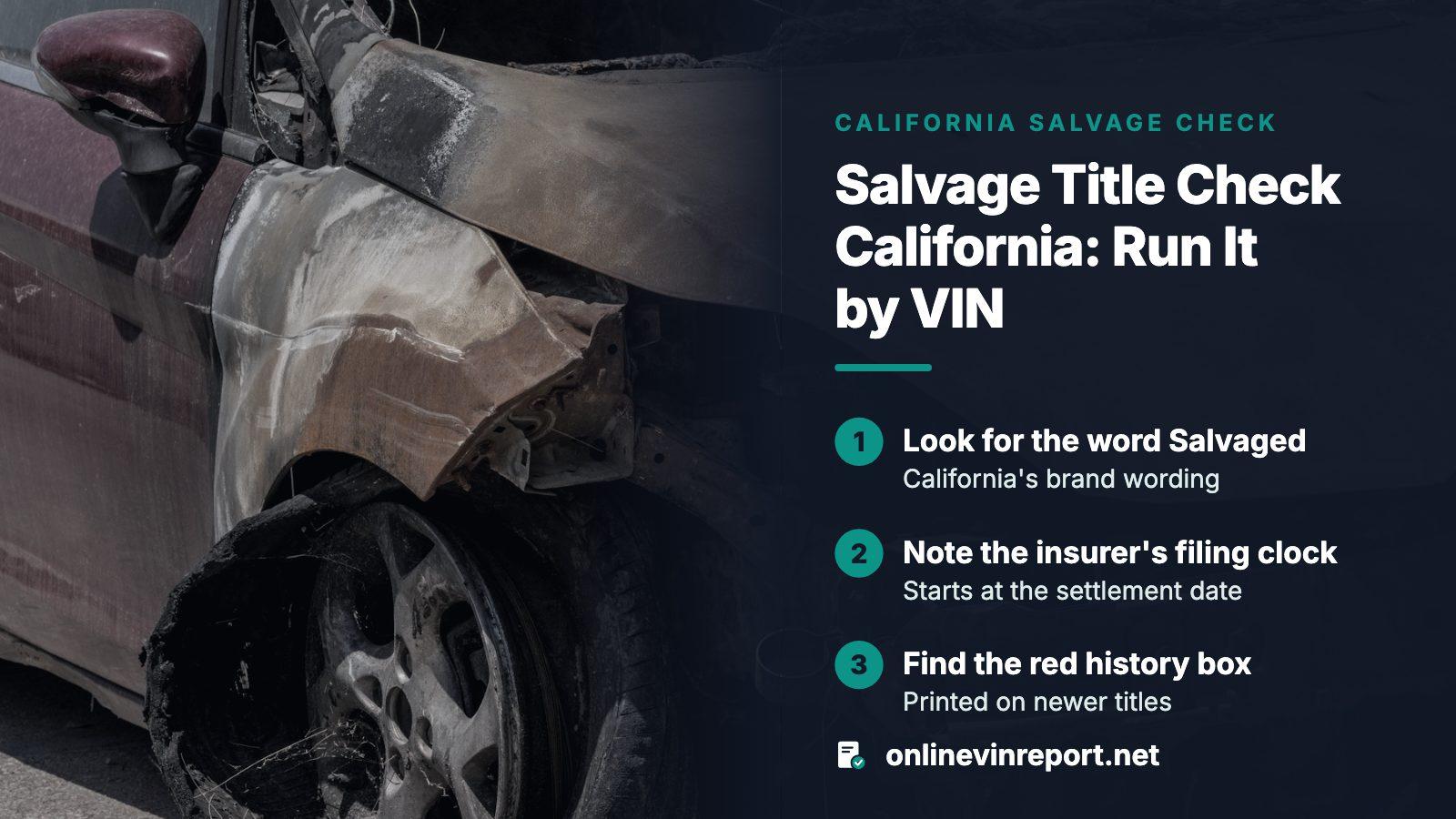
Enter the VIN and open the title brand and total-loss sections of the report. California uses one word, Salvaged, for collision wrecks, flood and vandalism cars and previously junked cars alike, so read the dates and any auction photos to learn which it was. A brand from another state counts too. Finding nothing is a good sign, yet it falls short of proof, because an entry exists only when someone filed the paperwork. Inspect the car before you pay.
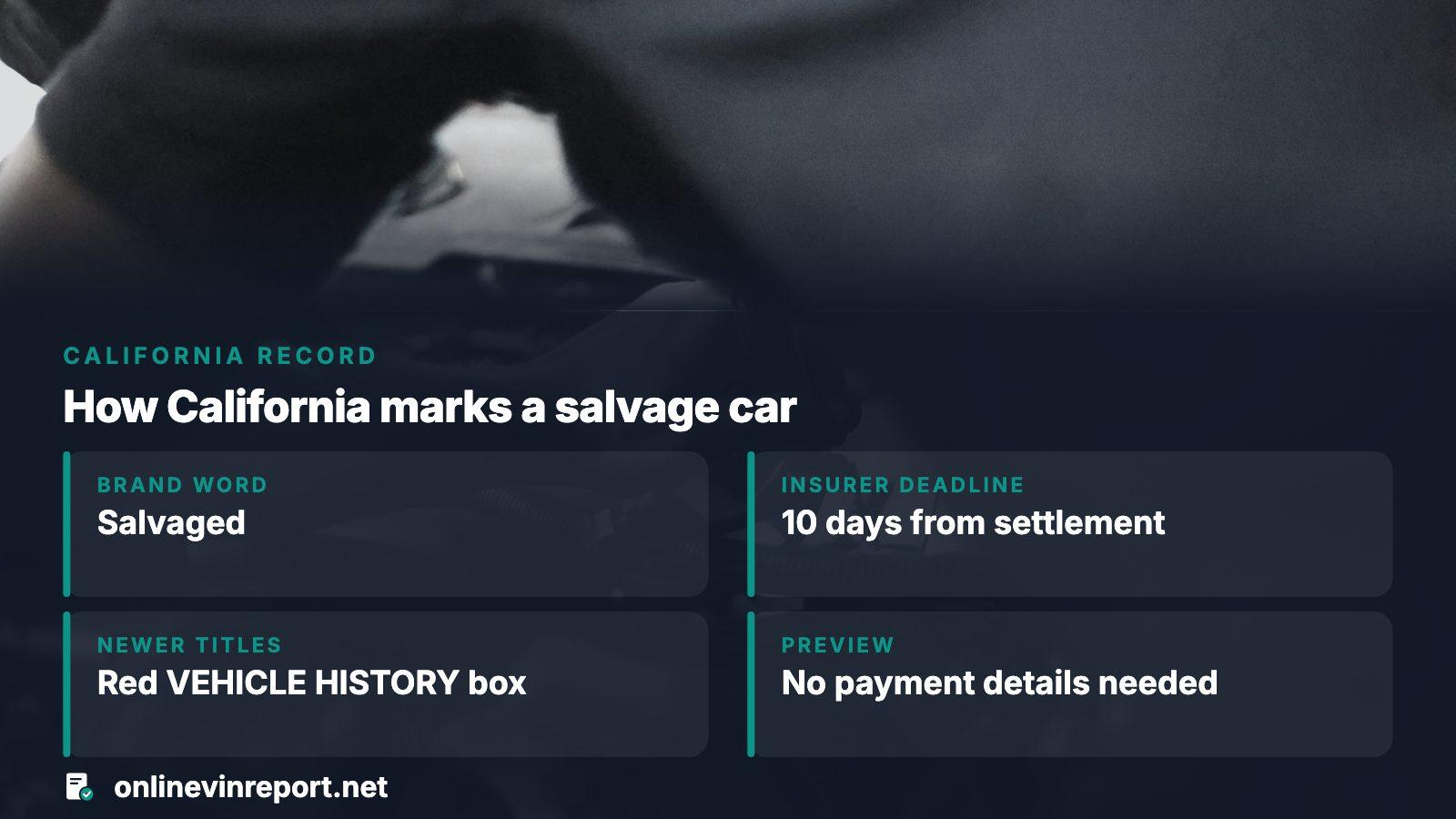
- California brand word
- Salvaged
- Insurer deadline
- 10 days from the settlement date
- Where it prints
- Red VEHICLE HISTORY box on newer titles
- Preview
- Free, no card needed
What a California salvage record covers
California's own brand list has no separate flood or rebuilt entry. It has one word for damage, Salvaged, and it stretches over a car wrecked in a collision, one hurt by flood or vandalism, and one dismantled as junk earlier. The word alone will not say which. An online check helps because it also pulls total-loss and salvage-yard entries, which carry dates and sometimes photos.
| Paper or record | What it says about the car | What the VIN check adds |
|---|---|---|
| Salvage Certificate | A loss was declared, and the certificate stands in for the title as the ownership document | The date of the loss and any yard or auction entries |
| Non-repairable certificate | Parts or scrap only: stripped, burned out, or declared so by the owner | Proof the car should not be sold as a runner |
| Revived salvage title | A written-off car was repaired, inspected and registered again | The write-off that came before the repair |
| Salvaged brand on a title | Printed in the red box near the upper right corner of newer title forms | Brands from other states that the paper may not show |
Running the check, step by step
Do this while the car is still an ad.
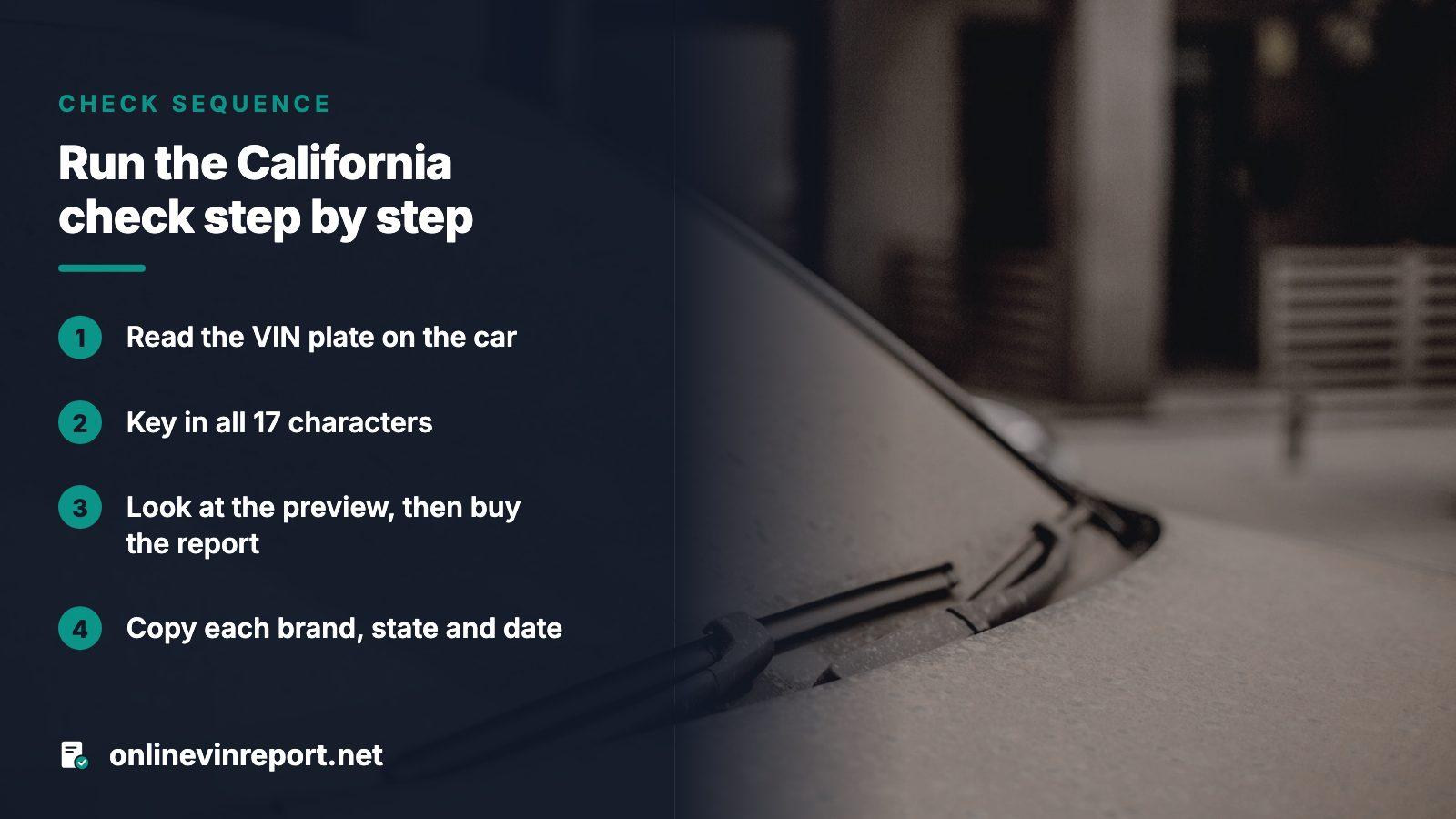
- Trust the car over the ad. A VIN plate is visible from outside near the driver's side of the windshield, and a second copy is printed on a sticker in the driver's doorway. Confirm both match the title.
- Key the 17 characters into the form on this page. One wrong character pulls up another vehicle or an error.
- Look at the preview first. No payment details are needed for it.
- If the car survives that look, buy the report and read the brand and total-loss sections before anything else.
- Copy down every brand, state and date, then ask the seller to explain each one.
How a California car lands on the salvage record
The record starts with a judgment call. California's definition, as the DMV manual words it, covers a vehicle that was wrecked, destroyed or damaged and was not repaired because the owner or insurer considered repair uneconomical. No percentage of value appears anywhere in it.
Who files depends on the money. When an insurer pays the owner for a total loss, the insurer has 10 days after settling to get a Salvage Certificate issued. With no insurance payment, the duty falls on the owner. A self-insured owner or that owner's insurer may apply, depending on the facts. Once issued, the certificate replaces the title as the car's ownership paper, so a seller handing you one has already told you the history.
A separate path exists for cars beyond saving. Once a non-repairable certificate is issued, the car can no longer be titled or registered as junk or revived salvage.
Reading what comes back
Most California results fall into one of five shapes.
| Result | What it means | Your move |
|---|---|---|
| Salvaged brand with a date | The car was written off, and that date should fit the owner list and odometer readings | Price it as a former wreck, or walk |
| Total loss or salvage-yard entry, no brand | A loss is on record that the paper title does not show | Treat the car as branded and put the question to the seller |
| Brand from another state, plain California title | The brand followed the VIN, and DMV admits out-of-state history is hard to police | Ask why the title moved |
| Revived salvage | Repaired and registered again after inspection | Ask for the inspection papers |
| Junk, dismantled or non-repairable entry | The car was stripped or scrapped | Not a car being sold as a runner |
DMV also lists the mileage at the last sale and the owner named on the title as things to check.
When the result says revived salvage
A revived car was a total loss that someone repaired and put back on the road. DMV will issue the branded title and registration only after the owner signs an application, proves ownership with a bill of sale or a dismantler's paper, and passes inspection: a DMV verification (REG 31) or a CHP certificate of inspection (CHP 97C), plus an electronic safety systems certificate. Smog certification is added where it applies.
Airbags get specific attention. The manual requires them to work, and a car that appears to be missing them goes to a CHP Salvage Inspection Station. A car salvaged outside California and now being registered here is sent to CHP as well.
The stolen-parts risk
DMV warns that stolen parts have turned up in some revived cars. When CHP or DMV decides the car or its parts were stolen, registration is refused and the car or parts are seized. No discount covers that, so ask what inspection the car passed and see the paperwork.
Dealer lots, private sellers and the disclosure gap
Licensed California dealers must pull a national title report from an approved provider before showing a used car. When it reveals junk or salvage history, or the title carries a brand, a disclosure statement goes on the car while it is displayed. Motorcycles, RVs and off-highway vehicles are exempt, as are cars with no record after the dealer tried. DMV itself calls the disclosure rule difficult to police, most of all with out-of-state cars.
That rule is written for dealers. In a private sale your own check does the dealer's job. Confirm the seller is the owner, too: when another person's name is printed on the title, request a bill of sale, a dealer report of sale or a power of attorney.
What no lookup sees, and what to examine on the car
A VIN check reads records. The federal title system flags brands, total losses and salvage history. It does not hold repair histories, recall data or maintenance logs, and its own guidance still urges an independent inspection. A clean result means nobody reported a loss, which is different from no loss happening. These are the DMV's own clues to hidden salvage history, worth checking in person.
- Heavy repair work on the inner fender structure
- Mud, mold or rust beneath the trunk carpet
- A VIN plate held on by something other than rivets
- An airbag warning lamp that stays lit
- Airbag covers that look resealed or badly fitted
- NHTSA stickers absent from the door edges, the hood underside or the rear hatch
Cost of the report, and the next move
Previewing is free and takes no card. The report is a single transaction for one VIN, with larger bundles of 3, 5 or 10 available. No subscription is involved, and rates are listed on the pricing page. The federal title-system site also points buyers to NICB's free database for flood damage.
- Match the brand and dates in the report to the paper in the seller's hand.
- If a brand shows, ask for the repair and inspection papers and have an independent mechanic examine the structure and airbags.
- Price the car as branded, or leave it.
Where this information comes from
- California DMV: Total loss, salvage and non-repairable vehicles — Who must obtain a Salvage Certificate, the 10-day insurer deadline, and what a non-repairable certificate closes off.
- California DMV: Branded titles — California's brand list, the red title box, dealer disclosure, buyer clues for hidden salvage history and the stolen-parts warning.
- California DMV: Revived junk and salvage vehicles — Application, ownership proof and inspection steps before a rebuilt car is registered again.
- California DMV manual: Salvage definitions — The uneconomical-to-repair test for a total loss salvage vehicle, and the certificate as ownership document.
- California DMV manual: Revived salvage, California record — Airbag requirement, CHP referral for out-of-state salvage cars and the safety systems certificate.
- NMVTIS: Understanding a vehicle history report — What the federal title system reports and what it leaves to private providers.
- NMVTIS: Buying tips — Inspection and test-drive advice, and the pointer to NICB's free flood database.
Sources and photos: Facts checked against the sources above in November 2026. Photos by engin akyurt, JavyGo and Mustafa Sheikhmouss on Unsplash; diagrams by OnlineVINReport.
Keep reading
- Salvage title smog check: what California asks for and what a VIN showsWhat California asks for on the emissions side once a rebuilt car goes back on the road.
- Salvage certificate: what it means and what a VIN check showsWhat the certificate is, who holds it and what a buyer should do with one.
- Title washing: how a brand vanishes and what a VIN title check can showHow a brand disappears between states, and how to spot the gap.
- Register out of state car in California: the title, VIN check and 20-day clockThe paperwork for a car coming into the state, brand history included.
Frequently asked questions
How do I check if a car has a salvage title in California?
Pull the VIN from the vehicle itself, preview the lookup, then read the brand and total-loss entries in the full report. Compare the result with the red VEHICLE HISTORY box on the seller's title or Salvage Certificate. DMV also tells buyers to confirm the seller is the owner named on the title.
Does California use a percentage to decide salvage?
No percentage appears in the DMV manual's definition. A total loss salvage vehicle is one wrecked, destroyed or damaged where the owner or insurer judged repair uneconomical. That ties the brand to a decision someone made and filed, so a clean California record still deserves an inspection.
Can a salvage car be registered in California?
Yes, after it is rebuilt. DMV will issue a branded title and registration once the owner has applied, shown ownership, passed inspection and supplied the safety systems certificate. The exception is a car holding a non-repairable certificate: it cannot be titled or registered as a revived car.
What does revived salvage mean on a California record?
It is the DMV's term for a total loss later restored to operating condition. Buyers usually call it rebuilt. The earlier write-off stays in the car's history, so ask for the inspection papers, have a mechanic check structure and airbags, and price it accordingly.
Will a VIN check show a salvage car that was fixed without insurance?
Only if someone filed. With no insurance settlement, California makes the owner responsible for getting the certificate, so the record depends on that owner doing the paperwork. A quiet repair can leave nothing on file, which is why DMV lists physical clues and the federal site urges inspection.
Now check the car itself
The guide explains what to look for. The report shows what this VIN has on record.