THE SHORT ANSWER
Plan on a smog certificate unless the car is exempt by age, fuel type or the type of sale. DMV lists smog certification among the items for a revived salvage car when it is appropriate, which points back to the ordinary rules. A pass proves emissions and nothing more. To see the brand, run the VIN through a title check, then read the smog and safety-systems history and ask the seller for the rebuild paperwork.
- What smog proves
- Emissions on one test date, not repair quality
- Where the brand lives
- Title records, not the smog file
- Private-sale pass
- Within the last 90 days
- Preview on this site
- Free, no card needed
A smog pass and a salvage brand answer different questions
A smog check happens at a licensed station on one day. It examines the emission controls and the on-board computer, then ends in pass or fail. Nothing in it reveals whether the car took a hard hit or sat in floodwater. The salvage brand answers that other question: an insurer called the car a total loss, DMV issued a salvage certificate, and the title now carries the history.
A seller who waves a fresh smog certificate as proof of a good car is answering a question you did not ask. The certificate reaches DMV electronically and stays valid for 90 days. Both records hang on the VIN, so one lookup can line them up.
What California asks for before a rebuilt car goes back on the road
DMV calls a car revived salvage once it was reported as a total loss and has since been repaired to running order. Registering it takes more than the usual paperwork.
- A signed title and registration application, plus proof you own it, for example a bill of sale or a dismantler's transfer form.
- An inspection by DMV staff or the Highway Patrol, which normally ends in a certificate of inspection.
- An electronic safety-systems pass, which replaced the older separate brake and light slips.
- Smog certification where it applies to that car.
- Fees, including an inspection charge collected up front. Ask DMV for the current amount.
For a car the same owner kept through the loss, DMV's staff manual says only the every-two-years smog rule applies. None of the DMV pages checked here say a salvage history excuses a car from smog, or call for a special emissions test.
When the smog rule applies: age, fuel and type of sale
The Bureau of Automotive Repair has no separate smog rules for salvage cars, so its general rules are the baseline.
| Situation | What the Bureau says |
|---|---|
| Gasoline, hybrid or alternative-fuel car | Smog Check for model year 1976 and newer; 1975 and older are exempt |
| Diesel | Smog Check for model year 1998 and newer; 1997 and older are exempt |
| Registration renewal | Every other year; a late-model gasoline-type car, eight model years old or newer, pays a fee in place of the test |
| Private-party sale | The seller gets the test, and the buyer needs a pass from the last 90 days |
| Dealer sale | A pass from within the past two years |
| Gas car four model years old or newer, at sale | No test; a smog transfer fee goes to DMV instead |
| First registration of a car from another state | Smog Check required |
Fix a lit check-engine light before testing. If the battery came off during repairs, drive a week or two so the readiness monitors reset. Other states with emissions testing have their own rebuilt-car rules that this guide did not review, so ask that state's DMV.
The safety-systems record a rebuilt car should have on file
DMV's manual requires the electronic safety-systems certificate when a car is registered as revived salvage or revived junk, and when a revived salvage vehicle titled in California changes owners. The Bureau of Automotive Repair keeps the database and posts results by VIN, beside smog history. A repair shop's own written statement about brakes and lights no longer counts.
Use the lookup as a cross-check
Search by VIN, since plates change. If the seller says the car was never wrecked and the history shows a safety-systems entry, ask what it was for. DMV ties that certificate to revived junk and revived salvage registrations, so the answer may be a rebuild nobody mentioned.
What a title check by VIN adds that a smog lookup cannot
NMVTIS, the federal title database, boils down to five indicators: where the car is titled now and when that last changed, any brand a state applied, the odometer figure, and the total-loss and salvage records. It draws on titling agencies, salvage yards, recyclers and insurers, and it is not built to hold repair history.
| Record | Kept by | What it tells you | Next question |
|---|---|---|---|
| Smog result | Bureau of Automotive Repair | Emissions pass or fail on a test date | Ask which repairs came before a fail turned into a pass |
| Safety-systems certificate | Bureau of Automotive Repair | A pass on file after a revival | Ask why the car needed a revival at all |
| Brand and total-loss entries | Titling agencies, insurers, salvage yards | That the car was written off, and where | Ask who rebuilt it and what was replaced |
The preview on this site costs you nothing. Buying the full report is one payment, best saved for a car that survives your first look, and the pricing page lists the options. Read the brand section, then any salvage or auction entries.
A salvage car coming in from another state
A previously salvaged car never registered in California goes to the Highway Patrol for inspection, and first registration in the state also requires a smog test. If the proof of ownership is a New York salvage certificate, the Highway Patrol must verify a confidential number on it too.
Ask about air bags separately. A car built with them needs working ones, and if they look deployed or removed, the inspection moves to a Highway Patrol salvage station. DMV also warns that some revived cars carry stolen parts, in which case registration is refused and the car or its parts are seized.
Before you pay for transport
Holding a salvage certificate instead of a title means planning for a Highway Patrol inspection, a smog test and a brand that follows the VIN. Pull the title history before booking a truck.
Where the smog paper and the title can disagree
- The seller says salvage cars skip smog. DMV lists smog certification among revival items, so ask to see the certificate.
- In a private sale, the pass handed over is older than 90 days.
- The ad says rebuilt, but the title copy shows no brand. On the latest California title, the brand is printed in a red panel labelled VEHICLE HISTORY, top right.
- A safety-systems entry appears in the Bureau's history for a car described as never damaged.
- Mileage on a smog report that does not fit the title check. Federal rules for state emissions programs list the odometer among the data taken at each test, so read a printed report against the NMVTIS figure and the dashboard.
- No repair invoices, no inspection papers and no account of who did the work.
A sensible order for checking a branded car
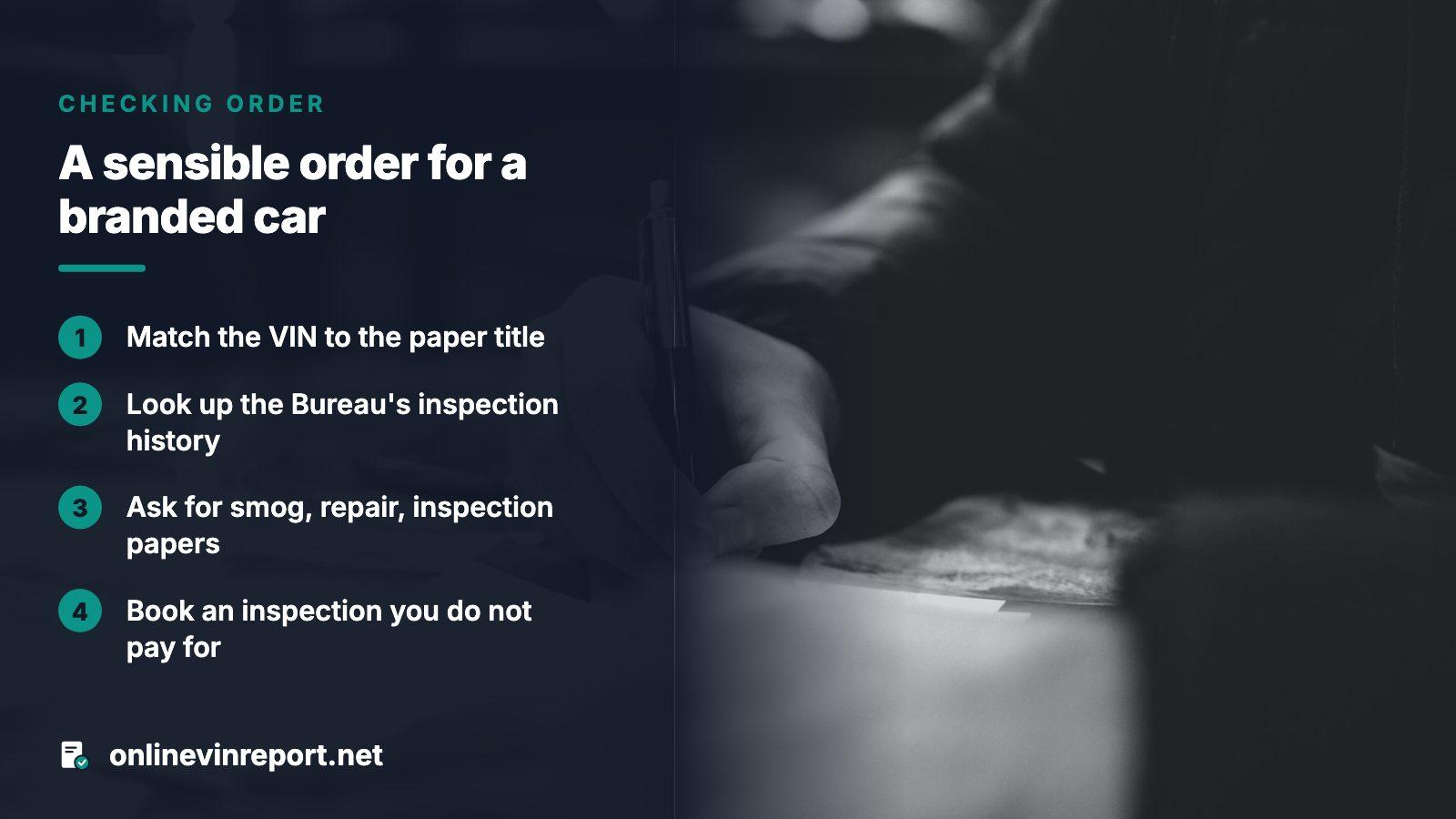
- Take the VIN off the car, match it to the paper title, then run the preview.
- If it survives that first look, open the full report and read the brand, total-loss and salvage entries first.
- Look up the same VIN in the Bureau's inspection history for smog and safety-systems entries.
- Ask the seller for the smog certificate, the repair invoices and the inspection papers from the rebuild.
- Book an inspection with a mechanic the seller does not pay.
DMV's list of clues gives that mechanic a start: repair marks inside the fenders, mud or rust beneath the trunk carpet, missing NHTSA labels. The federal title database also advises an independent inspection even when a report comes back clean.
Where this information comes from
- California DMV: revived salvage vehicle registration — The documents, inspection and safety-systems certificate DMV asks for, with smog certification listed among the extra items.
- California DMV manual: Vehicle Safety System Inspection Program — Which registrations need the electronic pass, and where results are posted by VIN.
- California DMV manual: revived salvage, California record — How the smog requirement is worded for a revived car, plus the Highway Patrol referral and air bag rules.
- California Bureau of Automotive Repair: Smog Check — The general smog rules by model year, fuel type and type of sale, and how long a pass lasts.
- California DMV: branded titles — How the brand appears on a California title and the clues DMV lists for repaired cars.
- US Department of Justice: NMVTIS vehicle history report — The five indicators the federal title system reports and what it leaves to private providers.
- 40 CFR 51.365: inspection program data collection — The federal list of data a state testing program records on each test.
Sources and photos: Facts checked against the sources above in November 2026. Photos by Dain Lindo, Owen Michael Grech and Mustafa Sheikhmouss on Unsplash; diagrams by OnlineVINReport.
Keep reading
- Salvage title VIN check: run it online before you payHow the brand lookup itself works, and how to read a result.
- Rebuilt title inspection: what the state checks and what a VIN title check addsWhat the state inspection of a rebuilt car involves.
- Register out of state car in California: the title, VIN check and 20-day clockThe steps for bringing a car from another state into California.
- What is a rebuilt title? What it means and what a VIN title check showsWhat a rebuilt brand means for value, insurance and resale.
Frequently asked questions
Does a salvage title car need a smog check in California?
DMV lists smog certification among revival items where it is appropriate, so the ordinary rules by model year and fuel type decide. Its salvage pages do not detail the rule, so confirm the answer for your exact car with DMV before budgeting for repairs.
Can a rebuilt car pass smog?
The Smog Check page does not treat rebuilt cars as a separate group, so the usual visual checks plus a computer or tailpipe test apply. Clear any check-engine light first.
Does a passing smog check prove a salvage car was repaired properly?
No. It records emissions on one date and says nothing about structure, air bags or wiring. Weigh it alongside the official inspection record, the safety-systems pass, your own mechanic's findings and the repair invoices.
How do I look up a car's smog and safety-systems history?
Use the Bureau of Automotive Repair's inspection history page and search by VIN rather than plate. That lookup does not show a title brand, so pair it with a VIN title check that covers total-loss and salvage entries.
Will a smog lookup show that a car has a salvage brand?
No. Smog records and title records are kept separately. A title check built on the federal database covers brands from any state. California dealers must pull such a report on used cars and post a disclosure on cars with a junk or salvage record or a branded title.
Now check the car itself
The guide explains what to look for. The report shows what this VIN has on record.