THE SHORT ANSWER
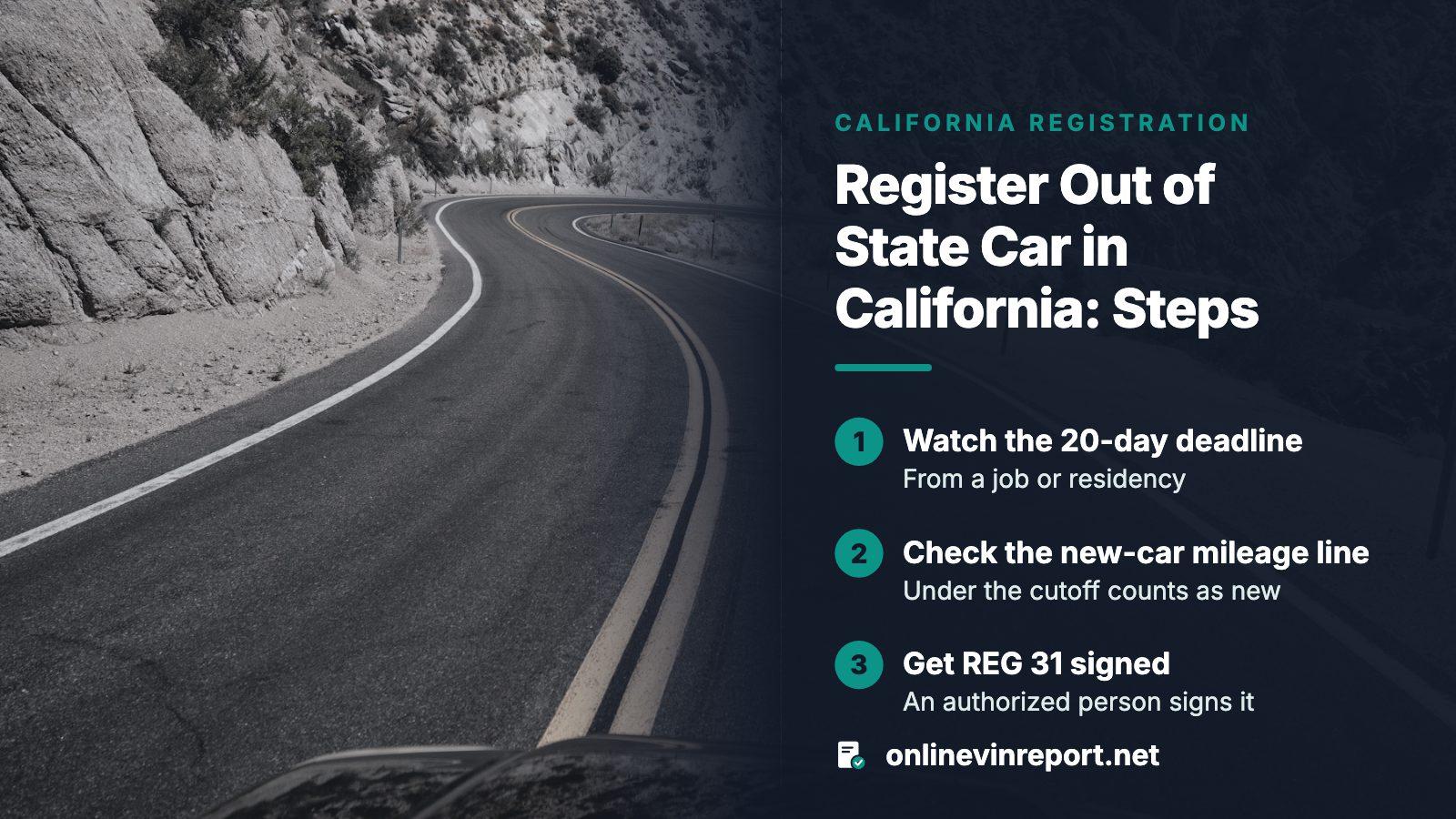
You have 20 days from the day you accept California work or establish residency, whichever is earlier. The package is form REG 343, the out-of-state title, a VIN verification on form REG 31, a smog certificate and your old plates. A nearly new car, under 7,500 miles when bought, must also be a California-certified model. Fees include a $53 base fee, a value-based license fee and use tax.
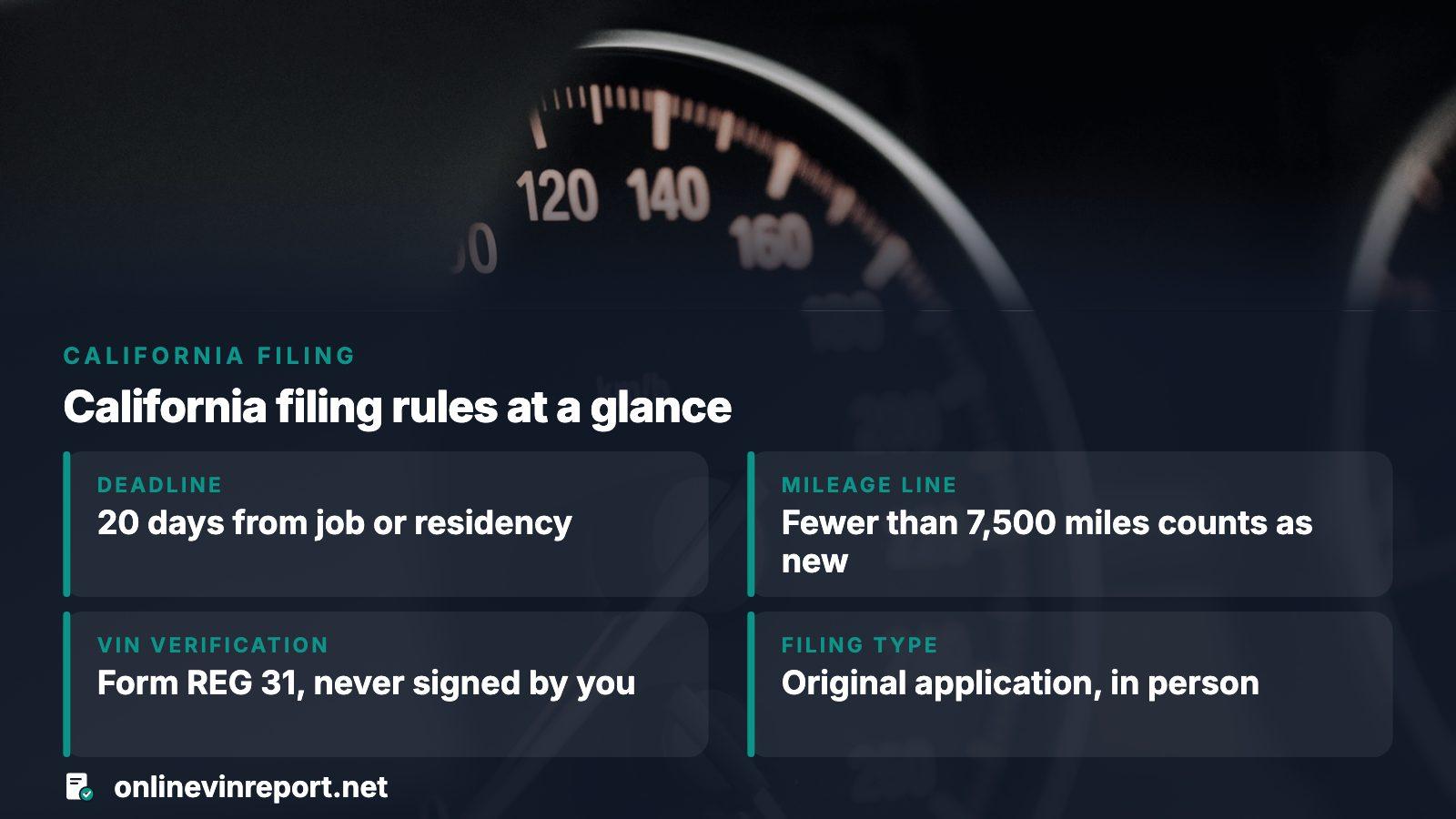
- Deadline
- 20 days from a job or residency, whichever is first
- Mileage line
- Fewer than 7,500 miles when bought counts as new
- VIN verification
- Form REG 31, signed by an authorized person, never you
- Filing type
- An original application, made in person
The out-of-state title does most of the talking
California does not continue your old registration. A car arriving from elsewhere goes through as an original application, and the paper at the center is the title from the state where it was last registered. California honors a currently valid title from that state, recorded liens included.
So whatever that title carries comes with the car: the owner's name, any lender still listed, and any brand the other state recorded, such as salvage or rebuilt. Read the title front and back before you book anything.
Twenty days, counted from a job or residency rather than arrival
Vehicle Code section 6700 lets a visitor drive on home-state plates until one of two events: accepting work in California, or establishing residency here. Whichever happens first starts the 20 days. The border crossing is not the trigger, and neither is the first drive on a California road.
Picture someone who signs an offer letter in October and moves after New Year. The clock may have run out before the moving truck is loaded. A separate rule in the same section covers a resident of California who uses a car registered in another state on a regular basis: 20 days from its first operation here.
Form REG 343 asks for three dates: when the car entered California, when it was first driven here, and the earliest of starting work, getting a California license or becoming a resident. Only the last carries the deadline.
The odometer line that can end the plan before it starts
California calls a car new if the odometer read fewer than 7,500 miles when you bought it, even when another state has already titled and plated it. New cars must be built to California emission standards, and some makers sell certain models only in the other 49 states, with federal-only smog equipment. The DMV states that an application for a non-qualifying car will not be accepted.
Check it yourself. The label under the hood should say the car conforms to California rules or may be sold here. Do not accept a seller's word, and ask for a photo of the label before you agree a price.
| Your situation | Does the rule block you? |
|---|---|
| Bought with fewer than 7,500 miles, a 49-state car, never registered by you in your home state | Yes, California will not register it |
| Same car, but first registered in your own name in your home state before the move | No, this is the main mover's exemption, and you must show proof |
| Bought with 7,500 miles or more | No, the new-car rule does not apply |
| Obtained through a divorce, an inheritance or a legal separation | No, a listed exemption covers it |
What goes in the envelope
- Form REG 343, the title and registration application, with all three date fields completed
- The original out-of-state certificate of title, not a scan
- Form REG 31, the verification of vehicle, completed by an authorized signer
- A smog certificate, either of compliance or, where the rules call for it, of noncompliance
- Your old plates, handed over for surrender
- Receipts showing sales tax paid elsewhere, which earn a credit against use tax
- Form REG 4008 for heavier pickups and commercial vehicles, declaring gross weight
REG 343 has a license number box for each owner, with a state beside it. Section 4150 requires a number only where the owner holds a license, so one from another state is fine.
Who may inspect the car, and who must send you to the DMV
Form REG 31 is the VIN verification, and the form bars the applicant from filling it in. Four kinds of people may sign: authorized DMV staff, California licensed verifiers, authorized auto club employees and trained peace officers. They complete it while inspecting the assembled car. Appointments with a private verifier are often easier to get than a field office slot.
The limits matter more than the permission. Licensed verifiers must decline cars whose federal label disagrees with the VIN or is unreadable or missing, cars revived from salvage or junk status, specially constructed vehicles, and cars with paperwork from another country. Those, and any car without an ownership document, are referred to the DMV or the CHP.
One cross-out can cost a second appointment
Any missing section, alteration, cross-out or erasure voids the form, even if initialed. Make sure all nine sections carry a checked box before you leave.
Smog certificate, old plates and use tax
Section 4000.2 requires a certificate of compliance, or of noncompliance where appropriate, for a car previously registered outside the state. The newest model years, exempt from the biennial inspection, are treated differently. The test measures how this car runs today, so a model certified for California can still fail.
Section 4301 requires you to surrender unexpired plates and other evidence of the old registration, and REG 343 asks what became of them. Some states want their plates back too, so ask the old state before you discard them.
Use tax is due with the application under section 4300.5. If the car entered California within one year of purchase and you paid sales tax to another state, REG 343 credits that amount against the use tax. Keep the purchase paperwork as proof.
What it costs, and what a late filing adds
Nobody can quote a single total without knowing the car. The base fee under section 9250 is $53, the smallest line.
| Cost | What sets it |
|---|---|
| Base registration fee | Fixed by section 9250 |
| Vehicle license fee | Driven by what the car is worth |
| Local charges | Depend on your address |
| Use tax | The price, less sales tax you can prove you paid elsewhere |
| Smog certificate | The licensed station |
| VIN verification | Whoever performs it |
| Weight fees | Heavier pickups and commercial vehicles only |
Section 9554 adds two penalties at once. A flat penalty on the registration fee starts at $10 for ten days or less and reaches $100 beyond two years. A percentage penalty on the license fee and weight fees starts at 10 percent and climbs through 20, 60 and 80 to 160 percent. At the top band the penalty is bigger than the fee beneath it. Already late? File now.
Buying from out of state: run the title check before money moves
Moving with your own car is one case; buying from out of state is another, and the order changes:
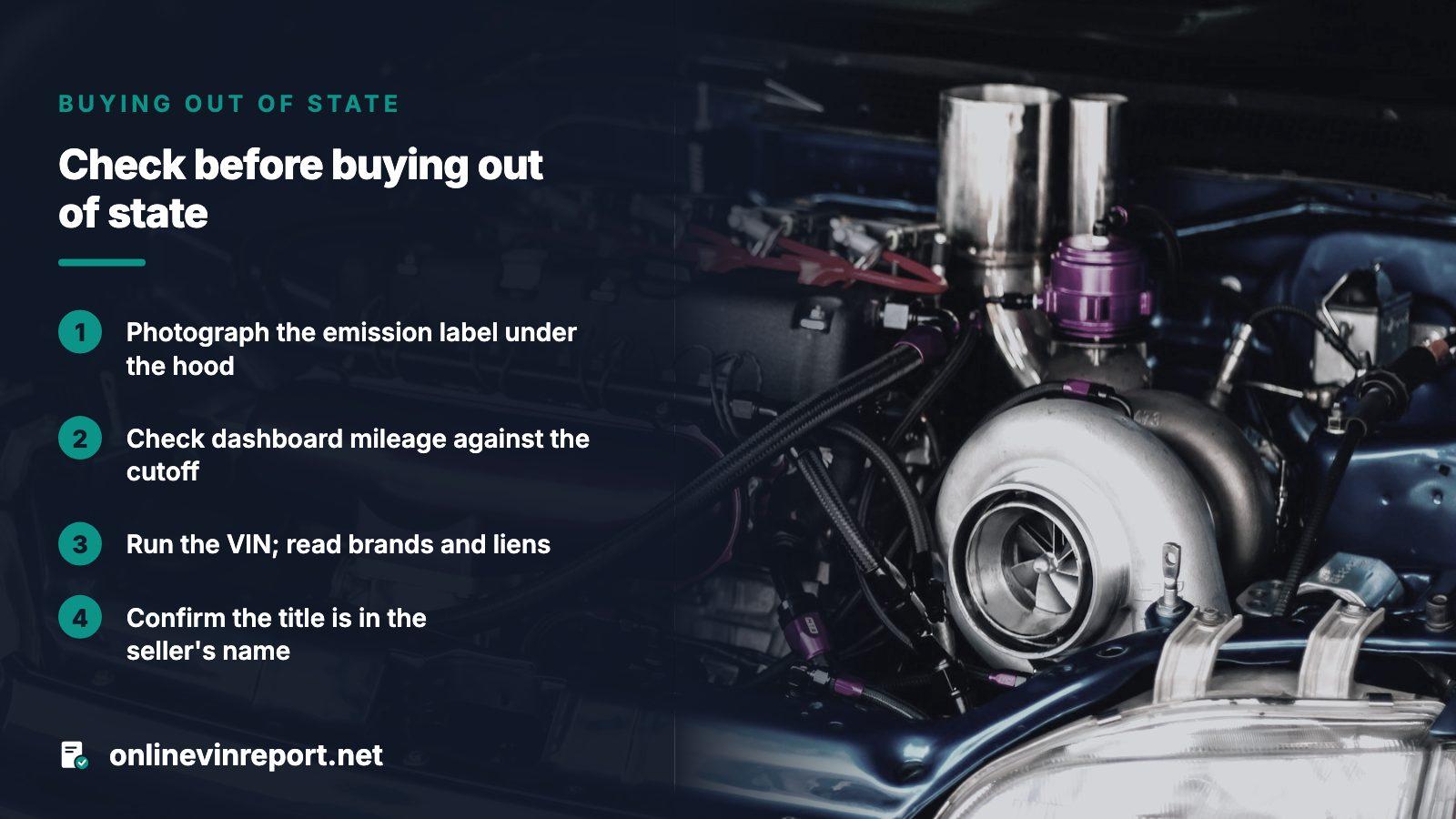
- Photograph the emission label under the hood.
- Check the dashboard mileage against the 7,500 cutoff.
- Run the VIN and read the title brands, liens and odometer history.
- Confirm the seller's title is valid and in the seller's name.
- Collect the out-of-state sales tax paperwork.
Step three is where a VIN record earns its place. A salvage brand from any state follows the car, and a car revived from salvage is exactly what a private verifier cannot sign for. The free preview from OnlineVINReport shows what exists for a VIN. The full report is paid once, with no subscription, and covers title brands, odometer readings, liens, salvage and auction history with photos, and theft and insurance records. It cannot read the emission label for you.
Where this information comes from
- California DMV: out-of-state vehicles — The department's own guidance on the 7,500-mile definition of a new car, 49-state vehicles, the emission label and the exemptions.
- California DMV: Form REG 31, verification of vehicle — Lists who may sign the inspection, what a licensed verifier may not touch, and why alterations void the form.
- California DMV: Form REG 343, application for title or registration — The application itself, with its three dates, the sales tax credit declaration and the plate disposition question.
- California Vehicle Code section 6700 — Sets the event that starts the 20-day period for a car registered in another state.
- California Vehicle Code section 9554 — Sets the flat and percentage penalties for registering late, by time band.
Sources and photos: Facts checked against the sources above in November 2026. Photos by Will Truettner, Willian Cittadin and CHUTTERSNAP on Unsplash; diagrams by OnlineVINReport.
Keep reading
- Registering a car without a title: what the VIN check shows firstThe longer road when a seller has no title.
- What is a rebuilt title? What it means and what a VIN title check showsWhat a rebuilt brand means, useful because revived salvage cars skip private verifiers.
- Salvage title VIN check: run it online before you payRun a salvage check by VIN and see any brand before you book an inspection.
- Bill of sale for a car: the deal it proves and the history it can'tThe sale paperwork to collect when you buy a car from another state.
Frequently asked questions
Can I register an out-of-state car online?
No. A car from another state is an original application, not a renewal, and three steps are physical: someone inspects it on form REG 31, you hand over the old plates, and California takes the out-of-state title itself. Online renewal covers only registrations California has already issued.
Do I need a California driver license first?
No. The statute asks for a driver license or ID card number only if you have one, and REG 343 has a state box beside it, so a license from another state works. The car and the license run on separate clocks, so a late license appointment is no reason to let the 20 days pass.
What if I am already past the 20 days?
File anyway, and file now. Section 9554 penalties step up by band, so every band you cross costs more and none gets cheaper with time. The percentage penalty on the license fee is the one to worry about.
Can a car with a salvage history be inspected by a private verifier?
No. A licensed verifier must decline a car revived from salvage or junk status, so it must be inspected by the DMV or the CHP instead. A private verifier's signature on it would be refused. Find any brand with a VIN check before you book.
Does the 7,500-mile rule apply if I am moving with my own car?
Only if the car counts as new: fewer than 7,500 miles on the odometer when bought, and built for the other 49 states. Movers are exempt if they first registered the car themselves in the home state, or for military personnel the last state of service, and can prove it.
Now check the car itself
The guide explains what to look for. The report shows what this VIN has on record.