THE SHORT ANSWER
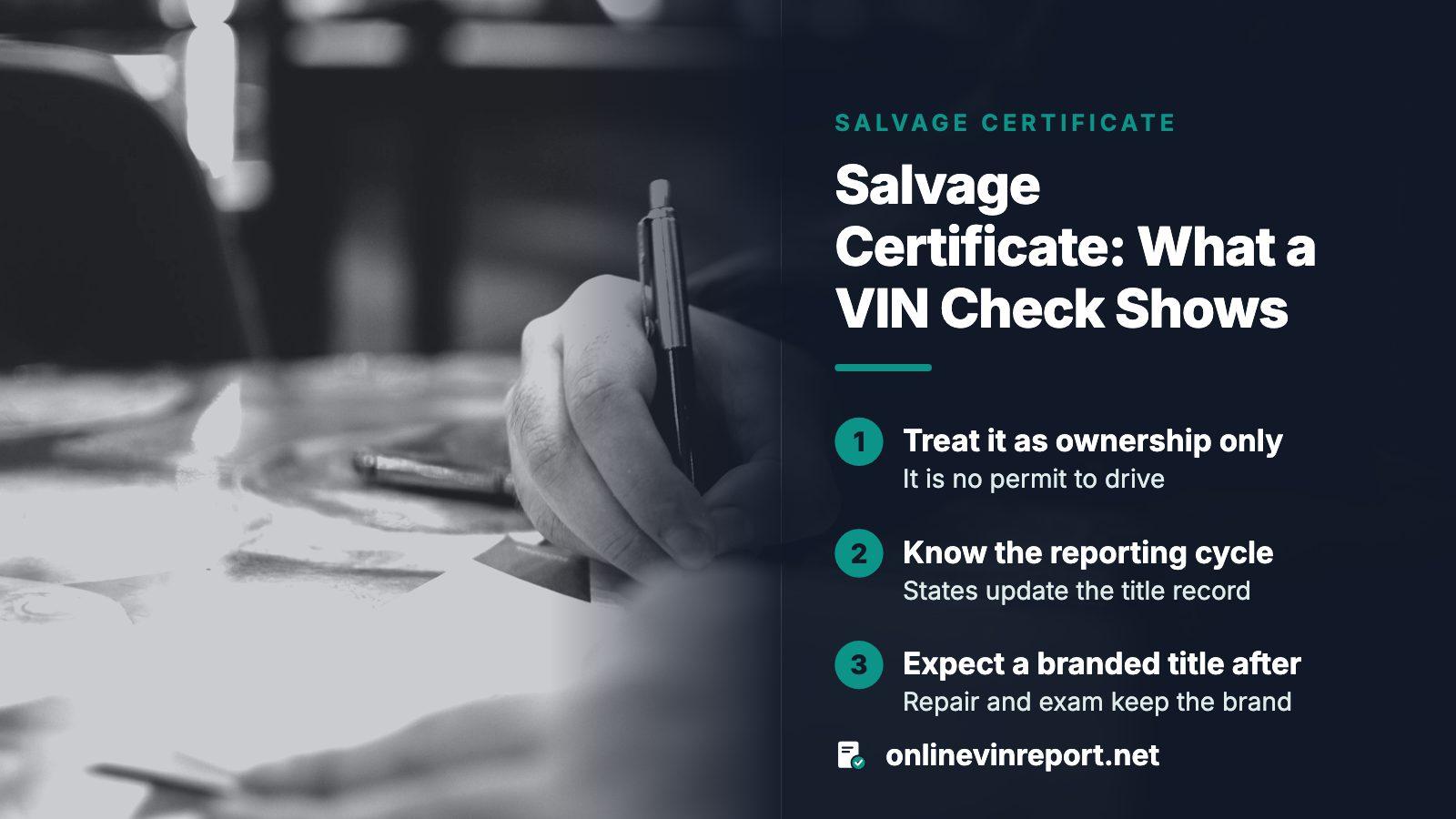
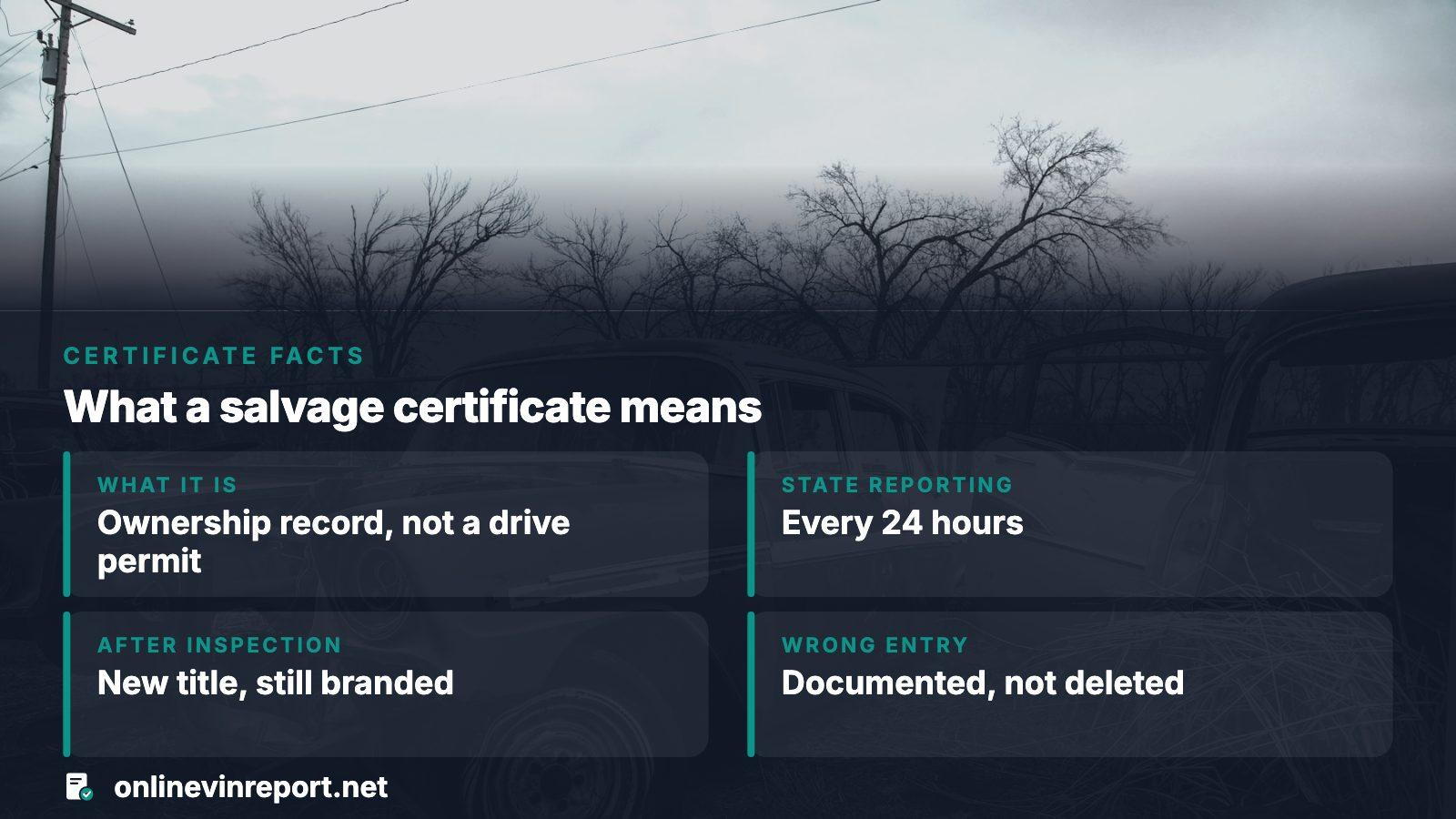
A salvage certificate is a state document naming the holder of a vehicle that was totaled or badly damaged. It establishes ownership but generally does not allow registration, road insurance or driving. In some states the certificate comes first and the branded title arrives later; others brand the title from the start. A VIN check shows the salvage brand on the national record, whatever name your state prints on its paper.
- What it is
- An ownership record, not permission to drive
- State reports to the title record
- Every 24 hours
- After repair and inspection
- A new title that is still branded
Reading a salvage certificate: custody, not permission
A salvage certificate works like a custody record. After a car is wrecked, burned, flooded or written off by an insurer, the state issues it to name whoever now holds the vehicle. From that point the car sits outside the population of ordinary titled cars, and the state tracks it on a separate instrument.
Missing from the document is any right to use the car on public roads. Registration, road insurance and driving usually wait for repairs, a state inspection and a fresh title. For a rebuilder or a parts buyer that is fine. For a shopper who needs a commuter by Monday, it is the wrong car.
Four different papers hide behind the word salvage
A seller who says salvage and stops there has told you very little. States print the word on different documents, and which document you hold decides what the car may do next.
| Instrument | What it records | Back on the road? |
|---|---|---|
| Salvage certificate | Who holds a wrecked car that cannot be driven yet | Yes, via repair, inspection and a new title |
| Regular title with a salvage brand | The same situation, shown as a brand on a standard title | Yes, via the state's repair route |
| Non-repairable certificate | A vehicle the state bars from the road for good | No |
| Certificate of destruction | A vehicle that is legally nothing but parts and scrap | No |
No federal rule fixes these names, so one wreck can earn a certificate in one state, a branded title in a second and a non-repairable paper in a third. Only the issuing state's motor vehicle agency can tell you what its own document permits. A fixed state-by-state list would go stale quickly on a topic where a wrong answer costs a car, so none appears here.
What an online VIN check adds to the paper in the seller's hand
The certificate is one state's statement on one date, and the person selling holds it. An online VIN check queries the national title record, which answers other questions. Use both.
| Question | The paper | The VIN check |
|---|---|---|
| What is the instrument called? | Printed on the document | Read it off the paper; names are the state's |
| Whose name is on it? | The holder is named | Not its job, so compare it yourself |
| Did any other state record a brand? | Shows the issuing state only | The record follows the VIN across state lines |
| Did the car go through a salvage auction? | Rarely says | Salvage and auction history, with photos when on file |
OnlineVINReport starts with a free preview that shows whether title and auction records exist for a VIN, so you can judge if the full report is worth buying. A full report is paid for once, never as a subscription, and the pricing page has the pack sizes.
Why a brand follows the VIN out of its home state
Three reporting duties feed the federal title record, so a salvage status never hinges on one party filing on time. Each catches the car at a different point.
| Who reports | What they send | How often |
|---|---|---|
| State titling agency | Titling data on every vehicle it maintains, including VINs and brands | Every 24 hours |
| Junk and salvage yards | Each junk or salvage vehicle taken in: VIN, date, source, and whether it was crushed | Monthly |
| Insurance carriers | Cars the insurer took over and classed as junk or salvage | Monthly |
The insurer stream has a blind spot. It covers a five-model-year window: this year's models and those of the four years before. An older car written off by an insurer may reach the record only through the state feed or a yard. So a clean result on an older car counts for less than on a recent one, and no check is conclusive.
Salvage and junk are separate federal tests
Under 28 CFR 25.52, a salvage automobile is defined by a comparison. Add what the wreck would fetch to the cost of making it legal for the road; if the sum beats the car's value in the moment before the damage, it qualifies. So does any car a state has ruled a total loss. Plenty of them are repairable.
Junk is the stricter label. The vehicle must be unable to operate on public roads and also have no worth beyond parts or scrap; both halves must be true. That is why a salvage instrument can precede a repair, while a junk instrument generally does not.
What a certificate holder can do, and the road back
- Own, store and sell the vehicle, with the document going along.
- Take it apart for parts, the real purpose of many of these cars.
- Not register or drive it on that paper, and usually not insure it for the road.
- Not repair the brand away. Once repaired, the brand stays, typically as rebuilt or reconstructed.
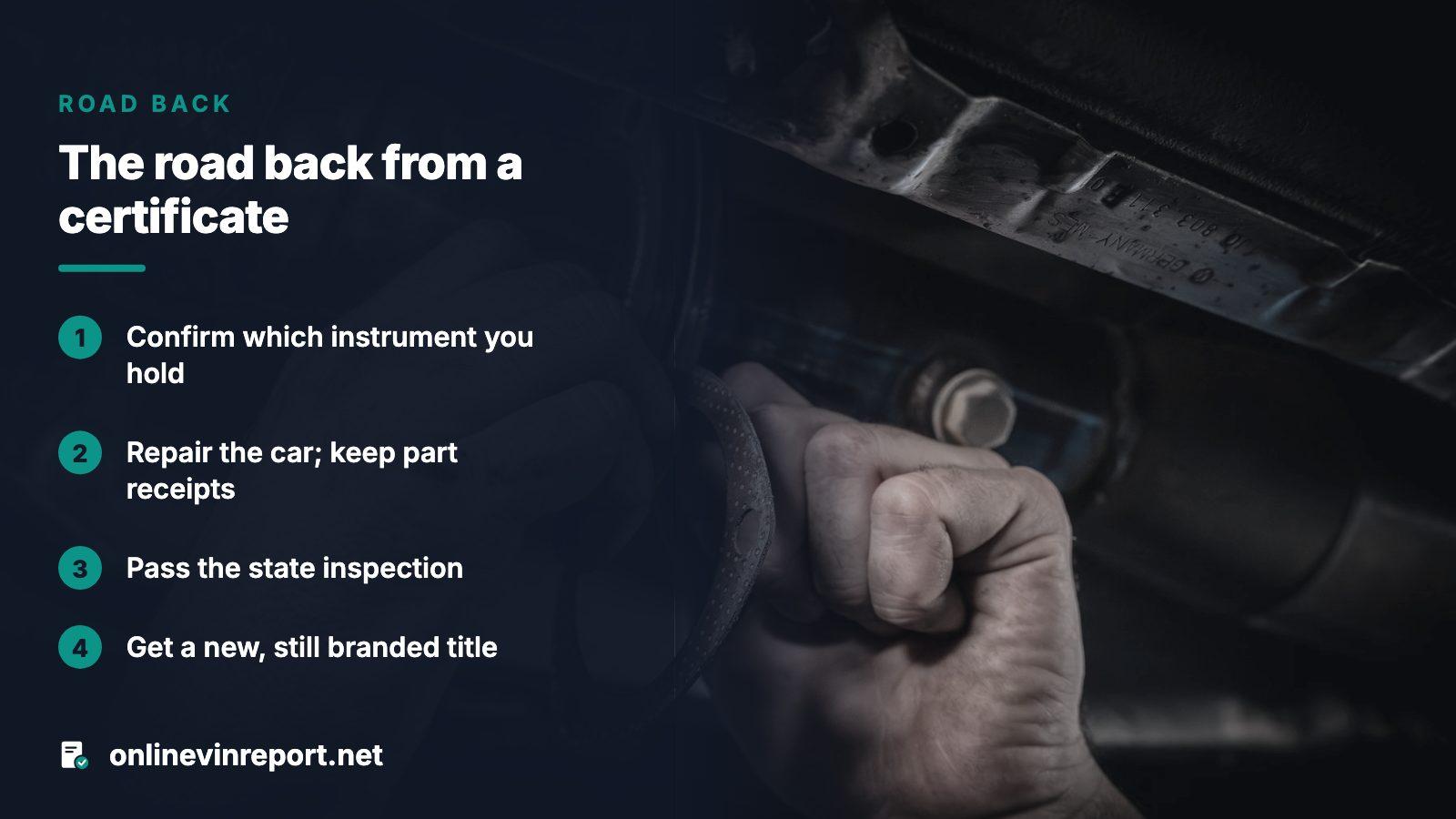
Where a repair route exists, it has four stages:
- Confirm which instrument you hold, since repairable and non-repairable papers look alike.
- Repair the car and keep receipts for major parts; inspectors ask where components came from.
- Pass the state inspection. It confirms identity and checks that parts are not stolen. It does not grade the quality of the repair.
- Get a new title, still branded, and register the car. The brand remains on the record and travels with the VIN through each later sale.
Some papers lead nowhere
A non-repairable certificate or certificate of destruction offers no inspection to pass. In that state the vehicle is legally parts and scrap.
Questions to settle before you buy a car on a certificate
Rebuilders buy these cars deliberately and often do well. Problems start when the buyer is unsure which paper is in play. Settle these before money moves:
- Get the instrument's exact name and read the document yourself.
- Compare the holder's name with the seller's. If they differ, the sale cannot hand over ownership.
- Learn the cause of the damage. A bent structure or a flood leaves the greatest lasting risk.
- Budget for the inspection and retitling as well as the repair.
- Run the VIN and set the record beside the paper. The brand should show whichever state issued the document.
The NHTSA recall lookup costs nothing and is worth running as well, because open recalls are easier to clear before a rebuild begins.
A wrong entry gets documented, not deleted
Sellers sometimes insist a brand on the record is an error. That can happen. Still, 28 CFR 25.57 stops the system operator from letting anyone remove an earlier junk report, because deletion would invite fraud. For a vehicle reported by mistake, the rule points to paperwork: an inspection in the state of title, where officials use hidden VINs to verify the car's identity, followed by filing and keeping the inspection reports.
A seller who promises to scrub a brand from a VIN is promising something the system is designed to block. Ask to see the inspection paperwork instead.
Where this information comes from
- eCFR: 28 CFR Part 25, subpart C (NMVTIS) — The federal text behind the salvage and junk definitions, the state and yard reporting duties, and the rule against deleting a junk report.
- NMVTIS: U.S. Department of Justice — The Justice Department's page on the national title record where a brand recorded in one state becomes visible from another.
- NHTSA: recalls lookup — Open safety recalls by VIN, useful to check before buying or rebuilding a damaged car.
- NHTSA: vPIC VIN decoder — Decodes the factory build from a VIN, including the restraint systems a rebuild has to restore.
Sources and photos: Facts checked against the sources above in November 2026. Photos by Owen Michael Grech, Martin Fennema and Leo_Visions on Unsplash; diagrams by OnlineVINReport.
Keep reading
- Salvage title VIN check: run it online before you payRun a salvage check by VIN and see what the record shows before you pay.
- What is a branded title? How to read salvage, flood and rebuilt brands by VINEvery brand type, from salvage to flood to junk, and what each one records.
- What is a rebuilt title? What it means and what a VIN title check showsThe title a repaired salvage car receives, and what it means for the next owner.
- Total loss threshold by state and what it means for a VIN title checkThe state arithmetic that decides when damage becomes a total loss.
Frequently asked questions
What is a salvage certificate in plain terms?
It is a state's note that a vehicle was totaled or damaged beyond ordinary titling, plus the name of whoever holds it. The paper establishes custody. Driving rights are a separate matter, and they usually arrive only after repair, inspection and a new title. Read the exact name printed on the document, not just the word salvage.
Do a salvage certificate and a salvage title differ?
In some states, yes. A certificate can serve as the ownership record while a car awaits repair, and the branded title follows inspection. In other states a single branded title covers the whole process. Everyone says salvage for both, so ask the seller which document exists and look at it.
Is a car on a salvage certificate legal to drive?
Not on that paper alone. Expect to repair the car, pass the state inspection and obtain a new title, which usually carries a rebuilt or reconstructed brand. Where the instrument is non-repairable or a certificate of destruction, there is no way back and the vehicle is classed as parts.
Does a VIN check pick up a salvage certificate?
It should pick up the brand. States send title data, with VINs and brands, to the national record every 24 hours, and salvage yards add monthly inventories. The record follows the VIN across state lines. On an older car, trust a clean result less, since insurers report only a five-model-year window.
Can the salvage brand come off once the repair is done?
No. Repair and inspection earn a new title, but it carries a brand of its own and the earlier report stays on the national record. Federal rules do not let anyone delete a prior junk report. An offer to wipe a brand away is title washing, which is fraud.
Now check the car itself
The guide explains what to look for. The report shows what this VIN has on record.