THE SHORT ANSWER
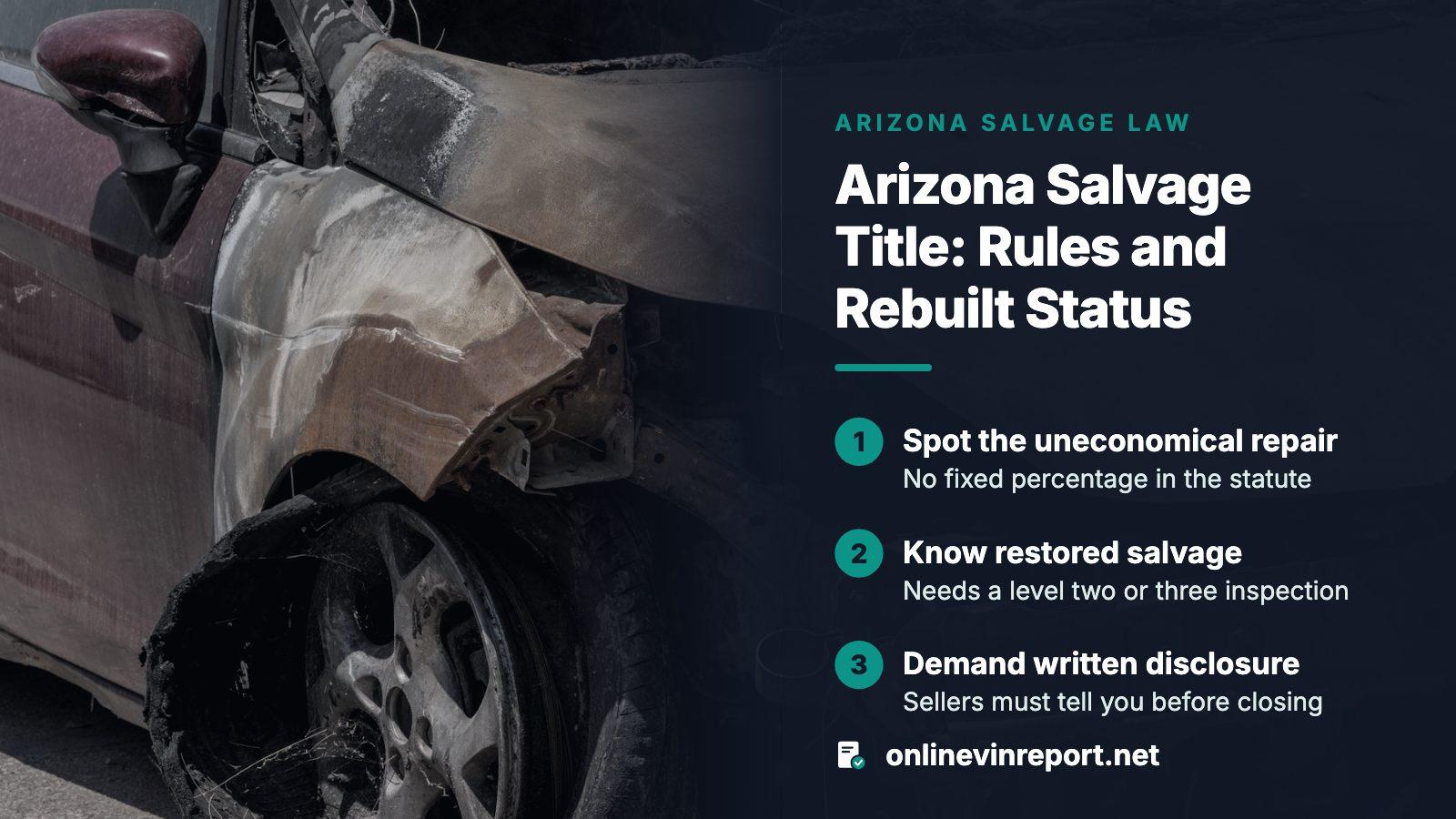
Arizona writes the salvage rule into A.R.S. 28-2091. A damaged, wrecked, stolen or flooded car that is uneconomical to fix gets a salvage title and cannot be sold as a normal car. Once repaired, it needs a restored salvage title from MVD after an inspection. Sellers who know about either title must disclose it in writing before the sale closes. Check the VIN first.
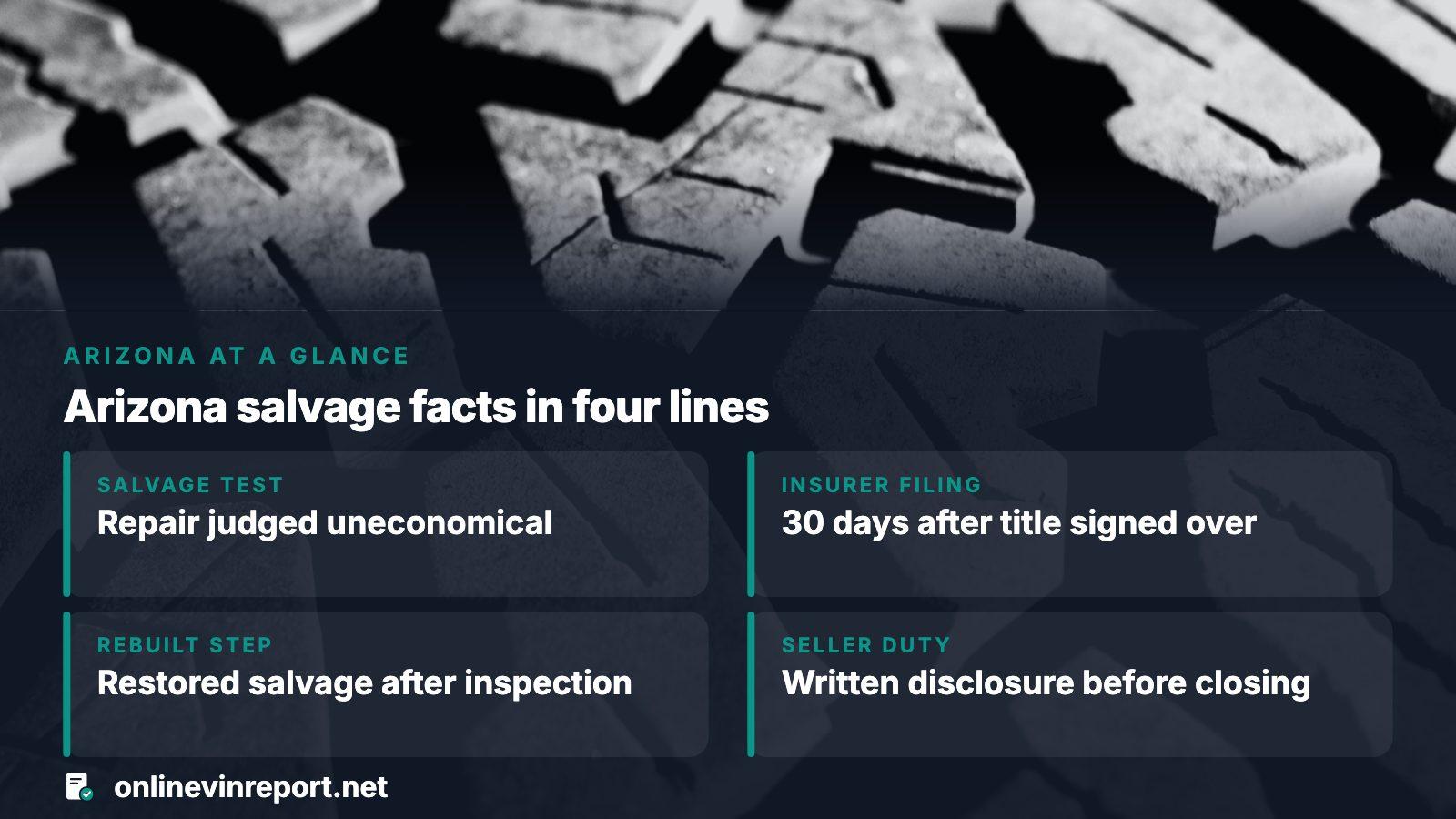
- Salvage test
- Repair judged uneconomical, no fixed percentage in the statute
- Insurer filing window
- 30 days after the owner signs over the title
- Rebuilt step
- Restored salvage title after a level two or three inspection
- Preview
- Free look, paid report later
How Arizona decides a car is salvage
Many states set a damage percentage. Arizona's statute does not print one. A vehicle counts as salvage when it has been stolen, wrecked, destroyed or hurt by water or other damage, and the owner, leasing company, bank or insurer considers fixing it uneconomical. That is a judgment call by whoever carries the loss, usually an insurance adjuster comparing repair cost to what the car is worth.
The practical result is that two cars with similar damage can end up with different titles, depending on who owned them and how the claim was settled. A buyer cannot back out the severity from the word on the title. You need dates, photos and the record of who declared the loss.
Salvage, stolen and nonrepairable are different titles
The same law creates three special titles, and only one of them can lead back onto the road.
| Title | What it means | Can it be driven again? |
|---|---|---|
| Salvage | Loss declared, car may still be repairable | Yes, after repair and an MVD inspection |
| Stolen vehicle | Ownership document for a car stolen and not recovered | Not applicable until recovered |
| Nonrepairable | Parts or scrap only, a stripped theft recovery, or a burned shell | No, registration is cancelled |
A nonrepairable title is stamped with that word on its face and can be reassigned only twice. After that MVD stops processing transfers and issues no further paper title. If a seller offers you a car with that brand as a project to register, walk away.
Rebuilt in Arizona means restored salvage
Searches for a rebuilt title in Arizona land on the restored salvage certificate. Under the law, an owner may not pass a repaired salvage car to anyone else until MVD has issued this certificate. The state's definition covers any vehicle that was restored after receiving a salvage or dismantle title.
The restored title is a permanent record that the car was once written off. It does not mean the repair was good. MVD's inspection is about identity: that the VINs match the paperwork and that the parts came from a lawful source. It is not a safety or workmanship exam, so a structural fault can pass.
The inspection and the parts paperwork
An application for the restored title sends the car to MVD for either a level two or a level three inspection. Level two lines up the public VIN, a second VIN and a hidden confidential VIN against the ownership papers. Level three repeats that and then reads VINs on some or all of the parts, at the inspector's choice, and confirms the car is fit for the highway. The statute lists twenty dollars for level two and fifty dollars for level three, so confirm current fees with MVD.
- Keep invoices for every replaced door, fender, bumper, hood, frame section, engine and transmission.
- Notarized bills of sale for used parts are an accepted form of proof.
- A part with no paperwork can be seized, and a stolen part must be seized.
- When MVD cannot schedule a level three inspection in the first twenty days after you ask, it must get to the car within forty-eight hours after that window closes.
Sellers of a salvage car are required to tell the buyer that part paperwork will be needed. If you are buying an unfinished rebuild, ask for the receipts before you hand over money.
What a seller has to tell you
If you sell a car and know it carries a salvage title, the law expects a plain, prominent statement to the buyer, on paper or by email or text, ahead of closing. Restored salvage titles carry the same expectation. Tucking a mention into a pile of forms is not what the statute describes.
Airbag disclosure is its own offense
Certain recovered theft cars get a regular title through an insurer's sworn statement, which notes each spot where an airbag fired or was taken out. Hiding a known airbag deployment or removal from the buyer on purpose is a class 1 misdemeanor. If the airbag light is on or the dash looks recently opened, ask to see the affidavit.
A general violation of the salvage section is a class 2 misdemeanor. None of this helps if the seller lies and the paper title shows nothing, which is why a record check matters.
When the brand does not show up
The federal title database says a state brand stays in the national record once applied. It also warns about gaps. Roughly 87 percent of US vehicles are covered, yet only a bit over half of states send data, so a search can come back falsely clear. Brand washing is the other risk: retitle a car in a state that skips the earlier-state lookup and it can emerge with a clean paper title. Experian counted more than 185,000 such titles in the first six months of 2008 alone.
States also draw lines differently. A car one state brands as salvage may not meet another state's threshold, and a few have no flood brand whatsoever. A car that spent time in Texas or Louisiana before reaching Arizona deserves a closer look than one with a single-state history.
Run the VIN check before you negotiate
Ask the seller for the VIN before you drive out, then compare it to the one on the car itself and on the title. Type it into this site's preview box. Seeing the preview carries no charge. A full report is a separate, single purchase listed on the pricing page, and it earns its cost only on a car you still seriously want.
- Look at the title brand history for salvage, flood, junk or rebuilt entries and their dates.
- Read the insurer total-loss line and any salvage auction listing with photos.
- Compare odometer readings across the dates to spot a jump or a rollback.
- Open the lien section; a salvage car with a lender's claim complicates the transfer.
- Cross-check recalls and theft entries before you book an inspection.

If you still want the car
Restored salvage cars sell for less, and some are sound. Ask for the photos from the loss, the repair invoices and the MVD restored title. Then pay an independent mechanic who works on frames to look at weld lines, panel gaps and airbag components. Check with your insurer before buying, since some carriers decline or limit coverage on branded cars.
Price it accordingly and expect resale to be harder, because the next buyer will find the same record you did. A car you cannot verify, with missing receipts or a seller who dodges the VIN request, is cheap for a reason.
Where this information comes from
- Arizona Revised Statutes 28-2091 — salvage, stolen and nonrepairable titles, insurer filing window, seller disclosure and penalties
- Arizona Revised Statutes 28-2095 — restored salvage title, inspection, parts proof and disclosure
- Arizona Revised Statutes 28-2011 — what each inspection level covers and the listed fees
- US Department of Justice: NMVTIS for consumers — what the national title database holds, its gaps, and brand washing
Sources and photos: Facts checked against the sources above in November 2026. Photos by engin akyurt, Michal Biernat and Marvin Sagisi on Unsplash; diagrams by OnlineVINReport.
Keep reading
- Salvage title VIN check: run it online before you payHow to read a salvage result in a VIN report.
- Rebuilt title inspection: what the state checks and what a VIN title check addsWhat an inspection of a repaired write-off checks for.
- How a car gets a salvage title, and what a VIN check showsThe path from a crash to a branded title.
- Do you have to disclose a rebuilt title when you sell a car?A seller's disclosure duties compared across states.
Frequently asked questions
Is a rebuilt title the same as a salvage title in Arizona?
No. Arizona issues a salvage title when a car is declared a loss. After repair and an MVD inspection it can receive a restored salvage title, which is the state's version of rebuilt. Both are permanent marks, and sellers must disclose either one in writing before the sale.
Can a salvage-titled car be registered in Arizona?
The owner of a repaired salvage car may not pass it on until MVD issues a restored salvage title. Registration questions beyond that, including fees and forms, are answered by MVD, whose pages I could not open, so confirm there.
Does a nonrepairable title ever become drivable?
No. Arizona cancels the registration, brands the title with the word nonrepairable, allows only two reassignments, and then stops transfers and paper titles. It is meant for parts and scrap, so treat it as a car that will not be legal to drive.
How do I know if a used Arizona car was ever salvage?
Put the VIN through a title check and read the brand history, insurer total-loss entries and salvage auction records. Federal data has gaps, so also inspect the car and ask for the title record from the state where it was last titled.
Does the MVD inspection prove a rebuilt car is safe?
No. It checks identity and part ownership by matching VINs and reviewing invoices, not the quality of repairs. Have an independent mechanic inspect structure and airbags before you buy.
Now check the car itself
The guide explains what to look for. The report shows what this VIN has on record.