
THE SHORT ANSWER
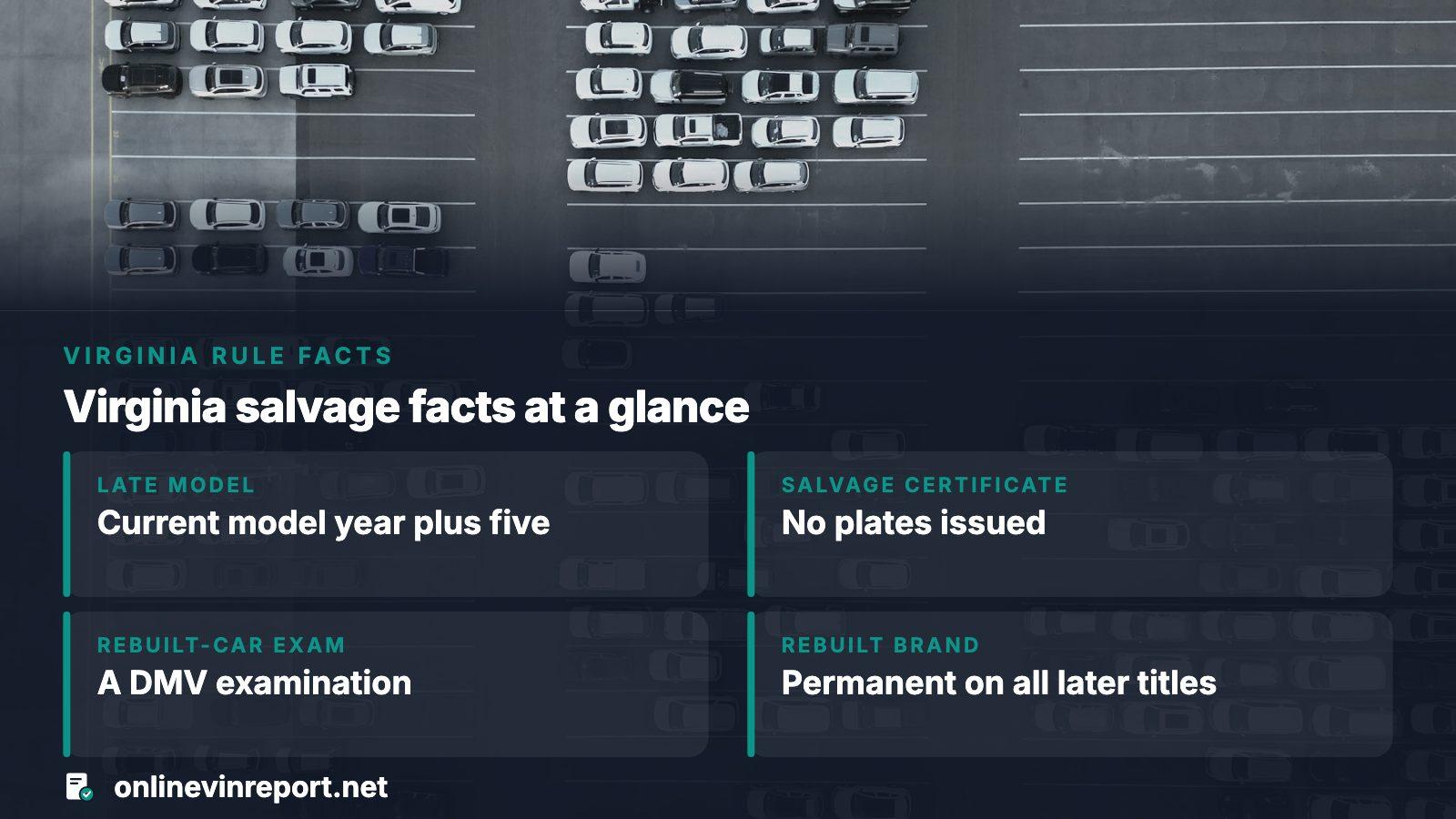
In Virginia a late model car becomes salvage when repairs would cost more than its value minus what the wreck would sell for, or when an insurer takes it over in a claim. The state then issues a salvage certificate with no plates. After repair, a safety inspection and a DMV examination, the car gets a rebuilt title, and that brand stays on every later title.
- Late model
- Current model year plus five, or worth $10,000 or more before damage
- Rebuilt-car examination
- DMV may charge $125 per vehicle
- Salvage certificate
- Statute sets the fee at $10; no plates issued
- Rebuilt brand
- Permanent on this and all later titles
Virginia's brands only reach late model cars
Most of Virginia's salvage law hangs on the phrase late model vehicle. The statute gives two ways in: the model year is this year or any of the five years behind it, or the car was valued at $10,000 or more just before the damage. A valuable nine-year-old truck is therefore covered, while a cheap old commuter may sit outside the scheme.
That changes how you read a clean title. On a recent or high-value car, a missing brand means something because the law demanded paperwork. On an older, cheaper car, silence proves less, and a VIN history check, which draws on insurer and salvage-yard reports, fills in what the title cannot.
Three routes into salvage status
The definition of a salvage vehicle has three limbs, and any one is enough.
- A late model car that an insurer took over while settling a claim, or one wrecked so badly, by any cause from a crash to a fire, flood or trespass, that fixing it would cost more than its cash value less its scrap-sale value. Towing, storage, loaner cars and diminished-value payments are not counted in that estimate.
- A stolen car that was found again and acquired by an insurer, where the fix would run past 75 percent of its cash value.
- Any other vehicle that its owner or its insurer puts forward by filing for a salvage certificate, provided it is not nonrepairable.
Because the first test nets out the salvage value, its target is smaller than the car's full worth, so a repair estimate crosses it sooner than a plain percentage test would.
What the salvage certificate does
When a car is declared salvage, the DMV cancels its title and issues a salvage certificate in the owner's name. The statute puts the fee for that certificate at $10, and the certificate is signed over to the next buyer if the car is sold. It cannot be registered: no plates are issued against a salvage certificate.
Insurers carry most of the filing duty. They must apply for the certificate on late model salvage cars they take over. If they never got the title from the previous owner, they can file an affidavit instead, and the DMV may charge $25 to process it. Owners of uninsured or self-insured late model cars must apply too once the repair estimate tops 75 percent of the car's worth before the damage, and an outside appraiser's estimate can stand in when no insurer produced one.
When the owner keeps the wreck
If an insurer pays a claim on a late model car with repairs estimated above 75 percent of its value and the owner keeps it, the insurer has to notify the DMV. A car can therefore be flagged without ever passing through an auction yard.
From wreck to rebuilt title
Getting a salvage car back on the road takes two separate checks, and passing the first does not skip the second.
| Step | Who does it | What it covers |
|---|---|---|
| State safety inspection | An inspector with no tie to the person asking | Whether the repaired car meets safety equipment rules |
| DMV examination | The Department of Motor Vehicles | Before-repair photos or video if they exist, receipts for parts and labor, the VIN and confidential number, the odometer, and the engine, transmission or electronic modules where they apply |
| Title and registration | The DMV, if nothing looks wrong | A title branded rebuilt, plus plates |
The statute describes the DMV examination as a guard against theft and fraud, and says it does not vouch for safety or roadworthiness. The Commissioner can charge $125 for each vehicle examined. A narrow exemption exists for old, low-value cars from long-licensed rebuilders. When the DMV spots problems, it tells the owner what to fix.
The rebuilt brand does not come off
Once the DMV approves a rebuilt car, its new title and every title after it carry the rebuilt brand. No waiting period makes it fade. The definition also reaches some cars that never had a salvage certificate: a recent or valuable car that was repaired after an estimate beyond 75 percent of its worth counts as rebuilt, though engine, transmission and drive axle damage is left out of that figure.
Nonrepairable is the harder stop. A vehicle judged good only for parts and scrap gets a nonrepairable certificate, issued with no fee, and apart from narrow exceptions it may never carry a Virginia title or registration.
Selling a rebuilt car: the written disclosure
A seller in Virginia has to give the buyer written notice that a car is rebuilt before the sale, using a form the Commissioner prescribes. If you are buying, ask to see that form first, and check its claims against the title and the VIN record. A seller who stays vague about repairs is already telling you something.
Salvage pools face limits too. A pool may sell a salvage vehicle stored in Virginia only to a licensed recycler, dealer or removal operator, or to a similarly regulated business in another state. That is one reason a private buyer usually meets these cars after a rebuilder has finished with them.
Cars that arrive from other states
The state can take in another state's salvage title and carry its brands forward. If that car has not been rebuilt and the Virginia steps have not been met, the DMV issues a salvage certificate. A parts-only, junk, destruction or not-to-be-repaired designation, whether printed on the old title or reported to the federal title database, is handled as if that state had issued a nonrepairable certificate.
One more path exists. A car rebuilt, titled and registered elsewhere despite such a brand can receive a nonnegotiable title in Virginia when repair paperwork accompanies the application. The state never issues a negotiable title for it, and any lienholder appears on the face of the document. It may be registered for road use.
Where an online VIN check fits
Paper can be altered or left blank, and a title from another state may not mention a brand that originated somewhere else. The federal title database, NMVTIS, collects brand history from motor vehicle agencies, insurers and the yards that handle junk, scrap and salvage, and was built to stop flood and salvage brands from being washed away by retitling.
- Run the VIN before you visit the seller, and again against the number stamped on the car.
- Look for salvage, rebuilt, flood, junk or nonrepairable entries and any total-loss record.
- Line up the odometer readings and owner count against the seller's account of the car.
- If the record includes salvage auction photos, study them against the car in front of you.
On this site the first look is a no-cost preview. After that, one purchase buys a full report, with no recurring plan, and the pricing page lists the options.

Where this information comes from
- Code of Virginia 46.2-1600: definitions — late model, salvage, rebuilt and nonrepairable definitions
- Code of Virginia 46.2-1603: salvage certificates — who applies, fees and the no-plates rule
- Code of Virginia 46.2-1605: rebuilt vehicles — inspection, DMV examination and the permanent brand
- Code of Virginia 46.2-1602: sales and disclosure — written disclosure of a rebuilt vehicle and who may buy salvage
- Code of Virginia 46.2-1606: out-of-state titles — carrying forward other states' brands
- NMVTIS: information for consumers — what the federal title database holds and why
Sources and photos: Facts checked against the sources above in November 2026. Photos by Annika Wischnewsky, Cole Keister and Iain on Unsplash; diagrams by OnlineVINReport.
Keep reading
- Salvage title VIN check: run it online before you payWhat a VIN check shows when a salvage brand is on the record.
- What is a rebuilt title? What it means and what a VIN title check showsHow rebuilt titles work beyond Virginia.
- Rebuilt title inspection: what the state checks and what a VIN title check addsWhat a rebuilt-title inspection looks at.
- Do you have to disclose a rebuilt title when you sell a car?Seller disclosure duties across states.
Frequently asked questions
What is a salvage title in Virginia?
Virginia issues a salvage certificate, an ownership document that replaces the cancelled title on a late model car declared salvage. No registration or plates go with it. The car can be retitled for the road only after repairs, a safety inspection and a DMV examination.
Can you get a rebuilt title in Virginia?
Yes, for a salvage vehicle that is not nonrepairable. It must pass a state safety inspection, then a DMV examination of photos, parts receipts and identification numbers. If the DMV finds no irregularities, title and registration may be issued, branded rebuilt.
Does a rebuilt brand ever go away in Virginia?
No. Under the statute the title issued for a rebuilt car, and each later one, stays branded for good. A buyer can count on that notice traveling with the car through future sales.
Can a nonrepairable car be put back on the road in Virginia?
Generally no. A vehicle with a nonrepairable certificate cannot be titled or registered for the highway, apart from narrow exceptions in the chapter. Another state's junk or parts-only brand is treated the same way for Virginia's purposes.
How can I tell if a car has a salvage brand?
Enter the VIN into an online title check. It searches brand history reported by state agencies, salvage yards and insurers, so it can surface a brand the paper title leaves out. Match the VIN on the report to the one on the car.
Now check the car itself
The guide explains what to look for. The report shows what this VIN has on record.