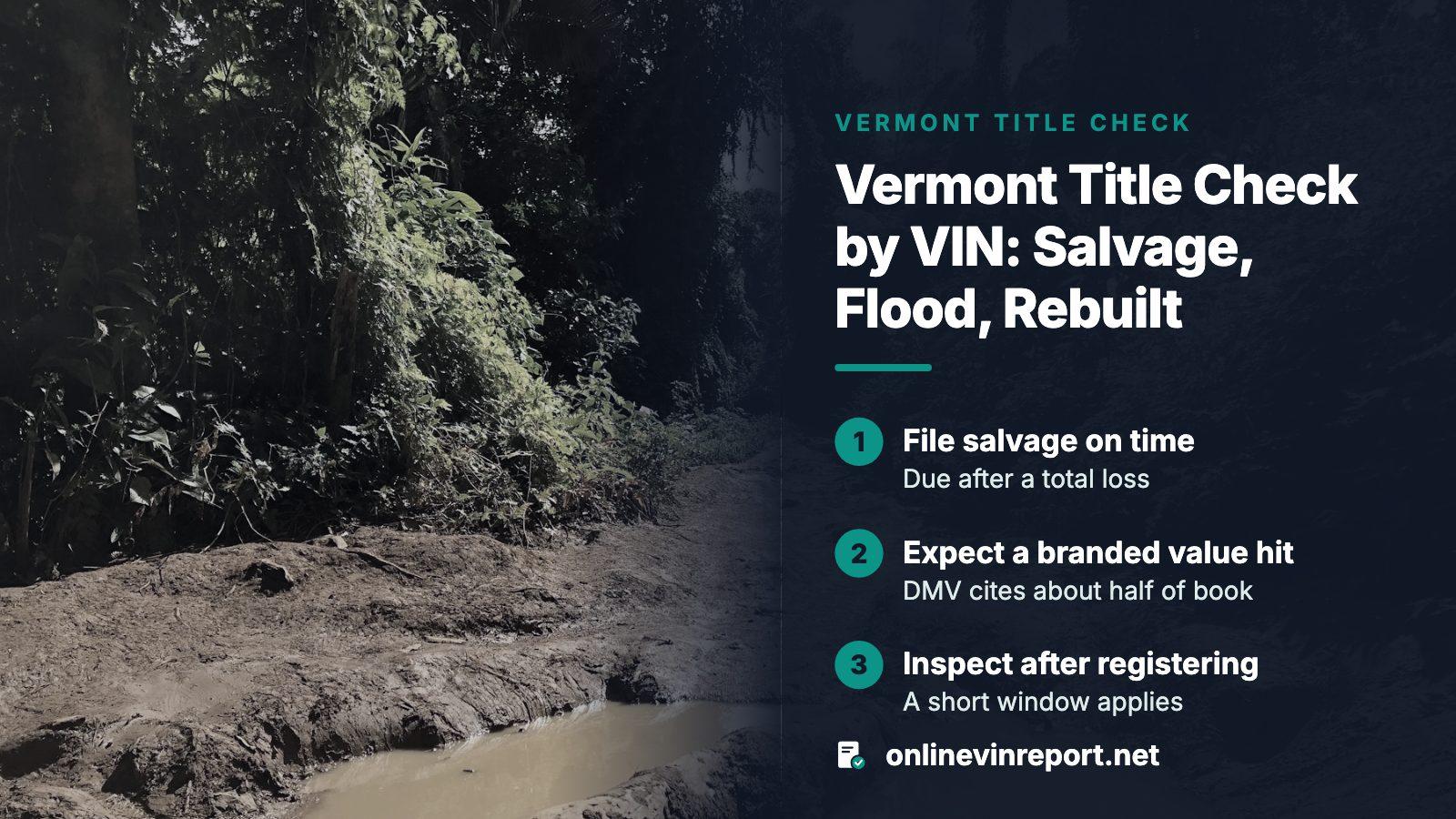
THE SHORT ANSWER
To run a Vermont title check, copy the car's 17-character VIN, put it through an online title check for brands, total-loss entries, the last odometer reading and the title state, then compare the result with the seller's paper. Vermont sellers must disclose a salvage, rebuilt or totaled history in writing. A brand that shows online but not on the paperwork is your cue to stop and ask questions.
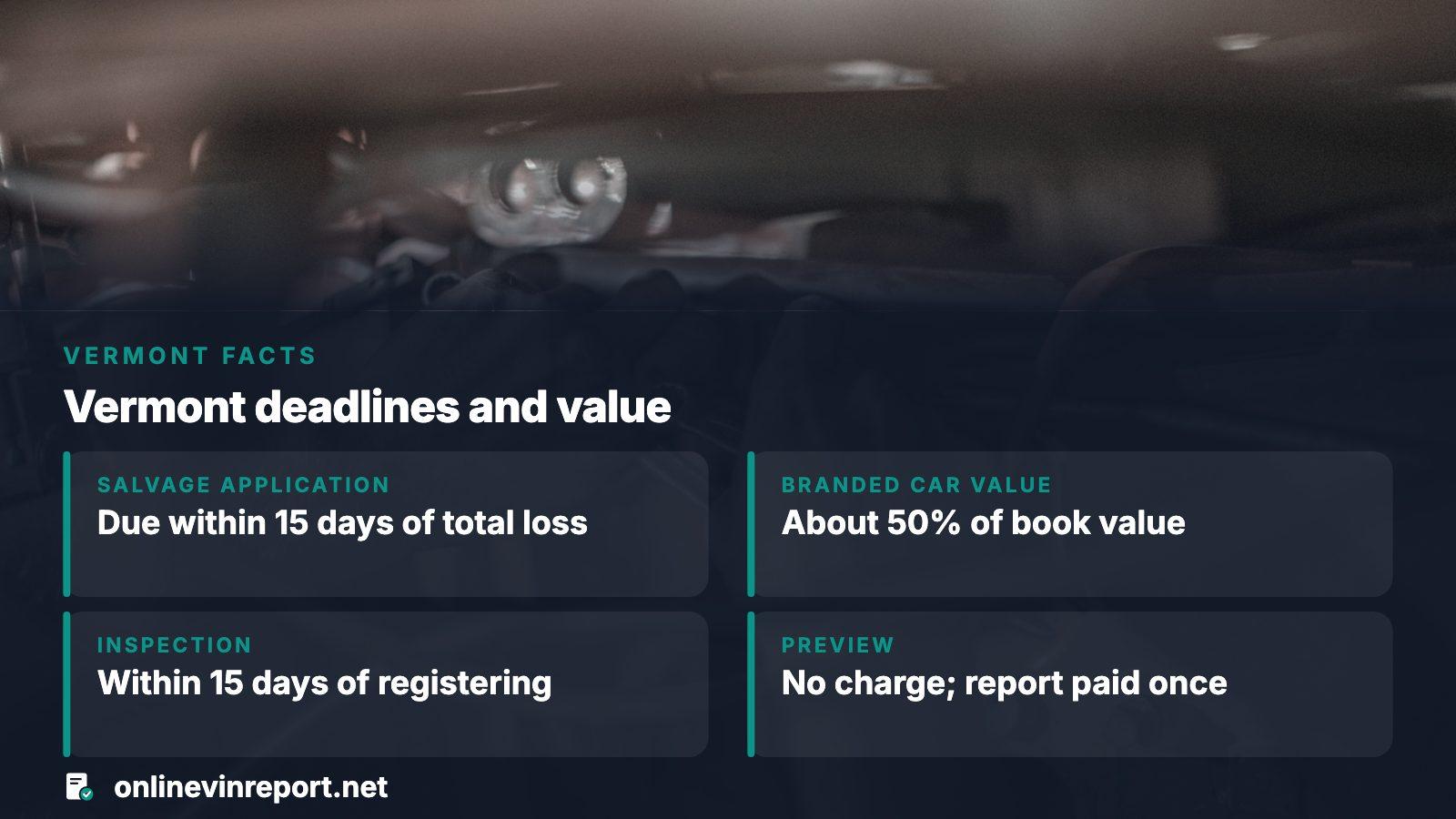
- Salvage application
- Due within 15 days of a total loss
- Branded car value
- About 50% of book value, per the DMV
- Inspection after registering
- Within 15 days
- Preview
- No charge; the report is paid once
What an online title check pulls up on a Vermont car
Think of the result as a brand ledger. It gathers what state titling offices, scrapyards, auto recyclers and insurers have reported about one VIN: any junk, salvage or flood brand, an insurer's total-loss ruling, the latest odometer reading, and a transfer to a salvage yard if one was logged. Vermont's own file is only one contributor.
That matters because a car on Vermont plates may have been titled somewhere else first, and a brand put on by another state remains in the federal file. The paper in the seller's hand shows what Vermont chose to print. The online record shows what every reporting state chose earlier.
It cannot see repairs that never triggered a write-off, or the car's condition today.
Run the check in five steps before you drive over
Order matters here. The car supplies the VIN, the report supplies the history, and the seller's paperwork gets judged last.
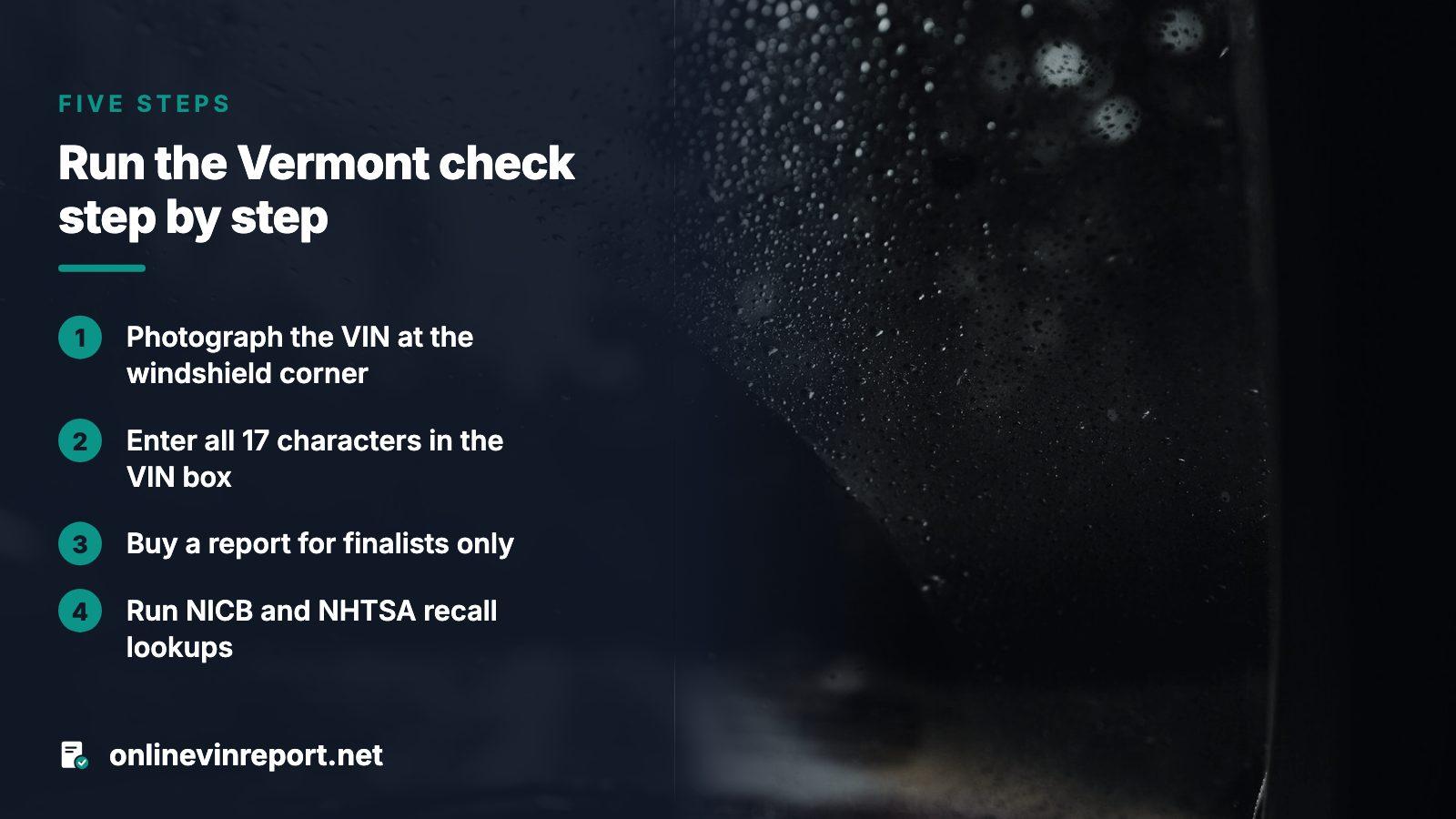
- Take the VIN from the vehicle, at the lower-left windshield corner, and photograph it. The registration card prints it too.
- Enter every one of the 17 characters in the VIN box here. No payment is needed for the preview, so run each car you are weighing.
- Pay for a full report on the finalists only. Read brands and total-loss entries first, the odometer second.
- Run NICB's VINCheck and NHTSA's recall lookup on the same VIN. Both cost nothing, though NICB allows only five searches a day per IP address.
- Set the printed title beside the screen: owner, VIN, any lender, any brand wording. Book a mechanic before money changes hands.
The brand words Vermont uses, and what each should make you ask
The DMV's buying advice names salvaged, rebuilt, totaled, flooded and reconstructed as brands that drag a car's worth down, to roughly half of book value. Here is how the common ones arise.
| Wording | How it arises in Vermont | What to ask for |
|---|---|---|
| Salvage certificate | An application is due within 15 days after a total loss or after someone acquires the car as salvage. Cars more than 15 years old are exempt. | The repair history and the name of whoever did the work |
| Rebuilt | An authorized representative inspects the repaired car before it can be titled or registered: VIN, paperwork for major parts, safety standards. | The inspection report and receipts for major parts |
| Totaled | An insurer declared a total loss. An owner who keeps the car goes through the rebuilt process. | The claim story, checked against the online record |
| True Mileage Unknown | Required wording when the odometer reading cannot be trusted. | The reason, and a lower price |
Vermont's disclosure rule, and why a missing brand is a red flag
Before a sale, a Vermont seller has to tell you, aloud and on paper, if the car was ever salvaged, salvaged-and-rebuilt or totaled. The written notice must appear on the sale paperwork and on the title itself. A seller who skips it may owe you the whole price back, taxes and fees included.
The mismatch that matters
If the report shows a brand and the seller's paperwork says nothing, you have found a disclosure problem before any money moved. Ask for the earlier title and the repair file, or walk away.
Disclosure covers history that the seller knows or that a state recorded, not damage nobody wrote down. The DMV says as much: a clean title does not prove the car never hit anything, because a crashed car may never have been written off, so no brand ever followed it.
Older Vermont cars: the title may not exist, and that can be legal
Vermont does not require a title for a car of model year 2009 or older that is registered in the owner's name. For those cars the registration certificate is the ownership document. The state changed its title law on July 1, 2024 under Act 165, so ask which document this particular seller holds.
The DMV's buying advice also says a sale without a title is illegal, so treat the exception as narrow: confirm the model year, then ask to see the paper. A title said to be sitting at home or with a lender is a warning sign, the DMV adds.
- A title that each listed owner has signed over, or the registration certificate where no title was ever required
- Bills of sale for each later sale, each showing VIN, price, mileage, signature and date
- A lien release for any loan that was ever on the car
- For an out-of-state car with no NMVTIS record, a notarized non-titled-vehicle affidavit (VT-025) plus a VIN verification (VT-010)
Reading each line of the result
No single line settles a purchase. Read them together.
| Line in the result | What it tells you | Your next move |
|---|---|---|
| Salvage, junk or flood brand | Some state applied it, and the federal record keeps it even if a later title leaves it off | Price the car as branded and ask for the repair file |
| Total-loss entry, brand absent | An insurer declared a write-off. Insurers may also apply the label to a theft victim still missing after 30 days, and it sticks even once the car is found | Ask what the claim was for |
| Recent retitle in another state | Brand rules differ, and a brand can be washed by retitling where the old record is not checked | Get the earlier state's title and compare the dates |
| Last reported odometer reading | A reference point for the mileage the seller quotes | If the dash shows fewer miles, ask why |
Liens and the paper title: where the check stops
A title check by VIN describes the car's record. The loan against it is a matter between the owner and a lender, and in Vermont the lender usually holds the paper: when a loan exists, the lender, not the owner, receives the mailed title within three weeks after the registration is processed.
For a used car that already had a title, the DMV wants every lien released before it will title the car in your name. The state's fee list shows $42.00 for a certificate of title and $14.00 for each lien.
Ask for the release in writing
If a lender still holds the title, ask for its lien release before you pay. Vermont uses form VT-008 for releases, and a paid-off loan's release goes in with any replacement title request.
After the result: inspection, odometer paper and cost
Vermont wants a car without a valid inspection sticker inspected within 15 days of registration, and an insurance card has to go with it to the station. If the car wears a sticker, match its make, year and VIN to the vehicle. A model year 2011 or newer needs an odometer disclosure statement with the bill of sale (VT-005).
The preview here costs nothing and shows what the check can find on a VIN. The full report is one payment, nothing recurring. Prices sit on the pricing page.
Where this information comes from
- Vermont DMV: vehicle title — Which cars need no title, the paper trail for used cars, lien handling and the form numbers.
- Vermont DMV: salvage or rebuilt title — The 15-day salvage application, the rebuilt inspection and the seller's disclosure duty.
- Vermont DMV: tips for buying a used vehicle — The value drop on branded cars, the title warning signs and why a clean title is not proof of no crash.
- Vermont DMV: title fees — Title and lien fees, plus the title search charge the page lists without explaining.
- NMVTIS: consumer information — What the federal title record holds, how brands persist and why a search can miss history.
- NICB: VINCheck — What the insurer-backed lookup covers, its daily limit and what it leaves out.
- NHTSA: check for recalls — Where the VIN sits on a car and what the recall lookup does and does not list.
Sources and photos: Facts checked against the sources above in November 2026. Photos by Frederick Rosa, Justin Cron and Nina Mercado on Unsplash; diagrams by OnlineVINReport.
Keep reading
- Title washing: how a brand vanishes and what a VIN title check can showHow a brand can vanish when another state issues a new title.
- Registering a car without a title: what the VIN check shows firstWhat registering a car without a title involves, useful for the older-car case.
- Rebuilt title check by VIN: is the car clean or rebuilt?A closer look at rebuilt brands and how to read them online.
- PricingWhat a single report and a pack cost, paid once with no subscription.
Frequently asked questions
Is there a free Vermont title check by VIN?
Part of one. The preview on this page costs nothing, NICB's VINCheck screens theft, salvage and flood claims from member insurers at no charge, and NHTSA's recall lookup is free too. The full brand history from every reporting state needs a paid report, so use those steps to cut your list first.
Does Vermont issue a salvage title?
Vermont brands a salvage certificate of title for a car that is totaled, scrapped or dismantled, and the application is due within 15 days unless the car is more than 15 years old. After repairs and an inspection, the new title carries the brand rebuilt.
Can the Vermont DMV run a title search for me?
The DMV fee list shows a title search at $27.00, but the page never says who may order one or what it returns, so contact an office before relying on it. When a purchase is close, a VIN-based title check reads the national record instead of one state's file.
Does every Vermont car have a title?
No. A Vermont-registered car of model year 2009 or older, held in its owner's name, needs no title, and the registration certificate proves ownership. Newer cars must be titled. The DMV also suggests getting a title first if the buyer plans to register the car in another state.
If the title check comes back clean, can the car still have been in a crash?
Yes. The DMV says an unbranded title does not rule out a collision, because a crashed car may never have been written off. Reports also depend on states, yards and insurers sending data in. Treat a clean result as a good sign, then pay a certified technician to look at the structure.
Now check the car itself
The guide explains what to look for. The report shows what this VIN has on record.