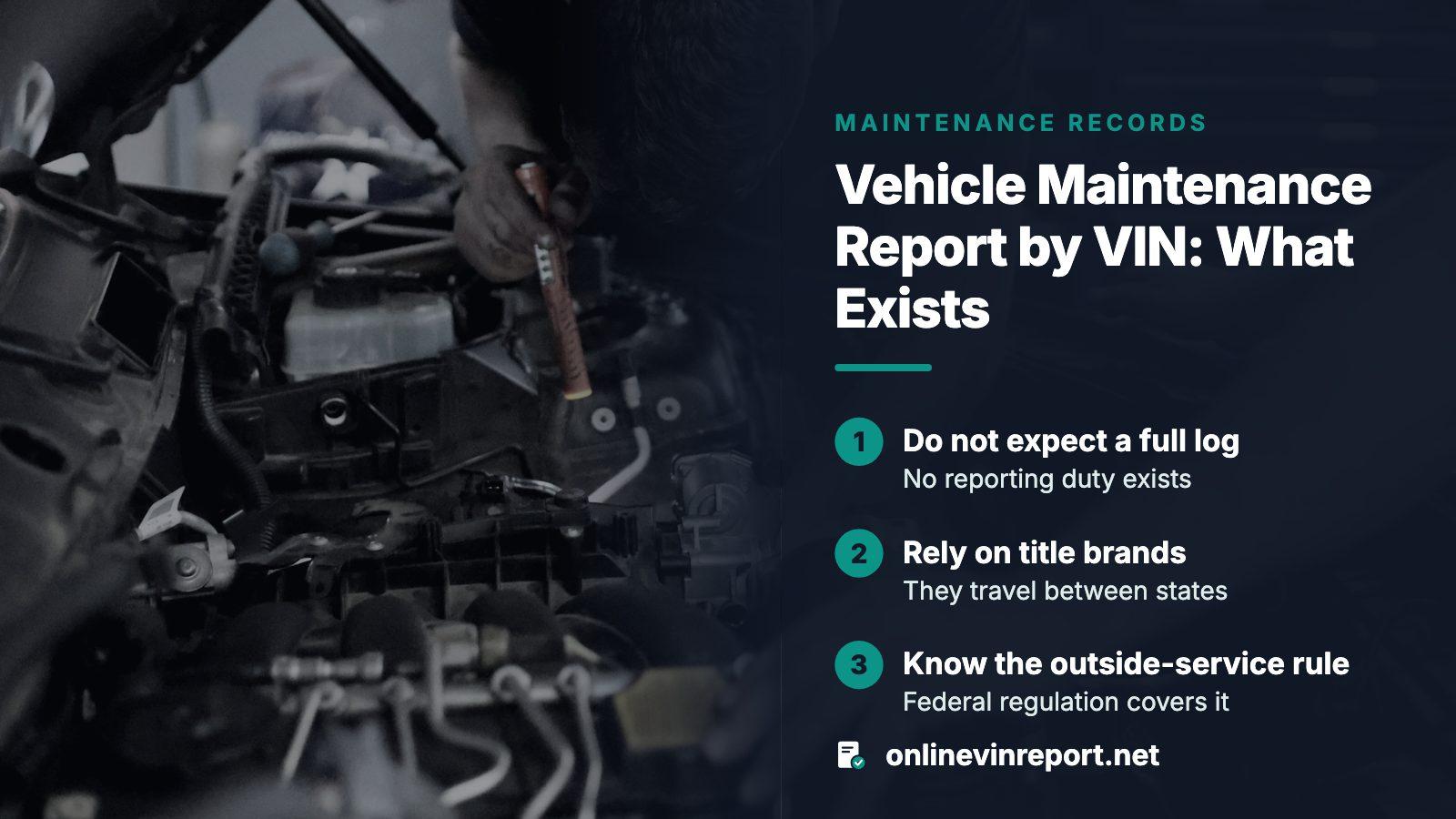
THE SHORT ANSWER
A complete service history cannot be pulled by VIN, since routine maintenance is reported to no national database. A vehicle history report covers only records that exist: title brands, accident and damage entries, odometer readings, salvage and auction history with photos, insurance records and open recalls. The preview is viewable at no charge, and the full report is a one-off payment. Pair it with the seller's receipts to judge how the car was kept.
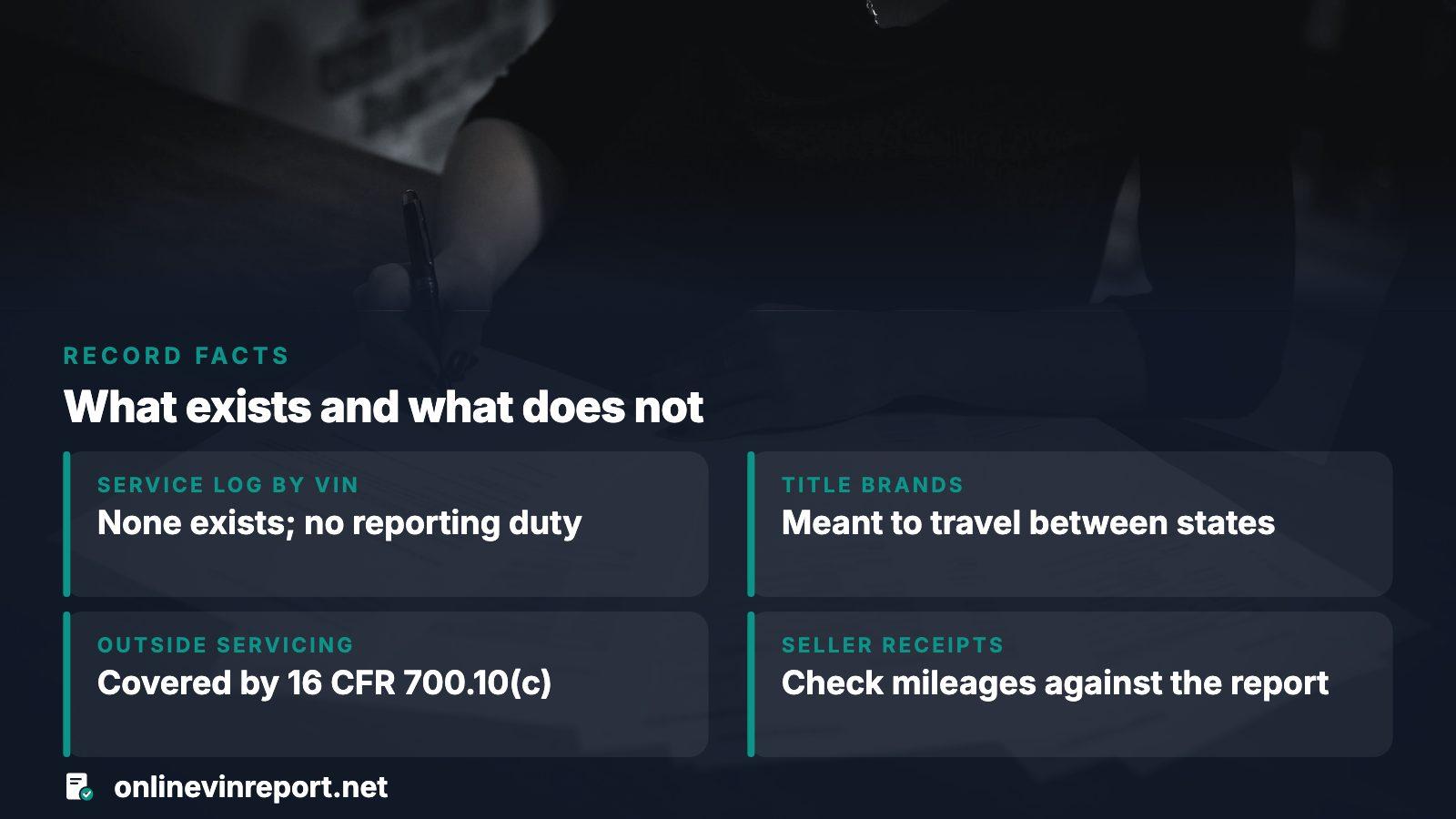
- Full service log by VIN
- None exists; no reporting duty
- Title brands
- Meant to travel between states
- Outside servicing
- Covered by 16 CFR 700.10(c)
Start with the title record, not the oil-change log
Most buyers type this search hoping for a tidy list of every oil change and brake job. That list does not exist for most cars, so the better question is what the car has been through that a seller might leave out. The title record answers that one.
A title brand is the notation a state puts on a title after a car is declared a total loss, flooded, rebuilt or sold for junk. Definitions vary by state. Federal law set up a system to carry brands from one state to the next, so a brand is meant to follow the VIN even after the car is retitled elsewhere. A missing oil-change entry proves nothing. A flood or salvage brand proves a good deal.
Gaps versus brands
A thin service record is a question for the seller. A brand on the title is an answer.
What the VIN report shows about a car's past
The report is built from records that exist because somebody had to file them: a state titling a car, an insurer paying a claim, an auction listing a sale, a regulator logging a recall. Each one says something about how the car was treated.
| Record | What it tells you about upkeep |
|---|---|
| Title brands | Whether salvage, flood, rebuilt or junk status was ever recorded |
| Accident and damage records | Crashes and damage events on file, which hint at repair work |
| Odometer readings | Whether mileage climbs in a believable line over the years |
| Salvage and auction photos | How the car looked on the day it was sold off |
| Insurance, theft, liens and impounds | Claims, thefts and money still owed against the car |
| Open recalls | Safety repairs the manufacturer owes that nobody has done |
It is a record of events, not a pile of shop invoices. Individual oil changes, tire rotations and brake jobs are not listed.
Running the check: where the VIN is and what to enter
Use the VIN on the car itself, never a number typed into an online listing.
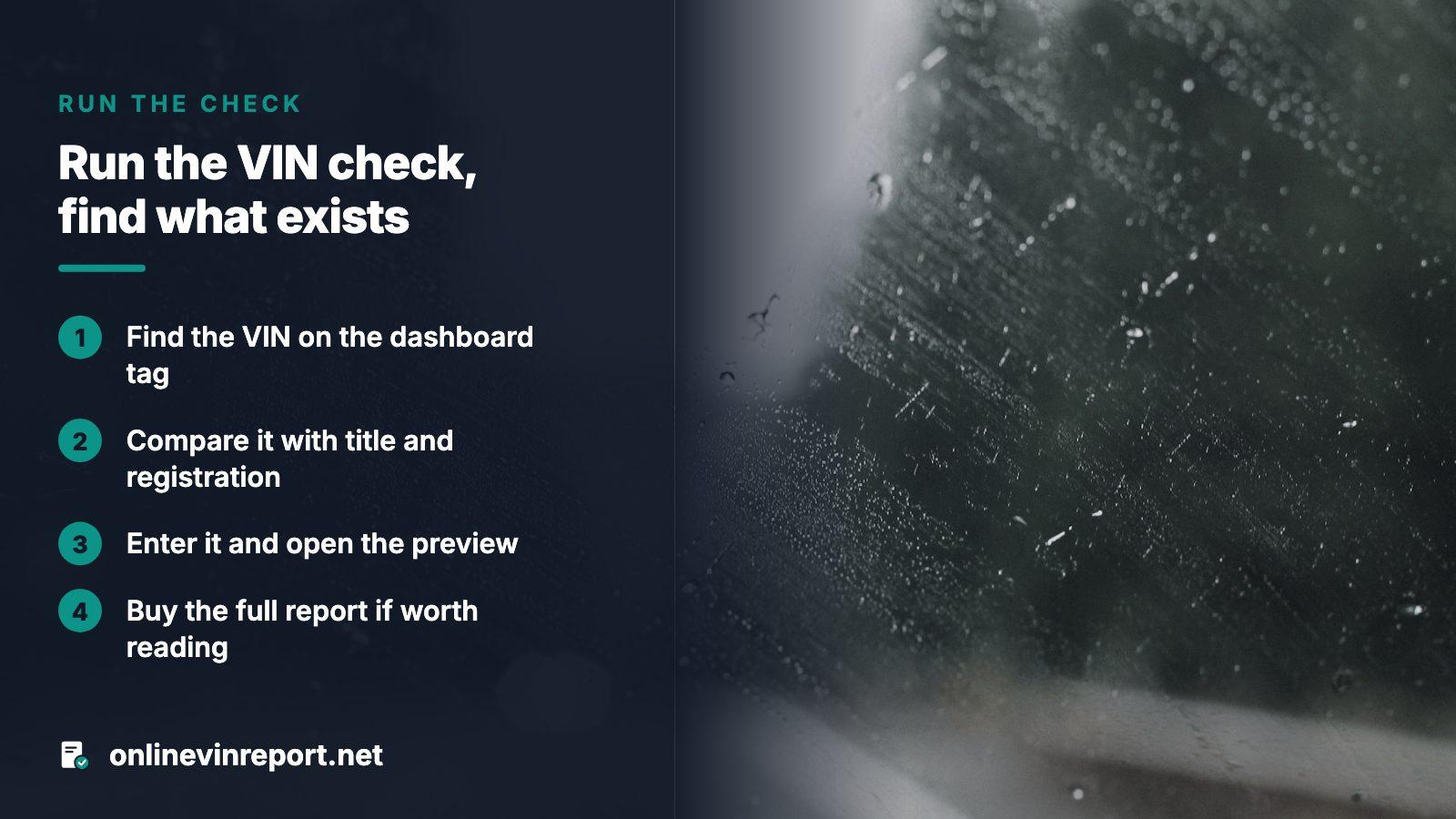
- Find the 17-character VIN on the metal tag at the dashboard corner nearest the driver, readable from outside the car, or on the label inside the driver's door frame.
- Compare it with the VIN on the title and registration. If the two differ by a single character, stop and ask why.
- Enter it in the VIN box on this site and open the preview, which needs no payment.
- If the preview shows records worth reading, buy the full report. Nothing recurs after that single purchase.
Reading the results: brands, mileage and red flags
Read the title section first, then the odometer line, then the rest. These entries should slow a purchase down.
- A brand in any state, even when the seller insists the repairs were done properly.
- An odometer reading lower than an earlier one, or a jump that does not fit the car's age.
- Salvage or auction photos showing damage the seller never mentioned.
- An accident record followed by a clean title and no repair paperwork.
- An open recall, a lien or an impound entry missing from the seller's story.
- A theft record with no sign the car was recovered and cleared.
One entry is a reason to look closer, not a verdict. Brand rules differ by state, so ask the state's motor vehicle agency what a particular brand means.
Why service records stay with the shop
A VIN reaches records that a law or a business model sends to a shared database. Routine servicing has neither. No rule makes a shop report an oil change, no federal system exists to receive one, and a small garage gains nothing by passing its customer files to a data broker.
- Franchised dealers log work in the maker's own system, which they can search by VIN but which cannot see work done elsewhere.
- Service chains keep their own files, usually searchable by the customer's phone number.
- Small shops keep invoices on paper or in local software.
- The owner holds the receipts, and that folder is the only copy that travels with the car.
A thin record is therefore ambiguous: the work may have been done at a shop that never shared it. Recall repairs are the exception, since manufacturers report those campaigns to NHTSA, and the recall lookup there is free.
Checking a seller's receipts against the report
Ask to see the folder, then lay it beside the report. Dates and odometer figures on invoices should climb together and agree with the readings the history lists. A receipt showing a lower mileage than an earlier reading is something the seller has to explain.
Scan for the bigger scheduled jobs as well as oil changes, and confirm the VIN or plate printed on the paperwork matches the car in front of you.
Missing paper is not neglect
No receipts means the paper is missing, not that the work was skipped. It is a reason to inspect the car more carefully and a fair reason to negotiate.
Routine work at an independent shop and the warranty
Buyers often ask whether a car serviced away from the dealer has lost its warranty. Federal law has answered that since 1975, under the Magnuson-Moss Warranty Act.
The FTC's rule at 16 CFR 700.10 says a warrantor cannot make coverage depend on a branded service or part unless it supplies that service or part at no charge. Paragraph (c) covers the case most owners care about: ordinary maintenance is non-warranty work, so the maker cannot require its own network for it.
The limit
A maker can still deny a claim where it can demonstrate that an outside part or service caused the defect. Proving that cause falls on the warrantor, and dated receipts are how an owner answers the charge.
Paid service contracts follow different rules
A written warranty comes with the sale of the car. A service contract is bought separately, and 16 CFR 700.11 treats the two as different instruments. Some breakdown policies are regulated by states as insurance, and the federal warranty statute does not override state insurance law.
The practical result is that a contract you paid for may lawfully ask for proof that the scheduled services were done when due, a condition a written warranty could not impose. If you hold one, keep every dated invoice showing mileage, work and parts, and photograph thermal receipts the day you get them, before the print fades.
Paying for the report and what to do after
Opening the preview is free. The full report can be bought for a single VIN, or as a pack if a few cars are on the table. Nothing recurs, and the pricing page has today's prices.
- Run the preview on the car you are considering.
- Ask the seller for receipts and compare their mileages with the report.
- Check the VIN yourself at NHTSA's recall page, a government tool open to everyone.
- Book and pay for a mechanic's inspection before agreeing on a price.
Where this information comes from
- eCFR: 16 CFR 700.10, prohibited tying — The FTC rule on tying coverage to branded service or parts, and the narrow causation exception.
- eCFR: 16 CFR 700.11, written warranty versus service contract — How the FTC separates a written warranty from a separately sold service contract.
- FTC: Auto warranties and routine maintenance — Consumer guidance on servicing a car and what a dealer may require.
- NHTSA: Recalls lookup by VIN — The public recall record for a specific vehicle, which manufacturers must report.
Sources and photos: Facts checked against the sources above in November 2026. Photos by Mustafa Sheikhmouss, Cole Keister and Dimitri Karastelev on Unsplash; diagrams by OnlineVINReport.
Keep reading
- Car title check online: salvage, flood, rebuilt and junk by VINRun the title check this page puts first and see what each entry means.
- What is a branded title? How to read salvage, flood and rebuilt brands by VINWhat salvage, flood, rebuilt and junk brands mean on a title.
- Flood damaged car: what a title check shows and what it missesWater damage is a title question that no service folder will answer.
- Sample reportSee what a finished report looks like before you buy one.
Frequently asked questions
Can I get a vehicle maintenance report by VIN at no cost?
Not a complete one. The preview on this site costs nothing and the NHTSA recall lookup is free, but no national database holds every oil change and repair. A site advertising a full free service history is usually returning recalls, title data and specs instead.
What shows that a used car was looked after?
Look for steadily rising odometer readings, receipts whose mileage and VIN match the car, scheduled services as well as oil changes, no open recalls and no title brands. Then have an independent mechanic inspect it. No single document proves good upkeep.
Does using a non-dealer shop for oil changes void my warranty?
No. The FTC's rule at 16 CFR 700.10(c) stops a maker from making coverage depend on its own network for ordinary maintenance, unless it supplies the service or parts without charge. It can still deny a claim if it demonstrates that an outside part or service caused the specific defect.
Do I need to keep maintenance receipts if the car has a clean title?
Yes. A clean title says nothing about upkeep. Dated receipts with mileage, work done and parts used support a warranty claim, satisfy a service contract that asks for proof of scheduled maintenance, and give the next buyer something concrete to check.
What happens after I run the free preview?
Buying is optional. If the preview points to records worth reading, you pay once for that VIN's full report, or once for a pack if you have several cars to check. Nothing renews, and no later charge follows. The pricing page shows current amounts.
Now check the car itself
The guide explains what to look for. The report shows what this VIN has on record.