THE SHORT ANSWER
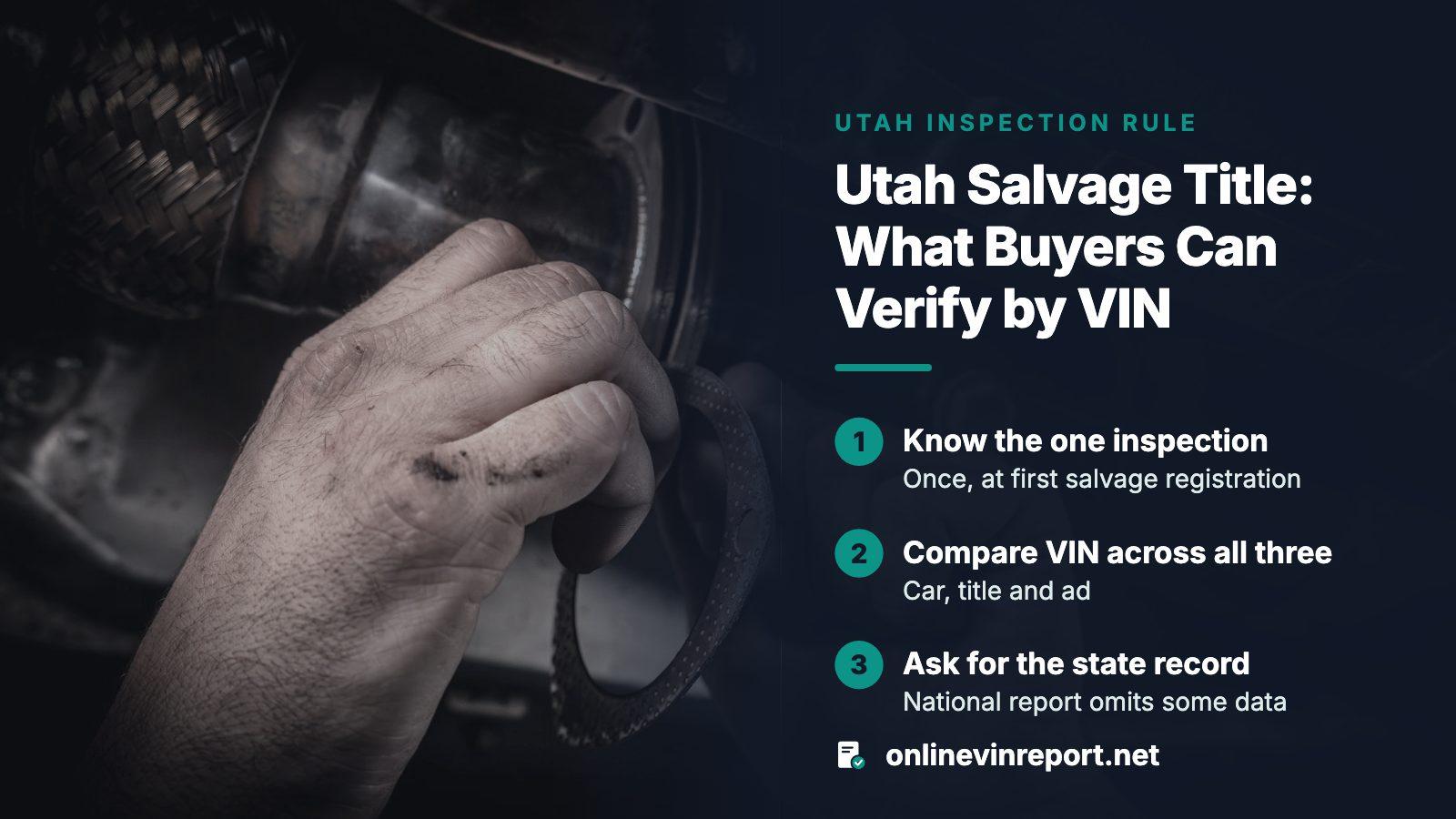
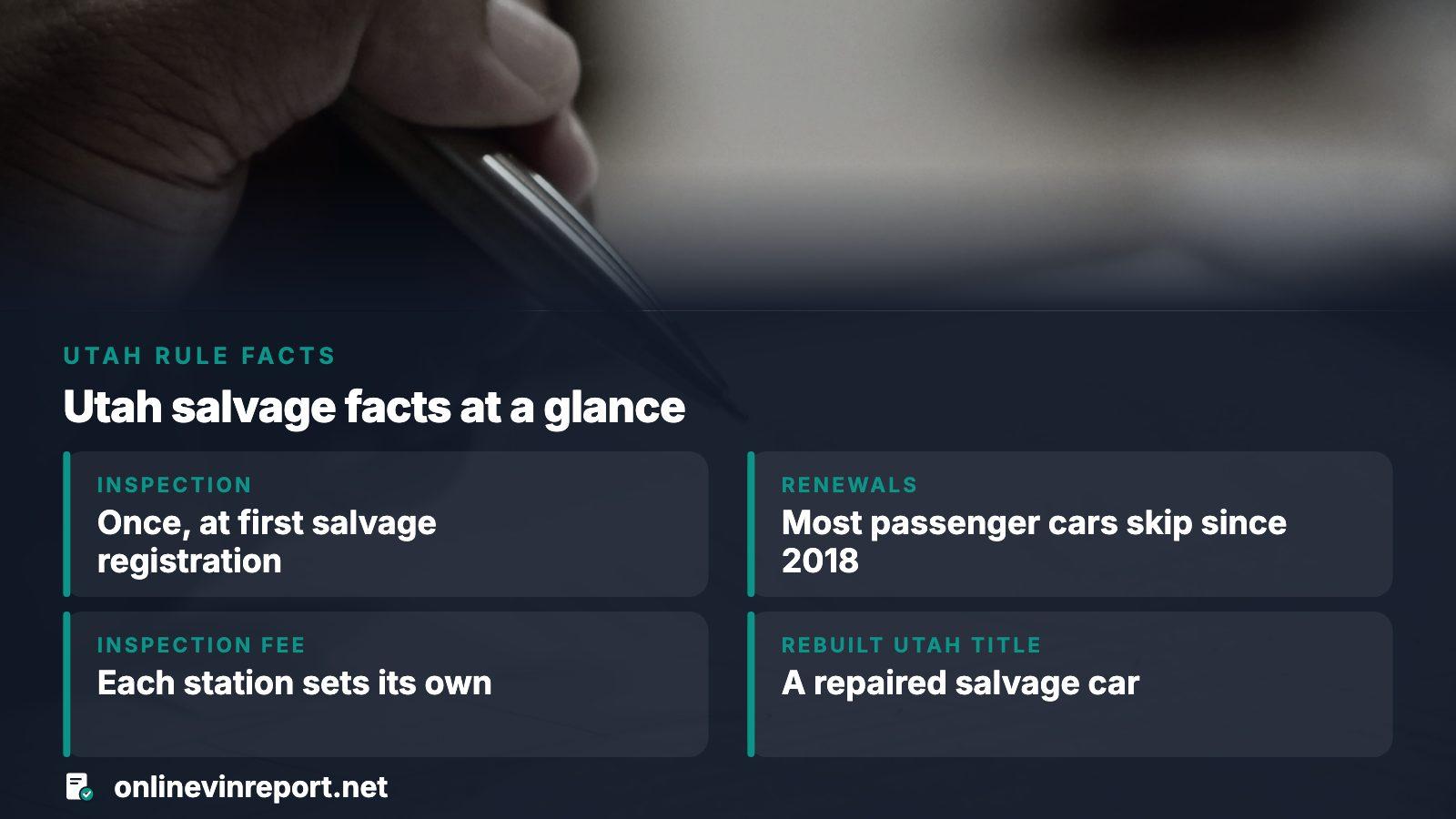
Utah requires a salvage vehicle to pass a safety inspection once, the first time it is registered as salvage. Whether a damaged car got a brand at all depends on state rules, and a rebuilt Utah title is simply a salvage car that was repaired. The surest buyer step is a VIN title check, then the state's own record and an independent mechanic.
- Inspection
- Safety inspection once, at first salvage registration
- Renewals
- Most passenger cars skip inspection since 2018
- Inspection fee
- Each station sets its own since May 6, 2026
- Preview
- Free to view; the full report is bought separately
What a Utah salvage brand tells you
A salvage brand is a flag on the title record: at some point the car took a hit serious enough to be written off. For you as the buyer, that one flag moves the price and raises the question of safety. A branded car can be fixed well. It can also be fixed badly by someone who knew nobody would look.
Utah buyers meet the brand in two forms. The first is the salvage title itself, held by a car that has not yet been repaired or has not yet been put back on the road. The second is the rebuilt title that follows once the car is fixed, inspected and registered. Both words appear in search results, and both describe one history at different moments.
This page sticks to what could be confirmed from official pages that opened. Utah's motor vehicle division site refused automated reading, so its dollar threshold for branding and its fee table are not quoted here. Check those two items with the division itself.
The one inspection Utah singles out
The Utah Highway Patrol lists salvage vehicles among the few categories that still need a safety inspection. The rule is narrow: the car must pass the first time it is registered as a salvage vehicle, and not again for that purpose. Since 2018, most ordinary passenger cars no longer need an inspection to renew their plates, so a salvage car is an exception to a mostly relaxed system.
Notice what the inspection is. It is a safety check of equipment, done at a licensed station. It does not audit repairs or the damage that came before. A passing result says the car met the standard on that day.
Ask for the fee up front
Under House Bill 192, passed in the 2026 session, the fee cap on safety inspections ended on May 6, 2026. Each station now sets a reasonable price, so ask what the station charges before the car goes on the lift.
Why the same wreck can read differently in another state
Washington's national title system, which the Justice Department oversees, leaves each state's rules as they are. A wreck in one state may be branded salvage there, while a neighboring state may leave the title clean because the repair estimate fell short of its own dollar or value test. Water damage works the same way: some states have a flood brand and some have no such label at all.
That matters in Utah because cars move. A truck bought at auction in another region and titled here arrives with whatever record the earlier state created. The national system keeps every brand any reporting state applied, so moving a car does not erase the entry the way a paper title sometimes does. This is why a title check by VIN beats reading the paper in your hand.
- A clean Utah title does not prove a clean history.
- A brand from another state can still be visible in the national record.
- An insurer's total-loss entry can exist even when no state applied a brand.
Reading a title check result
The national title report is kept short on purpose, with five indicators: the last title issued, its state and date, brands, mileage, insurer total losses and salvage yard entries. Justice Department staff call a clean result a good thing, and that is fair. A short report means fewer surprises.
Read it with its limits in mind. The database holds about 87 percent of the vehicle population, yet reporting is not universal across states. Its salvage and total-loss holdings number around 20 million entries. The department itself cautions about false negatives, where a search reports no salvage history only because a record never reached the system.
| Result line | What it suggests | Your next move |
|---|---|---|
| Salvage brand present | Written off or damaged beyond the state's test | Request repair paperwork and a mechanic's opinion |
| Total loss, no brand | Insurer wrote it off; the state may not have branded it | Ask the seller why, and read the damage and photo records |
| Brand from another state | Earlier state applied it; this one may not show it | Confirm with the Utah record before buying |
| Clean across the board | No reported record | Still inspect it; gaps in reporting exist |
A total loss that was not a wreck
Not every total-loss entry means a crushed car. The Justice Department points to stolen cars: an insurer can book one as a total loss when 30 days pass without a recovery. Should it surface later undamaged, the entry remains, and the car may go to auction running perfectly well.
So a total-loss entry deserves a question rather than an automatic walk-away. Ask what the damage record and photos show. If the file shows hail dents or a theft recovery, the price conversation is different from one about a frame repair. A seller with no answer has told you something.
The reverse also holds. A car that spent time in a salvage yard does not automatically carry a state brand, because state laws vary on when a brand is applied. The presence or absence of one word is a clue, not a verdict.
Run the title check before you drive out
Find the VIN stamped on the car, then read the same string on the title. Feed it to the title check. The no-cost preview signals whether brand or damage entries exist. Going further means buying one report, with no recurring charge, as laid out on the pricing page.
If a record turns up, open the salvage and auction section for photos and the odometer history for jumps. If the record is clean but the price is far under market, that gap alone is worth an explanation from the seller.
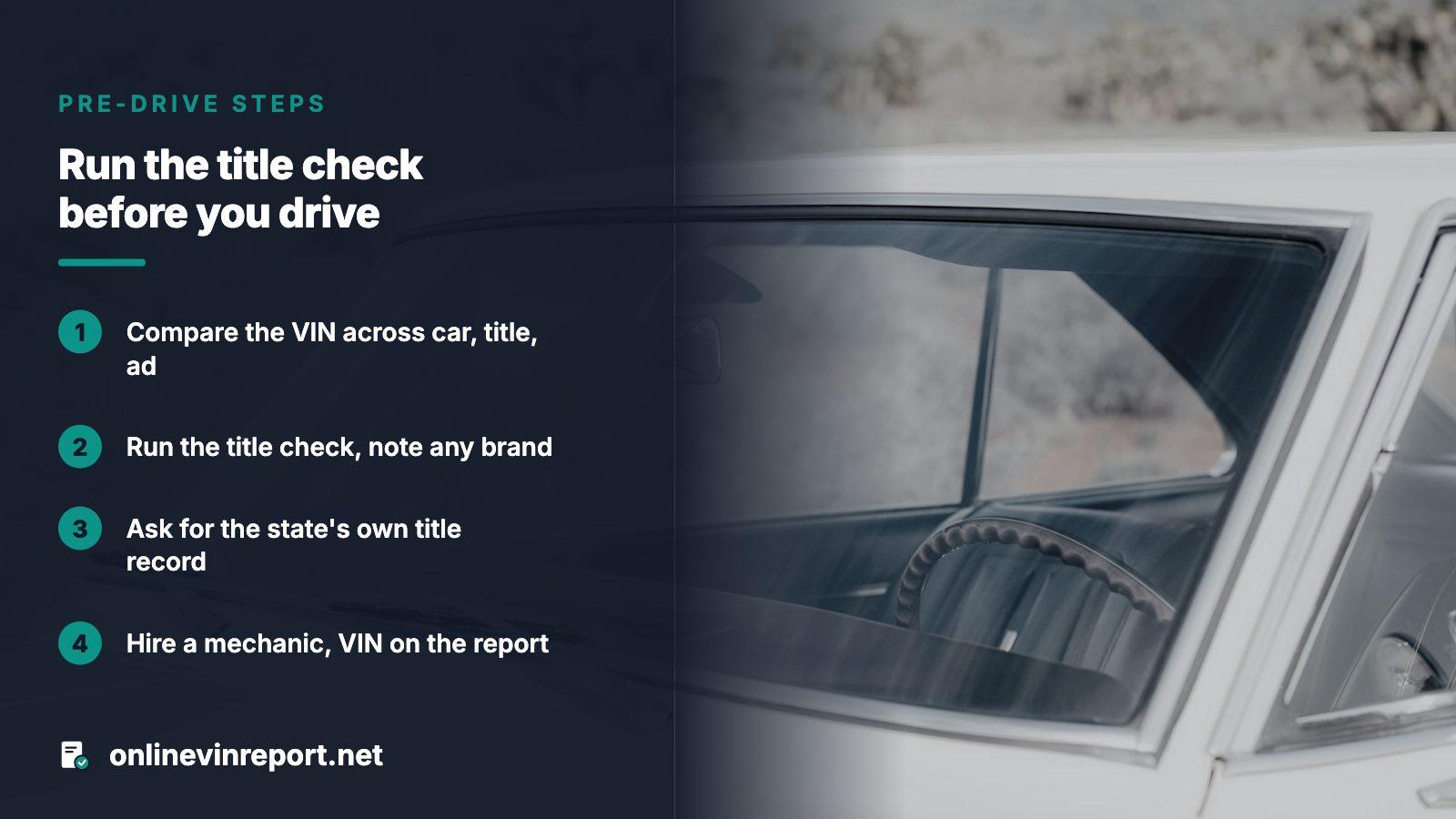
- Compare the VIN across car, title and ad.
- Run the title check and write down any brand, total-loss or salvage entry.
- Ask for the state's own title record, because the national report leaves out part of the file.
- Hire an independent mechanic, and make sure the written report lists the VIN.
Impound records and paperwork gaps
Utah runs an impound lookup through the State Tax Commission that accepts a VIN, a plate or a state impound form number. It exists so owners can find a towed car, not so buyers can vet one, but it shows how the state records a vehicle that sits in a yard. A state impound release needs a motor vehicle office visit and a Letter of Impound Release before the yard will hand the car over.
For a buyer, the lesson is about paperwork. Treat a murky story with suspicion: a gap in title dates, or no title in the seller's hands. Towing and storage charges fall outside the Tax Commission's reach, so a dispute over them goes somewhere else.
What to do with a branded Utah car
If the check shows a brand and you still like the car, treat the price as the main lever. A branded car should sell below an equivalent clean one, and the repair record decides how far. Ask for receipts, before-and-after photos and the name of the shop.
Get the mechanic's written estimate and the inspection result in hand before you sign. Call your insurer and your lender first, as each handles branded cars its own way. A seller who refuses a mechanic's visit has answered your question.
Where this information comes from
- Utah Highway Patrol: owner safety inspection page — salvage inspection rule, 2018 change and the 2026 fee change
- US Department of Justice: NMVTIS for consumers — brands, state differences, coverage limits and total-loss caveat
- US Department of Justice: used car buying tips for NMVTIS — what to do before purchase: inspect, check history
- Utah State Tax Commission: Impound Vehicle Service — how the state's impound lookup and release steps work
Sources and photos: Facts checked against the sources above in November 2026. Photos by Martin Fennema, Wesley Tingey and Masjid MABA on Unsplash; diagrams by OnlineVINReport.
Keep reading
- Salvage title VIN check: run it online before you paySee what a salvage entry looks like once a report is run.
- What is a rebuilt title? What it means and what a VIN title check showsThe rebuilt label explained for any state.
- Total loss threshold by state and what it means for a VIN title checkWhere each state sets the cutoff for a write-off.
- Rebuilt title inspection: what the state checks and what a VIN title check addsWhat a post-repair inspection checks and skips.
Frequently asked questions
Does a Utah salvage car need an inspection?
Yes. The Utah Highway Patrol says a salvage vehicle must pass a safety inspection the first time it is registered as salvage. After that first registration the rule does not repeat for that purpose, and most passenger cars skip inspection at renewal.
Is a rebuilt title in Utah the same as salvage?
They describe the same car at different stages. Salvage points to the write-off, while rebuilt points to the car after repair and inspection. This page could not confirm Utah's exact rebuilt steps, so check them with the state division.
Can a Utah car have damage with no salvage brand?
Yes. States differ on the damage level that triggers a brand, so a repaired car may carry a clean title. A VIN check can still show an insurer total-loss entry or auction photos that the paper title leaves out.
Does a VIN check always catch a salvage history?
No. The national database covers most vehicles but not every state reports, and the Justice Department warns of false negatives. A clean result is good news; inspect the car and ask for the state record anyway.
How much does a Utah safety inspection cost?
It varies. Utah removed the fee cap in the 2026 session, effective May 6, 2026, so each station sets its own price. Ask the station for the amount before the work starts, and compare two stations if you can.
Now check the car itself
The guide explains what to look for. The report shows what this VIN has on record.