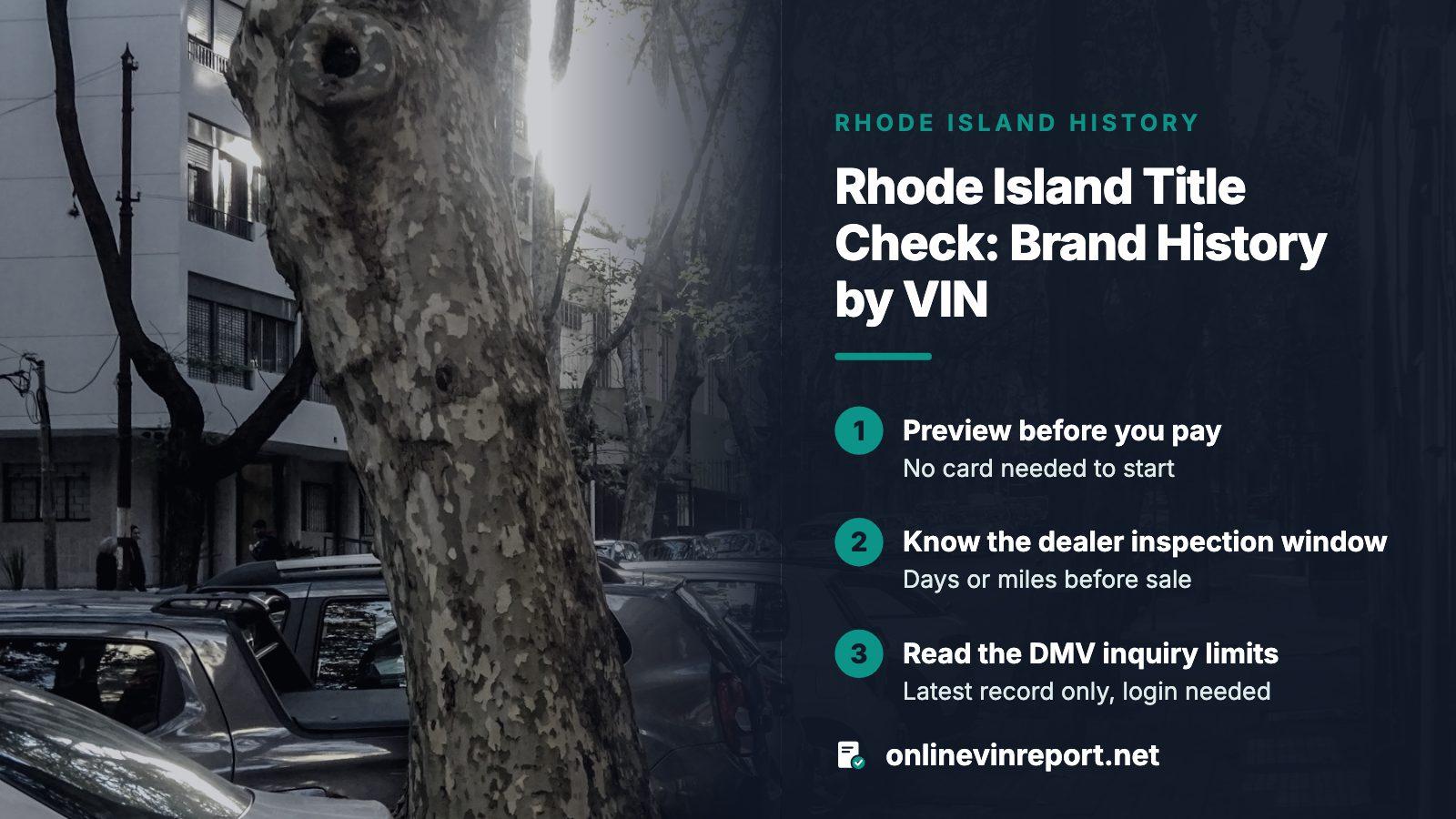
THE SHORT ANSWER
For a Rhode Island title search, copy the VIN from the car, run it through an online title check for brand history, total-loss and salvage entries, odometer readings and the latest title state, then hold the result against the seller's paperwork. If anything stays unexplained, ask the Rhode Island DMV for its record, and book a mechanic before any money moves.
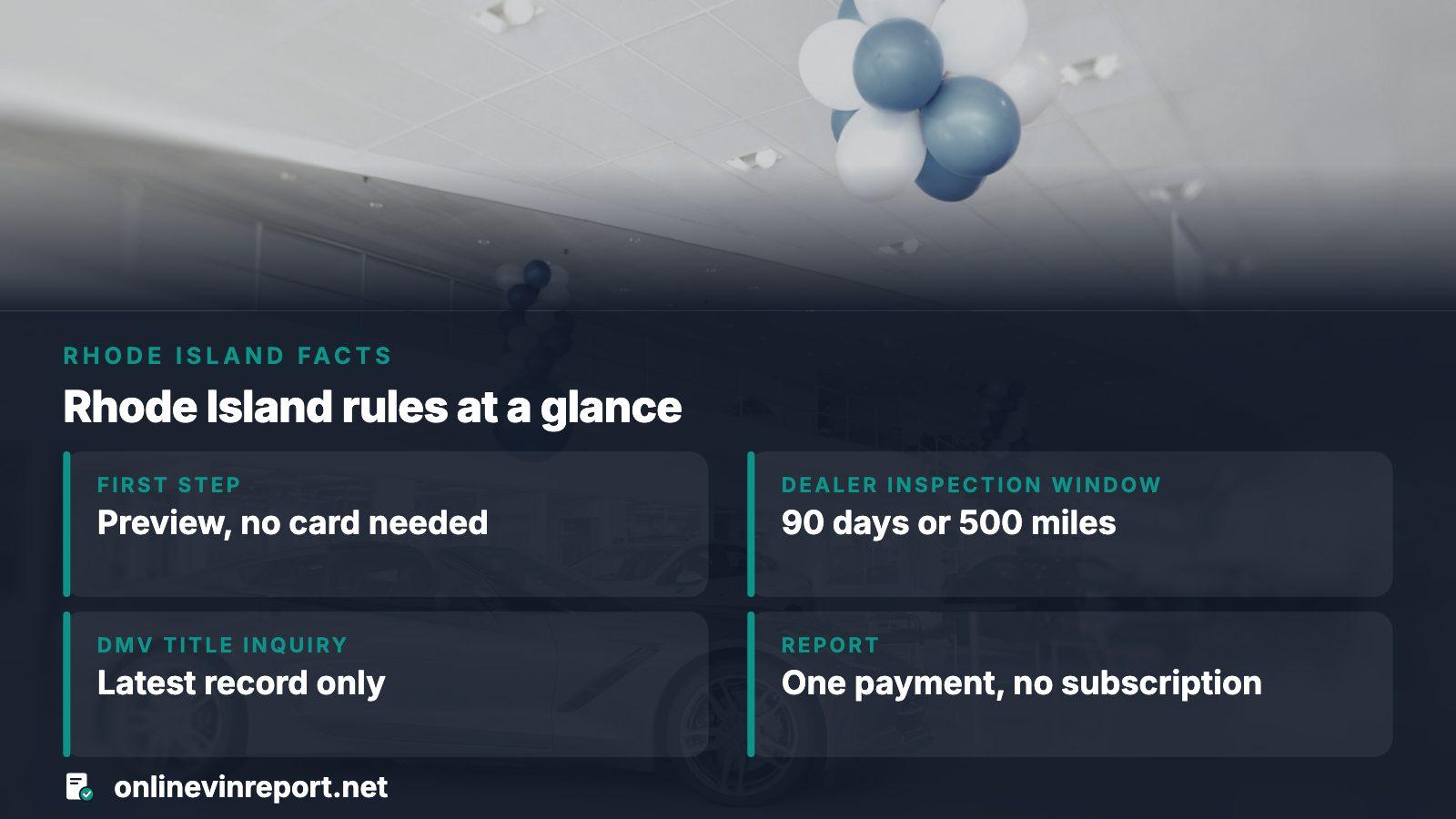
- First step
- Preview, no card needed
- Dealer inspection window
- 90 days or 500 miles before sale
- DMV title inquiry
- Latest record only, RI.gov login
- Report
- One payment, no subscription
Where a Rhode Island title search actually happens
No single office shows a car's whole title story. Each lookup below reads a different record, and the records disagree often enough that running more than one is cheap protection.
| Check | What it reads | What it can miss |
|---|---|---|
| Online title check by VIN | Brands from any reporting state, total-loss and salvage entries, odometer readings, latest title state | Repairs; any state, yard or insurer that never reported |
| Rhode Island DMV title inquiry | The latest title record the DMV holds, searched by VIN or by plate number and type | Earlier records; it needs an RI.gov subscriber login and carries a fee |
| NICB VINCheck | Flood damage, a theft never recovered, a salvage declaration | Anything outside those three flags |
| Seller's paperwork | Owner name, VIN, brand wording, odometer line, lender | Whatever the seller leaves unwritten |
| Independent mechanic | The car as it stands today | Brands, liens, anything on paper |
The check in order, from the car to the counter
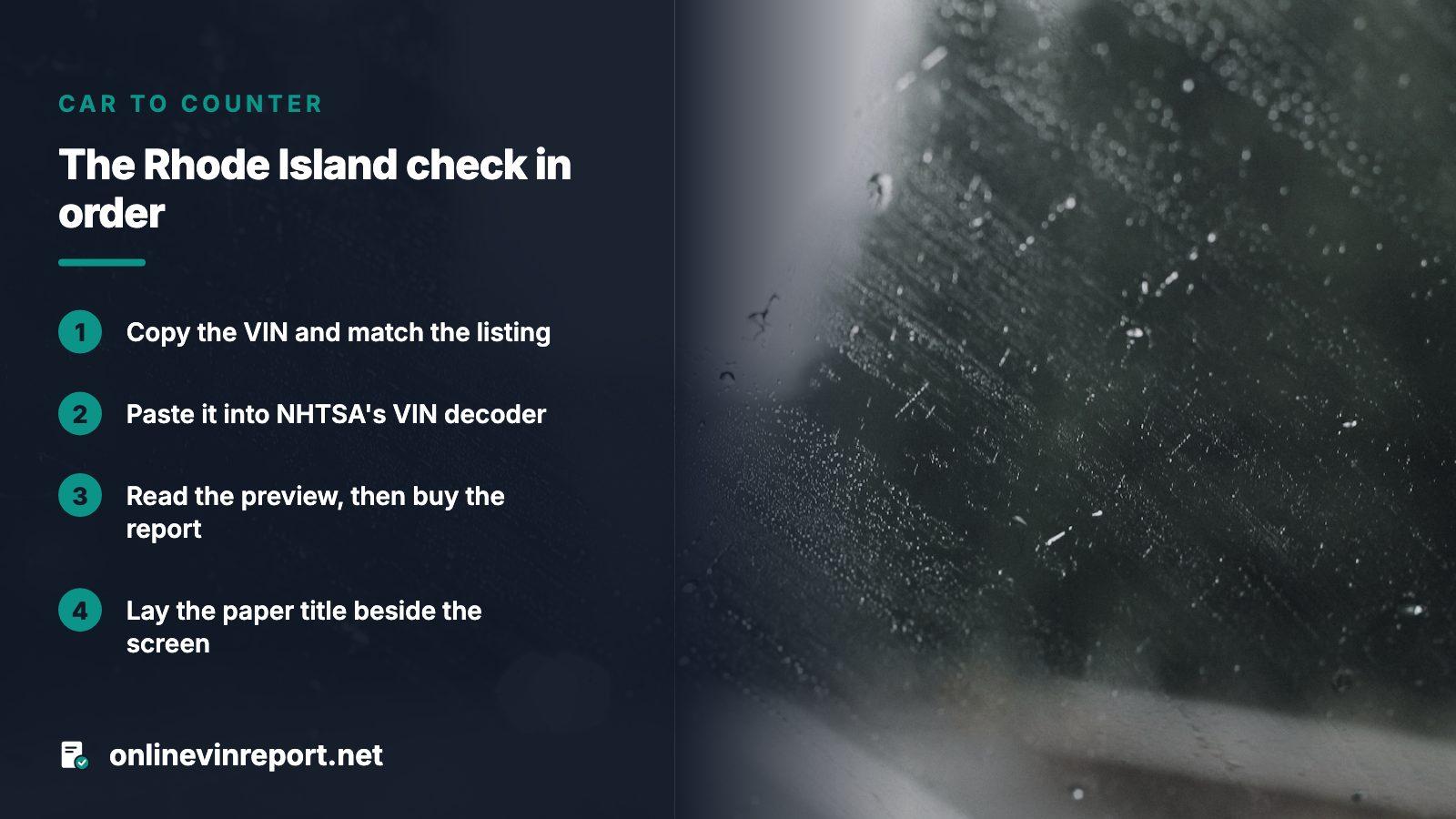
- Copy the VIN off the vehicle itself and hold it against the listing and the seller's title. One wrong character is reason enough to stop.
- Paste it into NHTSA's VIN decoder. Make, model year and build plant should match the advert; the manufacturer supplies that data.
- Key the VIN into the search field on this page and read the preview that comes back. Doing that for every candidate costs you nothing.
- Pay for the full report on the survivors only. Read the brand history first, then the total-loss and salvage lines, then the odometer readings and the latest title state.
- Add NICB's VINCheck and NHTSA's open-recall listing, both of which search by VIN.
- Lay the paper title beside the screen. Names, VIN, brand wording and any lender must agree.
- Hire a mechanic. The FTC says a history report does not replace an independent inspection.
Reading the brand lines on a Rhode Island car
Each state writes its own brand terms and damage thresholds, so one wreck can be branded salvage in one state and carry nothing in the next. A brand that a state has applied remains in the federal database permanently. That is why an online title check can show more than a paper title issued after a move.
| On the report | What it tells you | Your move |
|---|---|---|
| Salvage, junk or flood brand | A state applied that label; it stays on record whatever the paper title says | Price the car as branded; ask for repair invoices |
| Total loss, no brand | An insurer wrote the car off, yet no state may have branded it; an unrecovered theft can cause the same entry | Ask what happened; get it inspected |
| Rebuilt or restored history | Repairs followed damage; Rhode Island's dealer rules single out salvaged and restored cars for written disclosure | Ask for photographs of the work |
| Title state changed lately | An innocent move, or how a brand got left behind | Ask why; request the earlier title |
| No entries | A good sign, though reporting is incomplete | Inspect anyway |
The state's own copy: Rhode Island's title inquiry
The DMV offers an online title inquiry through RI.gov. It is open to RI.gov subscribers, takes a full VIN or a plate number and type, and returns the latest title record on file. For anything older, the page sends people to the DMV's title division.
That page lists $54.50 per search, of which $50 is a statutory title-search fee. It also carries a note about a fee change, so confirm the amount before relying on it.
The program's state page lists Rhode Island among the states that took federal money to meet its requirements in fiscal years 2007 through 2010, though it does not say who reports today. Rhode Island sets its own brand terms in state law, which this page does not quote, so ask the DMV what a title's label means for that car.
When the state record earns its fee
Use it on an older car, one just titled in Rhode Island, or any car where the report and the paper title disagree. The federal program encourages buyers to see the state record, since its data do not hold everything a state keeps.
What Rhode Island dealers must put in writing
Licensed dealers answer to DMV rules filed in the state code of regulations. Several bear directly on title questions.
- Salvaged and restored cars, plus others with heavy damage as the Department decides, must be named in writing on the bill of sale in each dealer-to-dealer sale up to the first retail buyer.
- The bill of sale shows the odometer reading and the warranty given, or states that none is given.
- A used car sold at retail needs a fresh inspection, done within 90 days before the sale or within 500 odometer miles, whichever is reached first.
- Title passes at the sale, or within 20 days when the dealer does the registering. The dealer must keep your signed receipt; without one, the rule presumes you never got the title.
- A title preparation fee must be itemized on the bill of sale and cannot top $20.
Buying from a private seller?
These rules cover licensed dealers. This page does not cover the DMV's private-sale steps, so ask the DMV which papers it wants before you hand over money.
Handover checklist for the paper title
- The seller's name matches the owner named on the title.
- The VIN on the title, the car and the report agree character for character.
- Any brand printed on the title agrees with the report. A report showing one that the title omits is a warning.
- If a lender is listed, get its written release before you pay.
- The odometer line holds a reading that fits the readings in the report.
- Do not pay anyone for the plates. Rhode Island DMV policy bars exchanging money for a plate transfer and treats a breach as grounds to suspend and revoke the plates.
- Keep a signed bill of sale showing date, price and odometer reading.
After the preview: payment and next moves
The preview is not billed. Should a car deserve closer scrutiny, one purchase covers its complete report, and shoppers juggling several candidates can buy reports in batches of three, five or ten. Nothing recurs on your card afterward, and the pricing page lists the amounts.
- Clean report and clean paperwork: book the inspection, then finish the sale.
- A brand you can live with: price the car as branded and collect the repair records.
- An unexplained brand, odometer gap or lender: pause until the seller answers in writing, or walk away.
Where this information comes from
- RI.gov: Vehicle Title Inquiry — What the DMV's online inquiry searches by, what it returns and the fee it lists.
- Rhode Island Code of Regulations: dealer, manufacturer and rental licenses — Dealer bill of sale, inspection, title delivery and salvaged-vehicle disclosure rules.
- Rhode Island Code of Regulations: transfer of registration plates — The DMV policy against exchanging money for a plate transfer.
- NMVTIS: consumer information — What brands are, where the federal data comes from and why a clean search can still miss something.
- NMVTIS: understanding a vehicle history report — The indicators a federal title report covers and what it leaves out.
- NMVTIS: states — What states must report and the list that includes Rhode Island.
- FTC: used cars — History reports, NICB's VIN screen, recall listings and the case for an independent inspection.
Sources and photos: Facts checked against the sources above in November 2026. Photos by Nikolai Kolosov, Cole Keister and Richard R on Unsplash; diagrams by OnlineVINReport.
Keep reading
- What is a branded title? How to read salvage, flood and rebuilt brands by VINWhat salvage, flood, rebuilt and junk brands mean on a title.
- Title washing: how a brand vanishes and what a VIN title check can showHow a brand disappears from a paper title when a car changes states.
- Check title and lien by VIN: brands first, then who holds a claimMaking sure a loan is closed before the title changes hands.
- PricingReport options, pack sizes and the single payment, with no subscription.
Frequently asked questions
Is there a free Rhode Island title check by VIN?
Parts of it are. NICB's VINCheck covers three things: flood damage, a theft never recovered, and a salvage declaration. NHTSA lists open recalls by VIN at no charge. The preview on this page is free too, while the full brand-history report is a one-time payment. The DMV's own title inquiry needs an RI.gov subscriber login and lists a fee.
Can I do a Rhode Island title search by license plate?
The DMV's title inquiry accepts a plate number and plate type as an alternative to a VIN, once you hold an RI.gov subscriber login. The report on this site starts from the VIN, so copy it from the car. The VIN follows a vehicle through every owner, while plates can change, which makes it the steadier key for a purchase decision.
Does a clean title in Rhode Island rule out past accident damage?
No. A federal title search reports brands, total-loss and salvage entries, odometer readings and title data, but not every state and yard reports, and a repair paid for out of pocket may leave nothing behind. Treat a clean result as a good sign, then pay a mechanic to look underneath.
What should I ask a Rhode Island dealer to put in writing?
Ask for a bill of sale that shows the odometer reading and any warranty, and for the inspection date on a used car. If the car was salvaged or restored, the rules call for that to be named in writing between dealers up to the first retail buyer, so ask whether it applies. Expect to sign a receipt for the title.
What if the report and the DMV record disagree?
Do not pick a winner by guesswork. The federal program says its data do not hold everything a state keeps, so the DMV copy can hold detail the report lacks, while the report can carry brands from other states. Ask the seller to explain the gap in writing, and pause the sale until it is explained.
Now check the car itself
The guide explains what to look for. The report shows what this VIN has on record.