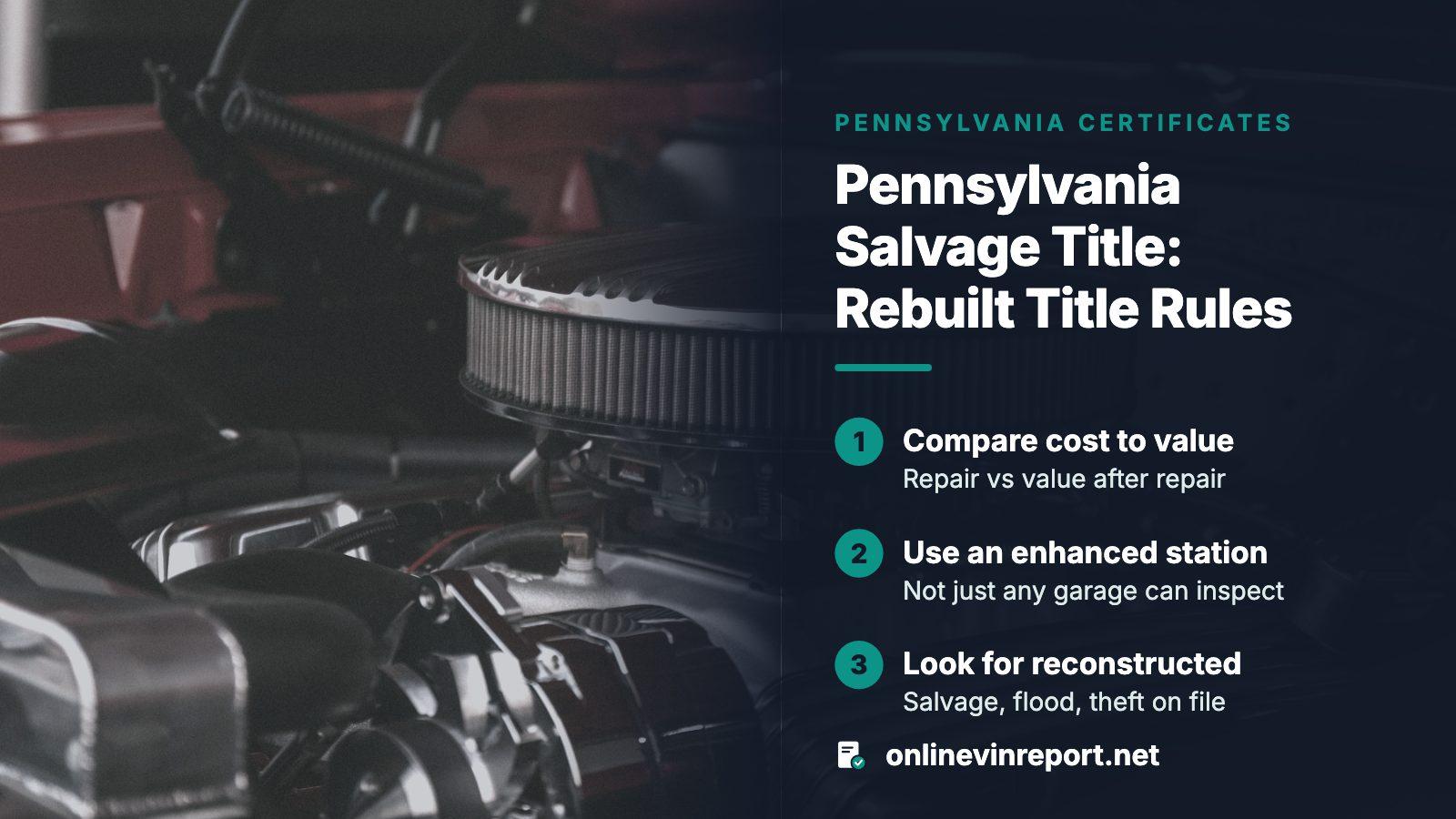
THE SHORT ANSWER
In Pennsylvania a car is salvage when the cost to repair it would exceed its value after repair. The owner holds a certificate of salvage until the car is restored and passes an enhanced safety inspection, then applies for a reconstructed title. Searching the VIN in title records shows whether a salvage, flood, theft or reconstructed brand is on file, whatever the seller says.
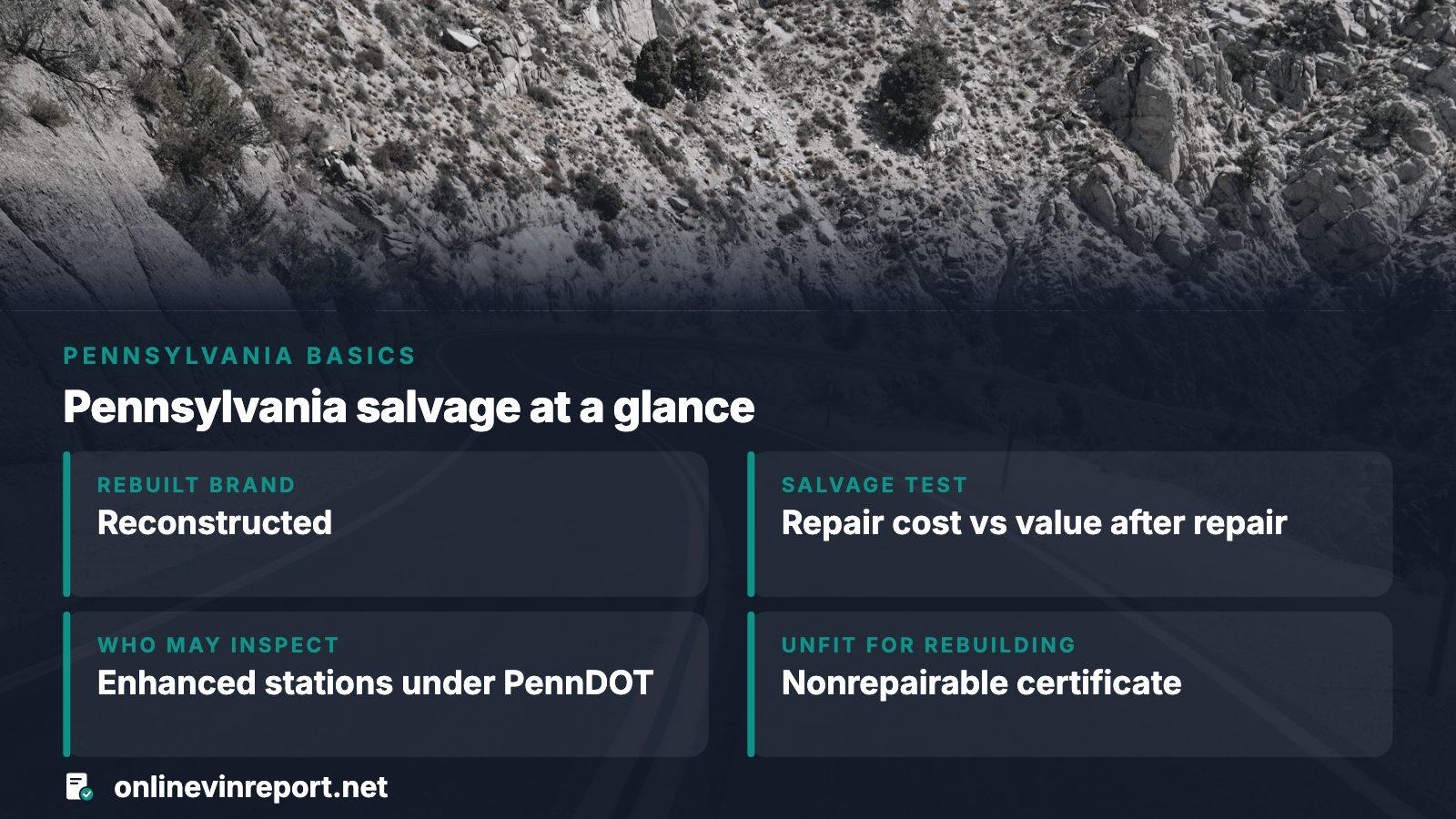
- Rebuilt brand name
- Reconstructed
- Salvage test
- Repair cost vs. value after repair
- Who may inspect
- Enhanced stations under PennDOT contract
- Unfit for rebuilding
- Nonrepairable certificate
Salvage and reconstructed are one car at two moments
Shoppers type salvage title Pennsylvania and rebuilt title Pennsylvania into search boxes as if they were separate problems. PennDOT treats them as a sequence. First comes the certificate of salvage, issued after a total loss. Later, if the car is repaired to the required standard and inspected, comes a title carrying the reconstructed brand.
That sequence matters when you read an ad. A car described as rebuilt has a salvage event somewhere behind it, and the state's own wording for the later stage is reconstructed. If the seller says repaired, fixed up or restored, ask which brand is printed on the title. An unbranded title on a car with a known salvage past is a mismatch worth chasing before you hand over a deposit.
What makes a car salvage here
In the department's fact sheet, salvage covers a vehicle that is inoperable, or that falls short of equipment and inspection standards, with repairs priced above its repaired worth. Notice what is compared. The reference is the repaired value, not the price before the crash. A dented car with a low post-repair value can cross the line sooner than the same damage on a pricier one.
Antique and classic vehicles get a carve-out: an old car that qualifies for that status except for lacking restoration or upkeep is not treated as salvage. The same exclusion appears in the reconstructed definition, so a genuinely old project car may follow a different path than a late-model wreck.
Flood, theft and nonrepairable variations
The state's salvage application, form MV-6, is where the cause of the loss gets recorded. It covers an original certificate, a duplicate and a nonrepairable certificate. The form has check boxes that change what the certificate looks like.
| Situation on form MV-6 | What results |
|---|---|
| Total loss caused by flood | Salvage certificate branded with a W |
| Total loss caused by theft | Salvage certificate branded with an N |
| Nonrepairable certificate requested | Vehicle can only supply parts or scrap |
| Certificate lost, stolen or defaced | Owner of record can obtain a duplicate with no fee |
The nonrepairable route is a dead end by design. PennDOT's form says such a vehicle may not receive a title or a salvage certificate afterward. A car sold with that paper has no legal road future in the state, however good it looks on a driveway.
Recovered theft cars have their own rules
Pennsylvania does not sort every stolen car into one bucket. After recovery, an insurer or licensed appraiser puts a dollar figure on the damage and on the car's replacement value, and that comparison decides the brand.
| What the assessment found | Title outcome |
|---|---|
| Repairs above replacement value, salvage certificate issued | Reconstructed recovered theft vehicle |
| Owner keeps the car, repairs run past 50% of replacement value | Recovered theft vehicle |
| Insurer paid, repairs at 50% or less | Owner may apply for an unbranded title |
| Individual never paid and got no salvage certificate | Existing title stays in use |
A clean title can still have a theft behind it
The third row means a stolen, damaged and repaired car can come back with no brand at all. That is one reason a paper title alone is not enough proof of history on a Pennsylvania car.
How an owner earns the reconstructed brand
The fact sheet expects a rebuilt car to be returned to the maker's designed condition, matching the original specifications and looks. Air bags, belts and other restraints, and emissions parts are named in particular. The sequence an owner follows looks like this.
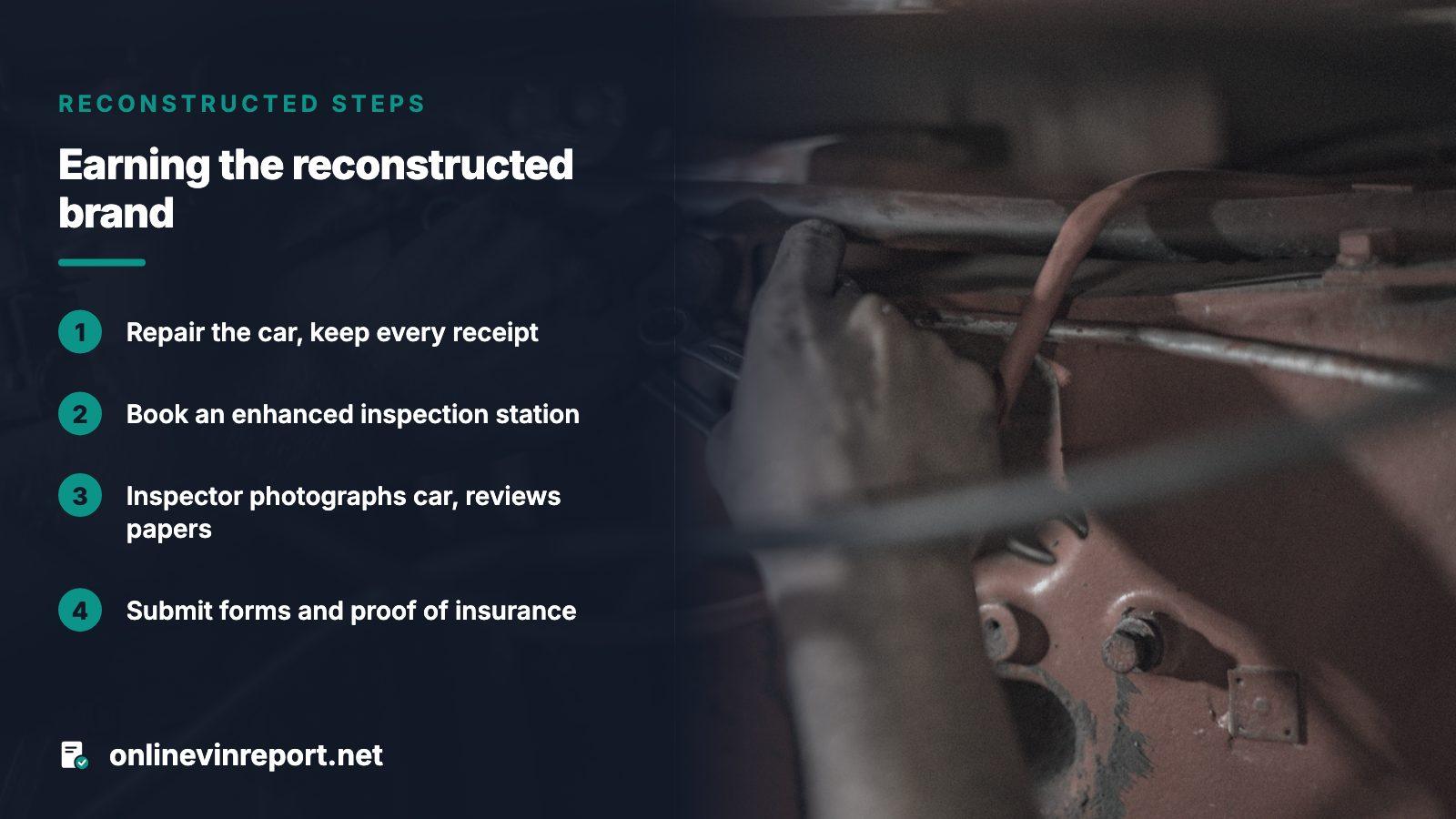
- Repair the car and keep the receipts for parts and work.
- Book the car at an enhanced vehicle safety inspection station and have it inspected there.
- After a pass, the inspector or a certified document reviewer takes pictures of the car and goes through the owner's papers.
- The file includes form MV-426B, proof of ownership such as the certificate of salvage, form MV-1 if the applicant is not the name printed on the front, and proof of insurance.
- Applications that have a Pennsylvania salvage certificate go through Online Business Partners; others go to PennDOT itself.
PennDOT warns that old copies of form MV-426B, revised in July 2023 or earlier, are rejected, and that any application can be slowed by a review at PennDOT or by the State Police.
The inspection is not done by just any garage
Starting January 1, 2007, the work moved to stations that PennDOT appoints and contracts as enhanced stations. Only they may inspect reconstructed, flood, recovered theft, specially constructed, collectible and modified vehicles for titling. PennDOT suggests phoning a station first to confirm it handles the work you need.
Once the car is titled and registered, the heavy requirement ends. The fact sheet says periodic safety inspections, and emissions testing where required, can be done at any station across the state. For a buyer, this means the enhanced inspection happened at one identifiable shop, so ask the seller to name the shop.
Cars arriving from another state
Reconstructed applications where the car arrives under another jurisdiction's brand or salvage paper, a replacement VIN or a change in gross vehicle weight rating must be sent to PennDOT. PennDOT accepts another state's salvage certificate or a title marked reconstructed as ownership proof, but it will not accept New York form 907A, or any document saying the vehicle is for parts only or unfit to rebuild.
- Ask for the previous state's title and any salvage certificate, front and back.
- Expect a VIN tracing or verification when a car moves in from another state.
- Have an authorized agent, tag service or dealer process an out-of-state title, which is the route PennDOT's buying guidance points to.
Where a VIN title check fits in
Before issuing a title, PennDOT queries the national title database, which it describes as storing VINs, mileage and condition brands like junk, salvage or flood. It also says the check reaches roughly 81 percent of the vehicles in the country. Brands stay attached when a car crosses state lines, which is exactly why a car titled elsewhere can still show a Pennsylvania-style history.
OnlineVINReport takes a VIN and shows whether a salvage, flood, junk or rebuilt brand is on record, along with damage and auction entries that have photos. A free preview comes first. After that the report is a single purchase, with nothing recurring, and the pricing page spells out the options. Run it before any money moves, and hold the result up to the title in the seller's hand.
Where this information comes from
- PennDOT: Reconstructed Vehicle Titling Procedure fact sheet — salvage and reconstructed definitions, paperwork, inspection steps
- PennDOT: Recovered Theft Vehicle Procedure fact sheet — theft brand outcomes and the replacement-value comparison
- PennDOT: Form MV-6, Application for Nonrepairable or Salvage Certificate — flood and theft letters, nonrepairable restrictions, duplicates
- PennDOT: Enhanced Vehicle Safety Inspections — which stations may inspect rebuilt cars
- PennDOT: NMVTIS — state use of the national title database
- PennDOT: NMVTIS Frequently Asked Questions — what a brand is and how it follows a car between states
Sources and photos: Facts checked against the sources above in November 2026. Photos by Victor Hughes, Nina Mercado and Will Truettner on Unsplash; diagrams by OnlineVINReport.
Keep reading
- Salvage title VIN check: run it online before you payRun the brand search on a specific VIN.
- Rebuilt title inspection: what the state checks and what a VIN title check addsWhat to inspect on a car that has already been rebuilt.
- What is a rebuilt title? What it means and what a VIN title check showsThe general meaning of the rebuilt brand across states.
- Flood car VIN check: find a flood brand before you buyHow flood brands show up, including the W certificate.
Frequently asked questions
How does a Pennsylvania salvage certificate differ from a rebuilt car's title?
The certificate of salvage comes after a total loss and applies to a car not yet restored. Once it is repaired and passes an enhanced inspection, the car can be titled as reconstructed. Both are brands that follow the VIN, so a record search can show which stage the car is at.
Can a Pennsylvania salvage title be turned into a clean title?
PennDOT's documents describe a path to a reconstructed title, not to an unbranded one, for ordinary salvage cars. The only unbranded outcome I found is for a recovered stolen car with repairs at 50% or less of replacement value after the insurer paid. Anything else, ask PennDOT.
Who inspects a rebuilt car for a Pennsylvania title?
An enhanced vehicle safety inspection station under contract with PennDOT. The owner cannot be the mechanic on a recovered theft car, and PennDOT lists the approved stations on its site. Phone the station first, because not every station offers every service.
Does a nonrepairable certificate mean the car can ever be titled?
No. PennDOT's form limits a nonrepairable vehicle to supplying parts or scrap, with no title and no salvage certificate to follow. A seller pitching such a car as a daily driver is describing something the state will not title; walk away.
How do I check a Pennsylvania car for a salvage brand before buying?
Ask the seller for the VIN and search it in title records, then read the result against the paper title and any salvage certificate. Our preview costs nothing, while the report is bought once. If record and paper disagree, stop and ask why.
Now check the car itself
The guide explains what to look for. The report shows what this VIN has on record.