THE SHORT ANSWER
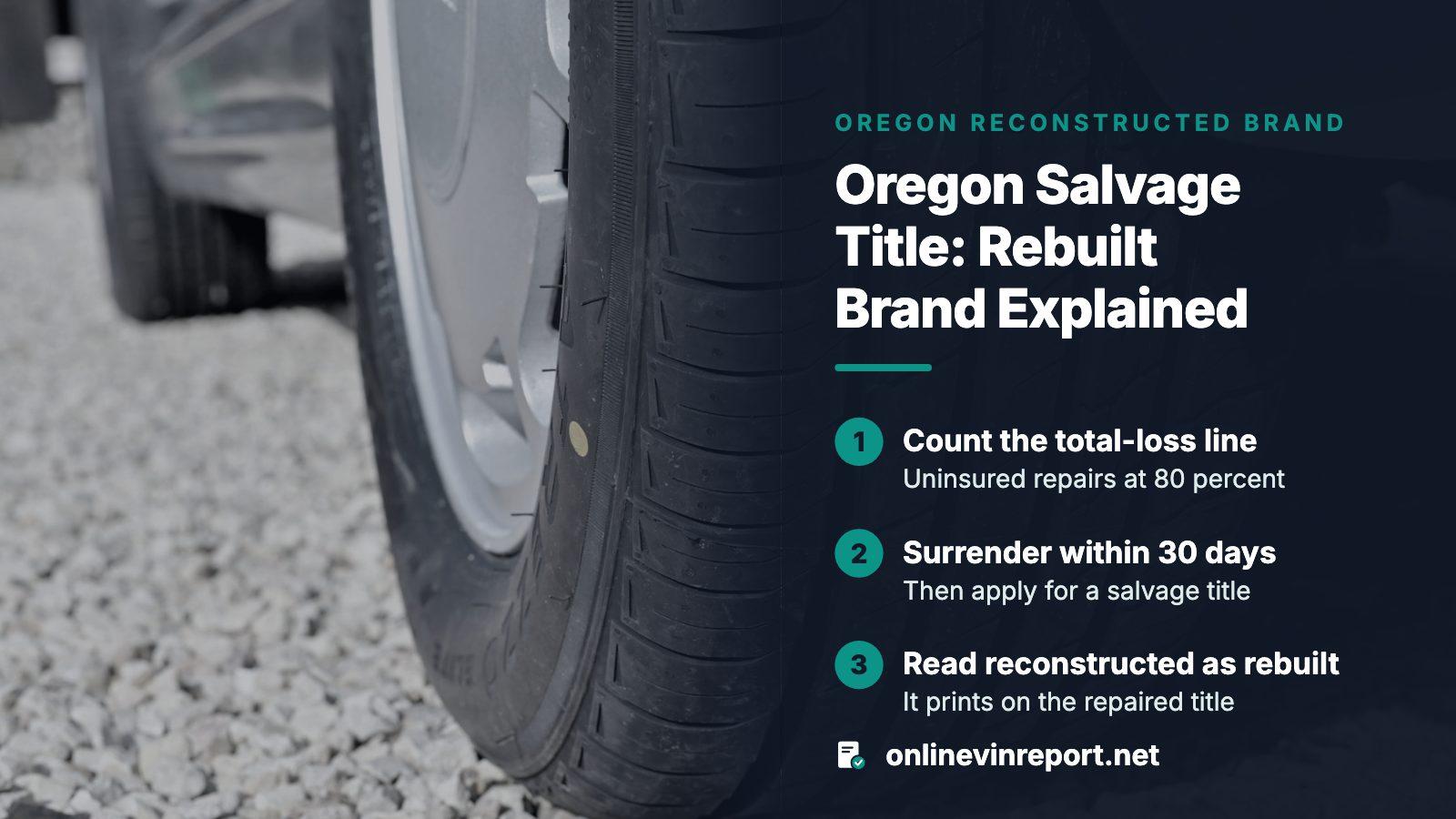
In Oregon, a car is totaled when its insurer declares a total loss or takes the car, or when uninsured repairs would reach 80 percent of retail value. The owner surrenders the title within 30 days and applies for a salvage title. A salvage-titled car cannot be driven or registered. After repair and a VIN inspection, the new title reads reconstructed.
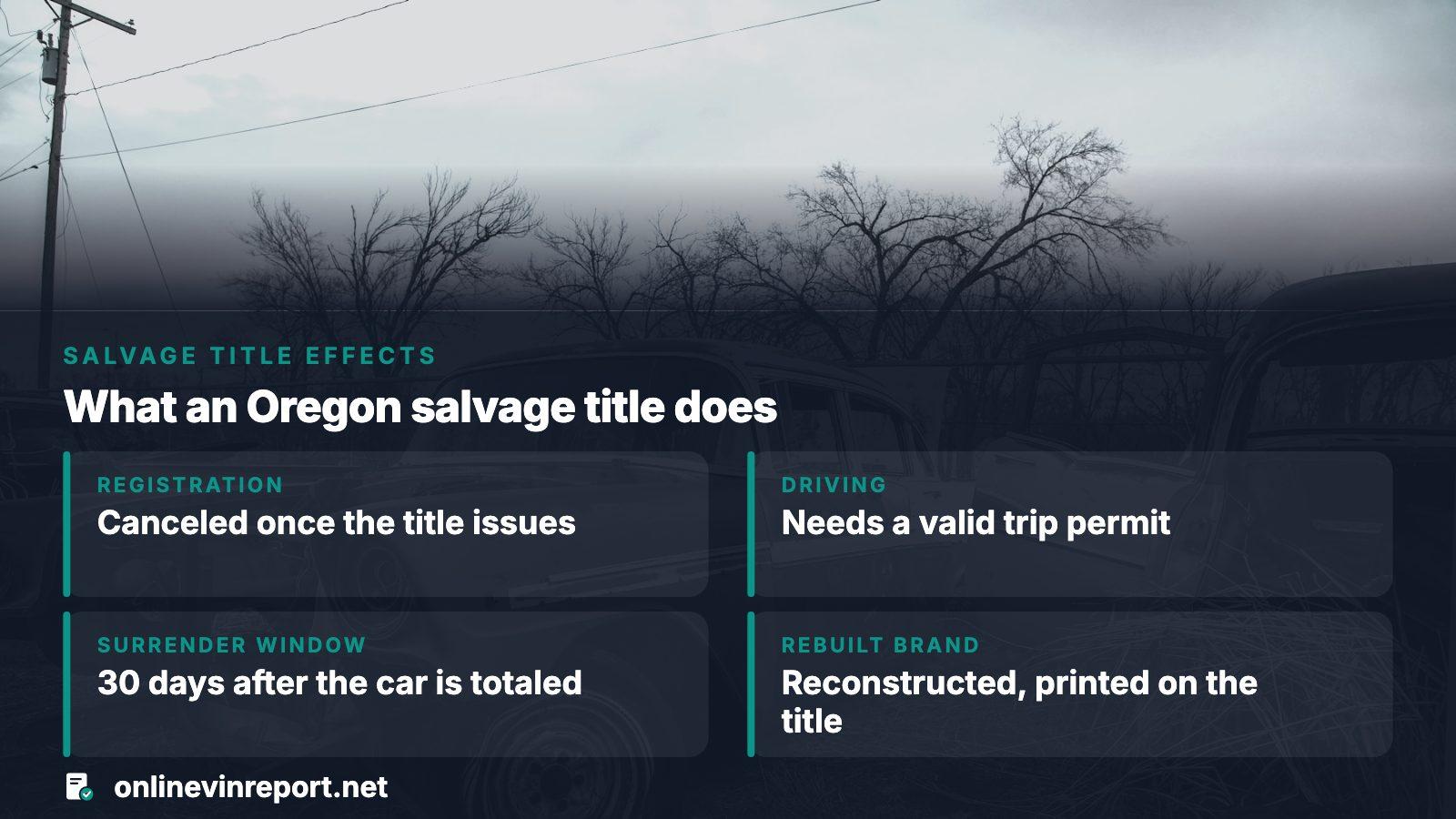
- Uninsured total-loss line
- Repairs at 80 percent of pre-damage retail value
- Title surrender window
- 30 days from the date the car became totaled
- Rebuilt car's brand
- Reconstructed, printed on the title
- Preview
- A free look first, then a paid one-time report
How Oregon decides a car is totaled
Oregon DMV's handbook lists three routes to the label. One: the insurer on the hook for a loss calls it a total loss, or ends up holding the car or its title, whether the cause was a crash or a theft. Two: a stolen car that stays missing for 30 days while no insurer covers it. Three: uninsured damage where the repair estimate hits 80 percent of what the car would have sold for at retail the moment before the damage.
For that last route the state points to the valuation guides that Oregon lenders rely on. There is no one percentage that fits every wreck. With an insurer involved, the insurer's decision is what counts, so a car can carry the brand at a ratio well under 80 percent.
What the salvage title does to the car
After a damage write-off, the owner has 30 days to send the title to DMV and request a salvage title. Skipping the surrender on a totaled car is a Class A misdemeanor, punishable by up to a year in jail, a fine of up to $6,250, or both.
- Any current registration is canceled as soon as the salvage title issues.
- Public-road driving is off the table unless the car has a valid trip permit.
- No lienholder, lessor or lessee is listed on the document.
- It travels with the frame or unibody, so a buyer of that structure must receive it.
- It lasts until the car is rebuilt, dismantled or recovered and DMV issues an ordinary title.
Why a rebuilt Oregon car says reconstructed
Shoppers search for a rebuilt title in Oregon, yet DMV words things differently. A collision-totaled car that gets repaired generally fits the reconstructed definition: the body still looks like one specific year, model and make, the maker did not rebuild it, and it is not a replica. RECONSTRUCTED gets printed on the title and stored in the DMV record. Assembled and replica are the neighboring categories, for one-off builds and reproductions.
Look at the VIN on the title: it comes from the frame, paired with the body's original year and make. Hold that against the car you are inspecting.
What a rebuilder has to prove
Before DMV issues the reconstructed title, the applicant assembles a stack of evidence. A buyer can ask to see it, and a missing piece is a conversation worth having.
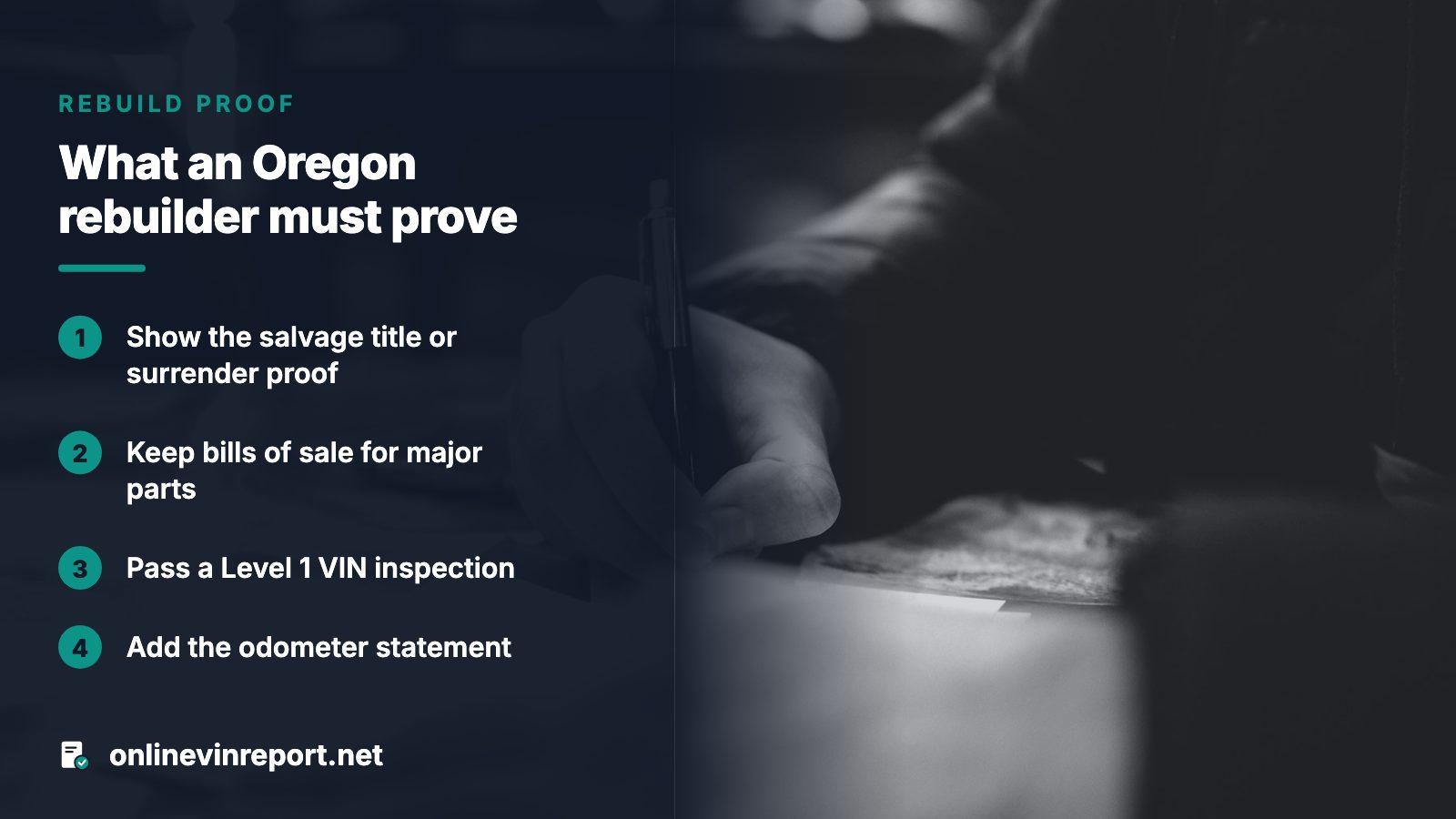
- The salvage title, or proof the title was surrendered here or in another state.
- Original bills of sale, titles or equivalent papers for each major part used in the repair.
- A Level 1 VIN inspection, performed only by DMV or a law enforcement agency.
- Form 6511, DMV's certification for vehicles in those three categories, or the equivalent section printed on the back of Form 226.
- An odometer statement under federal rules.
Registration can be requested together with the title, or later, and DMV issues a fresh plate and expiration date.
Brands that arrive from other states
A car does not have to be wrecked in Oregon to carry an Oregon brand. When an out-of-state title or its reassignment pages show damage, DMV stamps a brand onto the Oregon title. Flood brands come across as Flood plus the state name. If the old title has several brands, or none that match an Oregon term, the new one reads Branded plus the state.
| What DMV sees | What the Oregon title shows |
|---|---|
| Water damage brand from another state | Flood, with that state's name |
| Maker buyback brand from another state | Lemon Law, with that state's name |
| Multiple brands, or no Oregon equivalent | Branded, with that state's name |
| An insurer listed as owner in the chain of title | Totaled |
| Old Oregon title marked Previous Damage | Branded after the next transfer |
A bonded title alone does not trigger a brand.
Reading a listing and a bill of sale
Whoever declared the car totaled must pass the salvage title to the buyer. When DMV already holds the title and never issued a salvage one, the seller's bill of sale must carry four statements: totaled status, title surrendered to DMV, plates and registration void, and a required retitle as assembled, reconstructed or replica. Visible repair work plus a bill of sale lacking that wording is a reason to stop and ask.
Matching the paper to the car
Compare the VIN on the title, the bill of sale and the car itself. Reconstructed titles carry the frame's VIN, so any difference goes to the seller and DMV for an answer before money moves.
Where a VIN check fits
The state's rules describe categories; they cannot tell you what happened to the specific car in front of you. NMVTIS, the federal title database, stores title data, the latest odometer reading and brand history, supplied by state titling agencies, salvage yards, recyclers and insurers. Oregon DMV says this history can run deeper than other providers' and may drive its own branding.
Our preview shows whether a title brand or total-loss record exists for the VIN. The one-time report then lays out the record: brand, damage and salvage history, odometer readings. Pricing is on the pricing page, with no subscription. Run it before the inspection, since a brand on the record changes what you ask the mechanic to look for.
Red flags before you pay
- A seller says the car was in a bad crash but the title looks plain. Compare it with the VIN record.
- The title says Branded, Flood or Lemon Law with another state's name, which means the history started elsewhere.
- The seller cannot produce receipts for major repair parts.
- A salvage title is offered as if it were road-ready, though the car cannot be registered until it is retitled.
- The odometer carries a Not Actual notation on the title.
Any one of these is a prompt for questions and written records, not an automatic walk-away.
Where this information comes from
- Oregon DMV: Title and Registration Handbook, Chapter J — totaled definition, salvage title steps, reconstructed requirements and out-of-state brands
- US Department of Justice: NMVTIS for consumers — what the national title database holds and where its data comes from
Sources and photos: Facts checked against the sources above in November 2026. Photos by Andres Siimon, Owen Michael Grech and Leo_Visions on Unsplash; diagrams by OnlineVINReport.
Keep reading
- Salvage title VIN check: run it online before you payHow a salvage result appears when you run a VIN.
- What is a rebuilt title? What it means and what a VIN title check showsThe general meaning of a rebuilt brand outside Oregon's wording.
- Total loss threshold by state and what it means for a VIN title checkHow other states draw their total-loss lines.
- Rebuilt title check by VIN: is the car clean or rebuilt?Checking a specific car for a rebuilt record.
Frequently asked questions
Can I register a car that has an Oregon salvage title?
No. Issuing a salvage title cancels the registration, and the car may not be operated on Oregon highways except under a valid trip permit. Registration becomes possible after the car is repaired and an Oregon title is applied for under the reconstructed, assembled or replica category.
Does Oregon use the word rebuilt on titles?
Oregon DMV's handbook uses reconstructed, assembled and replica. A collision-damaged car that was repaired generally lands under reconstructed. Buyers searching for a rebuilt title in Oregon are usually looking at a title that says RECONSTRUCTED, so look for that word on the document.
Who applies for the salvage title?
The owner of a car totaled by damage sends the title to DMV within 30 days and applies on Form 229. A buyer who gets a totaled car with an unsurrendered title has the same duty. Insurers, dealers and dismantlers may skip an application in their own name if a salvage title already exists.
What if the car was totaled in another state?
DMV carries the damage onto the Oregon title when it receives the old documents. A flood brand turns into Flood with the state name, and an insurer shown as owner can produce a Totaled brand. DMV may also brand from NMVTIS history, so a clean-looking Oregon title is not proof of a clean past.
Is a stolen car that comes back always branded?
Not always. When an insurer paid a theft claim, salvage rules apply, yet a letterhead statement from that insurer saying the damage did not total the car permits normal titling. With no statement, the only option is totaled plus assembled, reconstructed or replica, after a Level 1 VIN inspection.
Now check the car itself
The guide explains what to look for. The report shows what this VIN has on record.