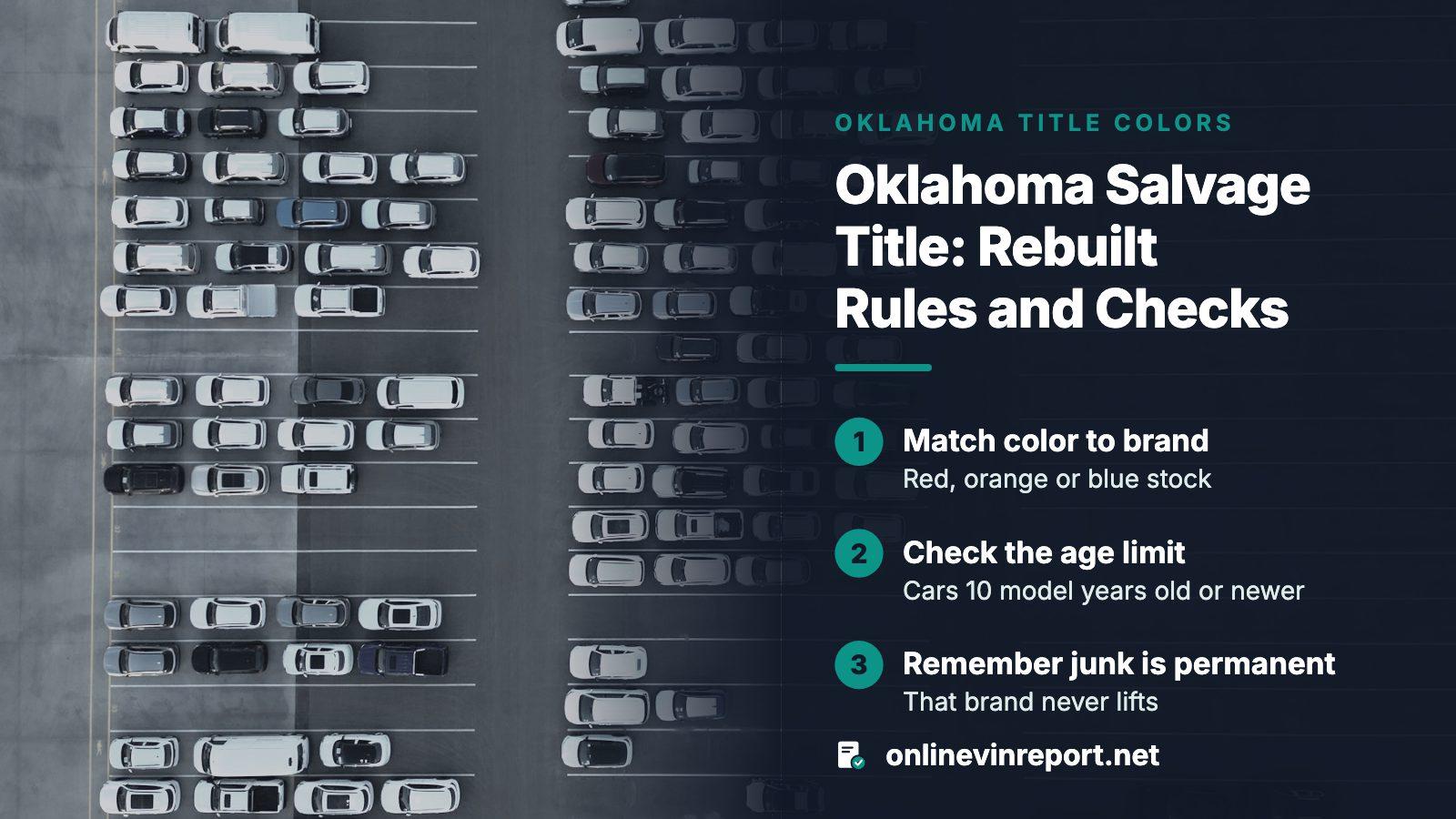
THE SHORT ANSWER
An Oklahoma salvage title goes on a car 10 model years old or newer once repair costs pass the state's damage threshold. The owner must repair it and pass a rebuilt inspection at a motor license agency before using it, and the car is then titled rebuilt. A junked title is permanent. Before buying, run the VIN through a title check to see which brand, if any, the record carries.
- Salvage threshold
- Repair cost above 60% of value, rising to a 70% to 79% band for losses from Nov 1, 2026
- Age limit
- Cars 10 model years old or newer
- Title colors
- Salvage red, rebuilt orange, junked blue
- Junk brand
- Permanent once issued
Where Oklahoma draws the salvage line
Service Oklahoma's glossary describes a salvage car as a vehicle 10 model years old or newer whose collision or other damage would cost more than 60% of its market value to fix for safe highway use. The ceiling is 80%, and the glossary flags a shift: for losses on or after November 1, 2026, the band is 70% to 79%.
Age matters. Count back from the newest model year on sale, treating July 1 as the day new models arrive. Beyond that cutoff, an owner may move a car into salvage or back out whenever he likes, and no inspection is needed to leave.
Two thresholds in print
The Tax Commission's rule text still quotes 60%, while the glossary shows the newer band. For a car totaled near the changeover, ask the seller for the loss date and the insurer's damage percentage.
Red, orange and blue: reading the title stock
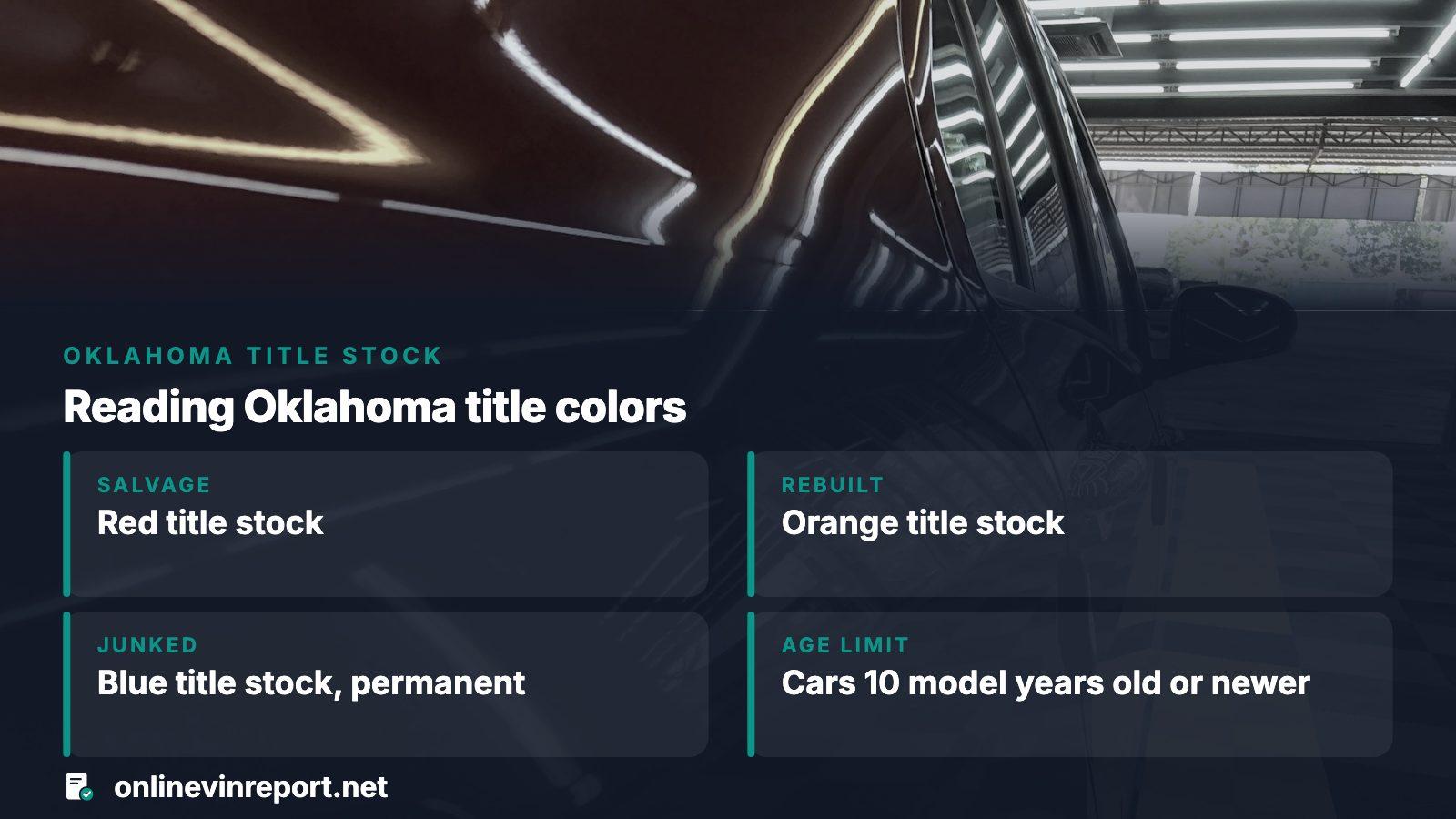
Oklahoma separates its titles by paper color as well as wording. Salvage prints on red, rebuilt on orange, junked on blue, and a clean title on green. A photo of the document tells you the status before you read a line.
| Title | Color | Meaning for the car |
|---|---|---|
| Salvage | Red | Damaged past the line; repair and inspection come before any use |
| Rebuilt | Orange | A former salvage car that was repaired and passed the state's examination |
| Junked | Blue | Parts or scrap only, and the brand never comes off |
A car leaving salvage counts as rebuilt, so that brand follows the repair and stays visible to every later owner.
How the brand lands on a record
Insurers set off many of these. After paying a loss above the line, or a flood claim, the company is obliged to instruct the policyholder to turn in the existing title so a red one can replace it, and the damage estimate goes to the Motor Vehicle Division. The next buyer does nothing to trigger it.
Owners start others. An application for an Oklahoma title on a vehicle in the newest 10 model years carries a damage and theft declaration, answered to the best of the owner's knowledge. Damage above 60% is handled as if the car arrived on a salvage title. Less than that leaves the title clean, and a theft recovery repaired for under 60% earns a Recovered Theft brand.
Moving states does not wash a brand off. A special brand on an out-of-state title is carried to the Oklahoma certificate, except where a car's age puts it outside branding.
Getting from salvage to rebuilt
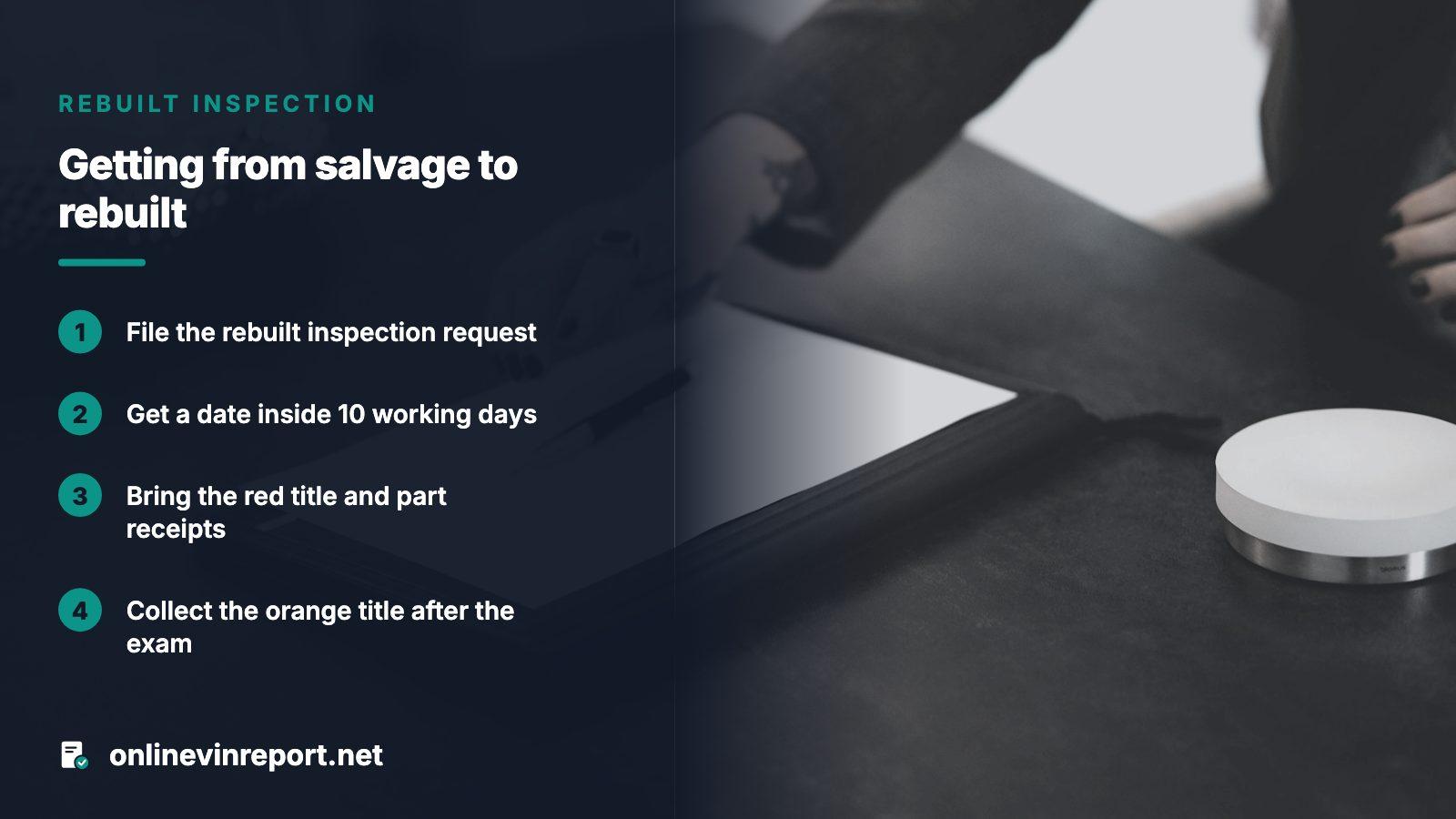
A repaired car inside the newest 10 model years needs an agent's examination before it goes back into use, and all the damage has to be fixed first. The path runs like this.
- The owner files OTC Form 788-B, the Rebuilt Vehicle Inspection Request.
- The agent names a date and place inside 10 working days.
- If the exam is off the rebuilder's premises, Form 788-C lets the car travel there. Insurance and a current safety sticker still apply.
- The owner brings the red title, receipts for each part installed, and valid liability coverage. A non-use affidavit is refused.
- The agent completes Form 788-A, and the inspection fee is only collected when the orange title issues.
The exam matches the VIN to ownership records, looks for tampering with the number and plate, runs the VIN through the state's analysis tool, and checks the odometer for rollback. It tests identity and paperwork, not the quality of the welds.
When a car fails the examination
The agent still finishes every part, then asks the Motor Vehicle Division to put a stop flag on the record. The owner takes home the top copy of Form 788-A. The orange title stays off the table unless police or a sheriff's office in Oklahoma signs off in writing.
With that letter in hand, the owner returns to the same agency, and the agent contacts the Title Section to clear the flag. A seller who says a car is repaired while holding a red salvage title has not finished this process.
Ask for the paperwork
A truly rebuilt car should come with the orange title and the parts receipts that the agent validated. If the car is called fixed and no orange title exists, stop and run the VIN.
Flood wording, junk and theft recoveries
Floodwater leaves its own mark. If a salvage or rebuilt car was flooded, or sat under water up to the dash or higher while an insurer paid a loss, the title face reads Flood Damaged. Owners also complete a flood disclosure when they apply for a title.
Junk is final. A car branded junk elsewhere takes an Oklahoma Junked Title that stays permanently, and such cars are for parts only. An owner may cancel a junk title using Form 701-8 at no charge, after which no title or registration can be issued again and later sales go through Form 766, the certificate of ownership.
A stolen car that the insurer paid off gets a purple unrecovered-theft title. If it turns up, it moves to an original, salvage or junked title based on the loss estimate.
What the brand does not tell you
A branded car costs less, and the gap looks attractive. The brand cannot show how the car was repaired or who did the structural work. A state inspection confirms identity, receipts and mileage, nothing about the quality of the repair.
- Compare the title color with the seller's story.
- Look for the Flood Damaged wording and ask how high the water rose.
- Read the number stamped on the vehicle against the title and any inspection forms.
- Find out if another state ever issued a title.
- Check the transfer date, since Oklahoma expects a title application within 2 months of getting ownership.
Insurers and later buyers treat a branded history differently, so weigh the lower price against how hard the car may be to sell.
Putting the VIN through a title check
A check by VIN reads the brand history attached to the number instead of the seller's account. The federal NMVTIS program collects title, brand and mileage records from motor vehicle agencies, insurers and scrap or salvage operators, and a brand stays on the record once a state applies it. Wording varies because every state sets its own standards.
An empty result is encouraging, not proof. By NMVTIS's own account about 87 percent of the nation's vehicles are covered and only a little over half the states send data, so a problem car can slip through. Keep the paper title in front of you too.
OnlineVINReport gives a free preview on the VIN you enter, which shows whether a brand turns up. Going further means a single payment rather than a subscription, with the choices listed on the pricing page, and the report adds salvage and auction records with photos plus odometer readings for judging a branded car.
Where this information comes from
- Service Oklahoma: motor vehicle glossary — salvage, rebuilt and junk definitions and the date the damage band changes
- Oklahoma Tax Commission: OAC 710:60 motor vehicle rules — title colors, rebuilt inspection steps, flood and junk rules
- Service Oklahoma: vehicle titles — the 2-month window to apply for a title
- NMVTIS: consumer information — what the federal title database holds and where it can come up empty
Sources and photos: Facts checked against the sources above in November 2026. Photos by Iain, Annika Wischnewsky and Clarence Tioh on Unsplash; diagrams by OnlineVINReport.
Keep reading
- Oklahoma title check: salvage, flood, rebuilt and junk brands by VINThe full Oklahoma title picture, including liens and title history requests.
- Rebuilt title inspection: what the state checks and what a VIN title check addsHow rebuilt inspections work in general, beyond Oklahoma.
- Salvage title VIN check: run it online before you payWhat a VIN check shows for a salvage brand.
- Why a salvage title is bad, and how a VIN check shows it firstWhether a branded car makes sense to buy.
Frequently asked questions
What is the difference between a salvage and a rebuilt title in Oklahoma?
A salvage title marks a damaged car that has not yet passed the state's rebuilt inspection, and it prints on red stock. Once repairs are finished and a motor license agent passes the car, it is titled rebuilt on orange stock. The rebuilt brand stays on the record for later owners.
Can I drive a salvage car in Oklahoma?
Not as a roadworthy car. A salvage car within the newest 10 model years has to be repaired and pass the rebuilt inspection before it is put into use. Older cars can come out of salvage on the owner's say, so the answer depends on the car's age.
Does a flood car show up on an Oklahoma title?
It can. When a salvage or rebuilt car was flooded, or sat under water up to the dashboard and an insurer paid out, the title carries the words Flood Damaged. Owners also complete a flood disclosure when applying for a title, but a VIN check is the way to confirm what is on record.
Can a junked car ever get a clean title?
No. A junked title is permanent once issued, and junked cars cannot be made roadworthy again. They may only supply parts. An owner can cancel the title, after which no new title or registration is issued and later sales use a certificate of ownership form.
Will a VIN title check catch every brand?
No tool does. NMVTIS holds only what states have reported, and just over half do, so a clean search is good news rather than proof. Set it beside the paper title, the seller's records and a look from a mechanic you trust.
Now check the car itself
The guide explains what to look for. The report shows what this VIN has on record.