THE SHORT ANSWER
A salvage title is bad for four reasons. The car is not road-ready until it is repaired and inspected, nobody can see how severe the original damage was, a branded car is worth substantially less than a comparable clean one, and insurers, lenders and even makers can be difficult. A salvage car can still be a fair deal at the right price, but only after a VIN title check and an independent inspection.
- What triggers it
- Repair cost plus wreck value above pre-damage value, or a total-loss call
- Road use
- Only after repairs and a state inspection
- What the brand omits
- The cause of the damage and the quality of the repair
- Where it shows
- State titles and the national NMVTIS record
The brand records a money decision, not a damage report
Federal rules call a car salvage when two figures, the wreck's resale value and the bill to make it legal for public roads again, add up to more than its fair market value ahead of the event. Collision, fire, flood and similar events all count, as does a total-loss ruling by a state or an insurer.
Because the test is about money, the label tells you little about the injury. An older, cheap car can be totaled by a repair bill that a newer car would carry without trouble, and the paper never says which part was hit. That gap is the first reason a salvage title is bad: you must price a car without knowing what happened to it.
A salvage car is not road-ready, and rebuilt is only a status
In Texas, a total-loss car is titled salvage. Once repairs are done and it clears safety and anti-theft inspections along with any further state standards, the brand is swapped for rebuilt. Junk sits below both: federal wording describes a car that cannot run on public roads and has no value beyond parts or scrap.
| Brand | What the record says | What it means for you |
|---|---|---|
| Salvage | Written off, not yet repaired and cleared | Not drivable as it stands; you are buying a project |
| Rebuilt | Repaired and passed the state's checks | Back on the road, repair quality unproven |
| Junk | Good for parts or scrap only | The wrong car if you need something to drive |
From an NHTSA owner complaint
A 2018 Honda Accord owner says the purchase happened last year, at a small dealership in another state, and the title already read rebuilt. After a failed head gasket was diagnosed, Honda, the owner says, would not pay and also refused a goodwill request, citing that title. The car now sits undriven because the repair is out of reach.
Rebuilt means the state let the car back on the road. It does not mean everyone else treats it as ordinary, and the brand stays on the record.
The repair is where hidden problems live
NMVTIS treats a total-loss or salvage entry as a pointer to earlier severe damage, but its report does not describe the repair. Texas lists what can go wrong there: damaged parts reused, pieces cut and welded together, a frame never aligned properly that now strains the drivetrain, wheels, tires and brakes. Fixing a car like that can cost more than the car is worth.
Before you treat a branded car as a driver, ask the seller for:
- Photos of the damage taken before repairs began
- Itemized repair invoices that show who did the work
- The reason the car was written off, checked against the records
- Permission for an independent mechanic to examine the structure before any money changes hands
Price, insurance and credit all move against you
Texas says a rebuilt car is worth substantially less than a comparable one that was never salvaged, and is often hard to insure, so its advice is to call an insurance agent before you commit. Because brand history follows the VIN from state to state, the lower value follows the car to its next owner too.
From an NHTSA owner complaint
A buyer who financed a 2006 Hyundai Sonata through a Maryland dealer says the dealer never mentioned a branded title. The discovery came later, when the buyer requested a quote for an extended warranty. After calling the state's motor vehicle administration, the buyer understood that Maryland dealers cannot finance a car like that because its real mileage is unknown. Then the brakes and a control arm needed work, and on a fixed income the buyer could afford neither those repairs nor another car.
Read that as a lesson in order of operations. A brand found after the paperwork leaves you holding the car and its repair estimates. Find it first.
Makers and dealers do not always honor repairs on a branded car
Owners of several models have written to NHTSA saying a dealer or maker refused recall or goodwill work because of the title. These are owners' accounts, not rulings, and a maker might dispute them. Still, a repair you assumed was covered may land on you, so factor that into the price.
From an NHTSA owner complaint
A 2012 Hyundai Sonata owner described a blinking check-engine light and uneven running. The dealer traced it to worn rod bearings, a known problem needing a replacement engine under a recall. According to the owner, Hyundai would not supply the engine because of the salvage title. The owner says that brand was earned through body damage with no link to the engine, and expects the recall to apply regardless.
Whether a refusal like that is right is for the maker and the regulators to settle. A buyer's job is smaller: learn the brand first, and ask a franchised dealer how it treats branded cars.
Why the brand can slip past a casual look
Brands are applied by individual states, and the wording varies. California says salvaged; other states use damaged, dismantled, rebuilt, totaled or water damage. The national NMVTIS record maps those labels onto common ones and keeps brands applied by any state, while the title in a seller's hand shows one state's view on one date.
California obliges every seller to reveal a salvage title and what lies behind it. Licensed dealers there must also run an NMVTIS report and attach a disclosure notice to any car with a junk or salvage past or a brand. Rules differ elsewhere, so on a private sale the VIN check is the safeguard you control.
What an online VIN title check shows before you pay
OnlineVINReport runs the VIN against title brands such as salvage, flood, rebuilt and junk, then adds the salvage-auction record with its photos where one exists, plus odometer readings and insurance records. Begin with the free preview. If you go on to the full report, it is a one-time purchase, and the pricing page lists the options.
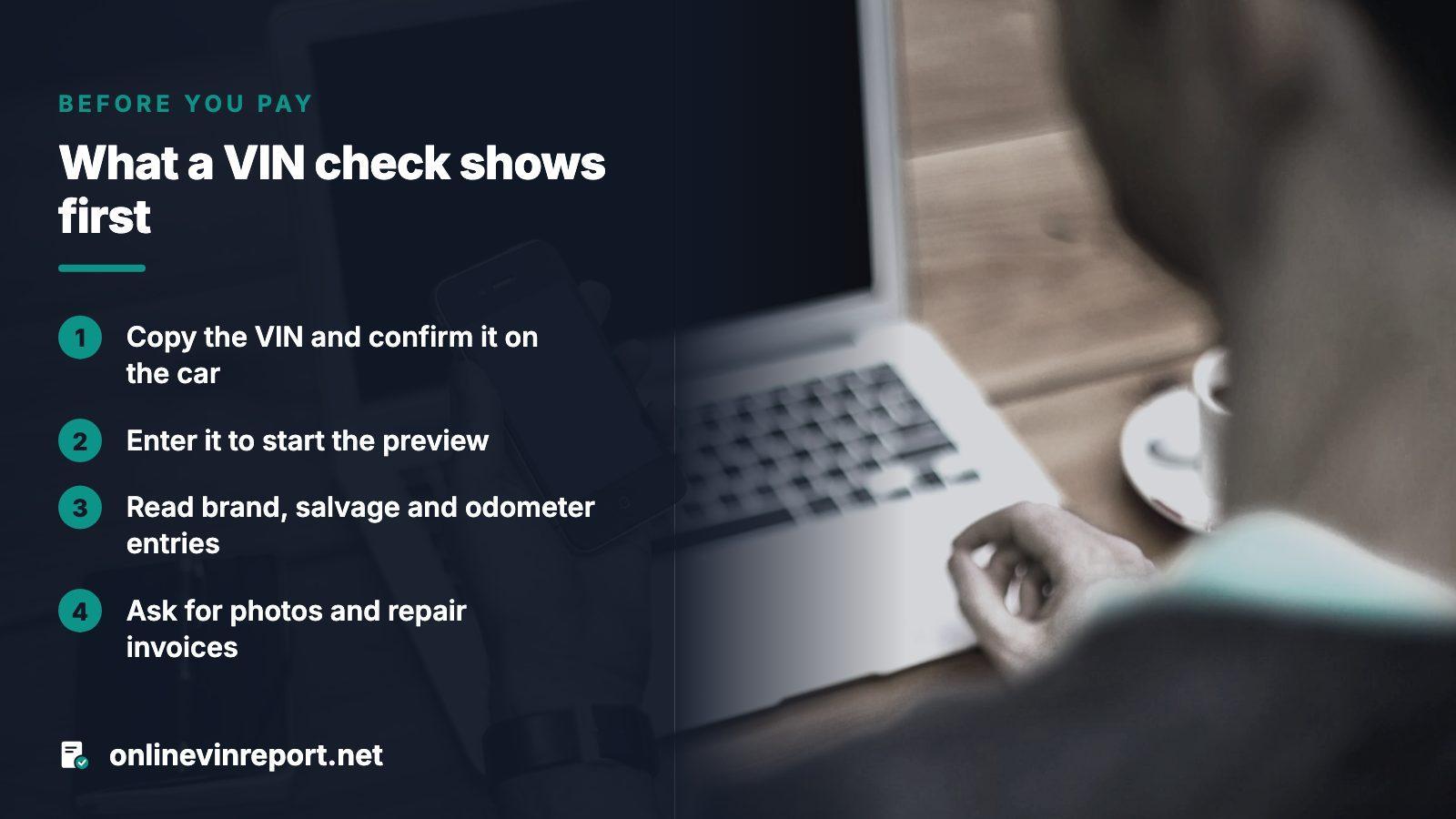
- Copy the VIN off the listing and ask the seller to confirm that it matches the car.
- Enter it on the site to start the preview.
- If you buy the full report, read the brand, salvage and odometer entries and note the dates.
- If a brand appears, ask for photos and repair invoices, then book an independent inspection.
Where the check stops and what to do with a hit
A bare NMVTIS record is short by design. It covers title status, brands, odometer, total loss and salvage, and leaves out repair, recall and maintenance data. The system's own guidance still urges an independent inspection. No hit is encouraging, but it does not prove a spotless history.
A brand is not an automatic no. It is a reason to reprice, inspect and confirm insurance before you sign. If the seller never mentioned it, ask why.
Where this information comes from
- 28 CFR Part 25, subpart B: NMVTIS rule — federal wording for salvage, junk and total loss
- NMVTIS: Understanding a vehicle history report — what a title record shows, what it leaves out, and who reports
- Texas DMV: Rebuilt vehicles — salvage-to-rebuilt steps, repair cautions, insurance and value
- California DMV: Branded titles — state brand wording and seller disclosure duties
- NHTSA owner complaint 11437731 — owner experience, paraphrased
- NHTSA owner complaint 11473277 — owner experience, paraphrased
- NHTSA owner complaint 11765319 — owner experience, paraphrased
Sources and photos: Facts checked against the sources above in November 2026. Photos by Maxim Tolchinskiy, Alejandro Escamilla and Nina Mercado on Unsplash; diagrams by OnlineVINReport.
Keep reading
- Salvage title VIN check: run it online before you payRun the salvage check step by step before you pay.
- What is a rebuilt title? What it means and what a VIN title check showsSee what the rebuilt brand adds and what it leaves open.
- How a car gets a salvage title, and what a VIN check showsLearn how a car ends up with the brand in the first place.
- Salvage check with pictures: see the damage before you buyLook at auction photos of the damage before you decide.
Frequently asked questions
Can a salvage-title car be driven on public roads?
Not in its current state. Texas requires repairs and an inspection before the car goes back on the road, and the title then becomes rebuilt. Every state runs its own process, so ask the agency in the state where the car will be registered before paying for one you plan to fix.
Is a rebuilt title better than a salvage title?
It is a step up, since a state signed off on returning the car to traffic. That sign-off does not tell you how well the structure was repaired, and Texas notes that rebuilt cars are often hard to insure and worth substantially less than comparable cars never salvaged.
Will a salvage title always show up on a VIN check?
Usually, when a state branded the title or an insurer, salvage yard or recycler reported the car, because NMVTIS gathers reports from all of them. A car that skipped those channels leaves no entry. So the report and a hands-on inspection work as a pair.
Does a salvage title mean the car was in a major crash?
Not necessarily. The label also covers fire, flood and other events, and it is triggered by cost against value, not by how bad the damage looked. One Sonata owner in an NHTSA complaint says the brand on that car came from body damage alone. Photos and invoices show what happened.
Is it ever sensible to buy a salvage-title car?
Some buyers do, at a price that reflects the brand. The sensible version has three conditions: a mechanic you trust has examined the structure, an insurer has confirmed it will cover the VIN, and you accept that resale will be harder. Without all three, a clean-title car is the safer buy.
Now check the car itself
The guide explains what to look for. The report shows what this VIN has on record.