THE SHORT ANSWER
A New Mexico salvage title marks a car as a salvage vehicle under state law, either because repair costs outweigh its value or because an insurer declared it one. Resales must stay on a salvage-branded title, and a car marked non-repairable can go only to a licensed auto recycler. Confirm current rules with the MVD, then run the VIN through a title check.
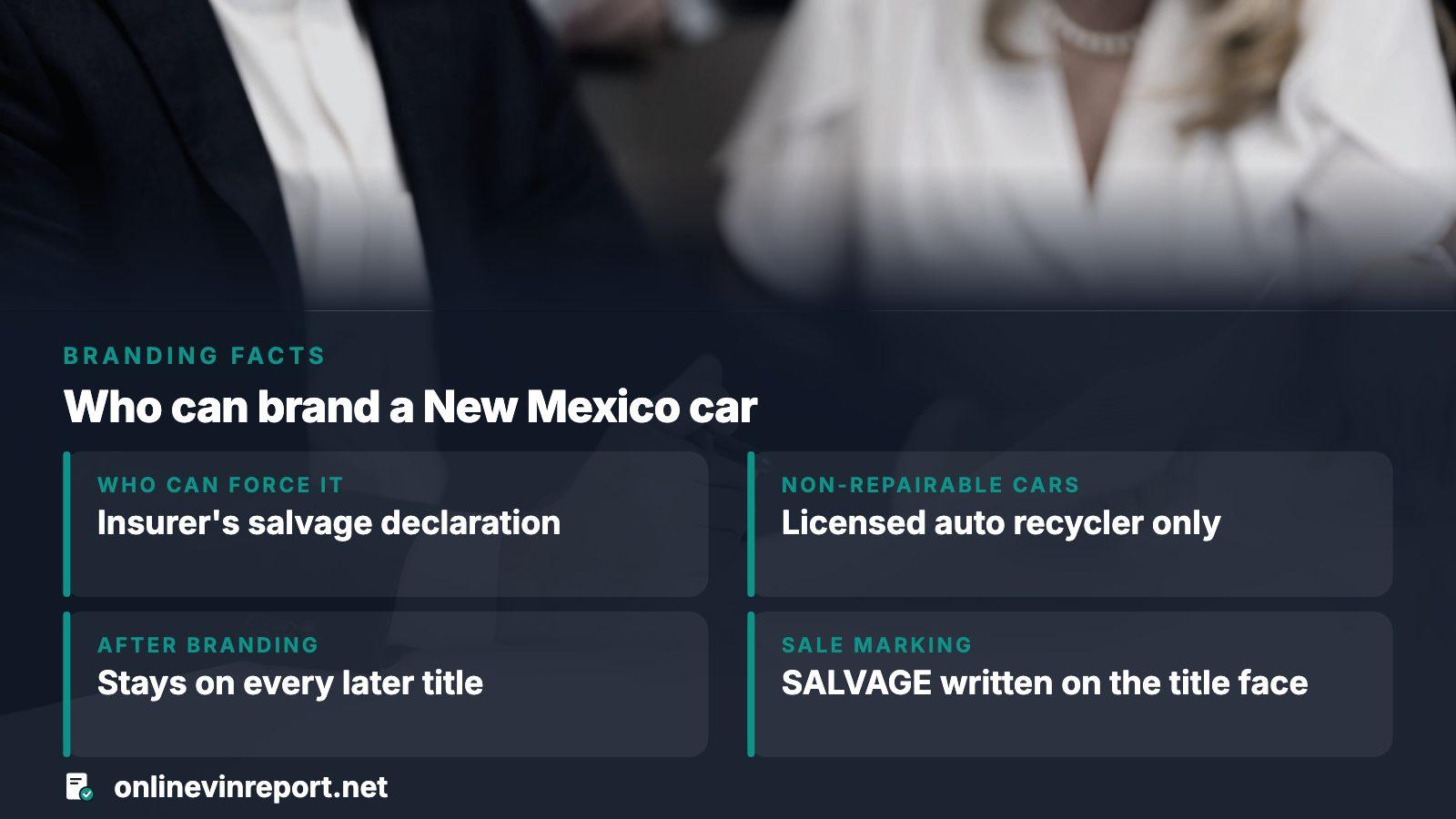
- Who can force the brand
- An insurer's salvage or non-repairable declaration
- Non-repairable cars
- Can go only to a licensed auto recycler
- After branding
- The brand stays on every later title
- Rule text we read
- Code copy shows changes through September 2006
What New Mexico means by a salvage vehicle
The state code defines a salvage title in a short, practical way: it is the title the MVD hands out when a car qualifies as a salvage vehicle. The full definition of a salvage vehicle lives in the Motor Vehicle Code, section 66-1-4.16, and the administrative rules point to it. We could not open the statute text itself, so the details below come from the administrative code and federal title-data pages.
Two points matter right away. A salvage title is required to move ownership of such a car, so a seller cannot hand over a plain title and call it a day. And a stolen car that was never recovered does not need one. If the car is found and turns out to be badly damaged, the owner then has to follow the salvage or non-repairable procedure.
How repair cost is counted against value
The code spells out what goes into the repair side of the comparison. Only work that returns the car to a safe, road-worthy state counts. Upgrades do not: swapping a clear windshield for a tinted one or adding racing stripes is left out. Money paid for unrelated losses, such as medical bills, a rental car or lost work time, is excluded as well.
Value comes from the pricing guide for used cars that the national automobile dealers association publishes, or a similar publication, and the price of add-ons like a stereo is not counted. The code gives a worked case: a vandalized car valued at $1,000 before the incident, plus a stereo worth $1,500, needs $800 of safety repairs. Eight hundred is under one thousand, so that car is not salvage. The takeaway for a buyer is that the label depends on a calculation, and two similar-looking wrecks can end up with different brands.
When an insurer makes the call
The same rules add a second path that skips the arithmetic. If an insurance company declares a vehicle salvage or non-repairable, it is one, whatever the repair estimate looks like next to market value, provided the declaration fits the statutory definitions. In the code's example, an insurer paid $2,200 on the claim and declared the car a loss, and that was enough.
Why this matters at the used lot
A car can carry a salvage brand even though a body shop says the damage looked minor. Insurers decide on their own cost picture, and the brand follows the declaration. Ask the seller who owned the car when the brand was applied, and whether an insurer was involved.
What the paperwork looks like when a branded car is sold
The code lays out two routes. When an insurer takes a car in a claim payment, it collects the title from the former owner, who signs the seller's release line, and before passing the car on, the insurer must apply, under its own name, for either a salvage title or a certificate marking the car non-repairable. It also sends the MVD a written reason and, for salvage, the repair cost and the pre-damage value.
When anyone else sells a branded car, the paper trail is more hands-on, and a buyer can use it as a checklist:
- The buyer takes reasonable steps to see that the seller is the named owner.
- The seller signs the release line and the buyer's name goes in the purchaser section.
- If the title is not yet marked, the seller writes SALVAGE or NON-REPAIRABLE on its face in ink, letters at least half an inch high, tilted about 45 degrees, clear of the vehicle description.
- A copy of the marked title goes to the MVD, with a written explanation if the brand is new.
A title with no such marking and no explanation, on a car with a visible repair history, deserves questions.
Non-repairable cars and the one-way street of resale
| Status | What the code says |
|---|---|
| Salvage-branded title | Each later sale needs a title carrying the salvage brand |
| Non-repairable vehicle | Can go only to a licensed auto recycler |
| After a non-repairable certificate | The MVD issues no further ownership certificates for the vehicle |
Read together, these rules mean a brand does not quietly disappear through ordinary resale inside New Mexico. If a car is offered to you with a clean-looking paper title and a story about a past wreck, the gap between the two is the thing to chase, because the rules say the branded title should have followed the car.
Rebuilt cars: what we could and could not confirm
Searches for a rebuilt title in New Mexico usually come from someone looking at a repaired car. The pages we could read did not describe New Mexico's rebuilt-title steps, fees or inspection form, because the MVD's own site would not open for us. We are not going to guess at them. Check the current process directly with the MVD.
One related detail did come from the administrative code: VIN and safety inspections can be done by an authorized inspector, and the division accepts that work as though its own staff did it. The inspector needs to be 18 or older, free of felony convictions, trained on rebuilt and reassembled vehicles, and covered by a $30,000 bond. That tells you who may inspect, not what a rebuilt car must pass.
What a federal title check adds, and its blind spots
The national title information system is run by the Justice Department, whose consumer pages explain why a VIN check helps. States label cars differently, so one state may brand a damaged car while another does not, and the system keeps every brand that was reported. A branded car retitled somewhere that does not ask the issuing state can come out with a clean-looking paper title, which is the trick known as brand washing.
The same pages warn that an empty result is not proof. Early gaps in reporting were real, and a car sitting in a salvage yard does not compel any state to brand it. The system also holds only part of a state's file, and repair history is not in it. Buyers are encouraged to get the state's full title record and an independent inspection.
Running the VIN check on a New Mexico car
Start with the seller's paperwork, then put the 17-character VIN through a title check. The preview is free. The full report that follows is bought once, not by subscription, and its cost is on the pricing page. For a New Mexico salvage question, read these sections first: title brands, salvage and auction entries, insurer total-loss records and odometer readings.
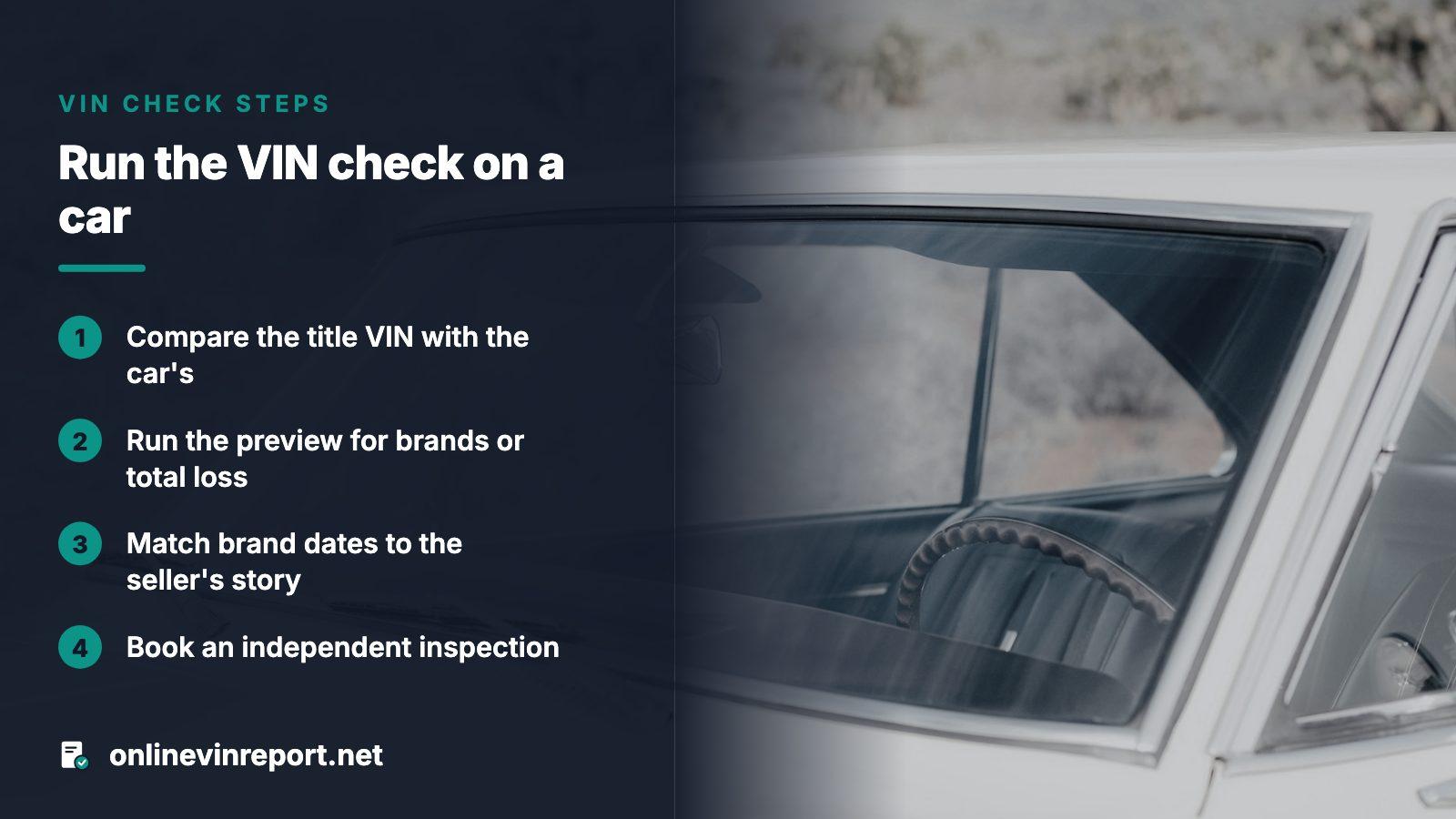
- Check that the VIN printed on the title is the one on the car.
- Run the preview and look for any brand or total-loss entry.
- Match the brand dates to the seller's story.
- Book an independent inspection for any car with a repair history.
A brand you find is not a reason to walk away by itself. It is a reason to see the repair records and have the work inspected.
Where this information comes from
- New Mexico Administrative Code 18.19.3 (salvage-branded titles) — definitions, repair-cost test, insurer rule and transfer steps
- U.S. Department of Justice: NMVTIS for consumers — what a brand is, state differences and false negatives
- U.S. Department of Justice: understanding an NMVTIS report — the five indicators and the inspection advice
- U.S. Department of Justice: NMVTIS for states — state title verification and why receiving states decide brands
Sources and photos: Facts checked against the sources above in November 2026. Photos by Johnathan Kaufman, Wesley Tingey and Carrie Allen www.carrieallen.com on Unsplash; diagrams by OnlineVINReport.
Keep reading
- Salvage title VIN check: run it online before you paySee what a VIN check shows for a salvage brand.
- What is a rebuilt title? What it means and what a VIN title check showsLearn what a rebuilt status means after the repair.
- Rebuilt title inspection: what the state checks and what a VIN title check addsUnderstand the inspection step on a rebuilt car.
- Clean title vs salvage title: how to tell them apart with a VIN checkCompare the two titles side by side before buying.
Frequently asked questions
What is a salvage title in New Mexico?
It is a title issued by the Motor Vehicle Division that shows a vehicle is a salvage vehicle under the Motor Vehicle Code. Once a car has one, each later sale has to carry that brand on its title, so the label travels with the car through each sale inside the state.
Can an insurance company make a car salvage even if repairs look cheap?
Yes. The state code says an insurer's declaration that a vehicle is salvage or non-repairable makes it one, regardless of repair cost against market value, as long as the call fits the statutory definitions. The brand follows the declaration, not a shop's estimate.
Who can buy a non-repairable car in New Mexico?
According to the administrative code, an owner may not transfer a non-repairable vehicle to anyone except a licensed auto recycler. After a non-repairable certificate is issued, the MVD does not issue further ownership certificates for that vehicle, so it is not meant to return to the road.
Does a VIN check catch a New Mexico salvage brand?
It can, because the federal title system keeps brands reported by state agencies, insurers and salvage yards. It is not perfect. Reporting had gaps and some cars never got branded, so pair the check with the seller's records and an independent inspection.
How do I get a rebuilt title in New Mexico?
We could not read the MVD's own rebuilt-title instructions, so we will not state steps or fees. Contact the MVD for the current process. The administrative code does say authorized inspectors, trained in rebuilt vehicles, may perform VIN and safety inspections for the division.
Now check the car itself
The guide explains what to look for. The report shows what this VIN has on record.