THE SHORT ANSWER
Read the VIN from the bike itself, enter all 17 characters, and look at the brand entries first. Salvage, flood, rebuilt and junk each point to a past write-off or heavy repair. Federal reporting duties cover four-wheeled automobiles, so a motorcycle can show less than a car would. Treat a clean result as a first screen, then hold it against the seller's paperwork and the state's own file.
- Brands read
- Salvage, flood, rebuilt, junk
- Search key
- The bike's 17-character VIN
- Preview
- Free
- Full report
- One payment, no subscription
What a title check reads off a motorcycle's VIN
The VIN opens the title record. A search matches it to entries that states, insurers and salvage yards have filed, and lists each with a state and a date.
- Salvage: an insurer or a state judged the bike too costly to repair and wrote it off.
- Flood: water caused the loss, though only some states use that brand.
- Rebuilt: a former salvage bike that was repaired and cleared for registration again.
- Junk: the bike went to a recycler or yard as parts or scrap.
The same screen can carry the latest odometer reading on file, a theft record where one exists, and lender claims. Brands come first because a brand rarely goes away: once a state applies one, the federal title system keeps it.
Why a motorcycle's record runs thinner than a car's
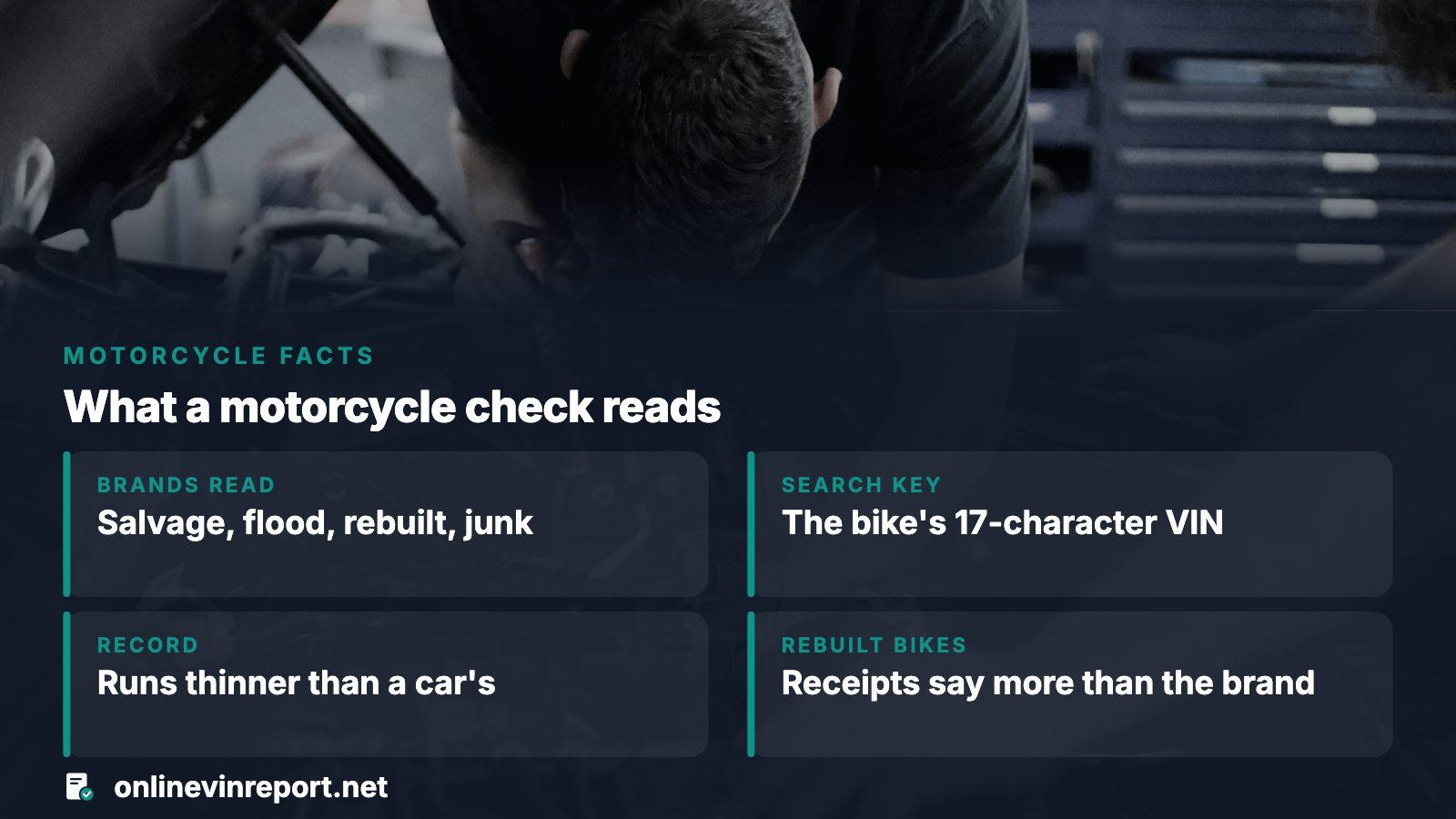
Federal rules make states send title data on automobiles, and the statute defines an automobile as a four-wheeled vehicle. Motorcycles sit outside that duty. Some states send bike records anyway, so what a search finds depends on where the bike was titled.
That changes how silence should be read. The Justice Department warns that gaps can produce a false negative, such as no salvage history shown for a bike that has one. Nor does a bike sitting in a salvage yard compel any state to stamp a brand on its title.
A clean result is a screen, not a verdict
On a motorcycle, an empty brand section means nobody reported a loss to the system. That is weaker than meaning no loss happened, so weigh it against the paper title and a hard look at the frame.
Read the VIN off the bike before you type it
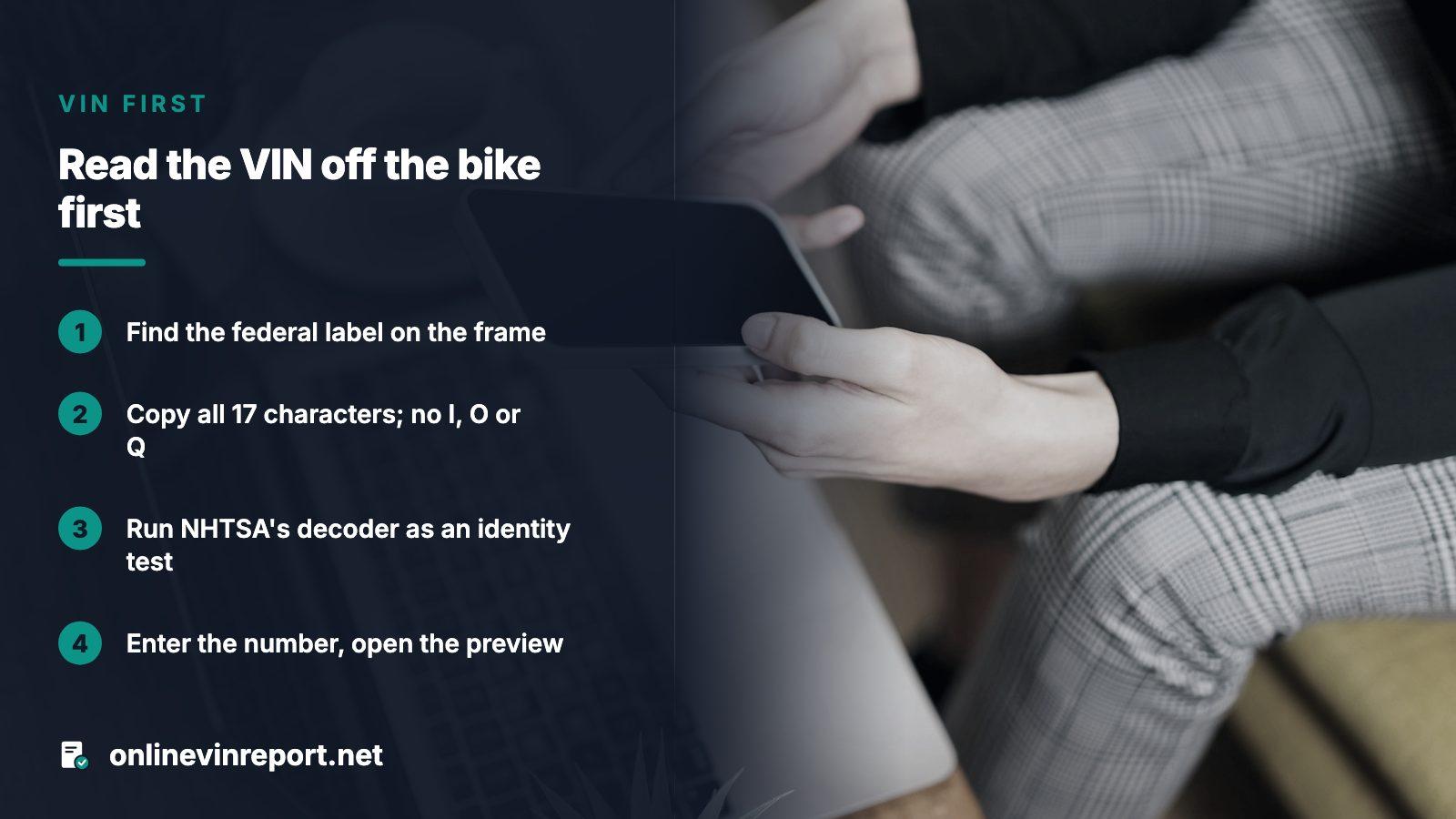
- Find the federal label. It is riveted to a fixed part of the frame near the point where the handlebars and steering post join, so turn the bars to one side and look.
- Copy every one of the 17 characters. VINs skip I, O and Q altogether, so what looks like one of those is really a 1 or a 0.
- If the number differs from the one on the seller's title or registration, pause and find out why before going further.
- Run NHTSA's decoder as an identity test. It should return the maker, a model year and a motorcycle vehicle type, and it reports whether the ninth-position check digit works out.
- Type the number into the search form above and open the preview.
Reading the result: brand first, then what it does to your offer
Brands first, then dates, then everything else on the screen.
| On screen | What it usually means | What to do |
|---|---|---|
| Salvage brand with a state and date | An insurer or state wrote the bike off | Line the date up with the odometer entries, then reprice or pass |
| Rebuilt brand | A salvage bike was repaired and registered again | Ask for the repair receipts and have the frame inspected |
| Flood brand | Water damage was recorded as the cause | Treat the wiring and engine internals as suspect |
| Total-loss or yard entry beside a clean title | A loss was reported but no brand was applied | Value it like a branded bike and have the seller explain |
| Total loss that follows a theft | A stolen bike unrecovered after 30 days can get this label, and it stays | Ask for the recovery paperwork before deciding |
| Nothing at all | No report, or a state that sends no bike data | Ask the state for its record and inspect before paying |
Rebuilt bikes: the brand tells you less than the receipts
A rebuilt brand records that a salvage bike was repaired and put back on the road. It gives no hint of how carefully the repair was carried out, and on a motorcycle the parts that decide that are few and structural.
Florida's statute shows which ones. For motorcycles it names the frame, engine, engine case, crank case, front fork assembly and wheels among its major component parts, and its rebuilt-inspection law asks for receipts or invoices covering such parts.
Ask a rebuilt bike's seller for the same paper trail, plus any photos from before the repair. Some states label this status revived salvage, so title wording and search wording can differ.
State rules that change what a search can find
Titling is a state matter, so the same bike can look different depending on where it lived. Look up how your own state's DMV treats bikes before you rely on any single record.
- New York does not title a motor vehicle once its model year is 1972 or earlier, or a limited use motorcycle, so a bike in those groups carries a registration there instead of a title.
- California requires its licensed dealers to pull a federal title report and post a disclosure for any junk or salvage history. Motorcycles are one of the listed exceptions.
- Some states brand flood damage while others fold it into salvage. California's list of required brands names flood only as a cause of salvage damage.
Older bikes and numbers that do not agree
NHTSA says its decoder is aimed at 1981 models and newer and skips bikes made to the older numbering, so a VIN search has little to grab for a vintage machine. California shows how a state copes: a motorcycle registered by engine number only needs a frame number from the Highway Patrol before DMV will register it.
Disagreeing numbers are the other warning. The same state sends a bike to the Highway Patrol for verification if its visible and secondary VINs disagree, if either shows tampering, or if the federal label is gone or illegible with no backup number. A title search only describes the number you typed, so a bike whose numbers disagree needs the state's help before it needs a report.
How the preview, the report and the cost work
Run the VIN through the preview first; it costs nothing and tells you whether any title entries turn up. The full report is bought once for the bike you name, and bigger packs exist for people comparing several. Nothing renews afterward. Check the pricing page for current amounts.
Open the report for any bike you are close to buying. It lays out brand entries with state and date, salvage and auction records with photos, the odometer line, and any theft or lien entry. Read those against the seller's paperwork, never instead of it.
After the check: confirm with the state and the bike
A national report is built to be short, and the Justice Department recommends reading the state's own title file before you buy. Consumer reports on the federal system link to that full state record, and the titling office can say what it holds for a motorcycle.
- Ask the seller for the title itself and read its brand box and lender section.
- Request a payoff letter if a lender appears anywhere.
- Have a mechanic examine the frame, forks and welds if a brand or a gap showed up.
Where this information comes from
- NMVTIS: Information for consumers — what a federal title search shows, how brands persist, and where motorcycle coverage runs out
- 49 U.S.C. 32901: Definitions — the four-wheeled wording that defines an automobile
- California DMV: Branded titles — brand names, revived salvage, and the dealer rule that excludes motorcycles
- California DMV handbook 1.160: VIN plate assignments — frame numbers for older bikes and when the Highway Patrol verifies a VIN
- New York DMV: Certificate of title — which vehicles get no title in New York, motorcycles included
- Florida Statutes 319.30: Definitions and salvage rules — the list of major component parts for a motorcycle
- NHTSA vPIC: VIN decoder — model years the decoder covers and what its data is built on
Sources and photos: Facts checked against the sources above in November 2026. Photos by Haberdoedas, Jakub Żerdzicki and Mustafa Sheikhmouss on Unsplash; diagrams by OnlineVINReport.
Keep reading
- Salvage title VIN check: run it online before you payStep through the brand half of this check in more detail.
- Rebuilt title check by VIN: is the car clean or rebuilt?Read what a rebuilt brand means before you price a repaired bike.
- Check title and lien by VIN: brands first, then who holds a claimSee how lender claims are checked next to brands.
- PricingSee the report options before you decide.
Frequently asked questions
Can I do a motorcycle title search for free?
The preview costs nothing and shows whether any title entries exist for the VIN. NHTSA's decoder is free as well, but it confirms maker, model year and vehicle type, not brand history. The brand entries come with the one-time report.
Will a salvage brand from another state show up on a motorcycle?
It can. The federal system keeps every brand it receives, so crossing a state line does not delete one that was reported. The catch is reporting: motorcycle records are optional for states, so a brand applied in a state that does not send them may never reach a search.
Does a total-loss entry always mean the motorcycle was wrecked?
No. If a stolen bike has not turned up after 30 days, its insurer may record a total loss, and the entry survives even when the bike is recovered unharmed. Read the date and the rest of the record, then ask the seller what happened.
Can I check a motorcycle built before 1981?
A search needs a 17-character VIN, and NHTSA built its decoder around 1981 and newer model years. Some older bikes are registered by engine number only, as California's handbook shows. For those machines, ask the state what its own record holds and have the numbers on the bike verified where the state offers that.
The number on the bike is different from the title. Is that a deal-breaker?
Assume so until someone explains it. A mismatch may be a typo on the paperwork, or a swapped or altered number. California, for one, has the Highway Patrol verify a bike when its visible and secondary VINs differ. Ask your state's titling office what it requires before any money moves.
Now check the car itself
The guide explains what to look for. The report shows what this VIN has on record.